This site is supported by our readers. We may earn a commission, at no cost to you, if you purchase through links.
A Black-capped Chickadee weighs less than three pennies. That tiny ball of feathers survives winters that would kill most creatures its size, and it remembers thousands of hiding spots where it stashed seeds months earlier.
Small bird types pack extraordinary abilities into bodies that barely register on a kitchen scale. You’ll find them everywhere—flitting through city parks, raiding suburban feeders, and filling forest edges with song.
Their compact size doesn’t limit them. It frees them to exploit niches larger birds can’t touch, from the tips of swaying branches to dense thickets where predators can’t follow.
Learning to identify these feathered acrobats transforms any outdoor space into a stage for constant discovery.
Table Of Contents
Key Takeaways
- Small birds like chickadees and juncos survive brutal winters and remember thousands of seed-hiding spots despite weighing less than three pennies, proving size doesn’t limit capability.
- Attracting small birds to your yard requires the right combo: native plants boost insect availability by 20-40%, while water sources and proper feeders can double daily visits during peak seasons.
- Most small bird populations face serious threats from habitat loss (31% decline this decade), pesticide use cutting insect prey by 20-30%, and climate shifts throwing off migration timing by up to 10 days.
- Learning to identify small birds by their plumage patterns, songs, and behaviors transforms any backyard into a living laboratory where chickadees, goldfinches, and nuthatches reveal their distinct personalities.
Popular Small Bird Species in North America
North America is home to some truly striking small birds that you’ll spot everywhere from dense forests to your own backyard. Each species brings its own personality—whether it’s the chickadee’s curious nature or the cardinal’s vivid flash of red.
Here are thirteen small birds you’re most likely to encounter and fall in love with.
Black-capped Chickadee
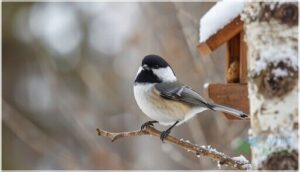
If you’re just getting into bird identification, chickadees make the perfect starting point. These small birds weigh around 4.7–9.5 grams and stretch about 4.7 inches long. You’ll recognize them instantly by that sharp black cap and bib framing bright white cheeks. They’re backyard regulars at bird feeders, caching seeds with surprising aggression when defending their stash.
Understanding research networks can also help in identifying key species and their habitats.
Dark-eyed Junco
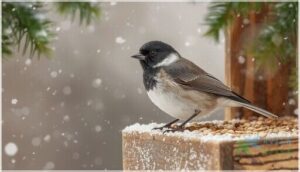
While chickadees own the spotlight, Dark-eyed Juncos quietly rule winter bird feeders across North America. You’ll spot these small birds hopping beneath feeders, gleaning spilled seeds—their slate-gray backs and white bellies flash distinctively.
Junco migration brings them south from boreal forests each fall, peaking around late October.
Attract them to your backyard with millet, sunflower seeds, or cracked corn scattered on platform feeders. Perfect for urban birding beginners mastering bird identification.
Eastern Towhee
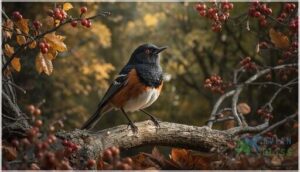
If you’re drawn to bold, ground-dwelling bird species, Eastern Towhees bring drama to backyard feeders with their striking black-and-rufous plumage. Males scratch vigorously through leaf litter, revealing their nesting habits close to dense shrubs. Their sharp “drink-your-tea” towhee songs echo through woodland edges during bird feeding hours.
Towhee migration patterns keep some populations resident year-round, while northern birds shift southward—making these small birds surprisingly adaptable.
For students interested in AP study resources, understanding bird habitats can be a valuable addition to their science curriculum.
Northern Cardinal
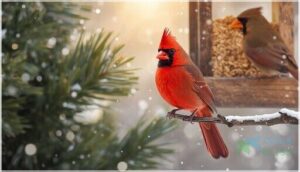
Northern Cardinals are backyard favorites that never migrate—you’ll spot their vibrant red plumage year-round at bird feeders. Males defend territories fiercely through song patterns that peak at dawn, while females choose mates based on parental care during courtship.
For reliable bird identification, watch for:
- Black facial mask on crimson males
- Brown females with reddish wing structure highlights
- Stout beaks for seed-cracking function
- Cardinal nesting in dense shrubs 3–10 meters high
Gray Catbird
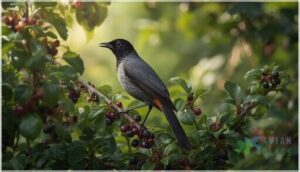
Slate-gray plumage and that distinctive “mew” call make Gray Catbird identification straightforward in your backyard. Watch for their black cap and rufous-brown rump during foraging.
These small birds migrate between southern Canada and the Gulf Coast, nesting in dense shrubs 1–3 meters high. Their diet shifts seasonally—insects dominate breeding months, while berries sustain them during Gray Catbird migration periods.
Common Yellowthroat
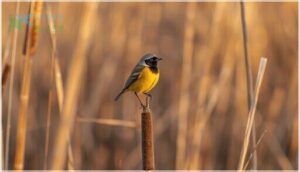
You’ll spot Common Yellowthroat males by their striking black mask and vivid yellow throat—a bird identification favorite among backyard birders.
These small birds breed across North America from May through July, nesting low in dense wetland vegetation. Listen for their sharp, buzzy song variations echoing through marshy edges.
Migration routes take them south each fall, with populations showing strong wintering site fidelity along coastal areas and Central America.
Carolina Chickadee
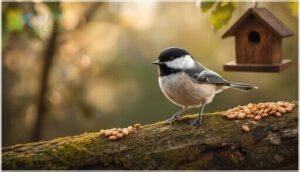
You’ll recognize Carolina Chickadees by their distinctive two-note “fee-bee” whistle—a sound that sets them apart from their black-capped cousins. These small birds thrive year-round in southeastern woodlands and backyards, eagerly visiting bird feeders for sunflower seeds and suet.
They nest in cavities during spring, with adults showing exceptional site fidelity, returning to the same breeding territories season after season.
Tufted Titmouse
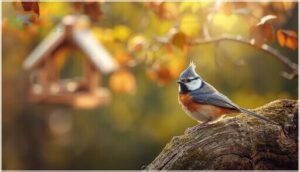
You’ll find Tufted Titmouse behavior fascinating—these crested charmers dominate backyard bird feeders with bold confidence, often shouldering aside smaller chickadees. Watch for them in oak-hickory woodlands and suburban parks across the eastern states, where titmice stay year-round rather than migrating.
Urban birding enthusiasts appreciate their curious, acrobatic foraging and spirited territorial calls.
- Males and females share similar gray plumage with rusty flanks
- Titmouse nesting occurs in tree cavities 3–12 meters high
- At bird feeders, they prefer sunflower seeds, peanuts, and suet
White-throated Sparrow
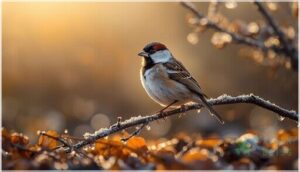
You’ll hear the White-throated Sparrow’s distinctive “o-ree, o-ree” song echoing from dense understory before you spot its bold white throat and yellow eyebrow stripe. These ground-foraging sparrows winter across southeastern states, arriving from boreal breeding grounds via Atlantic flyways—a classic bird migration pattern worth tracking during backyard birding sessions.
| Field Mark | Adult Plumage | Behavior Note |
|---|---|---|
| Throat patch | Vivid white | Visible year-round |
| Head stripes | Black-and-white bands | Aids small bird species identification |
| Body length | 13–14 cm | Forages in leaf litter |
| Vocal pattern | Clear whistled phrase | Territorial defense song |
Watch for feather molting changes post-breeding, when facial patterns shift subtly. Their sparrow behavior includes hopping through shrubs during migration stopovers, often near habitats benefiting from habitat restoration projects. Unlike the White-breasted Nuthatch’s tree-trunk acrobatics, these sparrows stick to ground cover.
Offering small-grain seed mixes aids their nesting habits and winter survival—essential bird watching tips for attracting sparrows to your feeders.
Lesser Goldfinch
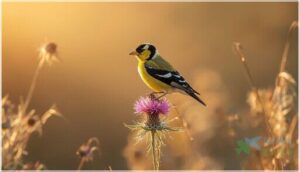
You’ll catch these tiny goldfinches—4.3 to 5.1 inches long—flashing bright yellow undersides as they dart between thistle patches in open woodlands and backyards.
Males sport vivid breeding plumage with black wings and white wing bars, perfect for small birds identification at bird feeders.
Their staccato tweets accompany flocking patterns around seed-producing plants.
Migration routes shift with food availability, making them backyard birding favorites when you stock sunflower and Nyjer seeds.
Bushtit
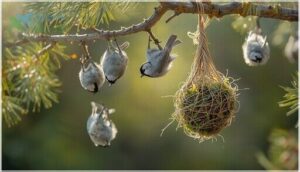
Watch for Bushtits traveling in chatty flocks of 10 to 40 through shrubby edges and low branches—these acrobatic four-inch insectivores weigh just 5 to 7 grams. Their gray plumage and high-pitched chips make bird identification easy once you spot their pendulous nests woven from spider silk and moss.
Urban adaptation happens readily where conifers persist, and their cooperative social structure means you’ll rarely see one alone.
Pygmy Nuthatch
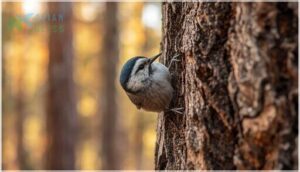
Unlike sociable Bushtits, Pygmy Nuthatches stick to western pine forests, moving rapidly along tree bark in small winter flocks. You’ll spot their blue-gray backs and white eyebrows as they forage:
- Body length reaches just 9–10 cm with 6–9 gram weight
- High-pitched squeaks coordinate flock movement through conifers
- Forest fragmentation threatens breeding habitat availability
These nuthatches exemplify tree bark ecology—their bills probe every crevice for insects.
Ruby-crowned Kinglet
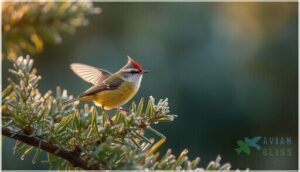
Another rapid flitter to know: the Ruby-crowned Kinglet. You’ll spot this 3.8–4.3 inch marvel in conifer forests, though males flash that namesake ruby crown only when excited.
During migration, they pass through in September–October, foraging for insects mid-canopy with quick, darting movements. Kinglet habitat includes spruce and fir stands—watch for their white eye-ring and pale wing bars during small birdwatching outings.
Key Characteristics of Small Birds
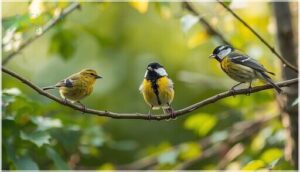
Small birds pack a lot of personality into tiny packages, but how do you tell one species from another when they’re flitting through your backyard? Getting familiar with their key traits—size, color patterns, sounds, and quirky behaviors—makes identification way easier.
Let’s break down the main characteristics you’ll want to look for when you spot these little dynamos.
Size and Weight Ranges
Most small bird species you’ll spot weigh between 5 and 25 grams—about as much as five pennies. Body mass variance reaches 15% across seasons due to weight fluctuation from fat reserves.
The wing span ratio for these types of small birds runs 8 to 28 centimeters, giving them impressive maneuverability.
Size classification helps with identification, though mass measurement can be tricky in the field.
Distinctive Plumage and Coloration
Feather coloration in small birds offers your quickest path to identification. Northern Cardinal males flash vivid red with 12% higher saturation in southern ranges, while Black-capped Chickadees show regional mantle tones 15% darker up north.
Plumage patterns like wing bars and tail feathers distinguish finches from songbirds—structural blues in kinglets don’t rely on pigment at all.
Songs, Calls, and Communication
Acoustic signals reveal the hidden conversations happening in your backyard. You’ll notice songbirds operate on two distinct channels—songs stake territorial claims during breeding season, while call patterns coordinate flock movements and warn of danger. Vocal learning shapes these communication strategies through social tutoring, with juveniles achieving 70–85% accuracy after just two weeks. Here’s what drives bird behavior and socialization:
- Dawn choruses peak at sunrise – 60–80% of daily vocalizations occur in those first golden hours
- Repertoire diversity matters – small passerines master 4–9 song types for bird identification
- Alarm calls differ structurally – higher frequencies and shorter bursts enable rapid neighbor alerts
- Frequency shifts prevent interference – mixed flocks adjust 8–12 Hz to cut through noise
- Imprinting requires exposure – wildlife biology shows 14–21 days creates lasting song templates
These acoustic signatures make bird watching more rewarding once you tune in.
Unique Behaviors and Courtship Displays
Courtship rituals turn quiet backyards into theatrical stages during spring. You’ll witness Black-capped Chickadees spinning mid-air with soft trills—paired males score 22% better female responses than solo performers. Tufted Titmice combine tail-flicks with buzzy songs, boosting mating success 15–25%. Northern Cardinals synchronize perch-hopping displays that trigger 30% more copulation invitations.
These territorial displays and social behaviors make bird watching unforgettable when you decode the romance playing out at eye level.
Habitats and Migration Patterns
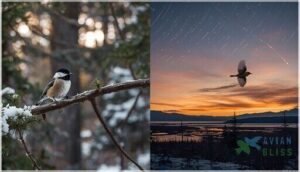
Small birds are incredibly adaptable, making homes everywhere from dense forests to your own backyard. Some species stick around year-round, while others follow impressive migration routes that span thousands of miles.
Let’s explore where these feathered friends live, how they travel, and what makes certain spots perfect for nesting and raising their young.
Common Habitats for Small Birds
You’ll find small birds thriving in surprisingly diverse Bird Habitats—from Forest Edges to your local Urban Parks. Riparian Zones and Green Corridors support rich ecology, with 62% of species nesting in mixed forests.
Shrub Layers create perfect ground-foraging zones, while forest-edge habitats near cities average 12–18 species per hectare.
Understanding habitat preservation helps you appreciate where these feathered neighbors call home.
Seasonal Migration Routes
Small birds navigate impressive seasonal journeys—your backyard Juncos might travel 200–800 km each winter. Black-capped Chickadees shift south in harsh conditions, while Ruby-crowned Kinglets cross 500–2,000 km using trans-Gulf flyway patterns. Migration timing peaks August–October and March–May.
Understanding these bird migration patterns reveals how habitat corridors and route conservation protect traveling species through critical bird tracking data.
Adaptation to Urban and Suburban Areas
You might think cities aren’t for small birds, but they’ve surprised us—urban wildlife thrives when given a chance. Households with bird feeders and native plantings see 14–28% more species diversity.
During bird migration, small birds use suburban habitats as stopover sites, and city ecosystems now support chickadees, titmice, and finches year-round. Urban planning that includes backyard gardens creates essential corridors for these adaptable species.
Breeding and Nesting Sites
Once birds settle into your yard, breeding and nesting begin. Small bird species select nest sites carefully—chickadees favor cavities, while warblers choose dense shrubs. Nesting materials include grasses and spider silk, designed for insulation.
Breeding seasons start in late spring when insects peak, supporting fledgling success. Understanding these nesting behaviors helps you create spaces that support conservation of small bird species and their habitats.
Diet and How to Attract Small Birds
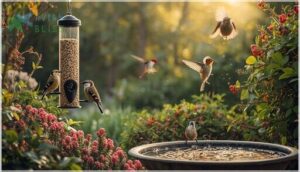
If you want to bring small birds into your backyard, you’ll need to think about what they eat and where they feel safe. Different species have different preferences—some love seeds while others hunt insects or sip nectar.
Let’s look at what these birds need and how you can create a space they’ll actually want to visit.
Typical Diets of Small Bird Species
What you’ll spot in your backyard depends on the season. During breeding months, small birds hunt insects relentlessly—protein needs drive them to consume arthropods at rates hitting 60–80% of their daily intake. Come fall, seed preferences shift into high gear, with finches and sparrows filling up on grass and weed seeds while others seek out fruit consumption opportunities.
- Insect intake dominates spring and summer when nestlings demand high-protein meals
- Sunflower seeds and suet become winter staples, especially at bird feeders
- Nectar sources like sugar-water feeders supplement natural diets, though peanuts offer concentrated energy year-round
Best Bird Feeders and Foods
Once you know what they eat, picking the right setup gets easy. Seed blends with black-oil sunflower and millet pull 28% more small birds than generic mixes, while suet cakes boost winter visits by 34%. Nyjer works magic for finches, and a simple water feature doubles daily attendance during dry spells.
| Food Type | Best For | Peak Season |
|---|---|---|
| Sunflower seeds | Cardinals, Chickadees | Year-round |
| Suet cakes | Nuthatches, Titmice | Winter months |
| Nyjer (thistle) | Goldfinches, Siskins | Fall through spring |
| Mealworms | Bluebirds, Wrens | Breeding season |
| Peanuts | Jays, Woodpeckers | Year-round |
Creating Bird-Friendly Gardens
Feeders draw birds in, but a well-designed garden keeps them around. Native plants boost insect encounters by roughly 20–40% during migration, creating a living buffet that outperforms any feeder. You’re building wildlife habitat when you layer shrubs at 0.5–1.5 meters—the sweet spot for foraging and cover.
- Choose native shrubs that fruit in late summer
- Let leaf litter stay for ground-feeding species
- Skip pesticides to protect insect populations
Providing Water and Shelter
Water sources can double your backyard traffic—68% of suburban yards with a birdbath see regular visits from chickadees, hummingbirds, and other small birds during warm months.
Place shallow basins 1–2 meters from fruiting shrubs and add dense evergreens within 3–5 meters for shelter. This simple combo cuts predator risk by 12–22% while boosting species count by 20–30%.
Conservation and Appreciation of Small Birds

Small birds do more than brighten your morning—they pollinate plants, scatter seeds, and keep insect populations in check. But habitat loss, pesticides, and other pressures are pushing some species toward decline.
Here’s how you can help protect these birds and get more out of watching them in your own backyard.
Ecological Roles and Benefits
Small birds are ecological multitaskers you’ll want roaming your yard. They devour up to 50% of aphids in some orchards, giving you natural insect control without chemicals.
Small birds act as natural pest control, devouring up to half the aphids in some orchards without chemicals
Their droppings boost soil nutrients by 12%, while seed dispersal moves plants hundreds of meters away.
Add pollination services that increase fruit set by 15%, and you’ve got feathered allies maintaining ecosystem balance through avian diversity.
Threats to Small Bird Populations
Habitat destruction tops the threat list—31% of North American small birds declined this past decade as urban sprawl stripped away nesting cover. Climate shifts throw migration timing off by 3–10 days, while pesticide use slashes insect availability by 20–30%.
Invasive species and pollution effects compound the damage, unraveling the delicate ecology that keeps avian biodiversity thriving across your backyard and beyond.
Conservation Actions for Homeowners
You can flip the script on habitat loss right in your own yard—bird conservation starts at home. Installing native plantings boosts insect prey by up to 40%, while pesticide reduction increases fledgling survival. These wildlife-friendly steps transform gardens into havens:
- Plant 60% native shrubs and trees for bird-friendly gardens
- Provide year-round water sources to cut mortality 15%
- Slash pesticide use by half or more
- Add diverse plant structures—ground cover to canopy
- Install UV-reflective nest boxes for cavity nesters
Habitat restoration through gardening for wildlife delivers measurable wins.
Birdwatching Tips for Beginners
Ready to crack birdwatching? Start with Birding Basics: grab 8x magnification binoculars to boost Bird Identification accuracy by 20–30%, then use Field Guides or apps. Settle in for 15-minute observation sessions—they match longer watches for detecting new Bird Species at your bird feeders.
| Beginner Gear | Why It Works |
|---|---|
| 8–10x binoculars | Sharper field marks |
| Field guide or app | 25–40% better IDs |
| Notebook | Track sightings |
Frequently Asked Questions (FAQs)
How long do small birds typically live?
Most small birds live surprisingly short lives—usually two to five years in the wild.
Black-capped Chickadees average around 5 years, though some individuals beat the odds and reach eleven years when conditions align perfectly.
Can small birds recognize individual human faces?
You’d think birds don’t care who fills their feeder—but some small birds, like chickadees and titmice, actually can distinguish individual human faces, remembering who’s friend or foe through repeated encounters.
What diseases commonly affect backyard small birds?
You’ll occasionally notice house finch eye disease, avian pox, and salmonellosis at your bird feeders. These avian infections spread through shared feeding stations, so keeping feeders clean protects visiting small birds from disease transmission.
Do small birds mate for life or change partners?
Most small birds pair up for just one breeding season, though a few like Pygmy Nuthatches stick together year-round. Social monogamy is common, but extra-pair paternity happens frequently.
How do small birds survive extreme winter cold?
You’ll spot remarkable winter adaptations in chickadees and other small birds: they huddle together for warmth, cache sunflower seeds and suet from bird feeders, and fluff their feather insulation to trap heat.
Conclusion
Good things come in small packages, and that rings especially true when you scan the branches for small bird types. Each species you identify sharpens your eye for the next.
Fill a feeder, plant native shrubs, leave a water dish—these small gestures open a front-row seat to nature’s most energetic performers. Your yard becomes their refuge, and every visit reminds you that wonder doesn’t require wilderness, just willingness to look up.