
This site is supported by our readers. We may earn a commission, at no cost to you, if you purchase through links.

Somewhere in the forests of Dominica, fewer than 60 Imperial Amazons—Amazona imperialis—still call through the canopy. That number isn’t a rough estimate; it’s the actual counted population of an entire species. When populations shrink that far, the margin between survival and extinction narrows to a single hurricane season.
Across the globe, hundreds of endangered bird types face similarly precarious odds, pressed by habitat destruction, illegal trade, invasive predators, and a shifting climate.
Understanding which species are most at risk—and why the numbers matter so much—is the first step toward meaningful action.
Table Of Contents
- Key Takeaways
- What Are Endangered Bird Types?
- Critically Endangered Bird Species
- Endangered Birds by Habitat
- Major Threats to Endangered Birds
- Conservation Efforts Saving Bird Species
- Frequently Asked Questions (FAQs)
- How do birds adapt to shrinking habitats?
- What role do zoos play in bird conservation?
- How can individuals help protect endangered birds?
- Are captive breeding programs effective for all species?
- What foods are harmful to endangered birds?
- Which bird species went extinct most recently?
- How do zoos support endangered bird recovery?
- How does light pollution affect migratory birds?
- What role do indigenous communities play in bird conservation?
- Conclusion
Key Takeaways
- Nearly one in eight bird species now face extinction, with critically endangered birds like Amazona imperialis (Imperial Amazon) hanging on with fewer than 60 individuals—proof that population numbers aren’t just statistics, they’re lifelines.
- Habitat destruction, illegal wildlife trade, invasive predators, pollution, and climate change don’t hit birds one at a time; they pile on together, which is why protecting any single species takes action on multiple fronts at once.
- Conservation efforts like captive breeding (which brought California condors back from just 27 wild birds), predator-free island sanctuaries, and CITES trade regulations are genuinely working—but only where people commit to the long game.
- You don’t need a research lab to matter: supporting local habitat restoration, refusing the exotic pet trade, and spreading awareness about species like Cacatua sulphurea (yellow-crested cockatoo) all make a measurable difference for birds on the edge.
What Are Endangered Bird Types?

Not every bird in trouble sits at the same level of risk — and that distinction matters more than you might think. The IUCN Red List gives scientists and conservationists a shared language for measuring how close a species is to disappearing for good.
A deeper look at how bird conservation status categories work reveals exactly why that shared language translates into faster, smarter action on the ground.
Here’s a closer look at how those categories work and what the numbers are telling us right now.
Endangered Vs. Critically Endangered Birds
Not all endangered birds face the same level of risk—and that distinction shapes legal protection, funding priorities, and recovery metrics in meaningful ways. On the IUCN Red List, an Endangered bird may have fewer than 2,500 mature individuals, while Critically Endangered status triggers when that number drops below 250. Stakeholder collaboration and endangered bird conservation strategies shift considerably based on where a species falls.
Recent assessments have nine species uplisted to Critically Endangered, highlighting accelerating threats.
How The IUCN Red List Classifies Birds
The IUCN Red List classifies birds using seven categories—from Least Concern to Extinct—built on standardized IUCN Red List criteria for avian species.
Criterion thresholds, such as a 50% population drop over ten years, can trigger Critically Endangered status. The Assessment Workflow combines Red List Metrics covering range, trend, and population estimates of critically endangered birds.
When data gaps exist, Data Deficiency prevents confident category definitions, leaving species’ extinction risk unresolved.
Why Population Estimates Matter
Once the IUCN Red List criteria for avian species assign a threat category, population estimates of critically endangered birds become the engine behind real action. Without solid numbers, conservation funding formulas lose their foundation — and so does everything built on them.
- Resource allocation for habitat protection and field teams
- Health services planning for captive-breeding facilities
- Scaling infrastructure at predator-free sanctuaries
- Risk assessment guiding population monitoring priorities
Population decline can’t be reversed if it isn’t measured.
Global Scale of Bird Endangerment
The numbers behind the global bird extinction crisis aren’t abstract — they’re a wake-up call. Nearly one in eight bird species now faces extinction risk, driven primarily by habitat loss and climate change effects on avian species. These anthropogenic pressures have accelerated population declines across every major geographic hotspot, from island endemics to migratory shorebirds.
Nearly one in eight bird species now faces extinction, a crisis driven by habitat loss and climate change across every corner of the globe
The IUCN Red List stands as an urgent, living record of this crisis, documenting the pervasive threat to avian biodiversity. Its data underscores a stark reality: without intervention, the trajectory of extinction risk will continue to escalate, demanding immediate global conservation action.
Critically Endangered Bird Species

Some birds are holding on by the thinnest of threads — not metaphorically, but in actual counted individuals. Across forests, coastlines, and remote islands, a handful of species have dropped to numbers so low that losing even a small group can tip the balance toward extinction.
Here are eight critically endangered birds you should know about.
Yellow-Crested Cockatoo
The yellow-crested cockatoo (Cacatua sulphurea) is a striking bird—its iconic crest display signals mood and social status within the flock. Adults nest exclusively in tree hollows and rely on seasonal fruiting cycles for food, using a powerful seed-cracking beak to access hard-shelled nuts.
Fewer than 2,000 survive in the wild today, driven down by illegal wildlife trade and habitat loss despite CITES regulations and active captive breeding and reintroduction programs.
Imperial Amazon Parrot
The imperial Amazon (Amazona imperialis) clings to a razor’s edge—only 40–60 individuals remain on Dominica, their survival threatened by habitat loss and illegal wildlife trade. Their cavity-nesting ecology is severely disrupted, compounding their vulnerability.
Highland genetic structure across fragmented montane forests further limits recovery, isolating populations and reducing resilience.
Researchers track individuals using dietary seasonal shifts and flight call variation, providing critical data to inform conservation strategies.
Meanwhile, CITES regulations, captive breeding and reintroduction programs, and community stewardship offer cautious hope for the species’ future.
Indian Vulture
The Indian vulture (Gyps indicus) once cleaned the subcontinent’s landscapes through Thermal Soaring and Carcass Scavenging—now fewer than 8,000 remain.
The primary culprit is diclofenac, a veterinary painkiller lethal to vultures, while habitat loss compounds the crisis. Conservation efforts now focus on addressing these threats through several initiatives:
- Diclofenac Ban enforcement across South Asia
- Vulture Restaurants—safe feeding stations
- Captive breeding programs
- Challenging Cultural Attitudes toward scavengers
- Habitat protection zones
New Zealand Storm Petrel
Once considered extinct, the New Zealand storm petrel (Fregetta maoriana) was rediscovered in 2003—a quiet reminder that nature sometimes surprises us. Fewer than 50 individuals survive, breeding through burrow nesting on Hauturu (Little Barrier Island).
Acoustic surveys and telemetry studies help locate hidden nest sites, while island biosecurity shields colonies from invasive species.
Habitat loss and climate change impacts continue threatening this tiny pelagic seabird’s fragile hold on existence.
Masafuera Rayadito
The Masafuera rayaditura (Aphrastura masafuerae) clings to a single island—Alejandro Selkirk, Chile—making island endemism and vulnerability its defining reality.
Fewer than 330 mature birds occupy a tight altitude niche within tree fern-dependent montane scrub above 800 meters. Habitat loss and invasive species like cats and rats pressure this already fragile population.
A 2006 nest box program and ongoing predator control support population monitoring and slow its decline.
Spoon-Billed Sandpiper
The Spoon-billed Sandpiper (Calidris pygmaea) carries one of nature’s most specialized tools—a spatulate bill perfectly shaped for mudflat foraging along Southeast Asian coastlines.
Fewer than 900 mature individuals survive today, threatened by habitat loss and climate change at critical stopover wetlands.
Tundra nesting on Russia’s Chukotka Peninsula, distinctive breeding plumage, and satellite tagging studies have sharpened conservation efforts, making protected areas along its flyway genuinely indispensable.
Philippine Eagle
From mudflat specialist to top predator—the Philippine Eagle (Pithecophaga jefferyi) commands a different kind of urgency.
Standing nearly 1 meter tall with a 2-meter wingspan, this raptor requires up to 40 square miles of contiguous rainforest per breeding pair—a habitat increasingly fragmented by deforestation.
- Nest site fidelity means pairs return to the same trees for decades, making habitat loss especially devastating
- Captive breeding programs at the Philippine Eagle Center support genetic diversity and potential reintroduction
- Protected areas on Luzon and Mindanao anchor climate resilience strategies for the species
- Eco-tourism potential and cultural symbolism as the national bird strengthen community-led protection efforts
Madagascar Pochard
From a mountain raptor to a diving duck—the Madagascar Pochard (Aythya innotata) tells a quieter but equally urgent story. Rediscovered in 2006 at Lake Matsaborimena after decades of feared extinction, this small diving duck survives today through a dedicated captive breeding program and wetland restoration work addressing habitat loss and water level control.
| Feature | Detail | Significance |
|---|---|---|
| Scientific Name | Aythya innotata | Critically Endangered diving duck |
| Key Site | Lake Matsaborimena | Primary wild population lake |
| Wild Population | Under 250 individuals | Extremely small range |
| Main Threats | Habitat loss, disturbance | Wetland degradation |
| Conservation Tool | Genetic management | Maintains breeding diversity |
Community stewardship and emergent vegetation protection now anchor conservation efforts—because without local buy-in, no sanctuary holds.
Endangered Birds by Habitat
Where a bird lives shapes everything about its survival—and its vulnerability. Each habitat type faces its own distinct pressures, from chainsaws to sea-level rise.
Here’s how endangered birds break down across the world’s major ecosystems.
Forest Birds and Deforestation
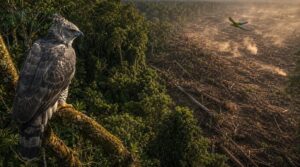
Deforestation doesn’t just clear trees — it dismantles entire ecological systems that forest birds depend on for survival. Logging and agriculture remove the old-growth hollows cavity-nesting species like the Imperial Amazon require, while canopy loss triggers insect prey shortages, habitat fragmentation, and increased edge predation. Species like the Harpy Eagle need vast, connected forest blocks.
- Habitat loss eliminates nesting cavities and deadwood
- Fragmented edges invite nest predators — snakes, cats, raptors
- Insect abundance collapses, starving chicks before they fledge
- Local stewardship programs and forest carbon link conservation to community benefit
Island Endemics and Isolation

Island isolation shapes birds differently than forests do. Genetic drift and founder effects create microendemic populations found nowhere else on Earth — species born from limited gene flow across ocean barriers. These unique evolutionary processes drive the emergence of distinct avian lineages.
Island radiations, such as Hawaii’s honeycreepers, showcase this beautifully. Yet island endemism also means vulnerability. Invasive species and habitat loss pose existential threats, while small population sizes amplify risks.
Conservation efforts and protected areas non-negotiable for these irreplaceable birds. Their survival hinges on urgent, targeted interventions to safeguard fragile ecosystems against irreversible decline.
Wetland and Coastal Bird Species

Coastal wetlands are among the most productive—and most threatened—habitats on Earth. Tidal marsh vegetation provides year-round shelter for herons and bitterns, while mudflats serve as vital foraging grounds for migrating shorebirds, such as the Spoon-billed Sandpiper (Calidris pygmaea), during critical refueling stops.
Reed-bed nesting, estuarine prey abundance, and coastal roosting all depend on intact hydrology. These ecosystems sustain species like the Mangrove finch (Camarhynchus heliobates), whose survival is intricately tied to wetland health.
Wetland loss, degradation, and inadequate restoration and water management exacerbate threats to biodiversity. Such pressures push vulnerable species, including the Mangrove finch, closer to extinction, underscoring the urgent need for conservation action.
Grassland and Open-Country Birds

Open grasslands might look simple, but they’re anything but. Ground-nesting species like larks and bustards depend on bare ground nesting sites, seasonal insect swarms, and grass height heterogeneity to survive.
Habitat loss from agricultural expansion and poor mowing schedule impacts destroy nests before chicks fledge.
Field margin connectivity and protected areas help, but habitat fragmentation from intensive farming still quietly unravels conservation efforts.
Mountain and Cloud Forest Birds

Cloud forests, draped in mist, shelter some of the world’s most specialized birds. Species here depend on misty microclimate stability, cavity nesting in old-growth trees, and specialist frugivory tied to high-elevation plant communities. Elevational migration shifts where birds feed seasonally, while wing morphology shapes how they navigate dense canopy.
Deforestation and logging impacts on forest birds—combined with habitat loss and climate change effects on avian species—push endemics upslope toward shrinking refuges.
Protected areas and climate adaptation planning remain the most reliable conservation strategies for endangered birds here.
Migratory Birds and Stopover Sites
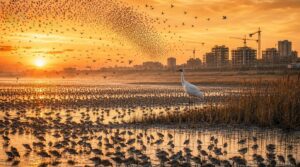
Migratory birds don’t travel in one stretch—they depend on a chain of stopover sites along established migration corridors, where feeding resource availability determines whether they survive the next leg.
Flyway connectivity breaks down when coastal development swallows wetlands, human disturbance impacts shorten feeding time, and climate timing shifts push birds off-schedule.
Stopover habitat restoration—especially wetland restoration—keeps these migration routes intact for vulnerable species.
Major Threats to Endangered Birds

Birds don’t disappear for one simple reason—they’re pushed out from multiple directions. Understanding what’s driving these declines helps you see why conservation is such a complex, urgent puzzle.
Here are the major threats putting endangered birds at risk today.
Habitat Loss and Fragmentation
Habitat loss doesn’t just shrink the map—it breaks it into pieces. Deforestation and wetland degradation leave birds stranded in isolated fragments, where edge effects dry out interiors and predators move freely along exposed boundaries.
Core area loss eliminates nesting sites critical for territorial species. Without landscape corridors and adequate patch size thresholds, even moderate matrix permeability can’t prevent local extinctions.
Forest fragmentation quietly unravels what takes decades to rebuild.
Illegal Wildlife Trade and Trafficking
Illegal wildlife trade hits birds hard—yellow-crested cockatoos (Cacatua sulphurea) and African grey parrots are disappearing from forests partly because online trafficking platforms connect poachers directly to buyers worldwide.
Smuggling route networks exploit trade finance loopholes and weak penalties to move live birds across borders. Forensic DNA tools now help authorities trace contraband origins, while demand reduction campaigns and CITES and international wildlife regulations work to curb hunting and poaching pressures on birds.
Invasive Predators on Islands
Invasive predator impacts on island fauna rank among the most destructive forces threatening endemic birds today, beyond trafficking. Stowaway pathways—such as rats hidden in ship cargo or feral cats released by settlers—have quietly dismantled island ecosystems for centuries. These invasive species threats hit flightless birds especially hard, as species like New Zealand’s kakapo (Strigops habroptilus) evolved without mammalian predators entirely.
Effective eradication techniques now give conservationists real hope. Key strategies include:
- Coordinated poisoning and trapping campaigns to remove rats and stoats across entire island boundaries.
- Biosecurity protocols—strict quarantine checks at ports—to prevent predator reintroductions after clearance.
- Long-term monitoring to manage non-target impacts, protecting native invertebrates alongside target bird species.
- Community stewardship engaging local residents as frontline guardians, sustaining predator-free status beyond initial project funding.
Invasive predator control projects in island ecosystems consistently show bird populations rebounding within just a few breeding seasons once pressure lifts. This proves that while predator introductions and ecosystem imbalance are severe, their effects aren’t always permanent.
Pollution, Toxins, and Lead Poisoning
Predator removal helps, but pollution cuts just as deep. Lead ammunition bans have saved California condors (Gymnogyps californianus)—once numbering just 27 wild birds—because scavengers ingest bullet fragments in carcasses.
Industrial emissions, soil lead, and waterborne toxins drive heavy metal bioaccumulation through entire food chains.
Environmental pollutants and pollution impacts affect species you’d never expect, quietly compounding losses that habitat work alone can’t fix.
Climate Change and Severe Storms
Climate change exacerbates existing challenges, with rapid storm intensification—fueled by warming seas—devastating island populations. Just 40–60 Imperial Amazon parrots (Amazona imperialis) survived in Dominica after Hurricane Maria.
Climate-driven hurricanes exacerbate:
- Storm-induced nest failure across coastal forest habitats
- Sea-level surge swamping shorebird roost sites
- Extreme rainfall flooding disrupting migratory stopover wetlands
- Altered storm tracks exposing previously sheltered breeding colonies
Hunting, Poaching, and Human Conflict
Storms aren’t the only force pushing birds toward extinction. Human pressure—through border poaching, cultural hunting traditions, and urban encroachment—drives direct persecution across dozens of species.
When compensation schemes fail rural families, livestock retaliation leads to raptor poisoning near farms. This direct conflict results in significant harm to bird populations.
Additionally, weak cross-border enforcement allows illegal hunting at borders to continue unchecked, leading to unmonitored harvest surges that further threaten avian species.
| Conflict Driver | Impact on Birds |
|---|---|
| Livestock retaliation | Raptor poisoning near farms |
| Illegal hunting at borders | Unmonitored harvest surges |
Disease Threats Like Avian Malaria
Disease threats such as avian malaria quietly devastate populations that already teeter on the edge. Culex mosquitoes transmit Plasmodium relictum through temperature-driven outbreaks, pushing Hawaiian honeycreepers toward local extinction.
Reservoir hosts—often non-native birds sustain transmission—even when native species grow rare.
Immunity variation means some birds survive while others don’t, creating uneven survival outcomes within affected populations.
Elevational refuges and vector control remain your most reliable shields against this invisible threat, offering critical protection in vulnerable habitats.
Conservation Efforts Saving Bird Species

The good news is that conservation is working — and the numbers prove it. From remote island sanctuaries to international wildlife laws, researchers and communities have found real ways to pull species back from the edge.
Here’s a closer look at the efforts making the biggest difference.
Captive Breeding and Reintroduction Programs
Captive breeding programs have quietly pulled species like the California condor back from the edge—27 wild birds in the 1980s became over 300 today.
Genetic management of critically endangered birds guides every pairing, using studbooks to avoid inbreeding.
Before release, birds undergo health screening, pre-release training in semi-natural enclosures, and time in acclimation pens.
Post-release monitoring then tracks whether reintroduction efforts are actually working.
Protected Areas and Habitat Restoration
Protected areas and wildlife reserves now cover 15% of global land, offering endangered birds a genuine foothold against habitat loss. Adaptive management inside these zones pairs monitoring data with targeted interventions—invasive species removal, wetland enhancement, and fire regime mimicry—to keep ecosystems functional. Restoration funding increasingly finances ecological corridors linking fragmented patches, which help wide-ranging species maintain viable populations.
- Restoration ecology rebuilds nesting sites through native replanting
- Invasive species removal reduces predation on ground-nesting birds
- Ecological corridors reconnect isolated forest fragments
Predator-Free Island Sanctuaries
Removing every rat, stoat, and feral cat from an island sounds extreme—until you realize invasive predator control on island ecosystems is one of conservation’s most reliable wins. Predator eradication, backed by fence engineering and biosecurity checkpoints, has transformed protected islands into true refuges.
Volunteer surveillance and genetic diversity monitoring sustain those gains, while funding partnerships keep programs running long enough to reverse island bird extinction crises.
CITES and International Wildlife Regulations
International agreements don’t save birds on their own—but CITES gets closer than most. Appendix I criteria require demonstrated extinction risk before listing revisions occur, banning commercial trade in species like Cacatua sulphurea and African grey parrots.
- Permit issuance controls every legal cross-border transfer
- Compliance enforcement targets illegal wildlife trafficking networks
- International monitoring tracks population responses post-listing
- International cooperation for wildlife protection closes loopholes between nations
Legal protections and enforcement challenges still persist where oversight is thin.
Community-Led Bird Conservation
Some of the most effective conservation work happens not in labs, but in local communities. When you train as a volunteer nest monitor or contribute citizen science data, grassroots funding and indigenous knowledge—rooted in generations of ecological observation—directly shape management decisions.
Community eco-tourism, education, and awareness campaigns, alongside community-based conservation programs, reinforce each other, creating a network that amplifies impact. This collective effort makes community involvement in conservation genuinely powerful for species survival.
Public Awareness of Exotic Pet Trade
Public awareness of exotic pet trade shapes real outcomes for species like Cacatua sulphurea. Social media influence normalizes illegal trapping by showcasing rare morphs, while legal awareness gaps leave buyers unknowing accomplices in wildlife trafficking.
Disease risk messaging and community education outreach counter this effectively—connecting personal health to conservation.
The impact of illegal wildlife trade is measurable, and informed consumers genuinely reduce demand.
Frequently Asked Questions (FAQs)
How do birds adapt to shrinking habitats?
Birds wing it—literally. Facing habitat loss, they compress territories, practice edge foraging, rely on stepping stone corridors, embrace dietary broadening, and sharpen cooperative vigilance to survive fragmentation’s squeeze.
What role do zoos play in bird conservation?
Zoos anchor captive breeding and reintroduction programs, manage genetic diversity through conservation genomics, and fund habitat restoration.
They also run education programs and drive policy advocacy, connecting millions of visitors directly to bird conservation efforts.
How can individuals help protect endangered birds?
You don’t need a research grant to make a difference. Backyard nest boxes, native plant landscaping, and citizen science monitoring each directly support struggling populations where they live.
Are captive breeding programs effective for all species?
Captive breeding and reintroduction programs work beautifully for some species—but not all.
Post‑release survival, behavioral adaptation, and long‑term monitoring determine whether conservation breeding truly aids species recovery or simply delays decline.
What foods are harmful to endangered birds?
Avocado toxicity, chocolate poisoning, cyanide seeds from fruit pits, high-salt diet foods, and alcohol hazards can all prove fatal to endangered birds—even in small amounts.
Which bird species went extinct most recently?
The clock ran out for the Javan Lapwing (Vanellus macropterus) most recently, having been declared extinct in the 2020s after no confirmed sightings.
This disappearance stands as one of today’s starkest examples of recent bird extinctions, driven by habitat loss.
How do zoos support endangered bird recovery?
Zoos pair Genetic Studbook tracking with Veterinary Monitoring and Soft-Release Acclimation to increase captive breeding success. Visitor Fundraising and Research Partnerships strengthen reintroduction program outcomes for critically endangered birds worldwide.
How does light pollution affect migratory birds?
Light pollution throws migratory birds off course by masking the stars and magnetic cues, causing disorientation from artificial light, fat reserve depletion due to circling, and light-induced collision risk.
Dark-sky corridors and motion-sensor lighting help mitigate these impacts.
What role do indigenous communities play in bird conservation?
Who knows a forest better than the people who’ve lived in it for generations? Indigenous communities bring traditional ecological knowledge, sacred site stewardship, and indigenous monitoring networks—practices that deepen their connection to the land.
These contributions make community-based conservation more grounded, more lasting, and more human, ensuring stewardship that honors both nature and culture.
Conclusion
What does it say about us that we’ve counted fewer than 60 Imperial Amazons—and still struggle to act? The fate of endangered bird species won’t be decided in a single policy room or research paper. It’ll be shaped by the choices you make: supporting habitat protection, refusing the exotic pet trade, and telling others why these species matter.
Every bird that survives does so because enough people decided its song was worth protecting.
- https://www.helpanimals.co.uk/post/7-of-the-worlds-most-endangered-bird-species
- https://earth.org/endangered-bird-species/
- https://www.ifaw.org/journal/most-endangered-birds
- https://www.audubon.org/press-room/us-bird-populations-continue-alarming-decline-new-report-finds
- https://datazone.birdlife.org/articles/state-of-the-worlds-birds-2025-annual-update