This site is supported by our readers. We may earn a commission, at no cost to you, if you purchase through links.

You probably assume turkeys are slow, clumsy birds that waddle around waiting to become dinner. Think again. A spooked wild turkey can blast off at 25 miles per hour, zigzagging through brush with the explosive power of a feathered sprinter. That’s faster than most humans can run, and certainly fast enough to leave predators—and surprised hikers—in the dust.
These birds pack serious leg muscle and razor-sharp instincts honed by thousands of years dodging coyotes, foxes, and anything else with teeth. Understanding how fast a spooked turkey can run reveals just how misunderstood these birds really are, from their remarkable burst speed to the survival tactics that keep wild flocks thriving across North America.
Table Of Contents
- Key Takeaways
- How Fast Can a Spooked Turkey Run?
- Why Do Turkeys Run When Spooked?
- Physical Traits That Make Turkeys Fast
- How Far Can Turkeys Run at Top Speed?
- Factors Influencing Turkey Running Speed
- Turkey Speed Compared to Other Birds
- Can Humans Outrun a Spooked Turkey?
- How Turkeys Use Agility to Evade Predators
- Myths and Facts About Turkey Running Speed
- Conservation Insights From Turkey Speed Behavior
- Frequently Asked Questions (FAQs)
- Conclusion
Key Takeaways
- Wild turkeys sprint at 20-25 mph when spooked—fast enough to outrun most humans and rival your bike speed—thanks to powerful leg muscles and explosive burst capabilities honed by millennia of predator evasion.
- Domestic turkeys run roughly half the speed of wild turkeys due to selective breeding for meat that doubled their body mass, crushing their running abilities and agility compared to their wild relatives.
- Turkeys can’t sustain top speed for long, typically covering under 100 meters in 20-30 second bursts before lactic acid buildup and energy depletion cut their speed by 10-20%.
- Understanding turkey running behavior isn’t just trivia—it’s vital for wildlife management and conservation strategies, helping biologists design habitat zones with proper escape routes, roosting areas, and travel corridors that support wild turkey survival.
How Fast Can a Spooked Turkey Run?
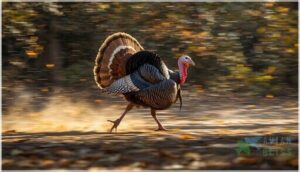
If you’ve ever startled a turkey in the wild, you know they bolt like feathered rockets. These birds are surprisingly fast runners, using their powerful legs to escape danger in seconds.
Let’s break down exactly how fast they can move, from full-grown wild turkeys to their domesticated cousins and young poults.
While turkeys may seem grounded, they share the skies with impressive hunters like the birds of prey that dominate Virginia’s landscape, which can reach speeds exceeding 100 mph in a dive.
Average and Maximum Running Speeds
When you spot a turkey sprinting across a field, you’re witnessing some serious speed limits in action. Wild turkeys clock ground coverage at 18 to 25 miles per hour when spooked—that’s Turkey Running Speed rivaling your bike ride!
This impressive burst of speed helps them escape danger quickly, much like ducklings instinctively follow their mother to stay safe from those same hawks and foxes.
Their sprint dynamics rely on powerful leg muscles and explosive running techniques. So how fast can a turkey run? Fast enough that you’d struggle to keep pace, even at your best.
Their instinct to flee predators sharpens their reflexes early on, much like how birds learn to fly through repeated practice and environmental pressure.
The turkey’s impressive speed is also aided by its remarkable vision capabilities.
Speed Differences in Wild Vs. Domestic Turkeys
Not all turkeys share the same need for speed—Wild Turkeys leave Domestic Turkeys in the dust! Turkey Genetics explain why: domestication effects from selective breeding for meat have doubled body mass, crushing Running Speed. Wild Turkey Habitat demands agility, so wild birds hit 18–25 mph while their barnyard cousins waddle at half that. Speed Adaptation reveals how Flock Dynamics shift when you trade survival for size:
- Wild turkeys run nearly twice as fast as domestic breeds
- Heavier domestic birds carry disproportionate skeletal loads
- Wild turkeys maintain longer strides and smoother gaits
- Domestic turkeys shuffle with constrained, labored movement
- Turkey Behavior diverges: wild birds sprint to survive, domestic birds can’t
The domestication process involves significant changes in locomotor dynamics, affecting their overall speed and agility.
Speed of Juvenile Turkeys (Poults)
Young birds tell a different story entirely. Poults clock 10–15 mph during their first eight weeks—respectable Turkey Running Speed for pint-sized prey! Fledgling Speed increases as leg muscles develop, with Juvenile Agility peaking around week six.
Turkey Chicks rely on quick bursts rather than sustained sprints, and Poult Development favors fast-twitch fibers that power those vital escape dashes. Sprint Capabilities improve weekly as Animal Speed and Agility mature alongside body mass.
Why Do Turkeys Run When Spooked?
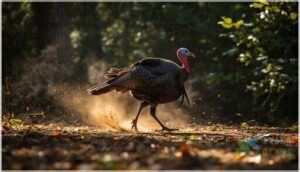
When a turkey bolts at lightning speed, it’s not showing off—it’s following millions of years of survival programming. These birds are hardwired to react instantly when danger appears, and running is their go-to escape plan.
When a turkey bolts at lightning speed, it’s following millions of years of survival programming hardwired to react instantly when danger appears
Let’s look at what drives this split-second decision to flee.
Predator Evasion Instincts
When danger strikes, you’re watching a finely-tuned survival machine kick into high gear! Here’s how predator evasion instincts shape turkey running abilities and escape mechanisms:
- Fear response determines how quickly turkeys hit their escape speed—higher threat means less hesitation
- Wild turkeys rely on sharp predator detection through vision to accelerate before predators close in
- Aerial threats trigger immediate flight patterns with rapid wing-beats for quick ascent
- Juvenile poults show inconsistent evasion strategies, often hiding rather than sprinting
- Energy costs influence survival tactics—turkeys weigh sprinting versus flying based on escape routes
Pretty impressive predator-prey dynamics, huh?
Common Threats Triggering Flight Response
Coyotes, foxes, and bobcats rank among the most common predator avoidance triggers you’ll observe—spooked turkey behavior kicks in fast! Threat detection includes human disturbance (sudden movements, loud noises), domestic dogs, and overhead raptors like hawks.
These flight triggers activate escape strategies instantly, with flock behavior amplifying alarm responses. Predator prey dynamics show turkeys use escape speed and turkey flight adaptively based on danger proximity.
Physical Traits That Make Turkeys Fast
Turkeys aren’t just fast by accident—they’re built for speed from the ground up. Their bodies pack some seriously impressive adaptations that turn them into feathered sprinters when danger strikes.
Their powerful leg muscles and lean build make them natural athletes, much like the agile movement patterns seen in various types of songbirds that also rely on quick reflexes to evade predators.
Let’s break down the physical traits that make these birds so surprisingly quick.
Leg Muscle Structure and Power
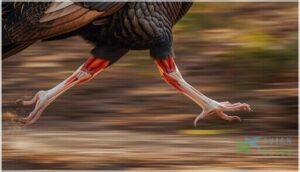
Ever wonder what powers a turkey’s lightning-fast escape? You’re looking at some seriously beefy leg muscles packed with fast-twitch muscle fiber types that fire in under a tenth of a second! The gastrocnemius and flexor muscles in their leg anatomy deliver explosive power output through impressive sprint mechanics.
Those thick thighs aren’t just for show—turkey legs are built like natural springs, storing energy in tendons that snap back during each stride, boosting their running speed before muscle fatigue kicks in.
Body Shape and Aerodynamics
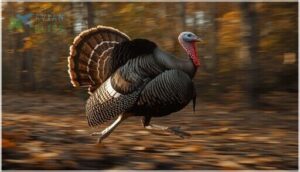
Turkeys might look chunky, but their body alignment during sprints is pure genius! When danger strikes, their wing configuration and feather dynamics work together to slice through air resistance like a feathered bullet.
Here’s what makes their aerodynamic features so wild:
- Horizontal body weight shift drops drag by angling that broad torso forward
- Rounded profile keeps momentum stable during crazy-fast acceleration
- Plumage orientation smooths airflow over flight muscles at top turkey speed
- Leg structure positioning maximizes power transfer without wobbling
- Torso-direction alignment turns turkey agility into pure escape artistry
How Far Can Turkeys Run at Top Speed?
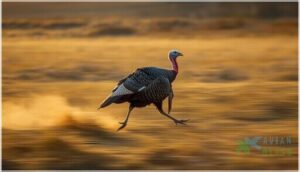
Turkeys might hit impressive top speeds, but they can’t keep that pace going for very long. When you’re facing down a spooked turkey bolting across a field, you’re watching a short-distance sprinter, not a marathon runner.
Let’s break down how far these birds can actually go before their legs give out.
Sprint Distance Limitations
When a startled turkey hits peak sprint distance, you’re looking at a brief but explosive show—most rapid escapes last under 100 meters before terrain or fatigue factors kick in. Their burst capacity for running speed relies on anaerobic energy, which flames out in 20–30 seconds flat. Here’s how sprint mechanics and terrain impact play out:
| Factor | Effect on Turkey Speed |
|---|---|
| Sprint Duration | 20–30 seconds max effort |
| Distance Covered | Under 100 meters usually |
| Speed Endurance | Drops ~50% after peak burst |
| Terrain Type | Uneven ground cuts speed 15–25% |
| Animal Speed Peak | Wild turkeys hit 25 mph bursts |
Effects of Fatigue on Running
Once muscle recovery time runs out, you’ll see turkey speed crash hard. Fatigue factors kick in after just 2–5 minutes of sprinting—lactic acid piles up, sprint endurance tanks, and energy depletion cuts their running speed by 10–20%.
That speed decline hits fast-twitch fibers first, turning a blur of feathers into a winded wobble. Animal athletics? More like animal exhaustion.
Factors Influencing Turkey Running Speed
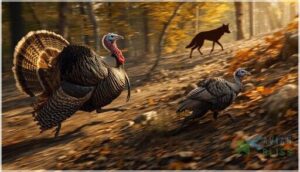
Not every turkey runs at the same speed when danger strikes. Just like you can’t sprint as fast after a big meal or on rocky ground, turkeys face their own speed limits based on a few key factors.
Age, terrain, and how terrified they are all play a role in whether that bird hits 25 mph or something slower.
Age and Health of The Turkey
Just like a young athlete outpaces a senior jogger, a turkey’s speed depends heavily on how old and healthy it is. Poults, or young turkeys, clock in at slower speeds—around 10-15 mph—while prime adults hit that impressive 25 mph mark.
Health factors like injuries, disease, or poor nutrition directly impact turkey development and running speed, affecting their survival within flock dynamics and predator evasion success.
Terrain and Environmental Conditions
Even the healthiest turkey hits a wall when the ground turns against it. Soft mud, steep terrain slope, or dense ground cover slow escape mechanisms fast. Weather effects like rain cut traction, while environmental barriers—fences or habitat fragmentation—force turkeys into tight spots where running speed drops.
Wildlife habitat quality directly shapes turkey speed, proving that where you run matters as much as how fast you can.
Motivation and Fear Level
A turkey that spots a fox doesn’t just jog away—it hits the gas like its life depends on it, because it does. Fear response and survival instinct crank turkey running speed to maximum, with stress factors like proximity to predators triggering an instant flight mechanism.
A spooked turkey’s escape mechanisms kick into overdrive, proving that motivation matters—panic breeds performance when predator avoidance is the only option.
Turkey Speed Compared to Other Birds

So how do turkeys stack up against other birds in terms of foot speed? You might be surprised to learn that these birds hold their own pretty well in the barnyard sprint!
Let’s compare turkeys to some of their feathered relatives and see how different birds choose between running and flying when danger strikes.
Turkeys Vs. Chickens and Pheasants
When you pit turkeys against backyard chickens, the speed gap is serious—wild turkeys clock in around 20 to 25 miles per hour, while chickens max out near 9.
Pheasants love to run through cover before flushing, but turkeys combine raw turkey running speed with agility. That mix of turkey speed and power makes wild flocks hard to catch once spooked!
Running Vs. Flying Escape Tactics
Spooked turkeys face a real choice: burn energy with a 55-mph burst into the trees, or keep it cheap and leg it on the ground. Running costs less fuel, but flight puts serious distance between them and danger fast. Here’s the trade-off:
- Energetic Costs: Flying drains stamina quick, while turkey running keeps them foraging longer.
- Predator Avoidance: Flight wins when threats close in tight.
- Turkey Agility: Sharp turns on the ground disrupt pursuit tactics.
Those escape strategies depend on how close danger gets!
Can Humans Outrun a Spooked Turkey?
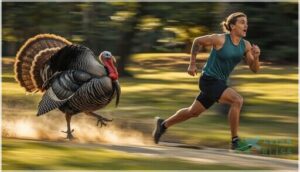
So you’re at a park and a turkey suddenly bolts toward you—can you outrun it? Not likely.
Let’s break down how human speed stacks up against a spooked turkey and what actually happens when you cross paths with one in the wild.
Human Average Running Speed Comparison
Most people can’t outrun a spooked turkey. Your average jogging pace sits around 5 to 6 miles per hour, nowhere near a wild turkey’s 25 mph sprint. Even trained sprinters averaging 18 mph fall short.
Human sprint capacity maxes out around 14 mph for most folks, while athletic performance comparison shows turkeys dominate in running speed variance and agility across all speed demographics.
Real-World Scenarios and Examples
In real life, turkey chase incidents pop up everywhere from jogging paths to front yards. Urban wildlife encounters show what happens when humans and turkeys collide:
- Ann Arbor runners got chased repeatedly on Huron Parkway by one aggressive bird
- Massachusetts resident needed a broom and golf club daily to fend off attacks
- DC cyclist knocked off his bike, then pursued for five minutes straight
- Mail carriers confronted during breeding season near nesting areas
- Hunters watch spooked turkeys sprint to cover when surprised up close
These suburban habitat encounters prove turkey speed and agility make escape mechanisms work—but also show bird attack strategies during human-turkey conflicts when territory’s at stake.
How Turkeys Use Agility to Evade Predators

Speed alone won’t save a turkey if it can’t change direction when a predator closes in. That’s where agility becomes the real key factor, turning a straight sprint into an unpredictable escape route.
Let’s look at the two main tricks turkeys use to stay one step ahead of danger.
Rapid Acceleration and Sharp Turns
When danger strikes, turkey agility kicks into overdrive. These birds don’t just bolt in a straight line—they execute rapid maneuvers with sharp turns that leave predators scrambling.
Wild turkeys shift their center of mass forward during escape, generating explosive acceleration from a standstill. Their powerful leg muscles support quick directional changes, producing zigzag escape strategies that make them one of the fastest running birds around.
Visual Acuity and Reaction Time
Ever wonder how a turkey spots you before you spot them? Their visual detection operates like a high-speed surveillance system—270-degree eye movement coverage scans for threats constantly.
With focal acuity three times sharper than yours and reaction speed clocking around 30-40 milliseconds, these birds convert visual input into explosive turkey running action. Their spatial awareness and avian behavior create a wildlife survival strategy that’s nearly foolproof!
Myths and Facts About Turkey Running Speed
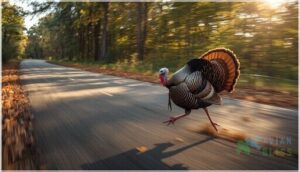
You’ve probably heard some wild stories about turkeys—maybe that they can outrun a car, or that they’re too slow to escape a backyard dog. The truth sits somewhere between the folklore and the exaggeration, and it’s worth separating fact from fiction.
Let’s bust some myths and see what the science actually tells us about these surprisingly fast birds.
Common Misconceptions
You’ve probably heard some wild Turkey Legends about these birds being speed demons or total slowpokes. Let’s clear up the most common Turkey Myths:
- Speed Myths claiming turkeys hit 40+ mph – they actually max out around 20-25 mph running
- Misconception Origins confusing Flight Speed (50-55 mph) with Running Abilities
- Assuming domestic turkeys match wild Turkey Running speed – farm birds are much slower
- Believing turkeys sprint for miles – they tire after 100-200 yards
- Thinking humans easily outrun spooked turkeys – most folks can’t match their 20 mph burst
Debunking Turkey Myths helps you appreciate their real Speed and Agility without the folklore nonsense. Running Facts beat legends every time!
Scientific Findings and Studies
Research on Turkey Anatomy and Avian Physiology reveals wild turkeys hit about 25 mph in short bursts—that’s 11 meters per second! Studies comparing Running Mechanics show domestic birds max out around 5 mph due to heavier builds and altered Muscle Structure.
Scientists measured Speed Variations on treadmills, confirming wild Turkey Running relies on elastic tendons and powerful leg muscles. Flight Patterns kick in only after sprinting fails—Speed and Agility work together in their escape toolkit!
Conservation Insights From Turkey Speed Behavior

Understanding how turkeys run isn’t just about satisfying your curiosity—it’s actually a breakthrough for wildlife managers trying to protect these birds. When biologists know how fast turkeys move and what triggers their sprinting behavior, they can design better conservation strategies that actually work.
Let’s look at why turkey speed matters for keeping wild populations healthy and thriving.
Importance for Wildlife Management
Understanding how fast turkeys can sprint when threatened isn’t just trivia—it’s actually vital intel for wildlife managers trying to protect these birds and their habitats. When you understand turkey running and animal locomotion patterns, you can design better habitat preservation zones that support their escape routes.
These management strategies help maintain ecosystem balance, ensuring species protection while supporting broader wildlife conservation and bird conservation efforts across diverse landscapes.
Role in Turkey Survival and Habitat Needs
That survival speed you just read about? It shapes where turkeys choose to live. Their habitat selection centers on escape routes—brushy cover within a quick sprint, roosting trees nearby, and travel corridors linking feeding spots.
These survival tactics and ecological adaptations drive conservation strategies that protect the mosaic landscapes turkeys need, ensuring their wildlife survival strategies actually work in the real world.
Frequently Asked Questions (FAQs)
How fast can a spooked Turkey fly?
When spooked, wild turkeys explode into flight at impressive speeds—hitting 50 to 55 miles per hour in short bursts. That’s faster than most highway exits! Their powerful wings and aerodynamic build make escape flight lightning-quick.
How fast can a Turkey Run?
Wild turkeys clock in at a solid 20 to 25 miles per hour on foot—pretty impressive for a bird, huh?
Domestic turkeys? They lumber along much slower, thanks to heavier bodies bred for the dinner table.
Are wild turkeys fast?
You bet they’re fast! These birds clock around 20–25 miles per hour when danger strikes—outpacing most humans and plenty of barnyard cousins. Their escape tactics blend wild running power with surprising agility.
Do turkeys run uphill?
Yes, turkeys run uphill when escaping predators or traveling between roosting and feeding sites. However, incline locomotion costs about 30 percent more energy than level running, so they prefer gentler slopes and saddles.
How do turkeys survive a predator?
When danger strikes, turkeys rely on sharp eyesight, lightning-fast evasion strategies, and flock behavior to outsmart predators.
Their camouflage, combined with powerful escape tactics and predator avoidance instincts, keeps wild turkey behavior surprisingly effective against threats.
Can wild turkeys fly?
Despite those powerful running legs, wild turkeys possess fully functional wing structure and aerodynamic feathers, enabling true bird flight.
Their flight capabilities include roosting habits in tall trees and escape strategies reaching 55 mph!
How fast can a turkey run when spooked?
When threatened, turkeys transform into feathered bullets. Wild birds hit 20 to 25 miles per hour in explosive bursts, while domestic turkeys lumber along closer to 20 mph, showcasing impressive turkey speed and agility.
Will a spooked turkey come back?
Most spooked turkeys won’t return quickly—escape tactics drive them to new areas. Flock dynamics, predators, and foraging opportunities shape reoccupation patterns.
Habitat selection and turkey behavior suggest return timing remains unpredictable, often spanning weeks or months.
Can a human outrun a wild turkey?
In a straight sprint, you’re likely to eat dust—wild turkeys clock 20-25 mph while most humans max out around 8-12 mph.
Trained sprinters might briefly match them, but turkey speed and agility usually win.
How fast can turkeys run up to?
Turkeys can run up to 25 miles per hour when they need to escape—sometimes hitting 30 mph in wild birds.
Their powerful leg muscles and sprint mechanics make them surprisingly quick running birds with solid animal running endurance.
Conclusion
That feathered flash you see tearing through the woods? Pure survival speed. Now you know how fast a spooked turkey can run—up to 25 mph—and why those powerful legs aren’t just for show.
Wild turkeys have spent millennia perfecting their escape tactics, blending explosive sprints with sharp turns and split-second decisions.
Next time you spot one bolting across a trail, give it some respect. That bird’s running for its life, and it’s winning.