This site is supported by our readers. We may earn a commission, at no cost to you, if you purchase through links.
Step outside on a spring morning and count how many different bird songs you hear before your coffee cools—most people guess three or four, but a single backyard can host a dozen species all singing at once.
That layered chorus isn’t random noise.
Each voice belongs to a songbird with a distinct anatomy, a learned repertoire, and a reason for every note it sings.
There are over 4,000 songbird species worldwide, and a surprising number visit ordinary yards, forests, and fields across North America.
Knowing how to tell them apart—by sight, sound, and habit—opens up a whole new way of moving through the world.
Table Of Contents
- Key Takeaways
- What Makes a Bird a Songbird
- Common Backyard Songbird Types
- Woodland and Field Songbird Types
- Songbird Traits, Songs, and Behavior
- Where to Find and Support Songbirds
- Frequently Asked Questions (FAQs)
- What are the main types of songbirds?
- What are the 7 levels of classification for a bird?
- What type of bird is a songbird?
- What are the different types of songbirds?
- Do songbirds have a vocal organ?
- Are all birds that make vocalizations songbirds?
- What do songbirds have in common?
- How many types of songbirds are there in the world?
- Are all birds songbirds?
- What order do songbirds belong to?
- Conclusion
Key Takeaways
- Songbirds belong to the suborder Passeri and stand apart from other birds thanks to a specialized vocal organ called the syrinx, which lets them produce complex, layered songs that most birds simply can’t.
- You can identify common backyard species like the Northern Cardinal, Black-capped Chickadee, and American Goldfinch by pairing visual cues—color, crest, bill shape—with their distinct calls and feeding habits.
- Birdsong isn’t just music; it’s a communication system used for defending territory, attracting mates, and signaling threats, with young birds learning their songs the same way kids learn to talk—by listening and practicing.
- A simple backyard changes—native plants, a drip water station, predator-safe feeders, and no pesticides—can meaningfully attract and protect the songbirds already living near you.
What Makes a Bird a Songbird
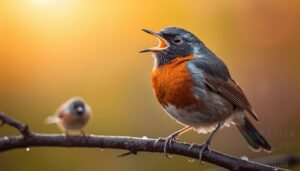
Not every bird that sings is actually a songbird. The difference comes down to biology — specific traits that separate true songbirds from the rest. Here’s what actually puts a bird in that category.
A songbird species comparison chart can help you quickly spot the biological traits that separate true songbirds from similar-looking species across different regions and seasons.
Passeri and Passeriformes Basics
If you’ve ever wondered why some birds seem to "sing" while others just squawk, it comes down to science. Songbirds belong to Passeri — a group within Passeriformes shaped by millions of years of evolutionary divergence and vocal learning evolution.
Through phylogenetic classification, we recognize over 4,000 Oscines species worldwide, evidence of impressive global species richness and habitat radiation across nearly every continent.
Their anisodactyl foot structure allows agile perching across diverse habitats.
Syrinx Anatomy and Complex Singing
What gives songbirds their musical edge? It’s the syrinx — an impressive avian vocal organ sitting where the trachea splits into two bronchi.
Each side operates independently, creating Dual Voice Mechanics that let birds sing two pitches at once.
Syringeal Muscle Types with Fast Fiber Dynamics enable rapid pitch shifts, while Membrane Tension Control and Neural Motor Coordination shape every note of their complex songbird vocalizations.
Perching Feet and Body Shape
Beyond the syrinx, songbird bodies are built for gripping. Three forward toes and one backward toe — called Anisodactyl Mechanics — lock automatically when a bird lands.
Toe Locking tightens with body weight, so they sleep perched without falling. Leg-Hip Alignment keeps balance steady, while Tail Counterbalance and Body Streamlining help perching birds in order, Passeriformes hold firm across any habitat:
- Tendons clench toes passively, saving energy
- Short legs lower the center of gravity
- The tail offsets body pitch on uneven perches
How Songbirds Differ From Other Birds
So what sets a songbird apart from, say, a hawk or a heron? It comes down to a few key traits working together.
Songbirds belong to the order Passeriformes and carry specialized brain vocal nuclei that make vocal learning in birds possible — something most other birds simply can’t do. Add dual-tone singing, a high metabolic rate, and altricial offspring, and you’ve got a truly distinct group. That’s songbird taxonomy and classification in action.
Why Birdsong Matters for Identification
Think of birdsong as nature’s fingerprint system. Each species carries unique syllable fingerprints, you can actually learn to read:
- Pattern motifs — the repeating phrase sequences that stay consistent across individuals
- Frequency ranges — pitch levels that separate similar-looking species instantly
- Dialect differences — regional song variations that sharpen identification in overlapping ranges
Seasonal timing and vocalization characteristics of common species make birdwatching far more rewarding than looks alone.
Common Backyard Songbird Types
Some songbirds don’t need a forest trail or a pair of binoculars to find — they’re already outside your window. Your backyard is home to a surprisingly diverse cast of species, each with its own look, song, and personality.
Here are six of the most common ones you’re likely to spot.
American Robin
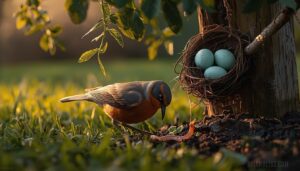
The American Robin is probably already visiting your yard. Watch for its orange-red breast and white eye ring as it runs across your lawn, stops, tilts its head, and pulls out an earthworm — that’s classic run-and-stop foraging.
Females build cup-shaped mud nest constructions in low branches, laying blue eggs with egg spotting.
Come winter, robins shift to berries and form small winter roosting flocks.
Northern Cardinal
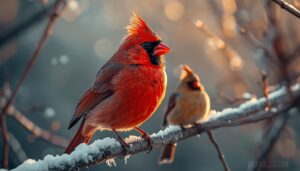
Few backyard birds stop you in your tracks like the Northern Cardinal. That bold red comes from carotenoid nutrition — the pigments males absorb from berries and seeds. Watch his crest behavior: raised means alert, lowered means relaxed.
Three quick identification tips:
- vivid red males are; females wear warm brown with red tinges.
- Both visit platform feeders for seed feeding, especially sunflower.
- They show habitat edge preference — shrubby yards near woods.
Year-round residency makes them reliable company.
Black-capped Chickadee
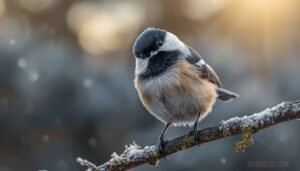
Meet the Black-capped Chickadee — a tiny bird with a bold personality. Its black cap and bib make it easy to spot at feeders.
Those famous "chicka-dee" calls aren’t just greetings; they’re acoustic threat signals that shift in complexity based on danger level.
It uses spatial memory for cache retrieval across dozens of hiding spots.
Nest boxes in wooded habitat work great for attracting them.
House Finch
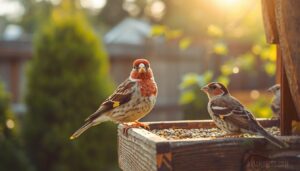
Few birds light up a feeder quite like the House Finch. Males flash rosy-red plumage on the head and chest — a color intensity tied directly to diet quality, which matters during courtship feeding when females pick the best-fed males.
They’re flexible with nest site selection, choosing eaves, ledges, or dense shrubs. Their warbling song patterns even shift in pitch due to urban noise impact.
American Goldfinch
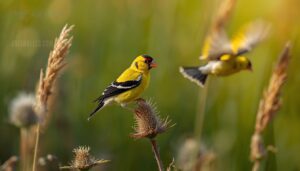
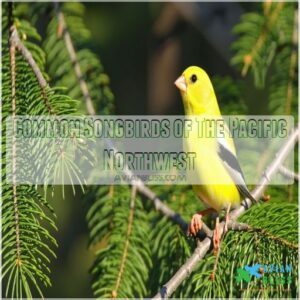
Tiny, electric, and impossible to miss — the American Goldfinch is a feeder attraction you’ll recognize instantly. Males undergo a dramatic Seasonal Plumage Shift from dull winter olive to vivid lemon yellow each spring.
Their conical bill, which follows a Bill Coloration Cycle tied to molt, is perfectly built for seed feeding for birds like thistle.
Watch for their bouncing Flocking Flight Pattern and grass-woven Nest Construction Materials.
Eastern Bluebird
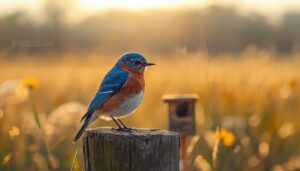
If the goldfinch is your summer showstopper, the Eastern Bluebird is its quieter, more soulful neighbor. You’ll spot this small thrush perched on fence wires, scanning open fields with that unmistakable brick-red breast and vivid blue back.
Here’s what makes them stand out:
- Juvenile plumage starts grayish-brown with speckled markings
- Clutch size usually runs 3–5 pale blue eggs (egg coloration helps ID nests)
- Nesting sites inside boxes need predator guards to boost survival
- Seasonal singing peaks during breeding, drawing them closer to suburban habitat
Woodland and Field Songbird Types
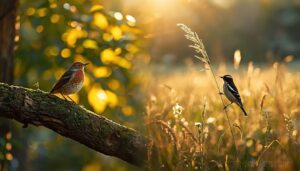
Not all songbirds show up at your feeder — some of the most stunning ones live just beyond your backyard, out in the woods and open fields.
These species have adapted to wilder spaces, and each one brings something worth knowing.
Here are the woodland and field songbirds you’re most likely to encounter.
Indigo Bunting
If you spot a flash of vivid blue singing from a fence post or brushy field edge, you’re likely watching an Indigo Bunting. That stunning color comes from feather structural coloration, not pigment.
This small songbird thrives with an open habitat preference, fueling up on a seed insect diet. It’s a long-distance migration champion, and females choose nesting sites carefully in low, dense brush.
Wood Thrush
From vivid blue to warm, spotted brown — the Wood Thrush is a completely different personality.
Step into a mature forest at dawn and you’ll hear it before you see it. Its ethereal dawn song floats through the trees like something from another world.
Here’s what makes this bird special:
- Leaf litter foraging — it hunts beetles, worms, and snails right on the forest floor.
- Mature forest dependence — fragmented woods hurt its seasonal singing and breeding behaviors.
- Cowbird parasitism — a real threat in broken-up habitats.
- Seasonal fruit shift — it switches to berries before migration.
Northern Mockingbird
Unlike the forest-floor Wood Thrush, the Northern Mockingbird owns open yards and park edges. Its mimicry repertoire spans 12–30 species — sometimes frogs and car alarms too. Territory size runs 1–4 acres, fiercely defended through song.
| Trait | Detail | Why It Matters |
|---|---|---|
| Urban Adaptation | Parks, lawns, hedges | Easy backyard sighting |
| Nest Architecture | Cup-shaped, 3–6 ft high | Shrubs work perfectly |
| Diet Shifts | Insects → berries seasonally | Attracts year-round |
Baltimore Oriole
Few birds make a spring morning feel like a celebration, quite like the Baltimore Oriole. The male’s vibrant male plumage — bold orange against jet black — is impossible to miss.
These skilled weavers create pendulous nest architecture suspended from elm branches.
Spot one with birdwatching tips for backyard feeders: offer sugar water feeding stations or orange halves, and they’ll visit reliably during spring migration arrival.
Sparrows, Warblers, and Wrens
Three groups — sparrows, warblers, and wrens — cover a huge range of woodland and field niches. Here’s how to tell them apart:
- Bill Shape Variation: Song Sparrow has a thick, seed-cracking bill; Yellow Warbler carries a slim, insect-picking one; Carolina Wren splits the difference.
- Foraging Microhabitats: Sparrows work the ground; warblers comb leaf canopies; wrens probe dense brush.
- Social Flocking Behavior: Sparrows flock freely; wrens prefer solitude.
- Plumage Seasonal Changes: Warblers brighten dramatically in spring; sparrows stay earth-toned year-round.
Habitat-Based Songbird Groups
Think of habitat as a bird’s address.
Forest Canopy Niches shelter warblers and vireos; Grassland Edge Specialists like meadowlarks thrive in open meadows. Riparian Corridor Species follow streams between both worlds.
Coastal Dune Assemblages cluster where salt air meets scrub, while Urban Greenway Flocks adapt to parks and gardens.
Knowing these habitat preferences of North American birds instantly sharpens your birdwatching.
Songbird Traits, Songs, and Behavior
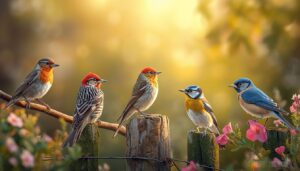
Songbirds are more than just pretty voices — their looks, habits, and behaviors tell a surprisingly rich story. Once you know what to look for, identifying and understanding them gets a lot easier.
Here’s a closer look at the key traits that define how songbirds live, sing, and thrive.
Plumage and Size Differences
Color and size tell you a lot before a bird even opens its beak. Male songbirds often sport brighter plumage than females — that’s Sexual Dimorphism at work.
Here’s what drives those differences:
- Carotenoid Brightness — Diet-based pigments create vivid reds, oranges, and yellows.
- Melanin Durability — Produces sturdy blacks, browns, and grays.
- Structural Iridescence — Microscopic feather layers shift blue-green hues with the light.
Smaller species often show sharper color contrast, while Size-Linked Camouflage helps larger birds blend into their habitat.
Territorial Singing and Courtship
Song is a songbird’s first line of defense — and its best pickup line. During the breeding season, males belt out territory song motifs to warn rivals and woo mates at the same time.
Vocal aggression signals get louder when intruders approach. Courtship duet dynamics soften things considerably, with intricate, quieter phrases showcasing repertoire size.
Multimodal signaling — think wing displays paired with song — seals the deal without a single fight.
Dawn Chorus and Seasonal Vocal Activity
Before sunrise, something notable happens. Dawn Onset Timing kicks off just minutes before first light — robins and cardinals lead the spring chorus, peaking within 20 minutes after sunrise.
Temperature Influence matters too: cool air carries songs farther, while Light Pollution Shift can nudge urban birds to start earlier. Humidity Effect sharpens certain frequencies.
Species Peak Patterns follow day length, so seasonal singing intensifies through spring.
Song Learning and Mimicry
Young songbirds don’t hatch knowing their songs — they learn them, much like you learned to talk. During a critical period, each juvenile picks a tutor, listens closely, then practices until the sounds stick. That’s avian vocal learning in action.
Young songbirds learn their songs the way children learn to talk — by listening, practicing, and making the sounds their own
- Neural circuitry wires the tutor’s song into memory
- Dialect formation happens as neighbors imitate each other
- Environmental noise shapes which notes get reinforced
- Mimicry and song learning in songbirds remarkably expands song repertoire size
Migration and Winter Flocking
Just as song learning is shaped by listening to others, migration works the same way — young birds follow experienced adults along established flyways, picking up Social Route Learning along the way.
They stop at Stopover Habitat sites to refuel, sometimes flying in V Formation Dynamics to save energy.
In winter, flocking keeps them warm at Winter Roosting Sites, proving community matters.
Feeding and Nesting Behaviors
After migration ends, the real work begins — raising the future offspring.
Parent songbirds divide duties naturally: fathers hunt larger prey while mothers handle incubation. Feeding Frequency is relentless — chickadees return every 8–12 minutes.
Watch for these nesting essentials:
- Nest Material Selection: grasses, mud, feathers, and hair
- Foraging Distance: mostly within 20–100 meters of the nest
- Nestling Begging Signals: loud chirps that trigger feeding trips
- Parental Role Division: both parents defend against predators
- Ground feeding sparrows may range up to 150 meters away
Where to Find and Support Songbirds
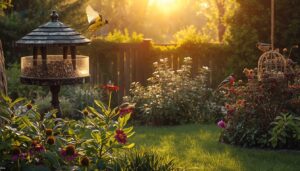
Songbirds are closer — they’re in your backyard, the park down the street, and the woods at the edge of town. Where you look and how you set things up make a real difference in what you’ll find.
Here’s what you need to know to spot more birds and keep them coming back.
Forest, Grassland, and Urban Habitats
Songbirds don’t pick their homes randomly — habitat preferences of songbird species are shaped by very specific needs.
Forests offer vertical stratification, giving warblers and thrushes layered canopy to work with. Edge habitat effects draw species like robins to forest margins.
Grasslands attract sparrows and meadowlarks.
Urban bird populations thrive where green corridors connect parks.
Microhabitat diversity and reduced noise pollution make any space more welcoming.
Regional Distribution in North America
Where you live shapes which birds visit your yard.
Northeast Bird Density peaks where forests meet suburbs, while Great Lakes Migration funnels thousands of warblers through each spring.
Southern Overwintering draws thrushes and sparrows seeking mild winters.
Western Mountain Communities shift with elevation, and Central Plains Grasslands host sparrows year‑round.
Habitat preferences of North American birds truly vary by region.
Best Places to Watch Songbirds
Some spots just deliver. Coastal migration stops like Cape May, New Jersey, and Point Pelee, Ontario, funnel huge waves of birds through each spring and fall.
Urban park hotspots, riparian trail corridors along streams, and marsh edge viewing areas all concentrate activity beautifully.
Protected reserve sanctuaries minimize disturbance, letting birdwatching song identification happen naturally. Wherever you go, habitat preferences of North American birds will guide you.
Feeders, Water, and Native Plants
Setting up your backyard doesn’t have to be complicated. A few smart choices go a long way toward attracting songbirds to your backyard.
- Seed Mix Diversity – Offer sunflower, nyjer, and millet to match habitat preferences of North American birds
- Drip Water Stations – Moving water draws far more species than a still birdbath
- Layered Native Plantings – Native trees and shrubs create shelter at every height
- Predator Safe Feeders – Tube-style bird feeders keep smaller birds feeding without interruption
- Seasonal Feeding Calendar – Shift from suet in winter to mealworms during breeding season
Nest Boxes and Safe Backyard Cover
A well-placed nest box can turn your yard into a genuine breeding ground.
Match your Entrance Hole Sizing to your target species — chickadees need smaller openings than bluebirds.
Add a Predator Guard Design around the entrance, provide Ventilation Drainage at the base, and follow Placement Height Guidelines (4–15 feet).
Stick to a Seasonal Maintenance Routine each spring to keep nesting boxes safe and inviting.
Conservation Threats and Backyard Protection
Songbirds face real threats right outside your door.
Light Pollution disrupts migration and dawn singing. Pesticide Impacts wipe out the insects that birds depend on. Cat Predation cuts survival rates for fledglings. Poor Water Quality and Invasive Plants shrink their food supply.
A bird-friendly backyard — clean feeders, native plants, no pesticides — is your best act of habitat conservation.
Frequently Asked Questions (FAQs)
What are the main types of songbirds?
You’ll find North American songbirds organized into Morphological Groups and Ecological Niches — backyard visitors, woodland dwellers, and field species — each shaped by unique Vocal Adaptations across distinct Geographic Clades within Oscine Families.
What are the 7 levels of classification for a bird?
Birds follow seven levels of phylogenetic classification: Kingdom Animalia, Phylum Chordata, Class Aves, Order Passeriformes, Family (like Corvidae), Genus, and Species.
This avian taxonomy framework makes species identification straightforward and precise.
What type of bird is a songbird?
A songbird is a member of the suborder Passeri — part of the order Passeriformes.
These birds are defined by their syrinx, a specialized vocal organ that makes complex bird song possible.
What are the different types of songbirds?
You’ll find them sorted into backyard favorites like the American Robin, Northern Cardinal, House Finch, and Eastern Bluebird, plus woodland specialists — each with a unique Vocal Repertoire, Evolutionary Lineages, and Migration Corridors shaping their world.
Do songbirds have a vocal organ?
Yes — and it’s called the syrinx, like a tiny instrument built into the chest.
This avian vocal organ sits where the trachea splits, enabling dual sound production through precise airflow pressure modulation.
Are all birds that make vocalizations songbirds?
Not every vocal bird is a songbird.
The difference comes down to the vocal complexity spectrum and structure — songbirds have a specialized syrinx enabling rich bird song, while non-oscine vocalizers produce simpler calls.
What do songbirds have in common?
They all share anisodactyl feet for perching, a syrinx for complex vocalization, and altricial development. Their neural song circuits support learned territorial and social behaviors tied to breeding season song.
How many types of songbirds are there in the world?
There are roughly 4,000 species within bird family Passeriformes — about half of all bird species diversity on Earth.
Global Species Count estimates reach 11,000 total birds, with Taxonomic Diversity still growing as new discoveries emerge yearly.
Are all birds songbirds?
Not quite. While all songbirds are passerines, not all passerines are songbirds.
Taxonomic boundaries matter here — raptors, waterfowl, and seabirds follow completely different evolutionary divergence paths, relying on calls rather than true birdsong.
What order do songbirds belong to?
Songbirds belong to the order Passeriformes — the largest bird order on Earth, with over 4,000 species.
Within it, true songbirds sit in the suborder Oscines, setting them apart from the less vocal Suboscines.
Conclusion
Once you crack the door open on types of songbirds information, the whole world starts singing back at you. You’ll notice the cardinal’s sharp whistle, track the chickadee by name, and recognize the wood thrush before you even spot it.
Every yard becomes a field guide. Every morning walk turns into a conversation you finally understand.
Start with one bird, learn it well, and let curiosity do the rest—the chorus has always been there, waiting.
- https://www.merriam-webster.com/dictionary/resonance
- https://premium.britannica.com/premium-membership/?utm_source=premium&utm_medium=inline-cta&utm_campaign=shorter-2026
- https://www.nwf.org/Educational-Resources/Wildlife-Guide/Birds/American-Robin
- https://www.audubon.org/field-guide/bird/northern-cardinal
- https://abcbirds.org/bird/kirtlands-warbler/