This site is supported by our readers. We may earn a commission, at no cost to you, if you purchase through links.

You spot a flash of yellow in the undergrowth, but before you can focus your binoculars, it’s gone. Was that a warbler? A finch? Without the right reference, that moment of discovery turns into guesswork.
Bird identification books for beginners bridge this gap, transforming fleeting glimpses into confirmed sightings. The best guides don’t just catalog species—they teach you how to see. They highlight the subtle differences between a Cooper’s hawk and a sharp-shinned hawk, explain why a bird’s posture matters as much as its plumage, and organize information so you can make identifications quickly in the field.
Whether you’re drawn to backyard feeders or planning hikes through varied habitats, choosing a field guide that matches your skill level and region sets the foundation for confident, rewarding birdwatching.
Table Of Contents
- Key Takeaways
- Essential Features of Beginner Bird ID Books
- Top 10 Bird Identification Books for Beginners
- 1. National Audubon Bird Guide
- 2. National Geographic Bird Field Guide
- 3. Peterson Field Guide To Birds Of North America
- 4. Stokes Field Guide To North American Birds
- 5. National Geographic Birds of North America Guide
- 6. North American Bird Guide Book
- 7. North American Bird Feeding Guide
- 8. National Geographic Bird Guide
- 9. Sibley Guide To Birds Second Edition
- 10. The Genius of Birds Book
- How to Choose The Right Bird Guide
- Effective Bird Identification Techniques
- Tips for Getting Started With Birdwatching
- Frequently Asked Questions (FAQs)
- Conclusion
Key Takeaways
- Choose a field guide that matches your regional location and skill level—regional guides focus on local species and migration patterns, while national guides offer broader coverage but less location-specific detail.
- Effective bird identification relies on combining visual field marks (wing bars, eye rings, tail shape) with behavioral cues (feeding posture, flight style, territorial displays) rather than depending on appearance alone.
- Start your birding practice with 10-20 common backyard species to build confidence and pattern recognition before tackling rare or difficult-to-identify birds.
- A beginner’s field kit requires only 8×42 binoculars, a compact regional guide, a weatherproof notebook, and birding apps like Merlin—keeping gear light and portable ensures you’ll actually use it in the field.
Essential Features of Beginner Bird ID Books
You can’t identify birds if your field guide confuses you before you even step outside.
Start by troubleshooting common feeder issues to make sure your setup actually attracts the species you’re trying to identify.
A field guide that confuses you at home won’t help you identify birds in the field
The right beginner book makes the difference between guessing at every sparrow and actually recognizing patterns that stick. Here’s what separates a helpful guide from one that’ll just gather dust on your shelf.
Visual Clarity and Illustrations

Illustrations are your first tool for breaking free from confusion in the field. You need high contrast colors that reveal wing bars and crown stripes at a glance, plus consistent image scaling so you can compare sizes instantly.
The Sibley Guide and Peterson Guide use annotated drawings with visual hierarchy that highlights key field marks, while the Kaufman Field Guide relies on color accuracy in photographs. Both graphic design approaches work when clarity drives identification.
Simple, Jargon-Free Language

Clear writing liberates you from the trap of ornithological terminology that drowns most beginner birding resources. You need simple vocabulary that explains “supercilium” as “eyebrow stripe” and “auriculars” as “cheek patch” right when you encounter them.
Look for these language tips in easy reference guides:
- Everyday comparisons for size (“robin-sized” instead of measurements in centimeters)
- Plain color names that match what you actually see in the field
- Short definitions built into descriptions, not buried in glossaries
Bird identification guides for beginners should read like conversation, not scientific journals. That’s how bird watching tips stick and beginner guides actually work when you’re standing in the woods with binoculars.
Regional Vs. National Coverage

After you’ve mastered plain language, geography shapes your next move. Regional guides zero in on species you’ll actually spot in your state or province, while national field guides like the National Geographic Field Guide to the Birds of North America cover every corner of the continent.
| Regional Guides | National Coverage |
|---|---|
| Local species lists customized to your habitat | Thorough geographic scope across all regions |
| Detailed bird migration timing for nearby areas | Broader patterns without local specifics |
| Place-specific breeding sites and stopover locations | Continental ranges with generalized habitat focus |
Regional bird guides cut through the noise when you’re tracking habitat-specific patterns or seasonal movements in your backyard.
Range Maps and Indexes

Once you’ve narrowed your geographic focus, range maps and indexes become your compass in the field guide. Range Map Details—like seasonal shading for breeding versus wintering zones—let you know which species appear when. Map Legend Symbols clarify migration corridors and isolated populations, while Geographic Boundaries orient you quickly. Peterson Guide and Sibley Guide excel here with clear Visual Cues.
- Color-coded regions show breeding, wintering, and year-round presence
- Indexing Methods by common name, habitat, or plumage morph speed lookups
- Annotations mark nearby states or provinces for local context
- Cross-references pair maps with illustrations to confirm bird identification
Portability and Size Considerations

A field guide lives in your pocket or pack, so Compact Designs matter. You want something between 5 and 7 inches tall—light enough to carry all day without shoulder strain.
Portable Formats with flexible covers resist wind and moisture better than rigid boards.
Weight Considerations run 8 to 12 ounces; heavier books tire your hands fast during long birding sessions.
Top 10 Bird Identification Books for Beginners
You’ve learned what makes a solid field guide, so now it’s time to see which books actually deliver for beginners.
The following ten guides balance visual clarity, accessible language, and practical field use without overwhelming you with technical details.
Each one offers a different approach to bird identification, giving you options that match your learning style and regional needs.
1. National Audubon Bird Guide
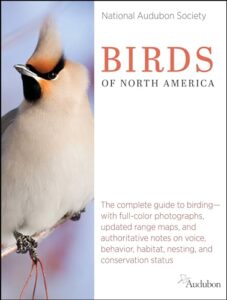
You won’t find a more thorough photographic guide than the National Audubon Bird Guide, which covers over 800 North American species with more than 3,000 color images. Each entry includes range maps, habitat notes, voice descriptions, and nesting behaviors to help you identify birds in your backyard or on vacation.
The April 2021 edition adds conservation status and climate change impacts, making it essential for understanding how birds adapt to environmental shifts. At 912 pages and 4 pounds, it’s your desk reference rather than a pocket companion.
| Best For | Birders of all levels who want a comprehensive desk reference with detailed species information, conservation updates, and stunning photography—though it’s too heavy for fieldwork. |
|---|---|
| Publisher | Knopf |
| Page Count | 912 pages |
| Language | English |
| Publication Year | 2021 |
| Weight | 4 pounds |
| Species Coverage | 800+ species |
| Additional Features |
|
- Covers 800 species with 3,500 photos, range maps, and detailed info on habitat, voice, and nesting habits
- Includes updated conservation status and climate change impacts to understand environmental threats
- Features essays from leading scholars that deepen your understanding of bird behavior and ecology
- Weighs 4 pounds and spans 912 pages, making it impractical to carry during hikes or bird walks
- Some range maps contain outdated or incorrect information according to user reports
- Size and weight limit its use as a portable field guide despite its comprehensive content
2. National Geographic Bird Field Guide
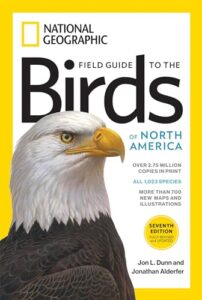
The National Geographic Field Guide to the Birds of North America puts 1,023 species at your fingertips with hand-painted illustrations that highlight field marks you’ll actually spot. This September 2017 seventh edition adds 37 new species and 250 fresh illustrations, organized with thumb tabs and a visual index for quick reference in the field.
At 592 pages and under 2 pounds, it balances portability with detail. You’ll find range maps, habitat notes, and behavior clues alongside artwork that shows seasonal plumages clearly.
| Best For | Birders at any level who want detailed illustrations and comprehensive coverage of North American species in a portable reference they can actually carry into the field. |
|---|---|
| Publisher | National Geographic |
| Page Count | 592 pages |
| Language | English |
| Publication Year | 2017 |
| Weight | 1.96 pounds |
| Species Coverage | 1,023 species |
| Additional Features |
|
- Covers 1,023 species with hand-painted artwork that clearly shows field marks, seasonal plumages, and key identification features
- Includes range maps, habitat descriptions, and behavior notes to help confirm IDs beyond just appearance
- Lightweight at under 2 pounds with thumb tabs and quick-find index for fast lookups when you spot something
- New taxonomic order might confuse users familiar with older systems until they adjust to the layout
- Range maps may not reflect recent climate-driven shifts in where birds actually show up
- Illustration style won’t appeal to birders who prefer photographic field guides over painted artwork
3. Peterson Field Guide To Birds Of North America
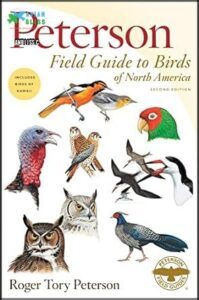
When you want proven identification power without the learning curve, the Peterson Field Guide to Birds of North America delivers. Its second edition covers all North American species using the famous Peterson system—arrows and labels point directly to field marks like wing bars and eye rings that separate look-alikes.
You’ll find illustrated plates showing multiple poses, from upper views to underside shots, with brief habitat notes and voice descriptions on facing pages. At $18.55, it organizes similar species side-by-side for instant comparison.
| Best For | Birders who want a straightforward, time-tested identification system that gets them to the right species quickly without memorizing complex field marks. |
|---|---|
| Publisher | Houghton Mifflin Harcourt |
| Page Count | 432 pages |
| Language | English |
| Publication Year | 2010 |
| Weight | Not specified |
| Species Coverage | North America comprehensive |
| Additional Features |
|
- Peterson’s arrow system cuts through confusion by pointing straight to the marks that matter—no guesswork about what to look for
- Side-by-side comparisons of similar species let you spot differences instantly instead of flipping back and forth
- Covers every North American bird including Hawaii exotics, so one guide handles your whole continent
- Larger format makes it awkward to carry in the field compared to pocket-sized guides
- Range maps can be small and occasionally outdated, limiting their usefulness for tracking migrations or local populations
- Doesn’t explain bird name origins or include deeper natural history details that some birders want
4. Stokes Field Guide To North American Birds

You won’t need guesswork when the Stokes Field Guide puts 853 North American species at your fingertips. Don and Lillian Stokes packed over 3,400 color photographs into this exhaustive reference, emphasizing shape-based identification that works even when plumage confuses you.
Each entry covers behavior, songs, and habitat preferences alongside detailed range maps showing migration routes. At 816 pages and three pounds, it’s hefty for backpack trips, but the downloadable CD with 600+ bird sounds adds audio learning you can’t ignore.
| Best For | Serious birders and nature enthusiasts who want comprehensive coverage of North American species with detailed photos and audio resources for home study and reference. |
|---|---|
| Publisher | Little, Brown and Company |
| Page Count | 816 pages |
| Language | English |
| Publication Year | 2010 |
| Weight | 3 pounds |
| Species Coverage | 853 species |
| Additional Features |
|
- Covers 853 species with over 3,400 color photos and 600 downloadable bird sounds for thorough identification
- Focuses on shape-based identification alongside behavior and habitat details, making it easier to ID birds in various conditions
- Includes updated range maps showing migration routes and seasonal distributions across winter, summer, and year-round territories
- Weighs around 3 pounds and measures 5.75 x 2 x 8.5 inches, making it too bulky for most field trips
- Western region birds may not receive the same level of detail as other species
- The audio CD may have limited usefulness for those who struggle to distinguish between similar bird sounds
5. National Geographic Birds of North America Guide

You’ll hit every region of the continent with over 1,000 species cataloged in this seventh edition hardcover. National Geographic updated the taxonomy to match current American Ornithological Society standards, so you’re working with accurate classifications.
Thousands of color illustrations show plumage variations across seasons and ages, while revised range maps display breeding, migration, and wintering zones.
Thumb tabs and quick-reference flaps let you flip to species fast during field observations, though at 752 pages it’s better suited for home study than trail hikes.
| Best For | Birders who want a comprehensive home reference covering every North American species with detailed illustrations and range maps. |
|---|---|
| Publisher | National Geographic |
| Page Count | 752 pages |
| Language | English |
| Publication Year | 2021 |
| Weight | Not specified |
| Species Coverage | 1,000+ species |
| Additional Features |
|
- Over 1,000 species with thousands of color illustrations showing plumage variations across seasons and ages
- Updated taxonomy matching current American Ornithological Society standards with revised range maps
- Thumb tabs and quick-reference flaps make it easy to locate species quickly
- At 752 pages, it’s too large and heavy to carry as a field guide on hikes
- Binding quality issues reported by some reviewers, leading to damage or breakage
- Could include more photographs to supplement the illustrations
6. North American Bird Guide Book
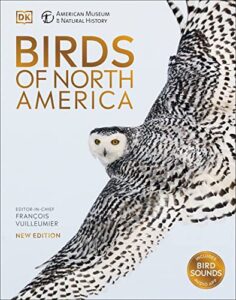
This companion guide gives you detailed species accounts plus identification tips that work in real field conditions. You’ll find color plates or photos for visual comparison, range maps showing seasonal distributions across states and provinces, and notes on common vocalizations and flight patterns.
The compact portable format fits in your field bag without adding bulk. High contrast plates highlight plumage differences between similar species, while side-by-side illustrations show wing, tail, and beak shapes for quick comparison during outdoor sessions.
| Best For | Bird enthusiasts and watchers of all experience levels who want a comprehensive at-home reference with stunning photography and detailed species information, but don’t need a portable field guide. |
|---|---|
| Publisher | DK |
| Page Count | 752 pages |
| Language | English |
| Publication Year | 2020 |
| Weight | Not specified |
| Species Coverage | 650+ birds |
| Additional Features |
|
- Over 650 full-color bird photographs with detailed accounts of characteristics, behavior, and flight patterns
- Includes color-coded distribution maps and a companion bird sound audio app for mobile devices
- Produced with the American Museum of Natural History, offering credible and thorough coverage for armchair enthusiasts and dedicated birders alike
- Large size (8.75 x 1.79 x 11.13 inches) and 752 pages make it too heavy and bulky for field trips or hiking
- May lack depth for professional ornithologists and doesn’t cover all age or sexual variations for some species
- Some customers have received damaged copies due to packaging and delivery issues
7. North American Bird Feeding Guide

This feeding-focused reference covers 196 North American species through colorful photos and behavioral insights. You’ll learn how to build DIY feeders, position them for safety and visibility, and select seed mixes that attract target species without waste.
The book explains high-fat winter feeding, seasonal nectar options, and maintenance routines that prevent disease. Practical tips on foiling squirrels, hand feeding, and setting up water sources turn your yard into a reliable observation post where birds return daily.
| Best For | Backyard birders who want to move beyond basic feeding and create a habitat that consistently attracts a wide variety of North American species. |
|---|---|
| Publisher | Firefly Books |
| Page Count | 296 pages |
| Language | English |
| Publication Year | 2019 |
| Weight | 1.9 pounds |
| Species Coverage | 196 species |
| Additional Features |
|
- Covers 196 species with rich photos and behavioral details that help you identify visitors and understand what keeps them coming back
- Practical DIY feeder plans and squirrel-proofing strategies save money while solving common feeding frustrations
- Goes beyond seed recommendations to cover seasonal needs, water features, and conservation activities that deepen your connection to birds
- Focus on North American birds means limited usefulness for readers in other regions
- At nearly 2 pounds and 296 pages, it’s too bulky to carry into the field as a quick reference
- May feel too basic for advanced birders or too detailed for casual feeders just starting out
8. National Geographic Bird Guide

The National Geographic Bird Guide delivers 960+ species through full-color illustrations that highlight wing bars, eye-rings, and plumage patterns you need for fast field identification. Each entry pairs artwork with color-coded range maps showing breeding and wintering zones, plus brief notes on habitat, vocalizations, and behavior.
Thumb tabs and a visual index help you flip straight to the right bird group. The seventh edition updates taxonomy and strengthens the cover for weather resistance, making it a dependable companion whether you’re scanning your backyard or hiking remote trails.
| Best For | Casual birdwatchers and backyard enthusiasts who want a compact, approachable guide to the most common North American species without overwhelming detail. |
|---|---|
| Publisher | National Geographic |
| Page Count | 256 pages |
| Language | English |
| Publication Year | 2019 |
| Weight | 14 ounces |
| Species Coverage | 150 species |
| Additional Features |
|
- Clear identification artwork with helpful visual cues like wing bars and plumage patterns
- Includes practical “Backyard Basics” section with tips on attracting and feeding birds
- Compact size (5.4 x 8 inches) makes it easy to carry on walks or keep by the window
- Covers only 150 species, which may feel limited for those exploring diverse habitats
- Smaller format means some users find the book tinier than expected
- May lack the depth advanced birders need for tricky identifications or rare species
9. Sibley Guide To Birds Second Edition

David Allen Sibley’s second edition spans 624 pages with nearly 7,000 hand-drawn paintings—illustrations 15 to 20 percent larger than the first release. You’ll find 810 species, each shown in flight to reveal wing shape and plumage in motion.
Updated range maps track winter, summer, and migration corridors, while habitat notes and voice descriptions accompany every entry. The flexibound cover withstands field use, and cross-referenced family pages let you compare related birds quickly when you’re sorting out warblers or sparrows on the trail.
| Best For | Birders who want the most comprehensive North American field guide with detailed illustrations and range maps, and don’t mind carrying a heavier book. |
|---|---|
| Publisher | Knopf |
| Page Count | 624 pages |
| Language | English |
| Publication Year | 2014 |
| Weight | 3 pounds |
| Species Coverage | North America comprehensive |
| Additional Features |
|
- Nearly 7,000 digitally remastered paintings with illustrations 15-20% larger than the first edition, showing birds in flight and multiple plumages
- Expanded species coverage including 115 rare species with updated range maps showing seasonal distribution and migration patterns
- Comprehensive reference with habitat information and voice descriptions for all 810 species, plus cross-referenced family pages for quick comparisons
- Weighs 3 pounds and measures nearly 10 inches tall, making it too heavy and bulky for easy field portability
- Small font size can be difficult to read, especially for users with vision challenges
- Some illustrations suffer from dark or inconsistent color reproduction that may make field identification harder
10. The Genius of Birds Book

Jennifer Ackerman’s 352-page exploration won’t help you distinguish a sparrow from a finch, but you’ll discover why birds outthink most mammals. Through examples like tool-making crows and memory-champion chickadees hiding thousands of seeds, Ackerman translates current research into accessible storytelling that reshapes your view of avian intelligence.
At $8.37, this Penguin paperback pairs well with any field guide—you’ll watch birds differently once you understand the problem-solving behind their feeding routes and social signals.
| Best For | Science enthusiasts and bird watchers who want to understand the surprising intelligence behind everyday bird behaviors without getting bogged down in heavy academic jargon. |
|---|---|
| Publisher | Penguin Books |
| Page Count | 352 pages |
| Language | English |
| Publication Year | 2017 |
| Weight | Not specified |
| Species Coverage | Various species |
| Additional Features |
|
- Accessible science writing that makes complex research on avian cognition easy to grasp, with real-world examples like tool-using crows and memory-expert chickadees
- Incredibly affordable at $8.37 for 352 pages of well-researched content from an award-winning author
- Changes how you observe birds in your backyard by revealing the problem-solving and social intelligence behind their actions
- Focuses purely on intelligence rather than identification, so it won’t help you tell different species apart
- Some research methods involving bird capture and surgery might be uncomfortable for sensitive readers
- The specialized subject matter on avian cognition may feel too niche if you’re looking for a general nature book
How to Choose The Right Bird Guide

Picking the right bird guide isn’t about finding the “best” book—it’s about finding the one that matches where you’re in your birding journey.
A field guide that works for someone who can spot a warbler at fifty paces won’t necessarily help you tell a sparrow from a finch.
Let’s break down two key factors that’ll help you choose a guide you’ll actually use in the field.
Assessing Your Skill Level
You can’t pick the right field guide until you know where you stand as a birder. Skill self-assessment isn’t about judgment—it’s about matching resources to your current abilities and tracking progress honestly.
- Rate your confidence identifying 10 common local species on a 1-5 scale during field observations
- Measure observation accuracy by comparing initial guesses against confirmed sightings over time
- Log identification speed and behavioral cues you recognize to reveal patterns in your learning
Beginner birders who reassess every 4-6 weeks build momentum through targeted bird identification techniques and beginner birding tips that actually stick.
Comparing Illustrations and Photographs
Illustrations offer artistic license that standardizes visual cues across species, while photographs capture true color accuracy and real image quality under field conditions.
The Sibley Guide uses refined rendering styles to highlight field marks, whereas the Peterson field guide blends both approaches.
You’ll master bird identification techniques faster when you recognize how each format supports different stages of your identification process. For a deeper understanding of how visuals impact communication, consider exploring this overview of visual storytelling benefits.
Effective Bird Identification Techniques

You’ve got your field guide, but turning those pages into real bird IDs takes practice and a few solid techniques.
The key is learning to read what you see—color patterns, behaviors, sounds—and knowing where to look for the clues that matter. Here’s how to sharpen your identification skills and build confidence in the field.
Using Visual and Behavioral Cues
You can sharpen species recognition by tuning into both plumage patterns and behavioral traits. Notice high-contrast wing bars, eye rings, and tail shapes—these visual signals work alongside feeding stances, flight style, and territorial displays.
When you combine what a bird looks like with how it acts, you’ll transform from guessing to knowing, making bird identification techniques click faster than relying on bird spotting guide photos alone.
Practicing With Common Species
Start with the birds that show up every morning—American Robins, Northern Cardinals, House Sparrows, and Mourning Doves anchor your practice. You’ll master bird identification by zeroing in on backyard birds and local birds first, building confidence before tackling rarities.
- Focus on 10 to 20 common species that frequent urban birding zones and bird habitats near you.
- Memorize 3 to 5 field marks per species—color patterns, tail shape, and bill structure matter most.
- Track seasonal shifts in behavior, like dawn songs in spring or winter flocking patterns.
- Practice field journaling after each walk, noting dates, locations, and IDs to sharpen bird species identification skills.
- Visit the same backyard or park repeatedly to recognize patterns and perfect bird watching for beginners techniques. Conservationists emphasize the importance of in local habitats to guarantee bird diversity for future generations.
Leveraging Range Maps and Field Marks
Range maps and field marks work together like a one-two punch for pinpointing species. You’ll master map reading skills by matching bird distribution patterns to your location, then confirming with field mark identification—eyebrow stripes, wing bars, or tail notches.
Study plumage variations in your field guide, cross-reference range map analysis with what you see, and you’ll nail species location techniques every time.
Keeping a Birding Journal
Once you’ve locked down your ID using maps and field marks, a birding journal transforms scattered bird sightings into real learning. You’ll track species, habitat observation details, and field notes that sharpen your eye over time—think of it as your personal field guide selection lab for backyard birding.
Here’s what makes journal structure work for birding for beginners:
- Record date, location, and weather so you spot migration patterns you’d otherwise miss
- Note field marks and behavior to build confidence in shaky IDs
- Sketch or describe distinguishing features before memory fades
- Review past entries regularly to see how far your bird watching for beginners skills have grown
Species tracking on paper locks in details that vanish from your head by dinner.
Tips for Getting Started With Birdwatching

You’ve got your field guide in hand—now it’s time to get out there and actually watch some birds. Starting doesn’t require expensive gear or expert knowledge, just a willingness to observe and learn as you go.
Here are the essentials that’ll help you build confidence in the field.
Building a Simple Birding Field Kit
You don’t need much to break free into bird watching—just a few key pieces that fit together like a natural system. Choose 8×42 binoculars with roof prisms for sharp, stable views.
Pack a compact regional field guide, a weatherproof field notebook, and a pencil for quick sketches. Add birding apps like Merlin for instant bird identification. Keep your outdoor gear light and organized for spontaneous adventures.
Exploring Local Birding Spots
Once you’ve assembled your field kit, put it to work where bird habitat meets opportunity. City parks with mature trees and ponds bring in warblers during spring migration and sparrows when winter settles.
Shorelines, wetlands, and riparian zones reveal herons, kingfishers, and dabbling ducks year round. Early morning hours between sunrise and 9 am offer the best bird watching for beginners—higher song activity and easier spotting techniques.
Joining Birdwatching Communities
Birding communities connect you with experienced watchers who accelerate your learning through mentor programs and local birding events.
Weekly walks, conservation efforts, and citizen science projects offer hands-on bird watching for beginners while building social benefits beyond field skills.
Community outreach through clubs provides shared expertise, conservation participation, and friendships rooted in nature—turning solitary observation into collective discovery.
Frequently Asked Questions (FAQs)
What is the best bird identification book?
You won’t find one perfect bird identification guide—the Peterson field guide excels for labeled features, while the Sibley offers lifelike illustrations.
Choose based on your region and preferred visual style.
What binoculars work best for beginner birders?
An 8×42 binocular configuration delivers the clearest field views for wildlife observation and beginner birding.
Look for fully multi-coated lens coatings, comfortable eyecup adjustments, and proper binocular magnification—skipping pricey image stabilization.
When is the best time to watch birds?
Dawn birding delivers dramatic results when warblers and waterfowl feed most actively during spring migration patterns, while seasonal birding and habitat timing align with weather effects that transform field guides into essential beginner birding tools for watching tips.
How do bird identification apps compare to books?
Apps like Merlin Bird ID offer instant photo and sound identification, while field guides provide detailed illustrations and work without batteries.
Digital guides excel at quick matches; books build deeper observation skills through systematic comparison.
What are the most common backyard birds?
You’ll spot American robins, northern cardinals, blue jays, American goldfinches, and house sparrows across North America.
These backyard birds show distinct feather identification marks—watch for the robin’s orange breast and cardinal’s bold red plumage.
How can I attract different birds to my yard?
You’ll attract backyard birds by offering diverse bird feeders, installing water features like bird baths, and planting native plants that create ideal yard habitat—essential steps for successful bird watching and identification.
Conclusion
Think of bird identification books for beginners as your field compass—they don’t just point north, they teach you to read the landscape. The right guide transforms confusion into clarity, turning every outing into deliberate practice rather than wishful guessing.
Start with one that matches your region and learning style, then let curiosity lead you deeper. Your binoculars capture the moment, but your guide builds the knowledge that makes each sighting stick.