This site is supported by our readers. We may earn a commission, at no cost to you, if you purchase through links.

That ruby-throated hummingbird hovering near your feeder isn’t just protecting its meal—it’s defending what it perceives as prime real estate in a landscape where natural nectar sources have shrunk by nearly 30% in recent decades. When birds clash at feeders, you’re witnessing territorial instincts amplified by habitat loss, climate disruptions, and the concentration of multiple species competing for limited resources.
The aggressive dive-bombs, wing-flaring displays, and persistent chasing don’t signal a personal vendetta; they reflect deep-rooted survival strategies triggered by environmental pressures. Understanding these behavioral drivers gives you the power to redesign your feeding setup, transforming your backyard from a battleground into a peaceful refuge where even the most dominant species can coexist without constant conflict.
Table Of Contents
- Key Takeaways
- Why Do Birds Fight at Feeders?
- How Feeder Placement Reduces Bird Fights
- Choosing Feeders to Minimize Aggression
- Creating a Peaceful Bird-Friendly Garden
- Maintenance Tips to Support Harmony at Feeders
- Frequently Asked Questions (FAQs)
- How to get two birds to stop fighting?
- Do birds fight over bird feeders?
- What time of day are feeder fights most common?
- Do weather conditions affect bird aggression at feeders?
- Can bird gender influence feeding territory disputes?
- Should I remove feeders temporarily during breeding season?
- How do I identify which bird species is most aggressive?
- Conclusion
Key Takeaways
- Feeder aggression stems from territorial instincts amplified by habitat loss and resource scarcity, not malice—understanding these survival-driven behaviors lets you redesign your setup to reduce conflict naturally.
- Strategic placement transforms battlegrounds into peaceful spaces: position feeders at least three meters apart, use visual barriers to break sightlines, and add multiple feeding stations to prevent any single bird from monopolizing resources.
- Saucer-style feeders with multiple ports and no perches discourage dominant birds from controlling access, allowing subordinate species to feed simultaneously and reducing direct confrontations by up to 50% within two weeks.
- Consistent maintenance—weekly cleaning, fresh nectar every 2-3 days, and reliable refilling schedules—prevents disease and eliminates the scarcity panic that triggers aggressive guarding behavior at feeding stations.
Why Do Birds Fight at Feeders?
If you’ve watched hummingbirds chase each other away from your feeders, you’re witnessing behavior that’s hardwired into their survival strategy. These tiny birds aren’t being spiteful—they’re responding to biological imperatives that have kept their species alive for millennia.
This territorial instinct is just one of many fascinating hummingbird behaviors that reveal how evolution shaped these remarkable creatures.
Hummingbird feeder battles aren’t spite—they’re survival instincts honed over millennia
Understanding the root causes of feeder aggression will help you create an environment where multiple hummingbirds can feed peacefully.
Territorial Instincts and Feeding Behavior
Territorial instincts drive most feeder fights, especially when food scarcity intensifies aggressive behavior. Birds mark and defend reliable patches using vocal cues, visual displays like wing flicks, and rapid chases to signal ownership. Hummingbird behavior and ecology reveal why these territorial marking strategies matter:
- Dominant birds control primary access to richer feeding zones
- Dawn and late afternoon trigger peak foraging pressure and territorial clashes
- Predictable food supply lowers feeder dominance and aggression triggers
- Scarce resources magnify fighting as birds battle for limited foraging strategies
Understanding the role of territorial behavior in animals can help explain why birds defend feeders so fiercely.
Species Most Prone to Feeder Aggression
While any bird can defend a favorite feeder, you’ll notice certain species dominate what some call “feeder wars” more consistently. Blue jays employ strong beak strikes to displace smaller songbirds, while house sparrows aggressively defend feeding patches through persistent guarding. Cardinals, doves, and crows also show distinct territorial fighting patterns, forming clear bird social hierarchy systems that reflect their feeding behavior patterns and species interaction dynamics.
Understanding and managing can play a vital role in minimizing aggression between birds.
Thoughtful bird cage placement tips for home ensure feeders are spaced adequately and positioned to reduce territorial conflicts among competing species.
Environmental Factors Influencing Conflict
Beyond species temperament, environmental factors shape how often aggressive encounters erupt near your feeding stations. Climate change disrupts natural food timing, pushing birds to concentrate at feeders during scarcity. Habitat loss shrinks foraging grounds, intensifying competition. Water availability during droughts heightens territorial disputes. Even microclimate effects like shade and wind exposure alter bird behavior, making thoughtful feeder placement essential for reducing conflict.
- Heat waves force birds to compete for cooler refuge spots near feeders
- Fragmented landscapes funnel multiple species into small feeding zones
- Inconsistent refilling creates boom-bust cycles that trigger guarding behaviors
How Feeder Placement Reduces Bird Fights
Where you position your feeders can make all the difference between a peaceful feeding station and an avian battleground.
Placement works hand-in-hand with nutritious bird food for winter feeding to create an inviting space where birds feel secure enough to visit regularly.
Strategic placement disrupts territorial behavior, giving more birds access to food without constant conflict. Let’s look at four key placement strategies that work with, not against, natural hummingbird instincts.
Increasing The Number of Feeders
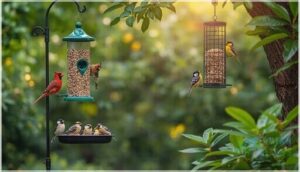
One of the simplest bird feeding strategies you can employ is adding more feeders to your yard. Multiple feeder benefits include offering distinct dining points for different bird groups, reducing direct competition when you provide four or more stations. You’ll want to stagger feeder heights and mix feeder designs to accommodate various species’ feeding styles and discourage single-point monopolization.
| Feeder Array Strategies | Expected Outcome |
|---|---|
| Four or more feeders | Reduces direct competition |
| Mixed feeder types | Accommodates different species |
| Staggered heights | Decreases aggression |
| Weekly rotation | Lowers territorial defense |
This approach to feeder density management transforms hummingbird feeder management from a battleground into a buffet, giving each bird population dynamics room to thrive.
Spacing Feeders to Minimize Competition

When you place feeders at least three meters apart, you directly disrupt competitive dynamics and reduce bird traffic bottlenecks. Proper feeder distance transforms aggressive fighting into peaceful coexistence by creating distinct feeding zones each territorial bird can claim without constant confrontation.
- Space feeders 3.0–3.5 meters apart to limit a single bird’s surveillance range
- Stagger spatial arrangement to prevent direct sightlines between stations
- Position feeders in separate garden quadrants to distribute territorial pressure
- Adjust feeder placement based on observed bird behavior and traffic patterns
Using Visual Barriers for Separation

Visual barriers effectively break sightlines between feeders, curbing territorial standoffs and aggressive encounters. By strategically using natural barriers like shrubs or artificial dividers, bird traffic patterns are transformed, creating distinct feeding zones that calm fighting impulses.
| Barrier Type | Height Recommendation | Best Use Case |
|---|---|---|
| Polycarbonate panels | 8–12 inches above ports | Multi-port feeder partitioning |
| Painted wood dividers | 10–14 inches tall | Separating adjacent feeders |
| Dense shrubs | 1.5–2.5 meters high | Natural visual separation zones |
| Garden trellises | 1.8–2.2 meters tall | Creating territorial boundaries |
| Opaque plastic sheets | 8–10 inches high | Quick seasonal adjustments |
You’ll notice reduced aggression when barriers prevent direct eye contact, allowing subordinate birds safer access without constant surveillance from dominant individuals.
Adjusting Feeder Height and Locations
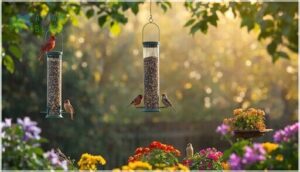
Height matters more than you might think when addressing territorial behavior at feeding spots. Position larger feeders 6 to 7 feet high while placing smaller ones 2 to 3 feet up—multi-level placement attracts different species to separate zones.
Seasonal adjustments help too: raise feeders 1 to 2 feet in winter, then lower them come spring to match fledgling activity and reduce birds fighting.
Choosing Feeders to Minimize Aggression
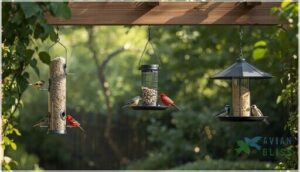
The feeder you choose can make a real difference in whether birds share peacefully or bully each other away from the food. Some designs naturally encourage multiple birds to feed at once, while others unintentionally give aggressive individuals the upper hand.
Let’s look at three key feeder features that help reduce conflict and create a calmer feeding station.
Feeders With Multiple Feeding Ports
Feeders with multiple feeding ports break up the monopoly that aggressive, territorial hummingbirds love to maintain. When you offer several access points around the same feeder, simultaneous feeding becomes possible—dominant birds simply can’t guard every angle at once. This port design approach delivers reduced aggression naturally:
- Each port allows independent access, so subordinate birds feed while the bully chases others
- Smooth, rounded port openings minimize wing collisions during close encounters
- Cleaning ports regularly prevents bacterial buildup that attracts pests and triggers competition
Saucer-style Versus Bottle Feeders
Saucer-style feeders let multiple hummingbirds access nectar flow simultaneously, which reduces territorial disputes that bottle designs can’t prevent. With 4 to 12 ports arranged around a shallow dish, these feeders distribute aggressive encounters across a wider feeding platform.
You’ll notice less fighting when dominant birds can’t monopolize every angle—saucer benefits include easier cleaning and more forgiving refill strategies that keep your feeder consistently full.
Removing Perches to Deter Dominant Birds
When perches vanish from your feeder, dominant birds lose their commanding view—and their ability to intimidate others drops by a measurable amount within two weeks.
Perch removal benefits include:
- Forcing birds to spread out across multiple ports, reducing direct confrontations and territorial blocking behavior
- Minimizing visual advantage that lets aggressive species monopolize feeding spots
- Giving subordinate birds new approach angles, shortening aggression windows in your backyard’s dominance hierarchy
- Lowering height-based intimidation, which shifts bird social dynamics toward more peaceful coexistence
Creating a Peaceful Bird-Friendly Garden

Beyond smart feeder choices, your garden’s overall design plays a vital role in reducing territorial conflicts among hummingbirds. When you create a space that offers abundant resources, natural hiding spots, and consistent food availability, you’re giving birds less reason to fight.
Here’s how to build a backyard environment where multiple hummingbirds can coexist peacefully.
Planting Nectar-rich Flowers for Natural Food Sources
Adding tubular blooms like anise hyssop and sunflowers transforms your yard into a dispersed nectar buffet, reducing feeder competition naturally. Native plant selection strengthens pollinator diversity, while flower cluster design in sunlit patches optimizes garden layout.
You’ll notice hummingbirds spreading out across nectar-rich flowers instead of battling at a single station. Stagger bloom times from spring through fall to maintain consistent nectar flow management, supporting peaceful coexistence among territorial birds.
Providing Shelter and Cover for Shy Birds
Once blooms draw birds in, shy species still need safe pathways to reach feeding spots. Dense shrubs and brush piles positioned near feeders create natural barriers that shield nervous visitors from threats, letting them approach with confidence. Consider this wildlife-friendly garden design:
- Plant evergreen hedges to maintain year-round natural cover near feeding areas
- Stack brush piles beside feeders as quick retreat routes
- Position shelter trees with overhead canopy for visual concealment
- Layer native ground cover to break open sightlines around feeder placement and design zones
Maintaining a Consistent Food Supply
Shelter alone won’t reduce skirmishes if your feeders run dry unpredictably. Steady refilling—topping up nectar sources every one to three days—keeps birds from guarding scarce resources. Diverse foods spread visitors across multiple stations, while seasonal planning adjusts quantities when migration peaks arrive. That way, feeder management becomes a calming rhythm rather than a last-minute scramble.
| Strategy | Benefit |
|---|---|
| Steady refilling schedules | Birds learn predictable availability, reducing panic |
| Diverse food types at separate feeders | Different species feed apart, lowering competition |
| Seasonal quantity adjustments | Prevents shortages during migration surges |
Maintenance Tips to Support Harmony at Feeders
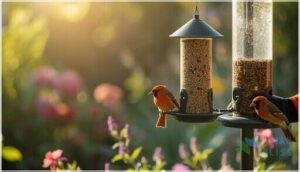
Even the best feeder setup won’t keep the peace if you’re not maintaining it properly. A clean, well-stocked feeder reduces stress and competition among visiting birds, which directly affects how they interact with each other.
Let’s look at three essential maintenance practices that support a harmonious feeding environment.
Regular Cleaning to Ensure Feeder Health
You can’t expect birds to share peacefully if their feeders are breeding grounds for disease. Feeder sanitation directly impacts hummingbird safety and health, so incorporate hygiene practices into your feeders management routine.
Clean each feeder weekly with a 10% non-bleach solution, scrubbing all ports thoroughly. During hot weather or peak activity, increase your cleaning schedules to twice weekly, maintaining nectar quality and supporting proper hummingbird feeder management strategies.
Fresh Nectar Preparation and Refilling Schedules
Fresh nectar makes all the difference in reducing feeder aggression and maintaining hummingbird feeder management strategies. Mix your nectar recipes using a 1:4 sugar ratio—one part white sugar to four parts water—without dyes or additives.
Refill timing matters: change nectar every 2-3 days, or daily when temperatures exceed 85–F. Proper nectar storage and feeder maintenance guarantee your nectar sources and feeding stations remain safe, fresh, and inviting.
Observing and Responding to Ongoing Bird Behavior
Watch your feeders daily to spot Bird Behavior Patterns and shifts in Avian Social Dynamics. Dawn patrols reveal peak Territorial Behavior, while midday visits tend to be calmer.
When you notice persistent fighting or aggression, apply Conflict Resolution Methods: add a second feeder, adjust spacing, or install visual barriers. Responsive Feeder Observation Tips and timely Aggression Reduction Strategies keep your bird feeding setup peaceful and welcoming.
Frequently Asked Questions (FAQs)
How to get two birds to stop fighting?
To curb aggressive behavior between two territorial birds, provide staggered feeding times at separate neutral zones.
This diffuses conflict by reducing social competition and discouraging fighting, applying feeder placement techniques that minimize direct confrontation naturally.
Do birds fight over bird feeders?
Yes, birds fight over feeders. Territorial behavior drives avian conflict when resources are limited, with dominant species like cardinals and blue jays defending prime feeding spots through wing flicks, vocalizations, and direct displacement.
What time of day are feeder fights most common?
Feeder fights peak during the morning feeder rush, especially the first thirty minutes after sunrise, when birds establish feeding order and territorial behavior intensifies.
Late afternoon clashes also increase as daily patterns shift before roosting.
Do weather conditions affect bird aggression at feeders?
Storm clouds gather, and so do tempers. Cold weather impact, freezing temperatures, snow cover influence, and windy conditions intensify territorial behavior.
These factors drive bird behavior shifts as rainfall effects and avian aggression heighten amid scarce resources and the struggle for dominance.
Can bird gender influence feeding territory disputes?
Gender feeding roles do shape territorial behavior at feeders. Males commonly defend resources more aggressively, escalating confrontations faster and dominating mixed interactions, while females prioritize nesting sites over feeding ports during breeding season.
Should I remove feeders temporarily during breeding season?
During the nesting period, temporary closure can reduce territorial behavior near breeding sites. Maintaining feeders helps parents meet high energy demands.
Balance bird safety with consistent food access for best results.
How do I identify which bird species is most aggressive?
Like a bouncer at a popular club, certain birds control feeders through bold behavior. Watch for repeated wing displays, loud alarm calls, direct chases, and monopolizing perches—these signal dominance hierarchy and territorial aggression.
Conclusion
You might think solving feeder conflicts requires constant supervision, but most adjustments you’ve learned here work passively once implemented. Strategic feeder placement, thoughtful garden design, and consistent maintenance create systems that naturally reduce aggression without your daily intervention.
When you understand how to stop birds from fighting at feeder stations through environmental modifications rather than behavioral policing, you’re not just ending skirmishes—you’re building a backyard ecosystem where competition becomes cooperation, and every species finds its niche.