This site is supported by our readers. We may earn a commission, at no cost to you, if you purchase through links.
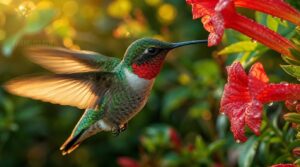
A hummingbird’s heart beats up to 1,200 times per minute. Your heart maintains around 60 to 100. These birds are basically flying at full throttle every waking moment, visiting up to 2,000 flowers a day just to stay alive.
What looks like a peaceful garden visitor is actually one of nature’s most extreme athletes, running metabolic systems that would burn a human body out within hours.
The interesting facts go far deeper than their shimmering feathers—from crossing the Gulf of Mexico solo to surviving freezing nights by dropping into a near-death state, these tiny creatures are endlessly surprising.
Table Of Contents
- Key Takeaways
- Amazing Hummingbird Feeding Facts
- Incredible Hummingbird Flight Abilities
- Tiny Bodies, Extreme Energy
- Color Vision and Flower Choices
- Hummingbird Diet and Nutrition
- Nesting and Parenting Surprises
- Migration and Memory Facts
- Territorial Behavior and Pollination
- Top 4 Hummingbird-Friendly Garden Items
- Frequently Asked Questions (FAQs)
- What makes hummingbirds unique from other birds?
- What are some amazing facts about hummingbirds?
- What is the largest hummingbird?
- What is a hummingbird?
- What is unique about hummingbirds?
- What are 5 interesting facts about hummingbirds for kids?
- Why do we not see baby hummingbirds?
- What is a flock of hummingbirds called?
- What is the unique ability of the hummingbird?
- What is an unusual hummingbird behavior?
- Conclusion
Key Takeaways
- Hummingbirds run one of nature’s most extreme metabolism — their heart beats up to 1,200 times per minute, they breathe 250 times per minute in flight, and they must eat every 10–15 minutes just to stay alive.
- Their figure-eight wing motion is what makes hovering, flying backward, and diving at 60 mph possible — both the upstroke and downstroke generate lift, something almost no other bird can pull off.
- At night, hummingbirds drop into a torpor-like state that cuts their metabolic rate by nearly 95%, which is basically their way of hitting a hard reset just to survive until morning.
- Before migrating thousands of miles solo — including a nonstop 500-mile Gulf of Mexico crossing — hummingbirds bulk up by nearly 40% of their body weight, running on fat reserves and sharp spatial memory the whole way.
Amazing Hummingbird Feeding Facts
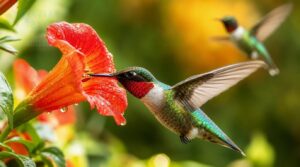
Hummingbirds eat in ways that seem almost impossible for such tiny creatures. Their feeding habits are packed with surprises — from how often they eat to what actually ends up on their menu.
Their diet is just one piece of the puzzle — hummingbird anatomy facts reveal even more about how these birds pull off their remarkable feats.
Here’s a closer look at what fuels these impressive little birds.
Nectar as Primary Fuel
Think of nectar as a hummingbird’s rocket fuel. Every sip delivers a rush of sucrose, glucose, and fructose — pure energy for that insanely high metabolic rate. Sugar concentration tradeoffs are real: richer nectar means more energy per drop, but thicker viscosity slows the tongue. Seasonal shifts and microbial modification of nectar constantly change the mix.
Here’s what fuels rapid nectar absorption:
- Sugars can reach 70% of dry weight in some flowers
- Nectar also carries amino acids, minerals, and organic acids
- Water content keeps hummingbirds hydrated during long foraging bouts
- Steady sugar streams directly power energy expenditure during flight and hovering
1,000 Daily Flower Visits
Their rocket fuel needs constant refilling. A hummingbird can visit 1,500–2,000 flowers daily — sometimes hitting that 2,000 mark during peak foraging. Floral Scheduling, Route Efficiency, and Patch Optimization drive every move, with birds using Patch Optimization to avoid depleted blooms and wait on Nectar Renewal cycles.
| Foraging Factor | What It Means | Why It Matters |
|---|---|---|
| Patch Optimization | Choosing richest flower clusters | Cuts wasted flight time |
| Nectar Renewal | Waiting for flowers to refill | Maximizes energy per visit |
| Metabolic Trade-offs | Balancing flight cost vs. intake | Keeps energy budget positive |
High flower visitation rates aren’t random — they’re smart.
Insects for Essential Protein
Nectar manages the energy side, but it can’t do everything. Hummingbirds are actually omnivorous — their diet includes protein-rich insects like fruit-fly larvae, spiders, and mosquitoes.
Insect prey capture supplies a strong Amino Acid Profile and Fatty Acid Benefits that nectar simply doesn’t offer. Their digestive systems handle Protein Digestibility surprisingly well, making insects a smart, complete nutritional complement to all that sugar.
Tree Sap During Migration
Beyond insects, tree sap quietly powers hummingbird migrations too. Early spring flowers aren’t always ready when birds arrive, so sap well selection becomes critical. Riparian sap hotspots — think maple-lined creek corridors — deliver a real phloem sugar boost when little else is available.
Through tree wound foraging and sap source memory, hummingbirds lock energy storage into their migration routes, smartly diversifying their diet composition.
Feeding Every Few Minutes
At dawn and dusk, hummingbirds shift into burst feeding mode — hitting flowers or feeders every one to three minutes. Their fast metabolism leaves zero room for long inter-feeding intervals.
During migration stopovers, stopover fueling kicks in hard, with birds cramming feeds together to top off reserves. Peak feeding times are relentless.
That high metabolism and intense energy expenditure basically demand a snack every 10 to 15 minutes.
Incredible Hummingbird Flight Abilities
Hummingbirds don’t just fly — they do things in the air that seem physically impossible. Their wings, speed, and agility set them apart from every other bird on the planet.
Here’s a closer look at what makes hummingbird flight so astonishing.
Figure-eight Wing Motion
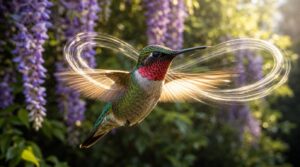
Watch a hummingbird up close and you’ll notice something extraordinary — its wings don’t just flap up and down. They trace a figure-eight pattern, and that changes everything about how flight works. Here’s what that wing kinematics magic actually does:
- Lift Enhancement — The figure-eight motion generates a leading-edge vortex, boosting lift on every stroke.
- Vortex Generation — Air swirls created mid-stroke increase the wing’s angle of attack without extra energy cost.
- Energy Efficiency — Both upstroke and downstroke produce usable lift, making this flight mechanical system exceptionally economical.
Engineers studying biomimicry applications are literally copying this figure-eight wing pattern into tiny drones.
Hovering in Midair
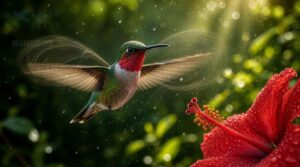
Hovering flight might be the most impressive thing a hummingbird does. Their wingbeat frequency reaches 50 to 80 beats per second, powered by precise shoulder rotation that keeps the figure-eight wing pattern perfectly timed.
This rapid motion creates aerodynamic vortices, generating lift with every wing pass. The resulting stability allows them to maintain position, even in challenging conditions like crosswinds.
The metabolic power required for such flight is enormous. To sustain this, hummingbirds rely on visual stabilization, enabling them to hover with helicopter-like precision.
Flying Backward and Sideways
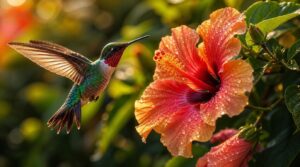
Most birds can barely turn quickly — hummingbirds can fly backward and sideways like tiny drones with precision control.
Here’s what makes that possible:
- Reverse thrust shifts via adjusted wing stroke angles
- Lateral thrust tilts the body sideways without spinning
- Tail rudder keeps yaw stable mid-maneuver
- Proprioceptive feedback fine-tunes each wing twist instantly
That’s energy efficiency and flight mechanics working together beautifully.
Fast Dives and Sprints
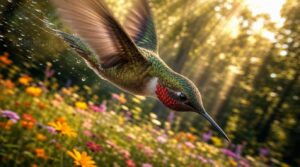
When a hummingbird dives, it’s pure physics in action. They dive at speeds over 60 mph, with precise entry angle and splash minimization built into every move.
Their wing rotation hits up to 80 times per second, powering an explosive underwater burst before shooting skyward again.
Adding a heart beating up to 1,200 times per minute, and you’ve got nature’s greatest sprint machine.
Signature Humming Sound
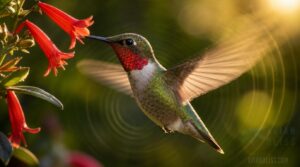
That buzzing you hear isn’t random — it’s pure physics. A hummingbird’s humming sound originates from its wingbeat frequency, with rapid wing beats up to 80 times per second generating oscillating pressure waves.
Higher wingbeat frequencies produce higher pitched tones, while the interaction between the bird’s body and air shapes the species’ timbre.
These harmonic overtones create a unique acoustic signature for each species, transforming the environment around your feeder into a surprisingly musical soundscape.
Tiny Bodies, Extreme Energy
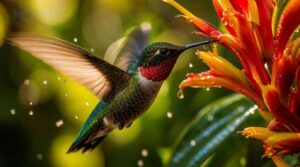
Hummingbirds are basically tiny engines that never stop running.
Everything about their biology is dialed up to the absolute maximum — heartbeats, breathing, metabolism, all of it.
Here’s a closer look at what makes these little birds so fascinatingly extreme.
Fastest Bird Metabolism
Few creatures push biology to its limits quite like a hummingbird. With the fastest metabolism of any bird species, their bodies run like tiny furnaces.
- Mitochondrial density in flight muscles is extraordinarily high, maximizing glucose oxidation per cell
- Enzyme turnover operates at exceptional speed, converting nectar sugars into usable energy within seconds
- Metabolic scaling means smaller size demands proportionally greater energy budgeting per gram
Their metabolic rate during hovering dwarfs even elite athletes — gram for gram, it’s ten times more intense.
Rapid Heartbeat Rates
That blazing metabolism comes with an equally wild heartbeat. A hummingbird’s heart can beat up to 1,200 times per minute during flight — tachycardia triggers include stress, temperature swings, and thermoregulation demands. Cold snaps raise the metabolic cost even further.
Monitoring heart rate trends actually works as stress indicators for researchers tracking bird health. At rest? It drops to a calmer 250 beats.
High Breathing Frequency
That rapid heartbeat connects directly to breathing. These birds breathe up to 250 times per minute during flight — far beyond most avian respiration.
Here’s what drives it:
- Neural Synchronization aligns each breath with wingbeats for peak oxygen delivery.
- Altitude Compensation pushes breathing higher where air thins.
- Thermoregulatory Breathing regulates heat through respiratory evaporation.
- Hormonal Modulation shifts rates during migration stress.
Torpor Saves Energy
All that breathing burns energy fast — so when night falls, hummingbirds do something astonishing: they enter torpor. Think of it as hitting a deep sleep switch. Their metabolic rate drops to nearly 95%, and fat reserve utilization kicks in to carry them through.
At night, hummingbirds enter torpor, slashing their metabolic rate by 95% to survive until dawn
Heat loss minimization keeps them stable, while daily torpor cycling and predator risk reduction make torpor one of nature’s most efficient metabolic tricks.
Cold Weather Survival
Even in freezing temperatures, hummingbirds are surprisingly tough. They rely on torpor each night for energy conservation, then wake and seek thermal microhabitats — sun-warmed branches and sheltered spots — to jump-start heat-generating activity at dawn.
Protective plumage adjustments trap warmth close to the skin, aiding survival.
Most species simply head to warmer wintering grounds, but those that stay develop resilience through strategic adaptations.
These resident hummingbirds build impressive cold tolerance by leveraging careful thermoregulation and winter energy stores.
Color Vision and Flower Choices
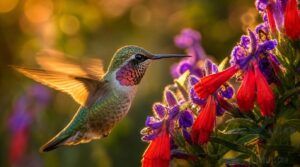
Hummingbirds see the world in a way you simply can’t imagine. Their eyes pick up colors, patterns, and light cues that are completely invisible to us.
Here’s what makes their vision so astonishing — and how it shapes every flower they visit.
Seeing Ultraviolet Light
Hummingbirds see a world you simply can’t. Their ultraviolet vision unlocks an entire ultraviolet spectrum invisible to human eyes — think of it as a secret color channel.
Through UV spectrum detection and UV pattern mapping, flowers reveal hidden nectar guides, almost like nature’s runway lights.
Their sharp visual acuity and color perception make UV navigation second nature, turning every garden visit into a precision-guided mission.
Red Flower Attraction
Red flowers aren’t just pretty — they’re basically a neon "open for business" sign to hummingbirds. Their color perception locks onto chromatic contrast instantly, making a red cardinal flower pop against green foliage like a billboard.
Tubular blossom design matches their beaks perfectly, while bloom timing synchronization and higher red nectar volume seal the deal.
Regional pollinator shifts even drive flower color attraction as visual signaling evolves over time.
No Strong Smell Reliance
Here’s a wild twist — smell barely matters to these birds. Unlike most animals, hummingbirds rely almost entirely on visual cue dominance to find food. Evolutionary scent reduction shaped them into aerial visual hunters:
- Odor object detection plays only a supporting role
- Color signaling beats fragrance every time
- Scent learning limits vary by species’ odor variability
- Ultraviolet vision in birds helps detect ultraviolet rays no nose could match
Iridescent Throat Patches
Those glittering throat patches — called gorgets — are not pigment at all. Nanostructure optics inside each feather use light interference to produce iridescent gorgets that shift from emerald to violet in an instant.
Species gorget shapes vary wildly, from crescent slivers to full blazing bibs.
Seasonal gorget variation increases the intensity during breeding season, while habitat light effects and gorget signal synchrony help males time their displays for maximum color signaling impact.
Visual Feeding Cues
Your garden is essentially a billboard for hummingbirds—signaled through color and shape. They are drawn to the color red and brightly colored flowers, particularly tubular corolla fitted blooms that match their beaks perfectly.
Additional cues like petal glossiness, nectar transparency, and floral motion act as signals for food. These sensory details combine to create an irresistible invitation for the birds.
Hummingbirds also rely on their excellent memory to locate flowers, ensuring they never miss a meal. This ability further enhances their efficiency in foraging.
Hummingbird Diet and Nutrition
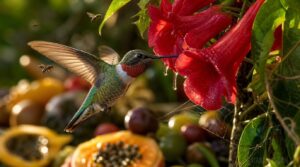
Hummingbirds aren’t just pretty — they’re basically tiny, high-performance eating machines. Their diet is surprisingly varied.
What they consume directly affects their health and energy. Here’s a closer look at what actually fuels them.
Sugar for Quick Energy
Think of nectar as rocket fuel in liquid form. Hummingbirds consume up to half their body weight in sugar daily — and their glucose uptake speed is astounding. They must feed every 10 to 15 minutes to keep up. Their rapid sugar metabolism and glycogen storage strategy keep those wings firing:
- Nectar sugar ratios match their exact energy needs
- Glucose fuels ATP for each wingbeat
- Insulin response dynamics stay balanced through constant feeding
Arthropods for Protein
Nectar powers the wings, but it can’t build muscle. That’s where insects come in, providing essential protein. Hummingbirds maintain an omnivorous diet, hunting protein-rich insects like tiny larvae and spiders throughout the day.
Diet diversity is the secret to their nutritional success. Even with sustainable insect farming principles at play in nature, hummingbirds ensure a sharp amino acid balance by targeting small insects with digestible, nutrient-dense tissue.
Mosquitoes and Spiders
Hummingbirds don’t stop at larvae — they actively hunt mosquitoes and spiders too. Spiders are especially valuable: they’re protein-rich insects packed with nutrients.
Fascinatingly, spiders use web trap efficiency and water-edge tactics to catch mosquitoes themselves, making both creatures part of the same food web. When a hummingbird snatches a spider, it’s basically getting a two-for-one protein meal.
Safe Homemade Nectar
Making your own nectar is surprisingly simple. Start with a one part white sugar to four parts water ratio to achieve the ideal sugar-water mixture. This basic recipe ensures the correct concentration for hummingbirds.
Boiling water helps dissolve the sugar completely, creating a consistent solution. Allow the mixture to cool fully before use. Once prepared, fill your nectar feeder with the cooled solution.
For storage, refrigerated batches stay fresh up to a week. However, change the nectar every few days to prevent fermentation, as spoiled liquid in sugar-water feeders poses serious risks to hummingbird health.
Avoiding Red Dye
Red dye in nectar is completely unnecessary — and it can actually harm the birds you’re trying to help. Hummingbirds naturally love the color red, so your nectar feeder doesn’t need artificial coloring. Keep your sugar-water feeders clean and dye-free with these simple tips:
- Read ingredient labels carefully for Red 40 or Red 3
- Screen household products like vitamins and syrups too
- Choose natural color alternatives like beet juice if needed
- Pick bird feeder designs with built-in red accents instead
Nesting and Parenting Surprises
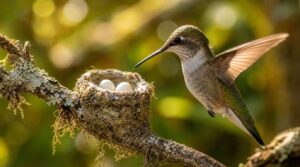
Hummingbird nesting is where things get really interesting. These tiny birds have some surprising tricks up their sleeve as they raise a family.
Their parenting habits are what make this process so extraordinary.
Females Build Nests Alone
The female hummingbird does it all herself — from material selection to solo nest defense. Her construction timeline spans five to seven days, with careful energy budgeting along the way.
She weaves hummingbird nests using nesting materials like moss and plant fibers, choosing spots with camouflage tactics that outsmart predators.
Tiny nests, big effort.
Spider Silk Nest Support
What holds a tiny nest together through wind and rain? Spiderweb silk. Spider silk helps create flexible nests that stretch without snapping — think of it as nature’s elastic band.
This silk reinforcement anchors hummingbird nests to branches, boosting wind resistance while shock cushioning protects eggs from tremors.
It also improves thermal insulation and facilitates flexible expansion as chicks grow, weaving nesting materials seamlessly into one tough, tiny structure.
Tiny Jelly-bean Eggs
Hummingbird eggs look almost unreal — each one barely the size of a jelly bean, roughly 0.5 inches long. That’s smaller than a ping pong ball’s curve.
These minuscule eggs sit snugly inside nests where spider silk helps create flexible structures that sway with the wind. Two eggs per clutch, white and smooth, hold chicks born blind, featherless, and helpless.
Frequent Chick Feeding
Once hatched, those blind, featherless, helpless chicks demand a serious feeding schedule. Mom returns every 10–15 minutes, delivering protein-rich insects alongside nectar — real protein boosters for rapid growth. Think of it like running a tiny restaurant that never closes.
She monitors crop health instinctively, adjusting portions to keep each chick thriving. That’s some impressive growth monitoring packed into a nest the size of a ping pong ball.
Fast Fledging Timeline
Growth happens fast in that ping pong ball-sized nest. By day 12, chicks start building wing muscles and fluttering like tiny athletes in training.
Here’s what the fledging timeline looks like:
- Wing muscle development begins around day 12
- Feeding frequency declines as short flight trials increase
- Nest departure timing hits around days 18–24
- Independence onset follows within 1–2 weeks after leaving
Migration and Memory Facts

Hummingbirds don’t just survive migration — they pull off feats that honestly seem impossible for a bird smaller than your thumb. Every fall and spring, these tiny travelers log thousands of miles completely alone, running on instinct and a memory sharp enough to find your backyard feeder year after year.
Here’s what makes their migration and memory so astonishing. Their ability to navigate vast distances solo, coupled with a memory sharp enough to find your backyard feeder year after year, defies expectations for such a small creature.
Long Solo Journeys
Think about flying thousands of miles — alone, no map, no flock. That’s exactly what solitary migrants, like rufous hummingbirds, do every year. Their seasonal migration spans nearly 4,000 miles, relying on instinctive strategies like Solo Flight Navigation, Fat Reserve Utilization, Altitude Optimization, and Tailwind Navigation.
These adaptations ensure survival during grueling journeys. By leveraging fat reserves, hummingbirds eliminate frequent feeding stops, while tailwinds slash energy costs. Optimizing altitude further boosts efficiency, shortening migration time by thousands of miles.
| Strategy | What It Does | Why It Matters |
|---|---|---|
| Fat Reserve Utilization | Fuels non-stop segments | Replaces frequent feeding stops |
| Tailwind Navigation | Reduces energy expenditure | Cuts energy expenditure modeling costs |
| Altitude Optimization | Maximizes airspeed efficiency | Shortens migration by thousands of miles |
Gulf of Mexico Crossings
Solo journeys are just part of the story. What happens when the path runs out of land? Ruby-throated hummingbirds migrate over 2,000 miles nonstop across open water — no rest, no refueling. Their Gulf of Mexico crossing demands serious migration endurance. In fact, they generally opt for land routes, a behavior highlighted by their land migration route preference. Here’s how they pull it off:
- Route Planning — Birds choose direct over-water or coastal migration routes based on wind and season.
- Weather Windows — Favorable easterly winds trigger departure timing.
- Fuel Management — Fat reserves nearly double body weight before the 500-mile push.
- Navigation Aids — Spatial memory and instinct guide them across featureless open water.
Rufous hummingbirds migrate a total of 4,000 miles, but the Gulf leg represents perhaps the boldest single stretch any bird of this size attempts.
Rufous Hummingbird Migration
If the Gulf crossing sounds bold, wait until you meet the Rufous hummingbird. Rufous hummingbirds migrate 4,000 miles along the Western Sky Route — one of the longest bird migration routes in North America.
Sex-specific departure means adult males leave breeding grounds first, followed by females and juveniles. Stopover refueling, pre-migration molt, and climate timing shifts all shape this astonishing seasonal movement.
Pre-migration Weight Gain
Before that long haul south, hummingbirds pull off something extraordinary — they bulk up fast. Fat storage kicks in weeks before departure, driven by hormonal triggers tied to shifting daylight. They can gain up to 40% of their body weight through relentless dawn feeding and stopover refueling. Their body composition shifts dramatically to pack maximum fuel.
Here’s how migration fueling strategies actually work:
- Nectar fuels rapid energy production for sustained wingbeats
- Insects supply amino acids that keep flight muscles strong
- Dawn feeding sessions optimize caloric intake before heat builds
- Spindle-shaped fat droplets form in muscle and liver tissue for quick release
- Stopover sites let birds refuel without sacrificing flight readiness
It’s a masterclass in energy-dense diet planning — they consume up to half their body weight in sugar daily, banking energy storage in fat reserves for the journey ahead.
Returning to Feeders
What’s striking is that hummingbirds use their excellent memory to locate flowers — and your feeder is no different. They build a mental map of every reliable hummingbird feeding station in their range. Consistent nectar concentration, a regular refilling schedule, and distinct feeder colors all reinforce that memory for food.
Add safe perching zones and a multiple feeder layout, and your hummingbird feeder becomes a permanent stop on their feeding ecology route.
Territorial Behavior and Pollination
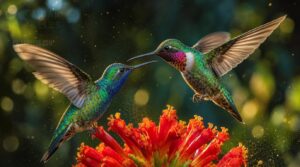
Hummingbirds aren’t just pretty visitors — they’re fierce little fighters with a surprising, unexpected role in sustaining ecosystems. Their behavior, from aggressive territory battles to accidental flower pollination, reveals a complexity often overlooked.
This duality makes them a significant force in the wild. While their combative nature secures resources, their foraging inadvertently supports plant reproduction, highlighting an ecological impact far greater than their size suggests.
Aggressive Feeder Defense
Don’t let their tiny size fool you — hummingbirds are fiercely aggressive and territorial around feeders. What looks like a garden snack bar is really a defended battleground.
Watch for these Perch Patrol tactics:
- Port Defense: blocking nectar ports with rapid, sharp aerial intercepts
- Intruder Intercepts: chasing rivals with alarm calls to force retreat
- Vigilance Rotation & Decoy Tactics: feinting flights to mislead competitors
Smart feeder design can ease this territorial aggression greatly.
Solitary Feeding Habits
Hummingbirds, though sharing your yard, operate fundamentally alone. Each bird establishes its own microterritory, carving out a personal circuit of preferred flowers and feeders. Through nectar recall and exceptional memory, they practice route specialization, repeatedly visiting blooms in a memorized sequence.
Weather-adjusted feeding further shapes their habits. Shifts in timing occur based on temperature and rain, compressing meals into tight temporal niches. These peak feeding windows help them avoid competitors, reinforcing their solitary existence.
| Solitary Habit | What It Means |
|---|---|
| Route specialization | Personal flower circuit, memorized and repeated |
| Weather-adjusted feeding | Timing shifts with temperature and rain |
| Temporal niche | Peak feeding windows to avoid competitors |
Courtship Dive Displays
Male hummingbirds don’t just ask for attention — they demand it. Each courtship dive follows precise Dive Kinematics: ascending 20–40 meters, then dropping in a smooth arc with maximum wing beat frequency. This Aerodynamic Sound Generation, combined with Multimodal Timing of flashing gorgets and vocalizations during flight, converges within 300 milliseconds.
The Tail Feather Display widens their visual profile, while Female Preference Metrics favor tighter, faster dives.
Important Pollination Role
Think of hummingbirds as nature’s tiny couriers — every nectar feeding run quietly powers entire ecosystems. Their pollination mutualism with flowering plants creates real results:
- Seed set boost in fruit-producing species
- Cross-species gene flow across wide landscapes
- Pollination network resilience during climate shifts
- Seasonal bloom synchronization with migration timing
- Landscape pollinator corridors linking fragmented habitats
Their pollination services genuinely keep wild plant communities thriving.
Habitat Conservation Needs
Hummingbirds need more than just your feeder. Deforestation impact and pesticide toxicity are shrinking their habitat fast.
For real hummingbird conservation, prioritize corridor widths of at least 100 meters and a native plant mix that blooms spring through fall. These steps ensure continuous food sources and safe passage.
Strategically place smart water feature placement near nectar sources to support hydration and foraging. Add nesting buffers around shrubs to protect breeding grounds from disturbances.
Top 4 Hummingbird-Friendly Garden Items
Want to make your yard a hummingbird hotspot? The right gear makes a real difference in how often these tiny visitors show up.
Here are four garden items that hummingbirds absolutely love.
1. Aspects Jewel Box Window Hummingbird Feeder
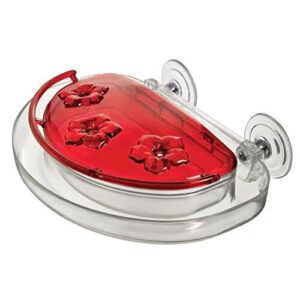
The Aspects Jewel Box Window Feeder is genuinely one of the smartest designs out there. Its bright red polycarbonate lid does exactly what science says it should—it grabs a hummingbird’s attention fast. The three flower-shaped ports allow multiple birds to feed at once, while the shared perch encourages them to stick around longer.
With an 8 oz reservoir, you’ll need to refresh the nectar frequently, ensuring it stays clean and safe. This design prioritizes both convenience and hygiene.
The suction-cup mount places you inches away from the action, eliminating the need for binoculars. This feature delivers an up-close, immersive viewing experience.
| Best For | Anyone who wants a close-up view of hummingbirds right from their window—great for home enthusiasts, families with kids, or anyone who just wants a little nature without leaving the couch. |
|---|---|
| Material | Polycarbonate |
| Weight | 10.88 oz |
| Wildlife Benefit | Attracts hummingbirds |
| Water Capacity | 8 oz |
| Ease of Setup | Suction-cup mount |
| Maintenance Need | Frequent refills required |
| Additional Features |
|
- The red polycarbonate design pulls hummingbirds in fast, and the perch gives them a reason to hang around longer.
- Super easy to refill and clean—the reservoir lifts right out without messing with the whole mount.
- Suction-cup setup holds firm and puts you just inches from the birds, no binoculars needed.
- Eight ounces goes quick, so you’ll be refilling more often than you might expect.
- Suction cups need a spotless glass surface to hold well, and they can slip in extreme heat or cold.
- It costs more than most basic window feeders, which might be hard to justify if you’re just testing the waters.
2. Mademax Solar Bird Bath Fountain
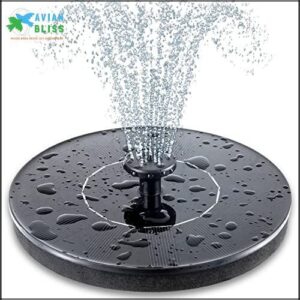
Besides a great feeder, hummingbirds genuinely love moving water. The Mademax Solar Bird Bath Fountain taps into that instinct. Drop it in your bird bath, and within 3 seconds of direct sunlight, the 1.4W solar panel powers a pump that shoots water up to 27 inches high. No cords, no batteries.
Eight interchangeable nozzles let you customize the spray pattern. It’s a simple, quiet upgrade that transforms any bird bath into an irresistible hummingbird hangout.
| Best For | Bird and wildlife enthusiasts who want a low-maintenance, eco-friendly water feature for their garden without dealing with cords or batteries. |
|---|---|
| Material | Plastic |
| Weight | 9.6 oz |
| Wildlife Benefit | Attracts birds and butterflies |
| Water Capacity | 160 L/h flow rate |
| Ease of Setup | Drop-in solar unit |
| Maintenance Need | Stops without sunlight |
| Additional Features |
|
- Starts up fast — just drop it in water and it’s running within 3 seconds of sunlight
- Eight nozzle options give you real control over the spray pattern and height
- Completely cord-free, so placement is flexible and setup takes almost no time
- Stops working the moment clouds roll in or the sun sets — no stored energy to keep it going
- High spray settings can toss water out of smaller bird baths, meaning more frequent refills
- Some users report the pump or solar panel wearing out after just a few weeks of regular use
3. HG Lifestyles Brass Patio Misting Kit
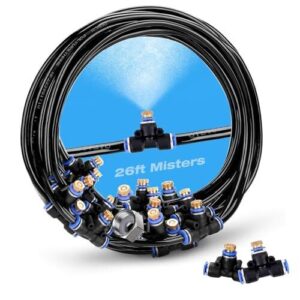
Moving water draws them in, and so does mist. The HG Lifestyles Brass Patio Misting Kit takes that a step further, cooling your outdoor space while creating a fine haze hummingbirds can’t resist flying through.
Eight brass nozzles spread across 29 feet of UV-resistant tubing, connecting directly to your garden hose. It lowers ambient air temperature noticeably — great for hot summer afternoons.
Just route the tubing carefully to avoid kinks, and keep the water pressure above 30 psi for best results.
| Best For | Backyard enthusiasts and gardeners who want a simple, plug-and-play way to cool down a patio, pergola, or greenhouse on hot summer days. |
|---|---|
| Material | Polyurethane/Brass |
| Weight | 12 oz |
| Wildlife Benefit | Cools outdoor habitats |
| Water Capacity | 29 ft coverage |
| Ease of Setup | Pre-assembled kit |
| Maintenance Need | Nozzle clog risk |
| Additional Features |
|
- Brass nozzles are built to last — rust-proof and clog-resistant, so you’re not replacing parts every season.
- Easy setup with quick-connect fittings and a standard garden hose adapter; no tools or plumbing knowledge needed.
- Covers a solid 29 feet of space with eight nozzles, making it practical for patios, gazebos, and even small garden beds.
- The polyurethane tubing kinks easily, so you’ll need to plan your layout carefully to keep water flowing smoothly.
- Nozzles are linked on one tube, meaning you can’t adjust one without nudging the others — no selective control.
- Low water pressure (under 30 psi) can cause nozzles to clog or underperform, which is frustrating if your outdoor supply runs weak.
4. Zoo Med Big Dripper Rainfall Simulator
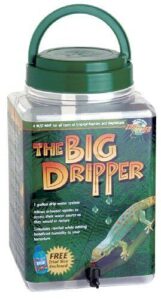
Want to keep water available all day without constant refilling? The Zoo Med Big Dripper holds a full gallon—roughly 3.8 liters—and slowly releases droplets that mimic natural rainfall. Hummingbirds love drinking from leaf surfaces, and this dripper recreates exactly that experience.
You can adjust the drip rate to just a few drops per minute, providing birds with a steady, gentle water source.
Just check the nozzle regularly, as the tubing can loosen over time and cause unexpected drips.
| Best For | Reptile and amphibian keepers who need a hands-off way to keep "dew drinkers" like chameleons, geckos, and frogs consistently hydrated throughout the day. |
|---|---|
| Material | Thin-wall Plastic |
| Weight | 4.8 oz |
| Wildlife Benefit | Supports reptile hydration |
| Water Capacity | 1 gallon |
| Ease of Setup | Hang-and-drip design |
| Maintenance Need | Drip rate adjustment needed |
| Additional Features |
|
- Holds a full gallon, so you’re not refilling it every few hours
- Adjustable drip rate lets you dial in just the right amount of moisture for your setup
- The folding handle makes it easy to hang above almost any enclosure
- Thin plastic means a single drop while full can crack the corners and cause leaks
- The nozzle and tubing tend to loosen over time and need regular tightening
- Getting the drip rate just right takes some trial and error—too fast and you’ve got a flood, too slow and it’s basically useless
Frequently Asked Questions (FAQs)
What makes hummingbirds unique from other birds?
Hummingbirds are unlike any other bird on Earth. They hover in place, fly backward, and visit up to 1,000 flowers a day — all powered by a metabolism that never slows down.
What are some amazing facts about hummingbirds?
These tiny birds pack more surprises than almost anything else in nature. From sipping nectar thousands of times daily to flying backward, they’ll genuinely leave you speechless.
What is the largest hummingbird?
Meet the giant hummingbird (Patagona gigas) — a full 3 inches long and weighing up to 18 grams. It’s basically the SUV of hummingbirds, ruling the Andean highlands of South America.
What is a hummingbird?
These dazzling little birds are among nature’s most astonishing fliers. They hover, dart backward, and dive at wild speeds — all while weighing less than a nickel.
What is unique about hummingbirds?
These little birds truly stand out from the crowd.
They hover mid-air, fly backward, and beat their wings up to 80 times per second. No other bird comes close to matching that.
What are 5 interesting facts about hummingbirds for kids?
Hummingbirds beat their wings up to 80 times per second, visit 1,000 flowers daily, fly backward, survive on nectar and insects, and use torpor at night to save energy.
Why do we not see baby hummingbirds?
You rarely see baby hummingbirds because nests are tiny, camouflaged, and hidden high in trees. Mothers keep them far from busy areas.
The whole nesting cycle wraps up in under a month.
What is a flock of hummingbirds called?
Believe it or not, a group of hummingbirds is called a charm. You’ll also hear hover or bouquet used.
All three fit — these tiny birds are equal parts magical, restless, and impossible to ignore.
What is the unique ability of the hummingbird?
Their most jaw-dropping ability? Hovering mid-air like a tiny helicopter.
Their wings beat up to 80 times per second in a figure-eight pattern, generating lift on both upstroke and downstroke — something almost no other bird can do.
What is an unusual hummingbird behavior?
One truly odd behavior? Some hummingbirds actually fly backward to escape threats.
They will also raid spider webs for protein — not just nectar. These tiny birds are far more resourceful than most people realize.
Conclusion
A ruby-throated hummingbird crossing 500 miles of open Gulf water alone—no rest, no food, just pure biological engineering in motion—says everything about what these creatures truly are.
The interesting facts about hummingbirds don’t just surprise you; they quietly reshape how you see the natural world. Something this small shouldn’t be capable of so much. But it is.
And the next time one hovers at your window, you’ll know exactly what you’re witnessing.