This site is supported by our readers. We may earn a commission, at no cost to you, if you purchase through links.
A Northern Mockingbird launches into song at 2 AM, cycling through nearly 200 distinct sounds it’s borrowed from everything around it—car alarms, other birds, even rusty gate hinges. This isn’t insomnia or confusion. Nocturnal vocalizations serve specific survival functions, from attracting mates when competition quiets down to claiming territory without the acoustic clutter of daytime.
The sounds of night birds reveal a hidden world of communication that most people sleep through, yet these calls follow patterns you can learn to recognize. Whether you’re hearing the mechanical repetition of a Whip-poor-will or the croaking announcement of a Black-crowned Night Heron passing overhead, each species broadcasts its identity through rhythm, pitch, and timing that remain consistent across populations.
Table Of Contents
- Key Takeaways
- Common Night Birds and Their Calls
- Unique Features of Night Bird Songs
- Reasons Birds Sing at Night
- Identifying Night Bird Sounds
- Conservation and Threats to Night Birds
- Frequently Asked Questions (FAQs)
- What is the common night bird?
- What birds sing at night?
- Why do birds sing at night?
- What birds make noise at night?
- What does a nocturnal bird song Mean?
- What bird is making noise at night?
- What night bird sounds like a squeaky toy?
- Why do I hear birds at 2am?
- What kind of bird sounds like a bat at night?
- How do night birds affect local ecosystems?
- Conclusion
Key Takeaways
- Nocturnal bird vocalizations serve specific survival functions, including mate attraction, territory defense, and avoiding daytime acoustic competition, with species like Northern Mockingbirds mastering nearly 200 distinct sounds through vocal learning and mimicry.
- You can identify night birds by recognizing consistent patterns in their calls—rhythm, pitch, repetition, and timbre—with common species including mockingbirds (repetitive phrases), nightingales (complex repertoires), Whip-poor-wills (relentless three-syllable calls), and Black-crowned Night Herons (sharp “quawk” sounds).
- Night birds concentrate their vocalizations between 1-5 kHz and adjust their singing behavior in response to environmental factors, with urban noise forcing frequency shifts and artificial light disrupting natural timing by advancing dawn songs 30-50 minutes earlier.
- Conservation threats to nocturnal birds include light pollution that disrupts breeding cycles and causes collision deaths, noise pollution that degrades communication effectiveness, and habitat loss from urbanization that fragments critical nesting and stopover sites.
Common Night Birds and Their Calls
If you’ve ever heard mysterious calls echoing through the darkness, you’re not alone—several bird species are most vocal after sunset. Each of these night singers has a distinctive sound that can help you identify them, from repetitive songs to haunting croaks.
If you’ve heard mysterious calls echoing through the darkness after sunset, you’re likely listening to one of several distinctive night singers
Here are five common nocturnal birds and the calls you might hear when the sun goes down.
Northern Mockingbird

The Northern Mockingbird stands out among nocturnal bird species with unmated males singing around the clock during breeding season. You’ll hear these persistent performers most often near urban areas, where their striking abilities shine:
- Mimicry Repertoire: Males master nearly 200 distinct song types through vocal learning
- Song Versatility: Each phrase repeats 2–6 times before switching
- Lunar Influence: Singing intensifies during full-moon nights
- Urban Adaptation: Higher-frequency songs cut through city noise, supporting strong territoriality
These birds are known for their distinct white markings.
Nightingale

If you’re seeking to identify nocturnal bird species by their nighttime vocalizations, listen for the Nightingale’s unmistakable complexity. Adult males develop a song repertoire averaging 190 distinct types, with older males maintaining about 53% larger catalogs. Their acoustic features include whistles, trills, and gurgles spanning broad frequencies.
You’ll notice impressive pitch control as they adjust frequencies in real-time, matching conspecifics across several kilohertz. These birds also modify their bird songs under noise, demonstrating striking vocal adaptability.
Researchers are examining nightingale song dialects across different regions.
Whip-poor-will
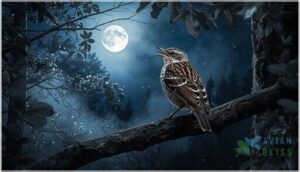
Where nightingales showcase vocal variety, the Eastern Whip-poor-will masters relentless repetition. You’ll recognize its three-syllable “whip-poor-will” phrase repeated hundreds—even over 1,000 times—consecutively during breeding season. Listen for these nighttime vocalizations peaking between 1:00 and 4:00 a.m., with calling intensity showing strong lunar correlation.
Key identification features:
- Frequency range: 2–3 kHz dominant energy
- Peak activity: Full moon phases
- Habitat: Open woodlands with partial canopy
Despite widespread population decline, you can still hear this iconic nocturnal bird across eastern North America.
Great Potoo

If you’ve ever heard a deep, haunting moan echoing through a tropical forest at night, you’ve likely encountered the Great Potoo. This strictly nocturnal bird produces a low, frog-like “baaaao” and a louder “whoap” call that carries over considerable distances. You’ll hear these potoo vocalizations more frequently on moonlit nights, when these masters of nocturnal ecology increase their calling activity.
| Feature | Description |
|---|---|
| Call Type | Deep moaning, frog-like “baaaao” and “whoap” sounds |
| Calling Pattern | Higher activity on moonlit nights; primarily nocturnal |
| Range | Southern Mexico through Central/South America to Bolivia |
| Population Status | 500,000–5 million individuals; slight decline (~7%) |
| Nesting Habits | Single egg laid directly on exposed branch depression |
You’ll find this striking species in lowland forests up to 1,500 meters elevation. Despite its large population status and “Least Concern” classification, habitat threats from deforestation pose ongoing challenges. The Great Potoo’s cryptic daytime camouflage and exposed nesting habits make bird identification during daylight nearly impossible—these nighttime sounds offer your best chance to confirm their presence.
Black-crowned Night Heron
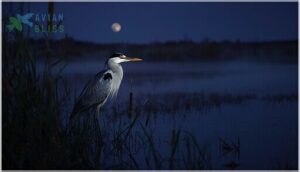
A sharp “quawk” cutting through the darkness signals the Black-crowned Night Heron—one of the most widespread nocturnal birds you’ll encounter near wetlands. Unlike strictly forest-dwelling night birds, this heron’s foraging ecology centers on marshes and shorelines, where it hunts from dusk until dawn.
Key identification features for nighttime sounds:
- Harsh, gurgling “quawk” call at 1.6 kHz, lasting about 163 milliseconds
- Barking squawk when disturbed at roosts or feeding sites
- Bill-rattling during greeting ceremonies adds mechanical clicks
- Multiple call types: hissing “plup” (courtship), repeated “wok” (disturbance)
- Juveniles progress from high “yip” to lower “chuck” calls
This heron’s nocturnal activity helps it avoid competing with day-active herons. You’ll hear birds departing roosts 10–20 minutes after sunset, their calls marking flights to feeding territories. Despite their adaptability to urban wetlands, conservation status varies regionally—populations in the northeastern U.S. have dropped roughly 50% since the 1970s, earning threatened or endangered listings in several states.
For bird identification, listen near water after dark. These opportunistic feeders often hunt alone, standing motionless in shallow edges or perching above streams, making their distinctive calls your most reliable detection method.
Unique Features of Night Bird Songs
Night birds have developed vocal strategies that set them apart from their daytime counterparts. Their songs aren’t just random sounds in the dark—they’re carefully structured performances shaped by the demands of nocturnal communication.
Let’s look at three distinctive features that make these nighttime calls so effective and recognizable.
Song Structure and Repetition
You’ll notice bird song characteristics differ dramatically when you listen to nocturnal bird vocalizations at night. Some species, like the Eastern Whip-poor-will, can repeat their three-syllable call over 1,000 consecutive times without pause. Meanwhile, nightingales organize their songs into motifs—stereotyped sequences of syllables—following syntactic rules that remain consistent across nights.
Vocal learning in birds allows mockingbirds to master around 190 distinct song types, with repertoire size varying by individual. Temporal patterns reveal intricate avian vocalizations: phrases may accelerate gradually within repeated sequences, and probabilities of switching between syllables stay stable from one night to the next.
Light effects from artificial illumination can alter when and how long these structured performances occur, with urban birds extending bird communication into darker hours.
| Species | Repetition Pattern | Repertoire Complexity |
|---|---|---|
| Eastern Whip-poor-will | 1,000+ consecutive calls | Single stereotyped song |
| Common Nightingale | Sequential song types | ~190–250 distinct types |
| Northern Mockingbird | 1–16 bout repetitions | Up to 200 learned songs |
| Thrush Nightingale | Multi-hour performances | 40+ song types, 50+ components |
| European Robin | Extended twilight singing | Moderate type diversity |
Volume and Frequency Range
When you record nocturnal bird vocalizations at night, you’ll capture song amplitude ranging from the nightingale’s 86 dB at one meter—loud as street traffic—to softer calls below 70 dB.
Most night birds concentrate avian vocalizations between 1 and 5 kHz, matching your hearing range’s peak sensitivity.
Urban noise forces frequency masking below 2 kHz, triggering the Lombard effect: bird sound recordings reveal species raising pitch and volume to cut through city din.
Mimicry and Vocal Learning
You’ll find that mimicry functions as a powerful mate-attracting strategy in night-singing species, with Northern Mockingbirds assembling repertoires of 45 to 203 distinct song types learned through juvenile auditory feedback. Learning mechanisms involve specialized forebrain pathways unique to vocal learners, allowing mimetic richness to reach hundreds of heterospecific elements.
Today, bird sound identification relies on automated tools processing nocturnal bird vocalizations to quantify repertoire size in cryptic species.
Reasons Birds Sing at Night

When you hear a bird singing after sunset, you might wonder what drives these nocturnal performances. The reasons aren’t random—they’re tied to survival, reproduction, and adapting to a noisy world.
Let’s look at the main factors that send birds into song during nighttime hours.
Attracting Mates
When you hear nocturnal bird vocalizations echoing through the darkness, you’re often listening to males advertising for mates. During the breeding season, unpaired males sing most actively at night—especially nightingales, whose breeding and mating behavior peaks before dawn. Female song preference drives this nocturnal performance, and reproductive success links closely to:
- Song complexity and repertoire size
- Longer, faster-delivered bird calls
- Dawn song timing synchronized with female fertility
- Higher overall vocalization rates
- Environmental constraints like predation risk balancing mate attraction benefits
Territory Defense
You might wonder why birds risk singing in the open night—territory defense often outweighs the danger. Nocturnal bird vocalizations mark boundaries, with playback aggression experiments showing males approach rivals even after dark. Territory size ranges from under 1 hectare in farmland songbirds to 4–10 hectares in Whip-poor-wills.
Environmental modulation and seasonal limits shape when you’ll hear these nighttime birds defending their turf through strategic bird calls.
Avoiding Daytime Noise
Beyond territory battles, you’ll notice urban noise masking drives temporal niche shifts—European robins in areas 10 dB louder than quiet sites switch to nocturnal singing to avoid daytime traffic. Rufous-collared sparrows start 70 minutes earlier in the noisiest zones.
These acoustic adaptations carry energetic trade-offs, but nighttime sound effects offer clearer transmission. Community patterns show birds redistributing effort when noise pollution peaks.
Identifying Night Bird Sounds
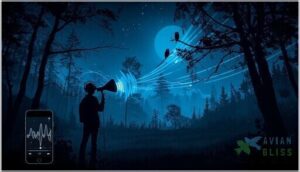
Learning to identify night birds by their calls takes a bit of practice, but you don’t need to be an expert to get started. Once you know what to listen for, you can distinguish between species and even track their activity patterns in your area.
Here’s how you can sharpen your ear and make use of the tools available to birders today.
Recognizing Species by Call
How do you separate one nocturnal bird species from another just by listening? You’ll rely on four key cues—rhythm, pitch, repetition pattern, and timbre—rather than matching exact notes.
Trained human observers correctly identify 92% of detections to species, slightly outperforming machine learning accuracy of roughly 86% in real-world conditions, though citizen science apps uniquely detect subtle calls humans miss.
Using Acoustic Monitoring Tools
Once you’ve trained your ear, acoustic monitoring tools take your nocturnal bird sound identification further. Autonomous recording units—ARUs—capture field recordings of birds across entire nights without you standing in the dark.
You’ll deploy these devices in high-use habitats, then run ML integration software to flag candidate calls.
Citizen science platforms let you validate detections, contributing to soundscapes impact research while sharpening your skills with real nocturnal bird vocalizations.
Accessing Night Bird Sound Recordings
Online archives like Xeno-canto give you access to over 900,000 bird sounds, including field recordings of birds made at night. AI platforms such as BirdNET help you match your audio files to species.
Acoustic datasets from citizen science projects capture flight calls during migration, and specialized sound library collections offer night bird sound effects you can study anytime—building reference libraries for confident identification.
Conservation and Threats to Night Birds
Night birds face mounting challenges in a world that never quite goes dark anymore. From city lights that blur the stars to sprawling development that swallows up wild spaces, these vocal creatures are losing ground.
Let’s look at the specific threats reshaping their world and what conservationists are doing to help.
Impact of Light and Noise Pollution
Artificial light disrupts your nightbirds more than you’d think. Urban illumination advances breeding phenology by up to two weeks and shifts vocal timing—blackbirds start dawn songs 30–50 minutes earlier near bright areas.
Noise pollution compounds these effects of light pollution, degrading communication fitness and masking key bird sounds.
Collision risks spike around lit structures as disoriented migrants circle light sources, while distribution changes show short-distance species increasingly occupying high-pollution zones.
Habitat Loss and Urbanization
When cities sprawl and habitats fragment, your night birds face tough odds. Urban Fragmentation and Light Pollution disrupt their routines, while Habitat Degradation pushes species out. You’ll notice:
- Fewer haunting calls at dusk
- Shrinking safe spaces for nesting
- Species Displacement from favorite haunts
- Ornithology revealing urgent needs for habitat conservation and smarter Conservation Strategies
Efforts to Protect Nocturnal Birds
You can join citizen science platforms that track nocturnal migrants and help reduce light pollution during peak seasons. Building guidelines now recommend shielded fixtures and treated glass to prevent collisions, while acoustic monitoring detects species at risk from habitat loss.
Habitat preservation efforts focus on corridors that sustain avian diversity, and habitat conservation programs address threats to bird populations by protecting critical stopover sites where night birds rest and refuel.
Frequently Asked Questions (FAQs)
What is the common night bird?
Like voices weaving through velvet darkness, Northern Mockingbirds dominate urban night birds across North America, calling hundreds of times nightly.
You’ll also encounter nightingales, whip-poor-wills, and owls—common species whose identifying nocturnal wildlife sounds reveal distinct nocturnal bird ID features.
What birds sing at night?
You’ll hear Northern Mockingbirds, nightingales, and Eastern Whip-poor-wills singing after dark.
These nocturnal vocalizations come from over 30% of North American species, with moonlight influence encouraging unmated males to perform crepuscular and nighttime songs.
Why do birds sing at night?
Birds sing at night for mate attraction, territory defense, and noise avoidance. Nocturnal vocal communication helps them avoid daytime interference, while artificial light disruption extends singing periods, altering natural life-history timing in urbanized areas.
What birds make noise at night?
Several species produce nocturnal bird sounds you’ll recognize. Northern Mockingbirds, Whip-poor-wills, and Black-crowned Night Herons rank among common night singers.
Owl sounds dominate wetland night sounds, while identifying nocturnal birds often reveals the Common Pauraque in warmer regions.
What does a nocturnal bird song Mean?
When darkness falls, song becomes a beacon for birds seeking mates or defending territories. Nocturnal vocalizations enable mate attraction, territorial defense, and species recognition, with signal redundancy helping messages cut through night’s acoustic challenges.
What bird is making noise at night?
You can identify species by their unique sound characteristics—Northern Mockingbirds sing complex phrases, while owl calls range from hoots to screeches.
Recording tools and habitat clues help confirm which nocturnal vocalist you’re hearing.
What night bird sounds like a squeaky toy?
The Brown-headed Nuthatch produces high-pitched, rubber-duck-like squeaks from southeastern pine forests. Eastern Screech-Owls deliver descending whinnies resembling toy wheels.
Northern Mockingbirds mimic artificial sounds nocturnally. Check AllAboutBirds.org for owl sound recognition and identification tips.
Why do I hear birds at 2am?
You’ll hear birds at 2am for several reasons: artificial light tricks their circadian rhythms into singing early, territorial males defend areas overnight, migrants fly over calling, and urban noise pushes vocal activity past dusk.
What kind of bird sounds like a bat at night?
Ever mistaken a bird for a bat? Common nighthawks, whip-poor-wills, and juvenile owls produce high-pitched, squeaky calls at night—creating acoustic confusion through frequency overlap.
Urban soundscapes increase this species identification challenge among nocturnal animals.
How do night birds affect local ecosystems?
Night birds deliver essential ecosystem services you might not notice. They provide pest control by consuming thousands of rodents and insects annually, while also supporting seed dispersal and pollination.
Their behavior acts as bioindicators of habitat health and light pollution impacts.
Conclusion
When the lights go out, a different symphony takes the stage. You’ve now got the tools to decode the sounds of night birds—from the mockingbird’s borrowed repertoire to the rhythmic insistence of a Whip-poor-will.
These vocalizations aren’t random noise; they’re purposeful signals shaped by millions of years of evolution.
Next time darkness falls and a call cuts through the silence, you’ll recognize what’s speaking and why it can’t wait until morning.