This site is supported by our readers. We may earn a commission, at no cost to you, if you purchase through links.

A gray-faced bird the size of a jay hammers a staccato rhythm against an aspen trunk in the Wasatch Mountains, while miles south in the red rock desert, its smaller cousin probes a prickly pear cactus for beetle larvae. Utah’s landscapes—from high-elevation spruce forests to arid scrublands—host eight distinct woodpecker species, each carved by evolution to exploit a specific niche.
These aren’t just tree-dwelling oddities; they’re ecosystem engineers that excavate homes for dozens of other cavity-nesting birds, control pest populations that threaten forests, and serve as living indicators of habitat health.
Whether you’re hiking Zion’s sandstone canyons or watching your backyard feeder, learning to identify these drumming architects opens a window into Utah’s wild pulse and reveals which species might already be patrolling the trees around you.
Table Of Contents
- Key Takeaways
- Woodpecker Species Found in Utah
- How to Identify Utah Woodpeckers
- Woodpecker Habitats Across Utah
- Diet and Foraging Behavior of Utah Woodpeckers
- Breeding and Nesting Habits
- Seasonal Patterns and Migration
- Ecological Importance of Woodpeckers
- Conservation Status and Protection
- Attracting Woodpeckers to Your Utah Yard
- Frequently Asked Questions (FAQs)
- What does a Utah woodpecker look like?
- How many woodpeckers are in Utah?
- Is it good to have woodpeckers around?
- What is the rarest type of woodpecker?
- What woodpecker species migrate through Utah seasonally?
- How do woodpeckers choose their nesting sites?
- What foods attract woodpeckers to backyard feeders?
- When is peak woodpecker breeding season?
- Which woodpeckers are most common in cities?
- Do woodpeckers damage healthy trees in Utah?
- Conclusion
Key Takeaways
- Utah hosts eight distinct woodpecker species adapted to diverse ecosystems from alpine spruce forests to Mojave Desert scrublands, with each species occupying a specialized ecological niche determined by elevation, vegetation type, and foraging strategy.
- Woodpeckers function as critical ecosystem engineers by excavating nest cavities that dozens of secondary cavity-nesting species depend on, controlling forest pest populations like bark beetles, and serving as indicators of overall habitat health across Utah’s landscapes.
- Key identification features include bill length relative to head size, distinctive color patterns like red nape patches or barred backs, drumming rhythms that vary by species, and behavioral differences such as ground-foraging versus tree-drilling or aerial insect-catching versus sap-feeding.
- Conservation challenges include habitat fragmentation from logging and development, climate-driven extreme fires destroying nesting trees, and species-specific declines like Lewis’s Woodpecker’s 67% population drop since 1970, though federal protections under the Migratory Bird Treaty Act and targeted habitat restoration efforts provide legal safeguards and recovery pathways.
Woodpecker Species Found in Utah
Utah’s diverse landscapes—from alpine forests to desert canyons—support eight distinct woodpecker species, each adapted to its unique niche. You’ll find everything from the tiny Downy Woodpecker to the striking Lewis’s Woodpecker across the state’s varied terrain.
Many of these adaptations mirror patterns seen in woodpeckers across neighboring Texas, where similar species thrive in comparable ecosystems.
Let’s explore each species so you can identify them in the wild and understand what makes them special.
From vibrant parrots to elegant finches, exploring different exotic bird types helps you appreciate their distinct behaviors and striking features.
Red-naped Sapsucker
The red-naped sapsucker stands out as one of Utah’s most fascinating woodpeckers in summer. You’ll spot this medium-sized bird drilling precise tree sap wells in aspens and mountain forests.
While Utah showcases the red-naped sapsucker, other regions like Vermont host their own striking species, including the crow-sized Pileated woodpecker with its distinctive blazing red crest.
Key identification features include:
- Black head with striking red nape plumage and forehead patch
- White facial stripes and lower belly creating bold contrast
- Length of 19-21 cm with a 41-43 cm wingspan
- Difficult sex determination due to similar male-female appearance
These sapsucker behavior specialists migrate to Mexico for winter.
For additional details on its nesting and feeding behaviors, see the Red-naped Sapsucker species profile.
Hairy Woodpecker
You’ll find the Hairy Woodpecker year-round across Utah’s forested mountains and riparian zones—one of the most reliable woodpecker species in the state.
This medium-sized bird stretches 18–26 cm long with a chisel-like bill nearly as long as its head. Males sport a small red patch on the back of the crown, while females lack this mark entirely.
Look for the clean white back stripe and unspotted white outer tail feathers that distinguish this species from its smaller cousin, the Downy Woodpecker. You can learn more about the Hairy Woodpecker’s permanent resident status in Utah and its preferred habitats.
Lewis’s Woodpecker
Unlike the common Hairy Woodpecker, Lewis’s Woodpecker breaks all the rules. This aerial acrobat catches insects mid-flight like a flycatcher rather than drilling for them.
Both sexes share the same bold plumage—a pinkish-red belly and dark greenish back—making them unusually hard to tell apart compared to most woodpeckers in Wisconsin.
Lewis’s Woodpecker defies expectations by catching insects mid-flight like a flycatcher instead of drilling for them
You’ll spot its striking rosy face and dark greenish-black plumage in Utah’s burned ponderosa pine forests and cottonwood groves, though sightings are increasingly rare.
The species has suffered a sobering 67 percent population decline since 1970, making conservation efforts critical for these unique woodpeckers in Utah.
Ladder-backed Woodpecker
If you’re exploring Utah’s Mojave Desert corner, watch for the Ladder-backed Woodpecker—a small specialist adapted to arid scrub most other woodpeckers avoid. This desert resident sports a black-and-white barred back and red crown, foraging on cacti, yuccas, and Joshua trees rather than pines.
Unlike migratory species, these birds stick around year-round, their tapping calls echoing through brushlands where conservation status remains stable despite gradual declines elsewhere.
Northern Flicker
You’ll recognize the Northern Flicker as one of Utah’s largest woodpeckers—28 to 31 centimeters with salmon-red wing shafts and a spotted belly. Unlike tree-drilling cousins, flickers forage on the ground for ants and beetles across open forests, parks, and yards statewide.
Watch for their white rump patch in flight and listen for their distinctive drumming during breeding season.
Downy Woodpecker
The Downy Woodpecker is North America’s smallest woodpecker—just 14 to 18 centimeters and weighing barely more than an ounce. You’ll spot this pint-sized drummer year-round across Utah, from mountain aspen groves to valley feeders, where its soft calls and delicate bill set it apart from the similar but larger Hairy Woodpecker.
- Appearance: Black and white plumage with white back stripe; males sport a tiny red nape patch
- Size: Distinctly short bill—shorter than head length—and dainty overall build
- Habitat: Breeds in montane aspen forests; winters in lowland valleys and suburban yards
- Foraging Strategies: Gleans insects from thin branches, weed stalks, and small twigs
- Nesting Habits: Excavates cavities 12 to 30 feet high in dead limbs during April-May breeding season
Williamson’s Sapsucker
Williamson’s Sapsucker ranks among Utah’s most sexually dimorphic woodpeckers. Males flash glossy black bodies with bold white wing patches and bright yellow bellies, while females wear such different barred brown plumage that early ornithologists actually classified them as separate species.
You’ll find these migratory breeders in Utah’s mature coniferous forests from May through August, where conservation efforts focus on protecting old-growth habitat from habitat loss.
| Feature | Male | Female |
|---|---|---|
| Body Color | Glossy black | Barred brown |
| Wing Pattern | Bold white patches | Subtle barring |
| Belly | Bright yellow | Pale yellow-white |
| Head Marking | Red throat patch | Brown head |
| Status | Migratory breeder | Migratory breeder |
American Three-toed Woodpecker
Utah’s high-elevation conifer forests harbor the rare American Three-toed Woodpecker, a species of conservation concern you’ll rarely spot outside the Uinta Mountains. This specialist thrives in disturbed landscapes where beetle-killed trees provide abundant larvae.
Providing species-appropriate bird habitat and nesting preferences helps protect these specialized woodpeckers by mimicking the natural cavities they excavate in standing dead timber.
- Males sport distinctive yellow crown patches while foraging
- Tree scaling behavior removes entire bark sections during feeding
- Nest excavation occurs in snags 3–15 feet above ground
Habitat loss threatens their already limited Utah range.
How to Identify Utah Woodpeckers
Spotting woodpeckers in Utah isn’t just about catching a flash of movement in the trees—you’ll need to tune into the details that set each species apart. From the size of their bills to the patterns on their wings, these birds carry their identification cards right on their feathers.
Let’s break down the key features you can use to confidently name the woodpecker tapping away in your backyard or on the trail.
Size and Bill Shape Differences
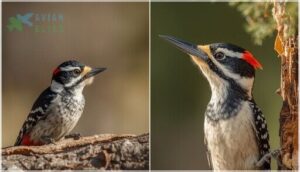
You’ll notice striking bill length variations when comparing Utah woodpecker species—ranging from the Downy’s dainty one-third-head-length beak to the Hairy’s impressive spike nearly matching its head size.
This woodpecker size spectrum spans six to eleven inches, with morphological adaptations reflecting each species’ foraging style.
Head size comparisons and beak shape differences provide your most reliable clues for confident bird identification in the field.
Color Patterns and Markings
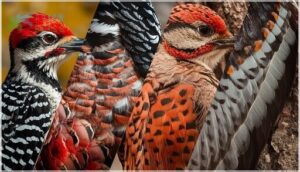
Beyond size differences, you’ll grasp woodpecker species identification by examining their distinctive color codes. Each Utah woodpecker sports a unique combination of markings that tell its story—from bold facial stripes to flashing wing patches.
- Head and facial markings distinguish species like the Red-Naped Sapsucker’s striking red crown and white eye stripe from the Northern Flicker’s gray face with a black breast crescent.
- Back and wing patterns reveal the Ladder-backed’s namesake barring versus the solid white back panel of Downy and Hairy Woodpeckers.
- Underpart coloration ranges from Lewis’s striking rose-pink belly to the heavily spotted buff underparts of Northern Flickers.
- Flight-visible features include the Flicker’s red tail feather shafts and Williamson’s Sapsucker’s conspicuous white rump patch flashing through conifer forests.
Male Vs. Female Features
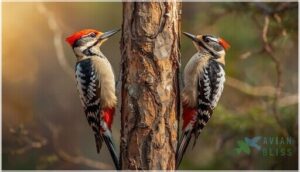
Once you’ve noted color patterns and markings, distinguishing males from females adds another layer to your woodpecker identification skills. Plumage differences in Utah woodpecker species often center on head coloration—males usually sport red patches that females lack.
| Species | Male Feature | Female Feature |
|---|---|---|
| Red-Naped Sapsucker | Entirely red throat | White chin patch |
| Hairy Woodpecker | Red nape patch | Plain black nape |
| Ladder-backed Woodpecker | Mostly red crown | Blackish crown |
Beyond these visual cues, sex roles differ too. Male Northern Flickers produce louder, more frequent drumming patterns and courtship displays than females, who generally observe territorial competitions. Bill size shows subtle differences as well, with males often possessing slightly longer, heavier bills for more forceful drilling. Williamson’s Sapsucker exhibits the most dramatic contrast—males display striking black bodies with red throats, while females wear cryptic brown plumage with heavy barring, making them look almost like different species altogether.
Unique Drumming and Calls

After you’ve sorted out who’s who by sight, listening to woodpeckers opens up a whole new dimension of identification—each species has its own signature rhythm and vocal personality. Hairy Woodpeckers deliver rapid-fire drumming patterns that sound like machine-gun bursts, while Northern Flickers produce slower, more deliberate sound waves.
Call variations matter too—Red-naped Sapsuckers emit nasal “mewing” vocalizations, and Lewis’s Woodpeckers use chattering auditory signals you won’t confuse with any other Utah woodpecker species.
Woodpecker Habitats Across Utah

Utah’s diverse landscapes create a patchwork of habitats where different woodpecker species have carved out their niches. From towering mountain peaks to sunbaked desert canyons, these birds have adapted to thrive in environments that might surprise you.
Let’s explore the key habitat types where you’re most likely to encounter Utah’s woodpeckers.
Mountain Forests
Head to the high country, and you’ll discover Utah’s mountain forests buzzing with woodpecker activity. Forest elevation matters—American Three-toed Woodpeckers stick to coniferous stands above 8,000 feet, while Red-naped Sapsuckers roam mixed aspen-conifer zones lower down.
Tree composition and disturbance ecology shape where these woodland birds thrive: burned tracts and beetle-killed snags become foraging hotspots, offering essential nesting resources for Utah woodpeckers year-round.
Red Rock Deserts
Drop into Utah’s red rock deserts and you’ll spot Ladder-backed Woodpeckers chiseling into yucca stalks and Joshua trees—desert woodland ecology at its most rebellious. Northern Flickers forage sandy washes below crimson cliffs, while Red-naped Sapsuckers winter along desert riparian zones where cottonwoods carve green corridors through arid landscape management challenges.
Canyon ecosystems here support woodpeckers adapted to sparse, xeric terrain and scattered snags.
Urban and Rural Areas
Right in Utah’s backyard birding hotspots, you’ll find urban woodpeckers thriving among suburban trees and rural habitats. Northern Flickers forage on lawns and park grounds, while Downys and Hairies drill street trees and orchard snags.
Human interactions shape these adaptable woodpecker species in Utah—farmland shelterbelts and residential corridors become essential lifelines for woodpecker migration and pest control across Utah wildlife communities.
National Parks and Forests
Across Utah’s national parks and forests, you’ll witness woodpeckers traversing diverse ecosystems—from Bryce Canyon’s conifer stands to Zion’s riparian woodlands.
Forest management in Uinta-Wasatch-Cache and Dixie National Forest balances habitat preservation with fire recovery, where post-burn snags become wildlife conservation gold mines.
Utah forests and woodlands maintain ecological balance through protected snag retention, supporting thriving woodpecker populations while safeguarding Utah’s natural heritage.
Diet and Foraging Behavior of Utah Woodpeckers
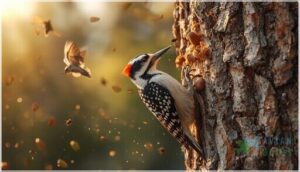
Utah’s woodpeckers aren’t picky eaters—they’ve adapted fascinating feeding strategies to survive in everything from high mountain forests to arid desert landscapes. You’ll find these birds drilling into bark, sipping from sap wells, and even catching insects mid-flight depending on the species.
Let’s break down what fuels these exceptional birds and how they’ve mastered the art of finding food in Utah’s diverse ecosystems.
Insects and Larvae
Utah’s woodpeckers are nature’s pest control squad, tackling everything from bark beetles to ground-dwelling ants with surgical precision. Insect prey diversity drives their foraging strategies—some chisel bark for larvae consumption while others specialize in aerial captures. Their insectivorous lifestyle delivers serious bark beetle control, with Three-toed Woodpeckers demolishing thousands of larvae daily during cold snaps.
- Bark excavators like Hairy and Downy Woodpeckers target wood-boring beetle larvae hidden beneath tree surfaces
- Ground specialists such as Northern Flickers probe soil for ants, comprising most of their diet volume
- Aerial hunters including Lewis’s Woodpecker snatch flying insects mid-flight during warm months
Sap and Tree Wells
Sap-feeding separates Utah sapsuckers from typical insectivorous birds—these specialists drill neat rows of shallow wells into aspen, willow, and conifer bark, revisiting them like clockwork.
Red-naped Sapsuckers maintain these feeding stations throughout the breeding season, lapping sticky sap with specialized tongues while snacking on trapped insects.
Their sapwell ecology creates foraging hotspots where hummingbirds and warblers steal quick sips, turning individual woodpecker species into ecosystem architects.
Seeds, Nuts, and Fruits
When insect prey dwindles each autumn, you’ll spot several woodpeckers shifting gears to exploit plant foods—Lewis’s Woodpeckers cache acorns in bark crevices, while Northern Flickers feast on wild berries.
Winter foraging strategies include:
- Black oil sunflower seed at woodpecker feeders attracts multiple species
- Lewis’s Woodpeckers favor Gambel oak acorns, shaping them for nut storage
- Chokecherries and huckleberries provide natural fruit attraction
- Caching behavior allows diet flexibility when backyard birds need it most
Specialized Tongues and Feeding Techniques
What makes a woodpecker’s tongue stretch five inches beyond its beak? Tongue adaptations drive Utah’s woodpecker diets—Red-naped Sapsuckers wield brush-tipped organs for lapping phloem, while Northern Flickers’ barbed, sticky tongues function like glue-coated sandpaper to harvest ants in bulk.
These feeding strategies reflect beak specializations and foraging techniques that define each species’ ecological role across diverse habitat and distribution zones.
Breeding and Nesting Habits
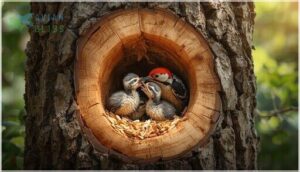
Understanding how woodpeckers raise their young reveals some of their most fascinating behaviors. From excavating nest cavities to timing their breeding with food availability, these birds have evolved impressive strategies for successful reproduction.
Let’s explore the key aspects of woodpecker nesting—from construction techniques to seasonal patterns.
Nest Cavity Construction
Woodpeckers are nature’s carpenters, chiseling out fresh nest cavities each breeding season with impressive precision and patience. Using powerful excavation methods, they drill into dead or decaying wood, creating tree cavities with impressive nest architecture.
You’ll find cavity depth usually ranges from 8-24 inches, depending on the woodpecker species. This construction can take 1-6 weeks, and each entrance hole is perfectly sized to exclude predators while welcoming their young.
Preferred Nesting Trees
Once they’ve mastered the art of excavation, these skilled drillers show surprising preferences regarding selecting their construction sites. Utah woodpeckers favor dead trees and snags with moderate wood decay—soft enough to excavate but sturdy enough to protect nesting cavities.
You’ll spot them in diverse forest habitats with varying forest density, from aspen groves to ponderosa pines, where habitat diversity aids their nesting and breeding needs throughout tree species-rich landscapes.
Breeding Seasons and Migration
After establishing their nesting sites, you’ll find most Utah woodpeckers breeding from April through September, with Red-naped Sapsuckers concentrating nests in May through July.
Migration patterns vary by species—Williamson’s Sapsuckers and Lewis’s Woodpeckers migrate south for winter, while Hairy Woodpeckers remain year-round.
These seasonal movements and nesting cycles directly impact fledging success and when you’ll spot different species.
Seasonal Patterns and Migration
Utah’s woodpeckers don’t all follow the same calendar—some stick around year-round while others treat the state like a seasonal vacation spot.
Understanding these patterns helps you know when and where to look for specific species.
Let’s break down which birds are residents, which are just passing through, and when you’re most likely to spot them in action.
Resident Vs. Migratory Species
Utah’s woodpeckers break down into two migration patterns you’ll want to understand. Resident species like Downy and Hairy Woodpeckers stick around year-round, while migratory breeders such as Red-naped and Williamson’s Sapsuckers head south each fall.
Northern Flickers show fascinating behavioral adaptations—some stay put while others migrate, creating shifting population dynamics that shift with Utah’s seasons and habitat preferences.
Best Seasons for Observation
You’ll catch Utah woodpeckers at their most visible during spring migration and summer breeding, when territorial drumming echoes through the forests. Here’s when seasonal activity peaks across the state:
- Spring (March-May): Lewis’s Woodpeckers arrive, Red-naped Sapsuckers defend territories
- Summer (June-August): Family groups increase, flycatching activity surges
- Autumn (September-November): Flocking concentrations at oak and pine sites
- Winter (December-February): Downy and Northern Flicker residency shines against snow
- Early mornings year-round: Peak foraging and drumming windows
Migratory Routes in Utah
Utah’s migratory woodpeckers follow north–south pathways through the Rockies and Great Basin, preferring interior corridors over coastal routes. Species like the Red-naped Sapsucker and Northern Flicker exhibit seasonal elevational shifts, moving from high-elevation breeding sites to winter valleys in pursuit of insects and sap. These movements peak during April and May northbound and August through October southbound, making elevational changes more defining of Utah’s bird migration patterns than transcontinental flyways.
| Species | Primary Route |
|---|---|
| Red-naped Sapsucker | Rocky Mountain north–south axis |
| Northern Flicker | Montane to lowland elevational |
| Lewis’s Woodpecker | Interior West regional corridors |
| Williamson’s Sapsucker | Southwestern downslope movements |
Ecological Importance of Woodpeckers
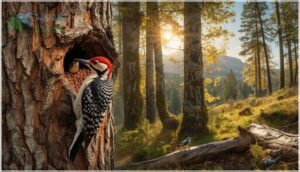
Woodpeckers aren’t just fascinating birds to watch—they’re essential workers in Utah’s forests and ecosystems. These birds control insect populations, create homes for dozens of other species, and maintain the health of woodland habitats in ways you mightn’t expect.
Let’s explore three key roles woodpeckers play in keeping Utah’s natural landscapes thriving.
Pest Control in Forests
Think of these birds as your forest’s built-in pest squad, working around the clock to keep trees healthy. Woodpeckers excel at pest regulation, especially when bark beetle populations threaten forest health and increase tree mortality. Their ecological role in maintaining ecosystem balance includes:
- Targeting mountain pine beetle and spruce beetle larvae hidden beneath bark
- Reducing western pine beetle survival rates in infested stands
- Consuming emerald ash borer adults before they spread
- Helping return epidemic beetle populations to manageable levels
- Supporting wildlife management goals through natural pest control
You’ll notice their handiwork by the bark flakes scattered at tree bases—evidence of their tireless forest ecology service.
Creating Nesting Cavities for Other Birds
Woodpeckers don’t just feed themselves—they’re nature’s carpenters, drilling out cozy homes that dozens of other bird species will later claim as their own.
In Utah, tree cavity creation by woodpeckers becomes prime real estate for bluebirds, chickadees, and even owls. These secondary cavity nesters depend entirely on abandoned woodpecker holes for nesting site selection, making cavity maintenance tips essential for bird conservation and wildlife habitat protection across the state.
Role in Utah Ecosystems
Beyond simply building homes, these feathered architects reshape entire landscapes through ecosystem engineering and habitat modification.
In Utah’s forests, woodpeckers influence forest regeneration by controlling insect pests like bark beetles, creating decay that speeds snag formation, and establishing wildlife interactions that ripple through food webs.
Their work maintains ecological balance, making conservation of woodpeckers essential for preserving wildlife habitat across the state’s diverse terrain.
Conservation Status and Protection
Good news: most woodpeckers in Utah aren’t struggling to survive right now. But like all wild birds, they face real threats—from disappearing habitat to climate shifts—that could change their story.
Understanding what protects them today helps you become part of keeping these fascinating birds drumming through Utah’s forests tomorrow.
Threats to Woodpecker Populations
Even protected by law, your favorite Utah woodpeckers face mounting pressures that test their survival. Here’s what’s stacking up against them:
- Habitat fragmentation isolates populations, leaving birds vulnerable when forests are carved into disconnected patches
- Climate shift drives extreme fires and storms that destroy nesting trees faster than birds can adapt
- Disease impact from West Nile virus has slashed Downy Woodpecker survival across North America
- Forest degradation through logging removes the dead snags these cavity nesters desperately need
- Human activities like postfire salvage operations can cut nesting density by 40 percent
Lewis’s Woodpeckers have declined regionally as open pine habitats vanish, while aspen stands critical for breeding have shrunk 90 percent in some areas.
These threats don’t work alone—they compound, squeezing Utah wildlife habitat from multiple angles and disrupting the ecological balance these exceptional birds help maintain.
Conservation Efforts in Utah
Fortunately, conservation groups across the state aren’t standing idle while these threats pile up—they’re rolling out targeted programs to protect woodpecker habitat before it’s too late. Utah’s ecosystem management initiatives now prioritize habitat preservation through snag retention policies and prescribed burns that mimic natural fire cycles.
Species monitoring projects track nesting success across Wildlife in Utah landscapes, while environmental conservation partnerships restore essential aspen groves and ponderosa pine stands these birds depend on.
Legal Protections and Regulations
All that habitat work means nothing without teeth, which is where federal laws come in. The Migratory Bird Treaty Act shields every native woodpecker in Utah, making it illegal to harm birds or nests without wildlife permits. Here’s what regulatory compliance looks like:
- Migratory protections cover all species regardless of conservation status
- Property owners need federal authorization before removing problem woodpeckers
- Active nests can’t be disturbed during breeding season
- Environmental protection applies on private and public land alike
- Violations carry fines up to $15,000
These environmental conservation rules guarantee wildlife in Utah gets real protection, not just good intentions.
Attracting Woodpeckers to Your Utah Yard
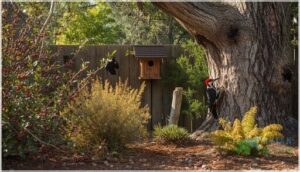
Turning your Utah yard into a woodpecker haven doesn’t require a forestry degree—just a few smart choices that mimic what these birds need in the wild.
You’ll want to focus on the right food sources, suitable nesting spots, and native plants that create a naturally inviting space.
Let’s break down the essentials that’ll have woodpeckers drumming at your door.
Best Foods and Feeders
Your feeder setup can make or break Woodpecker visits. High Energy Foods like peanut-enriched Suet Types pull in Downy and Hairy Woodpeckers year-round, while Northern Flickers favor platform designs loaded with sunflower seeds.
Peanut Feeders with tail props mimic natural Feeding Behaviors, and mesh designs let birds hammer nuts just like tree bark—transforming Bird Watching in Utah into front-row ornithology.
Providing Nesting Sites
If you want Utah birds hammering out their family drama in your yard, snag retention is your secret weapon—leave dead trees standing for natural cavity creation.
Nest box designs matter too: interior dimensions mimic wild spaces, and entrance holes keep out pushy avian species.
Smart tree selection and scattered nesting materials invite breeding and nesting right where you can watch the action unfold.
Landscaping With Native Plants
Your yard can break free from sterile lawns and become a rebel outpost for Utah birds when you embrace native plant selection. Wildlife gardening with regional species delivers ecological conservation wins:
- Gambel oak and pinyon pine fuel insect populations woodpeckers crave
- Mountain mahogany and chokecherry extend seasonal food resources
- Vertical layering with shrubs and trees mimics natural forest structure
- Drought-tolerant natives slash irrigation while boosting biodiversity
Sustainable yard practices meet bird-friendly designs head-on.
Creating a Woodpecker-Friendly Habitat
Think of your property as a stage where woodpeckers perform their daily routines—the trick is setting up the right props and scenery to keep them coming back for encores.
Your backyard design combines native plant selection with strategic woodpecker feeders and bird-friendly trees for habitat restoration that matters.
| Habitat Element | What to Provide | Utah Woodpecker Benefit |
|---|---|---|
| Dead Standing Trees | Leave snags 10+ feet tall | Natural foraging and nesting cavities |
| Woodpecker Feeder Stations | Suet cakes, peanuts | Year-round food security |
| Water Features | Shallow birdbaths, drippers | Drinking and bathing spots |
Ecological conservation meets bird watching gold when you create a layered forest structure—this habitat restoration approach transforms ordinary yards into woodpecker havens.
Frequently Asked Questions (FAQs)
What does a Utah woodpecker look like?
Picture a living checkerboard clinging to bark—that’s the essence of Utah woodpeckers. Most species sport bold black-and-white plumage patterns with crimson accents on their heads, though Northern Flickers display brownish tones.
How many woodpeckers are in Utah?
You’ll encounter eight distinctive woodpecker species across Utah’s diverse landscapes. This impressive avian diversity spans from mountain forests to red rock deserts, with each species showcasing unique adaptations that reflect the state’s outstanding ecological variety.
Is it good to have woodpeckers around?
Holes in trees seem destructive—yet they’re portals to thriving ecosystems. Woodpeckers deliver remarkable ecological benefits through pest management, biodiversity enhancement, and ecosystem engineering.
Their presence strengthens nature preservation efforts and bolsters Utah’s environmental health beautifully.
What is the rarest type of woodpecker?
In Utah birding circles, the American Three-toed Woodpecker stands out as the rarest species you’ll encounter. This endangered woodpecker specialist haunts high-elevation conifer forests, earning its rare species designation through exceptionally limited distribution and conservation concern.
What woodpecker species migrate through Utah seasonally?
Several species show seasonal movements through Utah’s flyways. Northern Flickers and Red-naped Sapsuckers make migratory routes between breeding and wintering grounds, while Lewis’s and Williamson’s Sapsuckers perform altitudinal migrations, moving between elevations seasonally.
How do woodpeckers choose their nesting sites?
Woodpeckers select nesting sites by evaluating tree decay, diameter, and height—favoring softer heartwood for easier excavation while maintaining structural integrity.
They also consider predation risk, cavity orientation for thermal regulation, and surrounding forest structure with adequate snag density.
What foods attract woodpeckers to backyard feeders?
High-energy suet feeders paradoxically outperform natural insect supplies in winter.
You’ll attract Northern Flicker and other Utah woodpeckers with peanut products, sunflower seeds, high fat foods, and mealworm options mimicking their natural diet and foraging preferences.
When is peak woodpecker breeding season?
Most breeding activity runs from late April through early July, with May and June representing peak nesting across Utah. RedNaped Sapsucker and other migratory woodpeckers follow these breeding patterns closely.
Which woodpeckers are most common in cities?
Who knew city life could be so appealing to woodpeckers? Northern Flickers and Downy Woodpeckers dominate urban woodpecker sightings in Utah, thriving in city park habitats and woodpecker-friendly yards with mature trees.
Do woodpeckers damage healthy trees in Utah?
Good news—woodpeckers usually zero in on trees already battling insect infestations or disease.
Healthy, vigorous trees rarely suffer serious damage in Utah, since these birds naturally target weakened specimens for foraging and nesting cavities.
Conclusion
Like John Muir discovering that “when we try to pick out anything by itself, we find it hitched to everything else,” the woodpeckers of Utah reveal forests as interconnected webs where every drumbeat matters.
You’ve now got the field marks, habitat clues, and feeder strategies to welcome these engineering marvels into your awareness—and maybe your yard.
Step outside. Listen for that staccato rhythm. Your nearest woodpecker is already rewriting the forest around you.