This site is supported by our readers. We may earn a commission, at no cost to you, if you purchase through links.

Wisconsin hosts ten woodpecker species—more than most people realize when they spot what they assume is "that black-and-white bird" hammering away at a backyard oak.
From crow-sized Pileated with its flaming red crest to the sparrow-small Downy that barely tips the scale at a third of an ounce, these birds carve out remarkably different lives across the state’s forests, suburbs, and fire-scarred north woods.
Some, like the ghostly Black-backed Woodpecker, only show up where catastrophe has struck—burned conifer stands that most birders never think to visit.
Whether you’re trying to name what’s raiding your suet feeder or planning a trip up to Bayfield County to find something rarer, knowing your Wisconsin woodpeckers makes every sighting sharper.
Table Of Contents
- Key Takeaways
- Wisconsin Woodpecker Species List
- Seasonal and Rare Wisconsin Woodpeckers
- Wisconsin Woodpecker Identification Tips
- Where Wisconsin Woodpeckers Live
- Attracting Woodpeckers in Wisconsin
- Frequently Asked Questions (FAQs)
- What is the most common woodpecker in Wisconsin?
- Are woodpeckers good to have in your yard?
- What does it mean if a woodpecker is pecking my house?
- What will keep woodpeckers away from your house?
- What is the rarest woodpecker in Wisconsin?
- Do woodpeckers stay in Wisconsin in the winter?
- When are woodpecker migration patterns typically observed?
- How do woodpeckers impact local ecosystems in Wisconsin?
- Are there any festivals celebrating woodpeckers in Wisconsin?
- How can residents report rare woodpecker sightings in Wisconsin?
- Conclusion
Key Takeaways
- Wisconsin hosts ten woodpecker species ranging from the sparrow-sized Downy to the crow-sized Pileated, each filling a surprisingly specific ecological niche based on habitat, diet, and body size.
- Disturbance habitats like recently burned conifer forests are woodpecker hotspots—the Black-backed Woodpecker, for instance, zeros in on charred snags within weeks of a fire to chase surging bark beetle populations.
- You can reliably tell species apart in the field using just a few quick clues—bill length, crown color, rump markings, and distinctive calls—without needing advanced equipment or expertise.
- Leaving dead trees standing and planting native oaks or maples does more for backyard woodpecker activity than any feeder setup, because the insects living in that wood are what these birds are actually after.
Wisconsin Woodpecker Species List
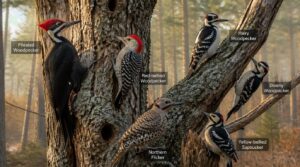
Wisconsin is home to nine woodpecker species, but six of them stick around all year long, drumming away in your backyard no matter the season. You’ll spot them in forests, suburbs, and maybe even your own backyard feeder if you know what to look for. Here’s a rundown of the year-round residents you’re most likely to meet.
Wisconsin’s birds go way beyond woodpeckers — if you’re curious what else is out there, Wisconsin waterfowl and water birds are just as worth exploring year-round.
Downy Woodpecker
The Downy Woodpecker (Dryobates pubescens) is the smallest woodpecker in North America, measuring just 5.5 to 6.7 inches long, yet it’s probably the one you’ll spot first at your bird feeder.
Males carry a small red nape patch, while females don’t — a quick, reliable clue for woodpecker identification.
Both sexes show a crisp black-and-white pattern and forage actively for bark-boring insects year‑round.
In winter, they often join mixed-species flocks.
Hairy Woodpecker
Mistake the Hairy Woodpecker (Dryobates villosus) for its smaller cousin? Easy—its bill nearly equals head length, the key woodpecker identification trick.
- Hammers bark for beetles and larvae
- Excavates clean nest cavities in dead wood
- Males show a red nape patch; females don’t
- Juveniles look slightly smaller, duller crowned
Across Wisconsin forests, that bill length comparison settles bird identification debates fast.
Pileated Woodpecker
If the Hairy Woodpecker impressed you, the Pileated Woodpecker (Dryocopus pileatus) is on another level entirely — Wisconsin’s largest woodpecker, stretching 16–19 inches, with a blazing red triangular crest that makes identification instant.
It hammers rectangular cavities into dead trees, hunting carpenter ants, and its loud, echoing drumming signals a genuinely healthy, mature forest.
Red-bellied Woodpecker
After the Pileated’s dramatic size and crest, the Red-bellied Woodpecker (Melanerpes carolinus) offers a subtler kind of charm.
Sexual dimorphism here is easy to spot: males wear red from crown to nape, while females show red only on the nape.
Its bold zebra-like black-and-white barring across the back is the fastest field mark you’ll find.
Northern Flicker
The Northern Flicker (Colaptes auratus) is perhaps Wisconsin’s most surprising woodpecker — one that spends more time on the ground than in trees, probing soil for ants with its curved bill.
You’ll know it by its white rump flash in flight, spotted brown plumage, and yellow wing shaft color in eastern birds.
This ground-foraging ant-eater couldn’t be more different from its fire-chasing cousin, yet both make appearances in this rundown of Michigan’s most distinctive woodpecker species.
Males also display a bold black mustachial stripe.
Seasonal and Rare Wisconsin Woodpeckers
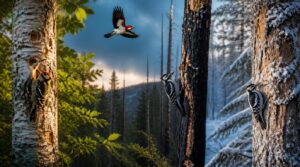
Not every woodpecker you spot in Wisconsin sticks around all year — some are seasonal visitors, some are specialists tied to very specific habitats, and at least one is an accidental wanderer that has no real business being here.
Wisconsin hosts a fascinating mix of these less predictable species, from summer breeders to northern forest specialists rarely seen south of the boreal zone.
Here’s a closer look at five woodpeckers that make Wisconsin birding genuinely exciting and a little unpredictable.
Red-headed Woodpecker
The Red-headed Woodpecker is one of Wisconsin’s most visually striking seasonal visitors — and honestly, once you’ve seen that solid crimson head against a jet-black back and crisp white belly, you won’t forget it.
Unlike many woodpeckers with just a red patch or streak, this species wears its color wall-to-wall, making it the only Wisconsin woodpecker with a fully red head.
Yellow-bellied Sapsucker
If you’ve ever spotted what looked like a Downy or Hairy Woodpecker with a surprisingly bold red cap and a barred black-and-white back, there’s a good chance you were looking at a Yellow-bellied Sapsucker — one of Wisconsin’s most fascinating seasonal migrants, drilling neat rows of sap wells into birch and maple bark with its brush-tipped tongue.
Black-backed Woodpecker
The Black-backed Woodpecker is fundamentally nature’s first responder after a forest fire — showing up in recently burned conifer forests within weeks, drawn by the explosion of wood-boring beetle larvae tunneling beneath charred bark.
You’ll find this year-round northern resident foraging on large blackened snags, peeling away bark to reach the beetle galleries hidden inside.
American Three-toed Woodpecker
The American Three-toed Woodpecker is a fascinating, somewhat secretive resident of Wisconsin’s northernmost boreal forests, quietly foraging on spruce and fir snags where beetle larvae tunnel beneath the bark.
- Three toes instead of four — genuinely unusual among North American woodpeckers
- Males sport a yellow crown patch during breeding season
- Diet centers almost entirely on bark beetle larvae
- Favors forests hit by beetle outbreaks
Rare Lewis’s Woodpecker Sightings
If you’re a birdwatcher with a taste for the unexpected, Lewis’s Woodpecker is Wisconsin’s rare gem unicorn — a western species that occasionally drifts into the state during late fall migration, often between September and November, moving through riparian corridors and open woodland edges where acorns and standing dead trees provide a temporary foothold.
Wisconsin Woodpecker Identification Tips
Once you know which woodpeckers call Wisconsin home, the next challenge is actually telling them apart in the field. Fortunately, a handful of reliable clues — size, head color, bill shape, wing markings, and sound — make identification much more manageable than you’d expect. Here’s what to look for with each one.
Size and Body Shape
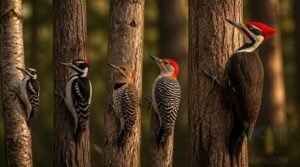
Size is one of your quickest clues in the field. The Downy Woodpecker, at just 6–7 inches, has a compact, short-necked body built for quick vertical scrambling, while the Hairy Woodpecker stretches to 9–10 inches with a noticeably longer bill — nearly as long as its head — giving it a more elongated profile.
- Pileated Woodpecker: 16–19 inches, rectangular body, long stiff tail for heavy-duty wood-ripping
- Northern Flicker: slender at 10–11 inches, slim-winged for fast flight and ground foraging
- Red-bellied Woodpecker: stout, rounded torso at 9–10 inches, balanced tail for vertical bark work
- Downy vs. Hairy: same pattern, but bill length instantly separates them
Body mass shapes foraging silhouette too — the Pileated’s pillar-like stance during flight looks nothing like a Downy’s choppy, bouncing wingbeats between trunks.
Head and Crown Colors
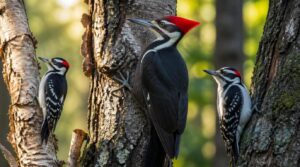
Once you’ve sized up a woodpecker, crown and head color becomes your next reliable shortcut.
Male Downy and Hairy Woodpeckers both sport a small, bright red patch on the nape — females have none, making sex identification surprisingly straightforward.
The Pileated’s red crest, blazing from forehead to nape in both sexes year‑round, is unmistakable.
Bill Length Differences
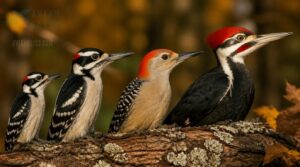
Bill length is the next clue worth adding to your toolkit — and it’s surprisingly useful once you know what to look for.
- Downy: 13–15 mm — short, stubby, perfect for probing small crevices
- Hairy: 25–32 mm — nearly as long as its head, the key Hairy Woodpecker separator
- Red-bellied: 20–30 mm — a chisel-like middle ground
- Pileated: 40–50 mm — projects visibly beyond the face
- Bill length = foraging niche — longer bills reach deeper larvae
Wing and Rump Marks
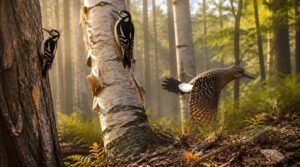
Once you’ve clocked a bird’s bill, your eyes naturally drift to the wings and rump — and that’s where things get genuinely interesting.
White wing patches on Downy and Hairy Woodpeckers appear as neat bars across the folded wing, while the Pileated flashes broad white patches, visible even mid‑flight.
The Northern Flicker’s white rump patch practically glows against its barred brown back.
Calls and Drumming Sounds
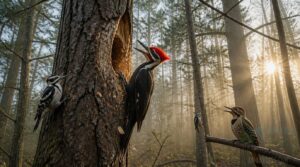
Sound is perhaps your sharpest ID tool in dense Wisconsin woods, where a clear sightline is rarely guaranteed.
- Pileated’s loud shriek cuts through forest noise like a warning siren
- Downy and Hairy’s whinnying calls sound nearly identical but differ subtly in pitch
- Northern Flicker’s "wicka-wicka" whistle is instantly recognizable during spring courtship
Drumming peaks in spring, when territorial displays intensify at dawn.
Where Wisconsin Woodpeckers Live
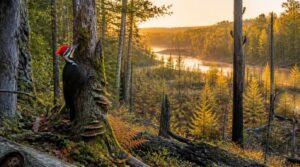
Wisconsin’s woodpeckers aren’t scattered randomly across the state — each species has carved out its own niche, shaped by the trees, fire history, and food sources available in a given area. Knowing where to look makes spotting them so much easier, and honestly, a lot more satisfying.
Here’s a breakdown of the key habitats you’ll want to explore.
Northern Conifer Forests
Wisconsin’s northern conifer forests — the boreal stretches of spruce, fir, and tamarack blanketing counties like Bayfield and Ashland — are fundamentally a woodpecker paradise built on disturbance.
Black-backed Woodpeckers zero in on recently burned stands, where fire opens the canopy and sends wood-boring insect populations skyrocketing.
The Yellow-bellied Sapsucker breeds here too, favoring young birch and maple mixed into the conifers.
Mature Mixed Woodlands
Mature mixed woodlands — think towering oaks beside balsam fir, with red maple and yellow birch filling the gaps — are where vertical habitat complexity really shines for woodpeckers.
Multiple canopy layers, from saplings to veteran giants, mean foraging opportunities at every height, making these stands magnets for Downy, Hairy, and Pileated Woodpeckers year-round.
Burned Forest Habitats
Few habitats rival the productivity of a recently burned forest for woodpeckers — it’s fundamentally a buffet that nature set on fire.
A recently burned forest isn’t a tragedy for woodpeckers — it’s a buffet nature set on fire
Post-fire insect surges, especially bark beetles and wood-borers swarming charred wood, draw species like the Black-backed Woodpecker, which specializes almost exclusively in these scorched northern stands, foraging on beetle larvae tucked beneath blackened bark.
Suburban Trees and Orchards
Your backyard might be doing more wildlife work than you realize.
Suburban trees and orchards, with their canopy layering and mix of native and ornamental species, create surprisingly rich microhabitats that attract Downy, Hairy, and Red-bellied Woodpeckers year-round — especially where native oaks and maples support the wood-boring insects these birds depend on.
Breeding and Migration Ranges
Breeding and migration ranges in Wisconsin shift dramatically by species — six woodpeckers stay year-round, while others like the Red-headed Woodpecker vanish completely after summer.
Territorial singing peaks in early June, drumming crescendos as males defend cavities they’ll often reoccupy the following year.
Juveniles usually disperse within regional woodlands rather than crossing large distances, keeping populations tightly connected to local habitat quality.
Attracting Woodpeckers in Wisconsin
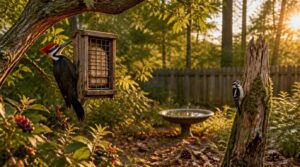
Getting woodpeckers to visit your yard in Wisconsin is more straightforward than you might think. A few simple changes to your outdoor setup can turn your backyard into a regular stop for Downys, Hairies, and even the impressive Pileated. Here’s what actually works.
Best Woodpecker Feeders
Choosing the right feeder makes a real difference. Tail prop suet cages give larger woodpeckers, like Pileateds, a vertical platform to brace against while feeding.
Squirrel-proof, weight-sensitive designs keep interference low.
Mount feeders at chest height on sturdy poles, slightly shaded to slow suet melt.
Galvanized steel or powder-coated frames handle Wisconsin’s freeze-thaw winters without cracking or rusting.
Suet and Peanut Foods
Once your feeder is set up, what you put in it matters just as much. Suet blocks are the preferred choice for Wisconsin woodpeckers — a high‑fat fuel source that helps birds like Downy and Hairy Woodpeckers stay warm through brutal cold snaps.
Look for blends combining rendered beef fat with peanuts, which pack in protein, essential fatty acids, and dense calories all at once.
Bird Baths for Woodpeckers
Food isn’t the only thing drawing woodpeckers to your backyard — water matters too. A good bird bath placed near your bird feeding stations can genuinely boost activity.
Aim for 1.5 to 2.5 inches of water depth, use a rough-textured basin for grip, and swap the water daily. Winter freezing is a real problem, so partial refills help maintain liquid depth on cold days.
Snags and Dead Trees
Beyond water, one of the most powerful things you can do is leave dead trees standing.
Snags — those bare, weathered trunks — go through decay stages over 5 to 30 years, softening gradually until woodpeckers like Pileated and Black-backed can excavate nesting cavities with ease, while the rotting wood hosts the bark beetles and wood-boring insects, they’re constantly hunting.
Native Trees and Insects
Planting native trees is like setting a table that never goes empty. Oaks alone host hundreds of insect species — caterpillars, beetle larvae, the works — while maples attract sap‑feeding beetles, pines draw bark beetles that woodpeckers actively hunt, and ash trees develop woodborer galleries that become foraging hotspots.
Skip the pesticides, and you’ll keep that insect buffet fully stocked year‑round.
Frequently Asked Questions (FAQs)
What is the most common woodpecker in Wisconsin?
The Downy Woodpecker holds that title easily — it’s the smallest and most widespread resident species, spotted year-round in backyards, suburbs, and forests alike, making it Wisconsin’s most commonly observed woodpecker.
Are woodpeckers good to have in your yard?
Absolutely—woodpeckers boost backyard biodiversity, controlling insect populations like ants and beetles while their cavities become homes for bluebirds and wrens. Add suet feeders and you’ll enjoy great birdwatching while pests stay naturally in check.
What does it mean if a woodpecker is pecking my house?
A woodpecker hammering your house is usually sending one of four messages: territorial drumming, hunting for wood-boring insects, excavating a nesting cavity, or seeking shelter — and repeated damage can signal a hidden insect infestation worth investigating.
What will keep woodpeckers away from your house?
A few reliable options: block access with netting, apply deterrent coatings, seal entry points, use reflective or motion-triggered visual deterrents, and reduce nearby food sources or dead wood that attract them.
What is the rarest woodpecker in Wisconsin?
That title goes to the Black-backed Woodpecker, tied to northern boreal forests and burned habitat, with such low population density that only a handful of confirmed sightings turn up yearly across Wisconsin’s far north.
Do woodpeckers stay in Wisconsin in the winter?
Far from fleeing south like sun‑chasing snowbirds, most species—Downy, Hairy, Red‑bellied, Northern Flicker, Pileated—stay put year‑round, relying on winter foraging, facultative migration, and tough cold‑weather survival skills to endure Wisconsin’s harshest winter months.
When are woodpecker migration patterns typically observed?
Autumn migration runs late September through November, while spring arrivals usually span March through May. Weather and food shortages drive timing, though many resident species simply shift short distances rather than leaving Wisconsin entirely.
How do woodpeckers impact local ecosystems in Wisconsin?
Woodpeckers are quiet engineers of forest health — drilling cavities used by over 80 species, suppressing bark beetles, redistributing nutrients, and creating microhabitats in dead snags that entire communities depend on.
Are there any festivals celebrating woodpeckers in Wisconsin?
Wisconsin actually punches above its weight here. Ashland’s Chequamegon Bay Birding Festival and Rhinelander’s Northwoods Wildlife Festival both feature guided woodpecker tours, while Madison and state parks host seasonal birding walks.
How can residents report rare woodpecker sightings in Wisconsin?
Spot something unusual? Submit your sighting on eBird, noting the date, county, and exact location. Attach photos or audio if you can — the Wisconsin Society for Ornithology reviews rare reports quarterly.
Conclusion
The theory that woodpeckers are just background noise in Wisconsin’s forests falls apart the moment you actually start watching them. Every species you’ve read about here occupies a surprisingly specific niche—size, habitat, food source, even disaster preference. Woodpeckers in Wisconsin aren’t interchangeable; they’re a layered system, each bird filling a role no other can.
Set up that suet feeder, leave the dead oak standing, and see exactly how right that turns out to be.
- https://www.birdfact.com/articles/woodpeckers-in-wisconsin
- https://birda.org/bird-identification-wisconsin-everything-you-need-to-know
- https://theornithologist.org/is-woodpecker-drumming-more-than-noise
- http://www.wisconsinbirds.org/plan/species/piwo.htm
- https://a-z-animals.com/blog/woodpeckers-in-wisconsin-pictures-id-guide-and-common-locations