This site is supported by our readers. We may earn a commission, at no cost to you, if you purchase through links.
A robin building her nest three feet from your students’ faces changes everything about a science lesson. No worksheet captures that—the tiny beak arranging twigs, eggs appearing overnight, chicks demanding food with wide-open mouths.
Window-mounted birdhouses bring that magic right into your classroom, turning an ordinary window into a live nature documentary.
But not every birdhouse works well in a school setting.
You need clear visibility, easy mounting, and something tough enough to handle weather and curious hands.
These nine picks cover window-mounted options for observation and DIY kits your students can actually build.
Table Of Contents
- Key Takeaways
- 9 Best Birdhouses for Teachers and Classrooms
- 1. LEOSYY Clear View Wooden Birdhouse
- 2. Transparent Wooden Window Birdhouse
- 3. Wooden See Through Window Birdhouse Suction Cup
- 4. MOBYKE Wooden Clear Window Birdhouse
- 5. LotFancy DIY Wooden Birdhouse Kit
- 6. Beetle Bee Kids Outdoor Birdhouse Kit
- 7. Pontuss Cedar Birdhouse DIY Kit
- 8. The Genius of Birds Book
- 9. Kids DIY Wooden Birdhouse Craft Kit
- Choosing a Window-Mounted Birdhouse for Classroom Observation
- Choosing DIY Birdhouse Kits for Classroom Projects
- How Classroom Birdhouses Support Science Curriculum
- Installing and Maintaining Classroom Birdhouses Year-Round
- Frequently Asked Questions (FAQs)
- Where not to put a birdhouse?
- What time of year should you put up a bird box?
- What birds do not use birdhouses?
- Can birdhouses be shared between multiple classrooms?
- What birds are best for urban school settings?
- How do teachers grade birdhouse observation projects?
- Are window birdhouses suitable for indoor classrooms?
- Do birdhouses require school administrator approval first?
- Conclusion
Key Takeaways
- Window-mounted birdhouses with clear panels turn your classroom into a live science lab, letting students watch nesting, hatching, and feeding happen right in front of them.
- DIY birdhouse kits like LotFancy and Beetle & Bee give kids a hands-on project that builds fine motor skills, creativity, and a real connection to wildlife — all in one class period.
- Choosing the right birdhouse means checking for durable wood like cedar, weather-resistant hardware, and an entrance hole sized for small birds like wrens, chickadees, or bluebirds.
- Keeping your birdhouse working year-round is simple: clean it at the end of each nesting season, check the mounting hardware, and store any removable panels indoors during harsh weather.
9 Best Birdhouses for Teachers and Classrooms
Whether you want a window-mounted house for live observation or a hands-on kit for a building project, there’s something here for every classroom.
For a deeper look at options that fit different grade levels and budgets, this guide to wild bird feeders for school classrooms breaks down what actually works in a learning environment.
These nine picks cover a range of styles, skill levels, and learning goals.
Let’s take a closer look at each one.
1. LEOSYY Clear View Wooden Birdhouse
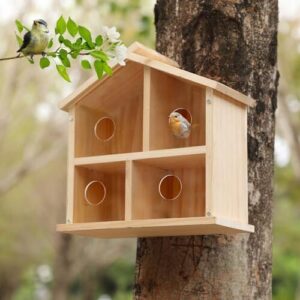
The LEOSYY Clear View Wooden Birdhouse is a quiet winner for any classroom window. Its carbonized wood finish withstands outdoor weather well, and the transparent viewing panel lets your students watch nesting activity without disturbing the birds inside.
Bluebirds, wrens, and chickadees are all welcome here.
It mounts easily with two hooks, so setup takes minutes. At just over two pounds, it’s light enough to reposition if needed.
One thing to note: the plastic panel can crack near the screws, so handle it gently.
| Best For | Teachers, parents, and nature-curious families who want a front-row seat to backyard bird life without spending much time on setup. |
|---|---|
| Material | Solid wood |
| Price | Not listed |
| Recommended Age | All ages |
| Assembly Required | No |
| Quantity Included | 1 |
| Outdoor Use | Yes |
| Additional Features |
|
- The clear viewing panel makes it genuinely fun to watch birds nest up close — great for kids.
- Carbonized wood holds up well outdoors, so it won’t fall apart after a few rainy weeks.
- Two-hook mounting means you can have it on your window in minutes, no tools required.
- The plastic panel can crack near the screws if you’re not careful during setup or cleaning.
- It’s on the small side, so don’t expect larger birds to move in.
- No built-in perch, which might make it harder to attract birds in the first place.
2. Transparent Wooden Window Birdhouse
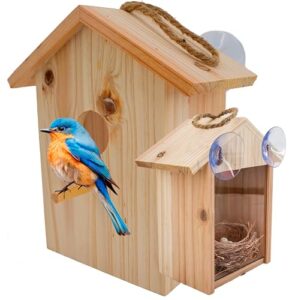
If you’re searching for a birdhouse that brings nature right to your classroom window, the Transparent Wooden Window Birdhouse fits the bill. Its clear viewing panel lets your students observe finches, wrens, or chickadees up close.
The sturdy wood frame and hook mounting make it easy to hang and reposition.
Cleaning is simple—just slide out the panel.
For teachers, this birdhouse offers a gentle way to spark curiosity and connect lessons to real-life science, all without disturbing the birds.
| Best For | Teachers, parents, and bird lovers who want an up-close look at backyard birds without stepping outside. |
|---|---|
| Material | Cedar wood |
| Price | $12.95 |
| Recommended Age | All ages |
| Assembly Required | No |
| Quantity Included | 1 |
| Outdoor Use | Yes |
| Additional Features |
|
- The clear viewing panel lets you watch birds nesting and moving around without disturbing them at all.
- Super easy to set up — stick it to a window with suction cups or hang it from a branch, and you’re done.
- Slide-out panel makes cleaning quick and painless, so upkeep doesn’t become a chore.
- The entrance hole is sized for small birds only, so don’t expect cardinals or blue jays to move in.
- Suction cups can lose their grip in cold weather or wind, which could be a problem in harsh climates.
- The wood isn’t fully weatherproofed, so leaving it out through rough winters may shorten its lifespan.
3. Wooden See Through Window Birdhouse Suction Cup
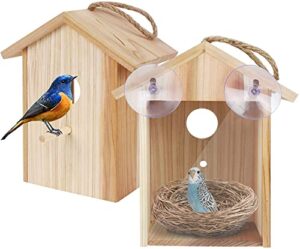
Want something even easier to set up? The Wooden See Through Window Birdhouse with suction cups is made for that.
Just press the two rubber cups onto clean glass, and you’re done — no tools, no drilling.
The clear acrylic panel gives your students a real front-row seat to watch bluebirds, wrens, or chickadees settle in.
When nesting season ends, the removable panel makes cleaning simple.
At around $20, it’s a practical pick for any classroom budget.
| Best For | Teachers, parents, and curious kids who want a close-up look at nesting birds without complicated setup. |
|---|---|
| Material | Solid wood with acrylic |
| Price | $20.89 |
| Recommended Age | All ages |
| Assembly Required | No |
| Quantity Included | 1 |
| Outdoor Use | Yes |
| Additional Features |
|
- Suction cup mount goes up in seconds — no tools, no holes in the wall
- Clear acrylic panel lets you watch birds up close without disturbing them
- Easy to pop off, clean, and put back when the season’s done
- Suction cups can lose grip in cold or wet weather, so a backup rope is smart
- Birds might still see you through the window — it’s not true one-way glass
- No guarantees any birds will actually move in
4. MOBYKE Wooden Clear Window Birdhouse
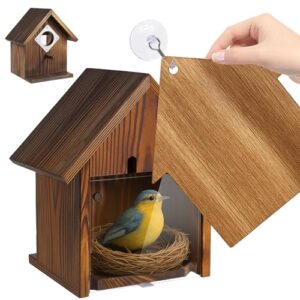
If you’re seeking visibility, the MOBYKE Wooden Clear Window Birdhouse delivers. Its stainless-steel predator guard ensures nest safety, while the transparent front panel offers students an unobstructed, close-up view of nesting activity without disturbing the birds.
At $23.99, this budget-friendly option includes adhesive hooks for effortless hanging. The built-in perch stick adds a charming detail that kids particularly enjoy observing birds use.
To keep it in top shape for years of backyard birding, these birdhouse maintenance and upkeep tips will help you protect your investment season after season.
| Best For | Families, students, and curious bird lovers who want a front-row seat to nesting activity without spending a lot. |
|---|---|
| Material | Heavy-burnt wood |
| Price | $23.99 |
| Recommended Age | All ages |
| Assembly Required | No |
| Quantity Included | 1 |
| Outdoor Use | Yes |
| Additional Features |
|
- The clear window gives you an actual view inside—great for watching eggs hatch and chicks grow up close.
- The stainless-steel guard helps keep predators out, so nesting birds have a real shot at success.
- At $23.99 with adhesive hooks included, setup is quick and the price is hard to argue with.
- Birds can be picky—if placement isn’t right, they may never move in.
- The window fogs up and collects debris over time, so expect to clean it regularly to keep the view clear.
- The shade panel is a bit of a trade-off: it helps protect the birds, but it also blocks your view when attached.
5. LotFancy DIY Wooden Birdhouse Kit

The LotFancy DIY Wooden Birdhouse Kit turns a simple craft into a full classroom experience.
Your students get 10 pre-drilled pine pieces, 28 screws, six paint colors, two brushes, and a hanging rope — everything except a Phillips screwdriver. At just $14.99, it’s genuinely affordable for classroom budgets.
Kids practice fine motor skills during assembly, then spark their creativity through painting. Once it’s done, hang it outside and watch it become a real bird shelter.
| Best For | Teachers, parents, and group leaders looking for an affordable, hands-on craft that keeps kids ages 4+ engaged while sneaking in some real skills. |
|---|---|
| Material | Solid pine |
| Price | $14.99 |
| Recommended Age | 4+ years |
| Assembly Required | Yes |
| Quantity Included | 1 |
| Outdoor Use | Yes |
| Additional Features |
|
- Everything’s included except a screwdriver — paints, brushes, rope, screws, and 10 pre-drilled pine pieces, all for $14.99
- Builds fine motor skills and creativity at the same time, from assembly to painting
- Actually functional when you’re done — hang it outside and it works as a real bird shelter
- Pre-drilled holes can misalign, which may cause cracking or frustration during assembly
- Younger kids will likely need adult help, so it’s not fully independent for the 4 crowd
- The wood can warp outdoors over time, and the included paint may dry out if you don’t use it right away
6. Beetle Bee Kids Outdoor Birdhouse Kit
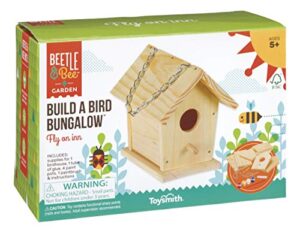
The Beetle & Bee Kids Outdoor Birdhouse Kit is a sweet spot between simple and satisfying. Your students get seven FSC-certified wood pieces, nails, glue, a hanging chain, four paint pots, and a brush — all for just $16.99.
Assembly takes about 30 to 45 minutes, making it perfect for a single class period. The picture-based instructions keep language barriers out of the way.
Once painted and sealed, it hangs outdoors and gives kids a tangible connection to real bird habitats.
| Best For | Teachers, homeschool parents, and families looking for a hands-on craft that gets kids building, painting, and connecting with nature. |
|---|---|
| Material | FSC-certified wood |
| Price | $16.99 |
| Recommended Age | 5+ years |
| Assembly Required | Yes |
| Quantity Included | 1 |
| Outdoor Use | Yes |
| Additional Features |
|
- Everything comes in the box — wood pieces, nails, glue, paint, brush, and a hanging chain — so there’s nothing extra to track down.
- Picture-based instructions mean kids of all language backgrounds can follow along without getting stuck.
- It actually works as a real birdhouse, so kids get to see the payoff when it’s hanging outside.
- The four included paint colors and tiny brush feel pretty limiting if kids want to get creative with their design.
- Aligning the pre-drilled holes and hammering nails can get frustrating fast, so an adult nearby is basically a must.
- It’s lightweight wood, so it may not hold up well through tough weather unless you add a sealant coat yourself.
7. Pontuss Cedar Birdhouse DIY Kit
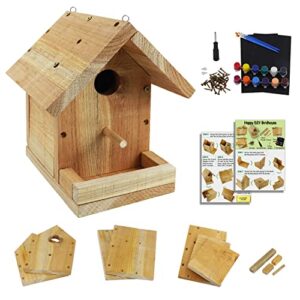
Seven cedar pieces, one screwdriver, and a whole lot of learning — that’s the Pontuss Cedar Birdhouse DIY Kit in short.
At $31.99, it comes with everything your students need: pre-drilled holes, sandpaper, paint strips, rope rings, and even stickers. No power tools required.
Cedar holds up beautifully outdoors, and the compact size makes it easy to manage in a classroom setting. It’s genuinely one of the friendliest kits you’ll find for kids aged five and up.
| Best For | Teachers, parents, and gift-givers looking for a hands-on STEM project for kids aged 5 and up. |
|---|---|
| Material | Solid pine |
| Price | $21.99 |
| Recommended Age | All ages |
| Assembly Required | Yes |
| Quantity Included | 2 |
| Outdoor Use | Yes |
| Additional Features |
|
- Everything’s included — wood, screwdriver, paint, and stickers — so there’s nothing extra to buy just to get started.
- No power tools needed, which makes it safe and manageable for young kids in a classroom or at home.
- Cedar wood holds up outdoors, so the finished birdhouse actually works as a real shelter for small birds.
- The instruction manual can be confusing, so younger kids will likely need an adult walking them through each step.
- Mounting hardware isn’t included, meaning you’ll need to track down hooks or nails separately to hang it up.
- The paint set only comes with a couple of colors, so customization is pretty limited without buying extra supplies.
8. The Genius of Birds Book
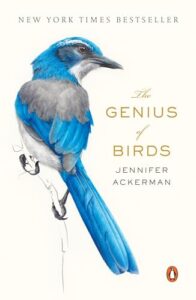
Not every classroom resource has wings — but this one might give your students some.
The Genius of Birds by Jennifer Ackerman is a wonderful companion to your birdhouse setup. It dives into how birds use tools, remember migration routes, and even learn from each other.
At just $10.11, it’s an easy yes. Use it to spark discussion after students observe nesting behavior firsthand. Science suddenly feels alive when the book and the birdhouse tell the same story.
| Best For | Bird enthusiasts, students, and educators who want an engaging, science-backed look at how smart birds really are. |
|---|---|
| Material | Cedar wood |
| Price | $31.99 |
| Recommended Age | 5+ years |
| Assembly Required | Yes |
| Quantity Included | 1 |
| Outdoor Use | Yes |
| Additional Features |
|
- Written by an award-winning journalist, so it reads like a story, not a textbook
- Covers fascinating real experiments — crows using tools, parrots mimicking language, pigeons navigating cities
- At $10.11, it’s a genuinely affordable classroom or personal resource
- Sticks mainly to corvids and parrots, so fans of other bird families might feel a bit left out
- Some technical terms like "nidopallium" can slow down readers without a science background
- Research stops at 2017, so you’ll need other sources for anything discovered since then
9. Kids DIY Wooden Birdhouse Craft Kit
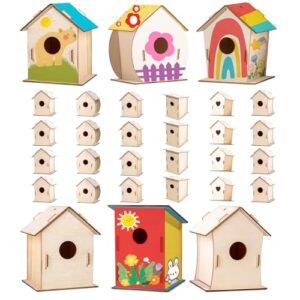
Want a craft activity that pulls your whole class in? This QUYSK set comes with 24 unfinished wooden birdhouses in six different shapes — plenty for a full classroom.
The slot-in design means kids can build without glue or nails, making setup simple and stress-free. Wood is smooth, non-toxic, and safe for ages three and up. Decorate them with paint or markers, then hang them outside.
It’s a surprisingly easy way to blend art, science, and wildlife education into one afternoon.
| Best For | Teachers, homeschool parents, and camp organizers looking for a hands-on craft activity that works for groups of kids ages 3 and up. |
|---|---|
| Material | Paperback book |
| Price | $10.11 |
| Recommended Age | Adult |
| Assembly Required | No |
| Quantity Included | 1 book |
| Outdoor Use | No |
| Additional Features |
|
- 24 birdhouses in 6 shapes gives every kid something to build and decorate
- Slot-in construction means no glue or nails — easy for little hands
- Doubles as art, STEM, and wildlife education all in one activity
- Wood quality can be inconsistent — some pieces may have imperfections
- No sealant included, so you’ll need to buy extra if kids want to hang them outside
- Very young kids will likely need adult help to get the pieces locked together
Choosing a Window-Mounted Birdhouse for Classroom Observation
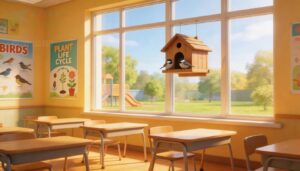
Picking the right window-mounted birdhouse can make a real difference in how much your students actually see and learn.
There are few key things worth looking at before you decide. Here’s what to keep in mind as you browse the options below.
Visibility and Observation Clarity
A clear view makes all the difference for curious young scientists. When choosing a window-mounted birdhouse, look for scratch-resistant glass and double-glazed panels — they stay clear season after season.
Anti-glare coatings and ambient light control reduce reflections during sunny lessons. Micro-adjustable hinges let you angle the transparent observation window perfectly for every student.
- UV protection for observation glass prevents yellowing over time
- Clear viewing panels give unobstructed sightlines into the nest
- Camera mount compatibility enables live classroom feeds
Durability and Weather Resistance
A good birdhouse needs to hold up through rain, heat, and everything in between. Cedar and treated pine are your best bets for weather-resistant wood — they naturally fight moisture and mold. UV protection coatings keep the wood from cracking after years outdoors, and stainless steel fasteners won’t rust through a single rainy season.
| Feature | What It Does | Why It Matters |
|---|---|---|
| UV Protection Coatings | Prevents timber from graying | Keeps the house looking good for 3+ years |
| Stainless Steel Fasteners | Resists corrosion in wet climates | Maintains structural safety long-term |
| Exterior-Grade Sealant | Extends sealant longevity | Protects wood through seasonal changes |
| Mold Resistance Design | Ventilation slots reduce humidity | Keeps the nest dry and birds healthy |
Weatherproof construction materials and smart design mean less maintenance for you — and more time watching birds with your class.
Easy Installation Methods
Durable materials keep the birdhouse standing strong — and easy installation methods keep your setup stress-free. Most window-mounted birdhouses use tool-free mounting that takes under a minute.
Look for:
- Snap-On Brackets that clip onto frames without drilling
- Suction Cup Grip systems holding up to 2 lbs per cup
- Elastic Lock Straps that stay secure when windows open and close
Quick-release latches make cleaning simple too.
Bird Species Compatibility
Not every bird fits every birdhouse.
Bluebird entrance size runs about 1½ inches, while chickadees prefer a perch inside to probe for insects. Wrens love a sloped wren roof angle that sheds rain. Finches need finch surface smoothness for easy entry.
Matching your house to small bird species makes bird nesting observation so much richer for your students.
Safety and Predator Protection
Once you’ve matched the right bird to the right house, keep that nest safe. Look for predator guard design features like a protective steel guard around the entrance hole.
Anti-climbing baffles on the mount stop raccoons cold. Some models even support mesh barrier installation beneath the box.
These predator-proof features meet safety standards for school birdhouses, giving your birds — and your students — real peace of mind.
Choosing DIY Birdhouse Kits for Classroom Projects
A good DIY birdhouse kit can turn a simple afternoon into a meaningful science lesson.
The best ones are safe, eco-friendly, and easy enough for kids to actually finish.
Here are the key things to look for before you buy.
Age Compatibility and Assembly Complexity
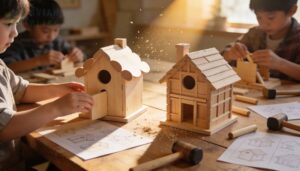
Not every every kit works for every age group — and that’s okay. Kits with precut wooden pieces and tool-free assembly suit ages five to ten, building fine motor skills without frustration.
Stepwise difficulty levels and age-appropriate parts let older students tackle more complex builds independently. Step-by-step guides support time management, while supervision guidance helps you keep younger builders safe and on track.
Material Safety and Eco-Friendly Standards
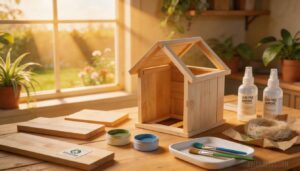
When kids are building in your classroom, what goes into the kit matters as much as what comes out of it. Look for FSC-certified wood, lead-free adhesives, and non-toxic, water-based paints that meet school safety standards.
Low-VOC finishes keep your air clean, while recyclable packaging and biodegradable nest liners make eco-friendly birdhouse materials an easy choice to feel good about.
Incorporating recycled material usage further cuts environmental impact.
Weather Resistance for Outdoor Use
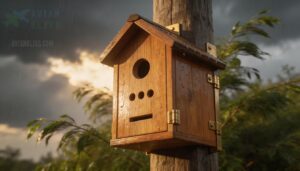
Once that birdhouse goes outside, it faces real weather. That’s why weather-resistant cedar and UV-stabilized coatings matter — they hold up through sun, rain, and freezing temps.
Look for weatherproof construction materials with corrosion-resistant hardware and proper drainage and ventilation holes to prevent mold. Temperature tolerant materials won’t warp or crack, and weatherproof sealants keep everything solid season after season.
Creative and Artistic Potential
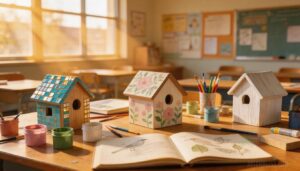
A DIY bird house kit isn’t just a building project — it’s a blank canvas. Students can explore Mosaic Birdhouse Art, paint Colorful Seasonal Themes, or add a milk paint finish for a rustic touch.
Handcrafted cedar birdhouse for teachers paired with Arts and Crafts Painting Kits for Kids Ages 4 support Student Sketch Journals and Interactive Storyboards, turning creative outdoor crafts that teach nature into living classroom art.
Educational Skills Developed Through Building
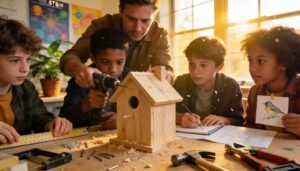
Building a birdhouse teaches far more than carpentry. Through project-based learning and hands-on learning, students grow in ways that stick.
- Team Collaboration – Students share roles and decisions together.
- Project Planning – Checklists and timelines build real responsibility.
- Fine Motor Skills – Measuring, drilling, and fastening sharpen precision.
- Scientific Observation – Tracking bird behavior deepens STEM education naturally.
Problem Solving happens at every step of the way.
How Classroom Birdhouses Support Science Curriculum
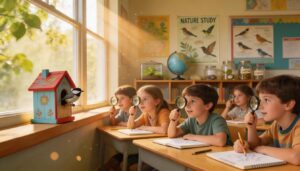
A birdhouse does more than give birds a place to nest — it turns your window into a live science lesson. From tracking nesting behavior to building habitat models, the right birdhouse opens up real learning opportunities across your curriculum.
Here’s how classroom birdhouses can bring your science standards to life.
Real-Time Nesting Behavior Observation
A transparent birdhouse turns your window into a live science lab. Through clear windows, students can track Nest Material Delivery, watch Feeding Rate Monitoring in real time, and notice Vocalization Timing as chicks grow louder each day.
They’ll spot Sentinel Flight Patterns and even observe Nest Temperature Fluctuations during incubation.
This kind of noninvasive wildlife observation drives genuine educational engagement with live birds.
Hands-on Environmental Stewardship Lessons
watching birds nest sparks curiosity, but it’s the action that builds stewardship. You can guide students through Service Learning Projects and Habitat Mapping Activities. Try Ethical Reflection Sessions to explore human impact.
For a hands-on nature curriculum, use eco-friendly birdhouse materials and Community Data Projects.
These environmental education tools bring project-based learning and cross-curricular collaboration right into your classroom birdwatching routine.
Student Data Tracking and Record Keeping
Once students start logging what they see, science gets real. Use classroom observation sheets to track attendance patterns in bird activity, note behavioral incident logs like territorial disputes, and record health record integration details such as species condition.
Grade trend visualization of nesting progress keeps student engagement through observation high.
Always follow data privacy protocols when sharing seasonal bird monitoring results school-wide.
Integrating Art and Science Through DIY Projects
DIY bird house kits for classroom projects open the door where science and art shake hands. Your students don’t just build — they apply color theory, practice texture exploration, and turn their designs into storytelling design pieces that show real habitat data. Interdisciplinary collaboration naturally follows.
DIY birdhouse kits turn students into builders, artists, and scientists all at once
- Fine motor skill development through hands-on building sharpens precision and focus
- Data visualization comes alive when students map nesting patterns alongside their painted designs
- Project-based learning and hands-on nature curriculum connect environmental education to creative expression
Installing and Maintaining Classroom Birdhouses Year-Round
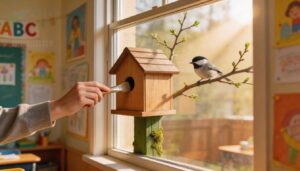
Getting a birdhouse up is the easy part — keeping it working all year is where the real care comes in. A few simple habits go a long way toward keeping your classroom birdhouse safe, clean, and ready for visitors each season.
Here’s what you need to know to make it last.
Recommended Mounting Height and Placement
Height matters more than you’d think. For outdoor placement, mount your birdhouse 8 to 12 feet up to deter predators. For classroom window-mounted designs (suction cup or slide-out styles), position them 4 to 6 feet high to align with eye-level observation.
| Placement Factor | Classroom Use | Outdoor Use |
|---|---|---|
| Mounting Height Guidelines | 4–6 ft | 8–12 ft |
| Ideal Viewing Distance | 6–18 inches from window | N/A |
| Angle for Sunlight | Entrance faces away from direct sun | South/southeast wall |
Before installing, check surface compatibility—suction cups require clean, dry glass. Always guarantee clearance from obstructions to ensure birds can fly in freely.
Cleaning and Seasonal Maintenance Tips
Once nesting season winds down, it’s time for your Bleach Disinfection Routine — mix one part bleach with nine parts water, scrub inside thoroughly, then rinse well.
Seasonal Drying Techniques matter too: let it dry fully in sunlight.
Your Pest Inspection Checklist should cover drainage holes and vents, supporting Mold Prevention Strategies and overall Ventilation Maintenance Tips for lasting, weather-resistant durability.
Inspecting Hardware and Replacing Components
Take a moment to check each birdhouse for mounting hardware safety and steel guard safety features. Look for corrosion-resistant hinges and stainless steel screws.
Make sure ventilation hole clearance isn’t blocked. Review your sealant application procedure after repairs.
Don’t forget a load-bearing bracket check—especially with suction cup mounting technology. Careful bird house maintenance means fewer surprises and happier birds.
- Corrosion-resistant hinges last longer outdoors
- Stainless steel screws prevent rust and splitting
- Ventilation hole clearance keeps interiors dry
- Sealant application procedure protects wood from moisture
- Load-bearing bracket check ensures safe mounting
Storing Removable Parts During Extreme Weather
When extreme weather hits, bring removable parts — like easy-to-open panels and inside covers — indoors right away. Store them in a climate-controlled space between 60 and 75°F for proper temperature regulation.
A simple labeling system helps you stay organized. Tuck silica gel packets inside containers for moisture control and pest prevention.
Weather-resistant materials last longer, but good storage habits make all the difference.
Frequently Asked Questions (FAQs)
Where not to put a birdhouse?
Avoid low window levels, sunlit window areas, near classroom feeders, and high foot traffic zones. Predator access zones and poor mounting height choices also deter birds and disrupt nesting success.
What time of year should you put up a bird box?
Put up your bird box in late winter or early spring — ideally before March. That gives birds time to settle in before their Seasonal Nesting Calendar kicks into full swing.
What birds do not use birdhouses?
Not every bird will move in.
Ground nesting birds like quail, cliff dwelling birds, and large parrots skip boxes entirely.
Open nest species and specialized cavity users simply follow their own rules.
Can birdhouses be shared between multiple classrooms?
Yes, birdhouses can absolutely be shared.
A rotation scheduling system and shared usage policy keep things fair. Use a multi-classroom log to track coordinated upkeep and guarantee equitable access planning across all participating classes.
What birds are best for urban school settings?
House sparrows, chickadees, and wrens are top picks.
They’re noise tolerant species with non‑aggressive temperament, small cavity nesters that thrive as local habitat adaptors — bringing colorful plumage and calm energy right to your schoolyard.
How do teachers grade birdhouse observation projects?
Grading birdhouse observation projects feels tricky, but a clear rubric makes it simple.
Teachers score rubric clarity, observation accuracy, data documentation, feedback integration, and presentation quality — turning student engagement through observation into measurable, meaningful learning.
Are window birdhouses suitable for indoor classrooms?
Window birdhouses work beautifully in classrooms. They let students enjoy noninvasive wildlife observation through transparent observation windows without stepping outside.
Just mind light exposure, classroom noise, and air quality to keep your feathered guests comfortable and settled.
Do birdhouses require school administrator approval first?
Most districts don’t require formal approval for a simple window-mounted classroom project.
But if it involves facility modification or permanent mounting, check your district policy and gather basic safety documentation first.
Conclusion
Investigate the magic that happens when nature meets learning. Classroom birdhouses bring science to life, fostering curiosity and wonder.
With the right birdhouses for teachers and classrooms, you can create a unique learning experience. Students develop a deeper appreciation for nature and its rhythms. By integrating birdhouses into your teaching, you’ll inspire a love of learning that lasts.
Start your journey today and watch your students thrive in this hands-on, interactive environment, naturally.
- https://lotusmagus.com/birdhouse-maintenance-annual-tasks-for-healthy-habitats/
- https://green-backyard.com/blogs/6-easy-steps-to-clean-your-birdhouse/
- https://www.perkypet.com/articles/how-to-clean-and-winterize-your-bird-house
- https://www.birds.cornell.edu/k12/maintaining-your-classroom-feeder/
- https://waldorfschoolgardens.com/lesson-plans/bird-house-building/