This site is supported by our readers. We may earn a commission, at no cost to you, if you purchase through links.
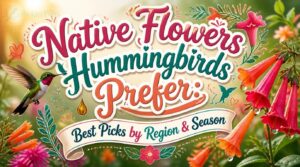
A hummingbird burns through half its body weight in nectar every day, and it won’t waste energy on the wrong flower twice. That’s precision, not preference. Petal color, corolla depth, sugar concentration — every trait signals whether a bloom is worth the visit.
This is why generic garden-center plants often fall flat. Bred for showy petals, they lose the nectar rewards and tubular shapes hummingbirds evolved to recognize. Native flowers hummingbirds prefer solve that mismatch — they co-evolved with these birds across specific regions and seasons.
Get the traits, the timing, and the regional picks right, and your garden turns into a flight path.
Table Of Contents
- Key Takeaways
- Native Flower Traits Hummingbirds Prefer
- Best Native Flowers for Hummingbirds
- Regional Native Flower Picks
- Build a Season-Long Nectar Garden
- Top 10 Native Flower Products
- 1. KVITER Wild Bergamot Bee Balm Seeds
- 2. Native Wildflower Seed Mix Non GMO for Pollinators
- 3. Plant Good Seed Hummingbird Sage Seeds
- 4. Hummingbird Sage California Native Groundcover
- 5. Native Wildflower Seeds For Pollinator Gardens
- 6. KVITER Red Trumpet Vine Seeds
- 7. Red Lobelia Cardinal Flower Seeds
- 8. Home Grown Wildflower Seed Mix
- 9. Eastern Red Columbine Starter Plant
- 10. Mountain Valley Pollinator Wildflower Seed Mix
- Frequently Asked Questions (FAQs)
- Do hummingbirds like native plants?
- Which plants are best for hummingbirds?
- Do hummingbirds pollinate flowering plants?
- Do hummingbirds eat native plants?
- What native flowers attract hummingbirds?
- Do hummingbirds return to the same garden yearly?
- Can hummingbirds survive on native flowers alone?
- Which predators pose the biggest threat to hummingbirds?
- How do temperature changes affect hummingbird migration?
- Are native flowers safe for pets and children?
- Conclusion
Key Takeaways
- Hummingbirds key in on red, orange, and pink tubular flowers with 20–25% nectar sugar and deep corollas matching their bill length, since these traits signal a worthwhile nectar reward.
- Native species like cardinal flower, bee balm, wild columbine, and penstemon outperform generic garden-center hybrids because they co-evolved with hummingbirds’ feeding anatomy and regional bloom timing.
- Matching plant choices to your region and USDA hardiness zone matters, since climate, soil, and seasonal shifts vary widely across the Eastern, Western, Southwest, and Canadian growing zones.
- A season-long nectar garden requires staggered blooms from early spring through fall migration, plus clustered plantings, perches, water, and pesticide-free care to fully support hummingbirds.
Native Flower Traits Hummingbirds Prefer
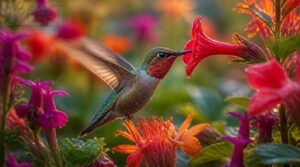
Hummingbirds don’t pick flowers at random—they’re wired to notice specific traits. Color, shape, scent, even sugar content all factor into which blooms earn a visit. Here’s what to look for before you plant a single seed.
For more insight into hummingbird preferences, check out this guide on bird seed nutrition and nectar-rich plants to help you choose the best blooms.
Red, Orange, Pink Blooms
Scan any hummingbird garden and your eye lands on red first. That’s warm color signaling at work—anthocyanin and carotenoid pigments make red trumpet-shaped flowers, cardinal flower, and coral honeysuckle pop against green foliage.
Orange and pink extend the palette. Nectar guide patterns direct birds straight to the reward, while color contrast against foliage speeds visual detection of nectar-rich native plants.
Consider the orange flower selections for added visual appeal.
Tubular Trumpet Flower Shapes
Color gets a hummingbird’s attention, but shape seals the deal.
Tubular trumpet flowers run 1–4 inches long, matching bill length to nectar depth—narrow tubes exclude bees while specialized feeding apparatus, that long bill and tongue combo, reaches the nectar canal at the base.
Corolla diameter matters too: a flared 0.25–1 inch mouth guides hovering birds straight to the reward.
20–30% Nectar Sugar
Shape gets a hummingbird to the flower—sugar keeps it coming back.
Ideal sucrose levels sit between 20 and 25 percent, the sweet spot for energy density balance. Too dilute wastes energy; too thick raises nectar viscosity, slowing extraction.
This nectar sugar ratio maximizes caloric intake efficiency per sip, and high-output native blooms reward hovering flight with exactly the fuel it demands.
Deep Corollas for Long Bills
Depth matters as much as shape. Corollas extending 20–35mm favor long-billed species, creating precise flower tube length matching bills.
- Reduces nectar robbing by short-billed visitors
- Allows specialized pollinator matching
- Protects nectar from evaporation in heat
- Reinforces bill length coevolution over generations
This longbill adaptation rewards patience—vertical bloom layers showcase these deep corollas, drawing dedicated foragers back again and again.
Unscented Bird-Pollinated Flowers
Here’s a fun fact: hummingbirds barely smell a thing. Their olfactory receptors are weak, so native blooms skip floral volatiles entirely, relying on visual cues instead of scent to lure visitors.
That absence isn’t accidental — it’s nectar theft prevention. Scentless tubular flowers dodge bees and moths, sidestepping bird-insect competition while red pigmentation does the heavy lifting scent normally does.
Scentless flowers aren’t an accident—they dodge bees and moths, letting red color do the work scent usually does
Best Native Flowers for Hummingbirds
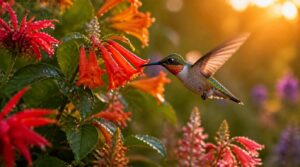
Now you know what to look for—red hues, tubular shapes, sugar-rich nectar. Time to put names to that list. Here are five native standouts that check every box.
Wild Columbine
Nodding red-and-yellow blooms with backward spurs — built for spring migration support. Height: 1–3 ft, blue-green foliage, rocky soil adaptation shines in zones 3–8.
- Blooms late spring, sometimes fall
- Thrives on woodland edges
- Self-sows into loose colonies
- Provides early spur nectar access
- Attracts bees and moths too
A dependable, low-fuss native for early-season pollinator gardening.
Cardinal Flower
Scarlet spikes rising from wet ground — Lobelia cardinalis earns its "cardinal" name honestly.
Crimson corollas, tubular and deep, hold nectar right where hovering bills reach it. This balance isn’t accidental; it’s evolution at work.
| Trait | Detail |
|---|---|
| Height | 2–4 ft |
| Zones | 3–9 |
| Soil | Consistently moist |
| Bloom | Mid-late summer |
| Habitat | Wetlands, stream banks |
Give it wet feet and full sun—it rewards you generously.
Bee Balm and Bergamot
Crush a leaf and you’ll smell why bee balm earns its keep — that spicy, citrusy punch is thymol at work.
Monarda didyma (bergamot) and M. fistulosa form 2-ft mint-family clumps, square-stemmed, spreading by rhizome. Blooms run mid-to-late summer, rich in nectar.
Space plants 12–18 in. apart for airflow — it prevents powdery mildew. Beyond hummingbirds, leaves flavor teas; flowers dress salads.
Penstemon and Fire Pink
Beardtongue earns its name honestly — that fuzzy staminode brushing pollinators as they dive for nectar. Penstemon offers bilabiate tubular blooms in red, pink, and orange, stacked on spikes that act as pollinator visual beacons.
Fire Pink colors run vivid scarlet. Both genera are drought tolerant perennials, thriving zones 4–5 in well-drained soil. Try Penstemon rostriflorus ‘Summer Fire’ for extended bloom.
Hummingbird Sage and Fuchsia
Two plants, one coastal strategy. Hummingbird Sage shrugs off drought once rooted, its magenta spikes feeding birds from late winter through summer. Fuchsia wants shade and steady moisture — opposite needs, same payoff: pendant, tubular blooms built for efficient nectar extraction.
Pair them anyway. Combined with red salvia, they create a layered, hummingbird-friendly wildflower planting that rewards smart pollinator garden design.
Regional Native Flower Picks
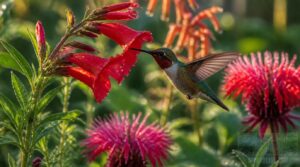
Not every native flower thrives everywhere—climate and soil call the shots. What works in a humid Georgia backyard won’t necessarily survive a New Mexico summer. Here’s how to match your region with the right blooms.
Eastern United States Natives
From soggy floodplains to shaded woodland edges, this region delivers some of the richest nectar-rich native plants anywhere.
Cardinal flower Lobelia cardinalis thrives in wetland nectar sources; bee balm Monarda spreads through sunny clearings; coral honeysuckle Lonicera sempervirens climbs woodland edge flora.
Eastern soil acidity suits them all, fueling migration corridors that keep Eastern US hummingbird flowers blooming reliably.
Western United States Natives
Cross the Rockies and the rules shift. Western elevation adaptations matter more than soil type here.
Wild columbine and penstemon dominate Great Basin species, while Pacific Coastal habitats favor salvia. Mountain meadow nectar sustains birds at altitude; Sierra foothill plants like red currant bloom early.
This diversity makes western US hummingbird flowers ideal anchors for any nectar highway garden design.
Southwest Drought-Tolerant Natives
Desert gardens play by different rules — water scarcity dictates everything. Drought tolerance strategies here rely on waxy leaf coatings that cut moisture loss and reflect heat.
Salvias, penstemons, and desert milkweed deliver high nectar volume despite scant rainfall. Pair them with native grasses like muhly for soil stability, and use xeric drip irrigation to stretch every drop through arid microclimates.
Canada-Friendly Native Flowers
Head north and the growing season shrinks fast — but ruby-throated hummingbirds still show up right on cue.
Red columbine and cardinal flower thrive in Quebec’s moist soils, while Ontario gardeners lean on bee balm for its long bloom run.
Atlantic provinces favor fireweed and Joe Pye weed for coastal hardiness.
Prairie provinces? Blanketflower and coreopsis handle drought without blinking.
Match USDA Hardiness Zones
Before you plant a single seedling, check your zone. The 2023 USDA map update pushed half the country one to two subzones warmer — so that Zone 6 label from a decade ago might now read 7a.
Match natives to your actual zone, not memory. Watch for microclimate effects near walls or slopes, and mulch marginal plants for winter protection against boundary surprises.
Build a Season-Long Nectar Garden
One flower isn’t enough. Hummingbirds need a relay of blooms, timed so nectar never runs dry from March through October. Here’s how to build that timeline, plus the layout details that turn your yard into a true hummingbird stop.
Early Spring Migrant Blooms
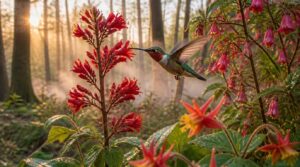
Timing is everything. Migration timing hinges on post-winter forage, so early sunlit windows at woodland edges matter most.
Three reliable early-season shrubs:
- Red Buckeye
- Red Flowering Currant
- Wild Columbine
These bloom 2–6 weeks, offering the first spring nectar pulse before deciduous canopy closes—critical fuel for early-season pollinators completing long migratory flights.
Summer Peak Feeding Flowers
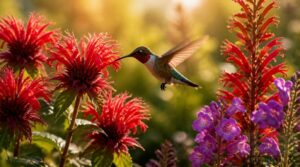
Once territories lock in, hummingbirds need serious fuel. Midsummer nectar density peaks now — Bee Balm, Cardinal Flower, and Penstemon keep pumping 20–25% sugar even through drought, sustaining that 480 bpm metabolism.
These heat-tolerant bloom varieties thrive where lesser plants wilt. Cluster tubular blooms in threes for visibility, and lean on drought-resistant nectar sources to maintain bloom succession straight through August’s dry stretch.
Fall Migration Nectar Sources
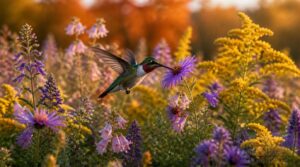
Fuel demand spikes before the long flight south. Ruby-throats need late-season sugar just as summer blooms fade — that’s where asters, goldenrod, and sages step in, filling migration energy gaps until frost.
Priority late bloomers:
- Asters (20-40% nectar sugar)
- Goldenrod
- Salvia species
- Penstemon digitalis
- Bergamot
Frost impact nectar availability fast, so regional fall corridors matter — consistent bloom succession sustains migratory flight when it counts most.
Cluster Plantings for Visibility
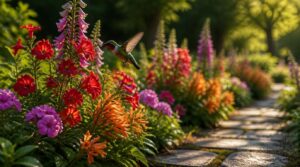
Solo blooms vanish in a landscape. Plant in clusters of three to five for a visible block hummingbirds spot from yards away.
| Cluster Element | Practical Guideline |
|---|---|
| Spacing | 2–4 ft. spread |
| Color Contrast | Red, orange, pink mixed |
| Layout | Along pathways, regular intervals |
| Vertical Interest | One tall focal plant |
| Purpose | Sharpen visual detection patterns |
Perches, Water, No Pesticides
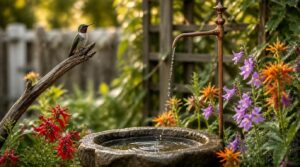
Nectar’s only half the equation. Hummingbirds need elevated resting spots—wires, trellises, dead branches 6–10 ft up—for surveying territory between feeding bouts.
Add a dripper or mister; moving water draws them in for safe bathing features far better than still basins.
Skip the sprays entirely. A truly pesticide-free garden keeps insect prey healthy and protects delicate tissue during every visit.
Top 10 Native Flower Products
Ready to plant, but not sure where to start shopping? Good seed and good stock make all the difference between a garden that struggles and one that thrives. Here are ten native picks worth adding to your cart.
1. KVITER Wild Bergamot Bee Balm Seeds
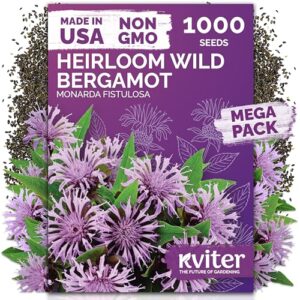
A thousand seeds for $7.49 — that’s the kind of math that makes this pack worth grabbing. Monarda fistulosa grows 2–4 feet tall, blooming lavender-pink from midsummer into fall with the tubular, hooded flowers hummingbirds are built to exploit.
Surface-sow at 60–70°F and keep the soil consistently moist; germination lands within 10–20 days. Once established, it shrugs off drought and spreads by rhizomes, so give it room to naturalize.
| Best For | Low-maintenance gardeners wanting a pollinator magnet that doubles as a culinary herb |
| Seed Type | Heirloom, non-GMO |
| Pollinator Appeal | Bees, butterflies, hummingbirds |
| Maintenance | Low |
| Drought Tolerance | Yes, established plants |
| Price | $7.49 |
| Extras | Citrus-scented foliage, self-seeding rhizomes, 1,000 seeds |
Best For: Low-maintenance gardeners in USDA zones 2–9 who want a drought-tolerant pollinator magnet that doubles as a culinary and tea herb.
| Price | $7.49 |
|---|---|
| Plant Form | Seeds |
| Maintenance Level | Low |
| Sun Needs | Full Sun |
| Non-GMO | Yes |
| Hardiness Zones | 2–9 |
| Additional Features |
|
- Attracts bees, hummingbirds, and butterflies while needing little water once established
- Citrus-flavored leaves are great for teas, potpourri, and dried-herb mixes
- Generous 1,000-seed pack of heirloom, non-GMO seed for $7.49
- Needs consistently moist soil during the 10–20 day germination window
- Spreads aggressively via rhizomes and may need dividing every 2–3 years to stay in bounds
- Prone to powdery mildew in humid or poorly ventilated spots
2. Native Wildflower Seed Mix Non GMO for Pollinators
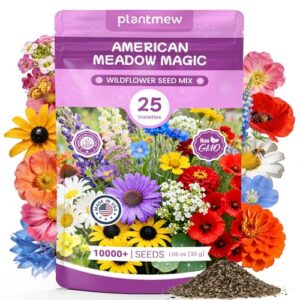
Bee balm alone won’t fill a meadow. That’s where PLANTMEW’s American Meadow Magic earns its keep — one 30 g pouch holds 10,000+ non-GMO seeds across 25 native varieties, covering roughly 100 sq ft.
Expect a mix of annuals and perennials skewed toward red, orange, and pink tubular blooms, the exact palette hummingbirds key in on, with nectar sugar averaging 20–25%.
Sow directly on prepared, sunny soil, keep it watered through establishment, and germination begins within weeks. The resealable pouch matters more than it sounds — humidity kills viability fast, so fresh seed means better stands.
| Best For | Beginners wanting instant meadow diversity |
| Coverage | ~100 sq ft |
| Price | $7.95 |
Best For: Beginner gardeners or anyone with a sunny, well-drained backyard who wants an easy, low-maintenance way to create a pollinator-friendly wildflower meadow.
| Price | $7.95 |
|---|---|
| Plant Form | Seeds |
| Maintenance Level | Low |
| Sun Needs | Full Sun |
| Non-GMO | Yes |
| Hardiness Zones | Varies |
| Additional Features |
|
- Extra-large packet with over 10,000 live, heirloom, non-GMO seeds covering up to 100 sq ft
- Simple "throw and grow" planting method that requires no special tools or experience
- Resealable, moisture-proof pouch helps preserve freshness and germination rates
- Needs full sun and well-drained soil, so it won’t thrive in shady or poorly draining spots
- Meant strictly for outdoor use — not suitable for indoor pots or containers
- Seeds have a limited shelf life and must be stored cool and dry to stay viable
3. Plant Good Seed Hummingbird Sage Seeds
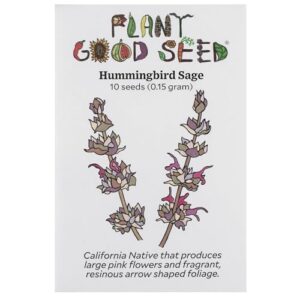
A meadow mix gives you breadth. This packet gives you one plant done right — Salvia spathacea, a true California native with magenta, tubular spikes built for hummingbird bills. You get 10 certified organic, non-GMO, heirloom seeds, grown and packaged in Ojai.
Sow outdoors after frost in warm soil; germination runs 7–14 days at 70–85°F. Growth stays slow at first, so patience matters more than watering here.
Once established, it’s drought-tolerant and low-maintenance, hardy from zone 7a up. Space plants 18–24 inches apart, give full sun to light shade, and you’ll get aromatic, evergreen foliage plus years of returning blooms.
| Best For | Zone 7a+ gardeners who want a low-maintenance native perennial that draws hummingbirds and pollinators to the garden. |
|---|---|
| Price | $10.99 |
| Plant Form | Seeds |
| Maintenance Level | Low |
| Sun Needs | Full Sun/Light Shade |
| Non-GMO | Yes |
| Hardiness Zones | 7a+ |
| Additional Features |
|
- Certified organic, non-GMO, heirloom seeds with clear planting instructions for depth, spacing, and germination
- Attracts hummingbirds and other pollinators while offering fragrant, resinous foliage and large pink blooms
- Drought-tolerant and low-maintenance once established, ideal for perennial and native garden landscaping
- Slow to establish, with germination and early growth taking patience
- Not well-suited for zones colder than 7a without winter protection
- Only 10 seeds per packet, so larger planting areas may need multiple packets
4. Hummingbird Sage California Native Groundcover
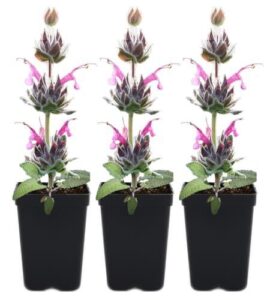
Skip the germination wait — this pack gets you three plug-grown Salvia spathacea plants, roots already established and ready for the ground. My Home Park grows them organically, so you’re not introducing chemical residue into a bed meant to feed hummingbirds.
Each plug spreads by rhizome into a dense, evergreen mat 12–18 inches tall, eventually covering several feet of ground. Come spring, magenta flower spikes rise above aromatic, fruity-scented foliage — the same lemony fragrance that makes hummingbird sage such a distinctive border plant.
It tolerates partial shade better than most nectar plants, which makes it genuinely useful under oak canopies or along north-facing slopes where sun-lovers struggle. Once established, drought tolerance kicks in, and irrigation needs drop off considerably.
For California and Mediterranean-climate gardeners battling erosion or bare shaded patches, this is a practical fix — not just decoration, but living groundcover doing real structural work while pulling in hummingbirds season after season.
| Best For | California and Mediterranean-climate gardeners who want a low-maintenance, drought-tolerant groundcover that attracts hummingbirds, bees, and butterflies while controlling erosion on slopes or shaded areas. |
|---|---|
| Price | N/A |
| Plant Form | Live Plugs |
| Maintenance Level | Low |
| Sun Needs | Partial Shade |
| Non-GMO | Organic |
| Hardiness Zones | Mediterranean/CA |
| Additional Features |
|
- Organically grown, chemical-free plugs establish quickly and arrive healthy
- Tolerates partial shade and drought once established, with fragrant, deer-resistant evergreen foliage
- Spreads by rhizome to form dense groundcover that stabilizes slopes and prevents erosion
- Not suited for humid, cold-winter, or heavy-rainfall climates like the Northeast, Midwest, or Florida
- Needs consistent watering for the first three months to establish strong roots
- Spreading habit may become too vigorous for small or tightly bordered garden spaces
5. Native Wildflower Seeds For Pollinator Gardens
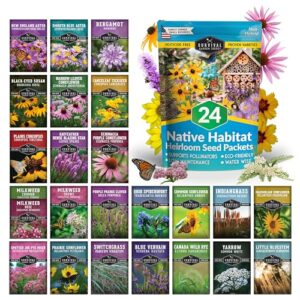
Twenty-four packets, one order — that’s the appeal of the Survival Garden Seeds mix, and it’s built for zones 3–8. You get New England Aster, Purple Coneflower, Milkweed, Little Bluestem, and twenty more, all non-GMO and heirloom, meaning they breed true year after year instead of petering out like hybrid stock.
Coverage runs full sun to light shade, and once seedlings establish, drought tolerance kicks in fast.
Bloom times stagger naturally across the collection, so you’re not stuck with a two-week nectar window and silence for the rest of the season. That’s real value for $34.99 — a season-long buffet for hummingbirds, bees, and butterflies without hand-picking two dozen species yourself. For low-maintenance gardeners short on planning time, it’s hard to beat.
| Best For | Gardeners who want a low-maintenance, season-long pollinator garden without picking out individual native species themselves. |
|---|---|
| Price | $34.99 |
| Plant Form | Seeds |
| Maintenance Level | Low |
| Sun Needs | Full Sun/Light Shade |
| Non-GMO | Yes |
| Hardiness Zones | 3–8 |
| Additional Features |
|
- 24 heirloom, non-GMO native varieties in one mix, covering perennials, annuals, and grasses
- Drought-tolerant and pest-resistant once established, thriving in full sun to light shade
- Staggered bloom times provide continuous nectar and pollen for bees, butterflies, and other pollinators
- Needs at least 6 hours of direct sunlight daily to perform well
- Germination timing varies by species, and some seeds require cold stratification
- Establishment can be slower than commercial hybrid mixes, leaving young plants to compete with weeds
6. KVITER Red Trumpet Vine Seeds
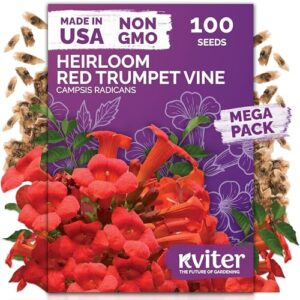
Fast growth, faster commitment — that’s Campsis radicans in short. Vines climb 20 to 40 feet at maturity via clinging aerial roots, smothering fences and trellises in bright red trumpet blooms from late spring through fall.
KVITER’s pack holds 100 heirloom seeds with up to 90% germination, provided soil temps sit at 70°F or warmer. Sow at 1/16 inch — barely below the surface — and expect emergence in 10 to 21 days.
Hardy through zones 4–10, cold-tolerant to -4°F, this vine rewards patience with dense summer coverage and steady hummingbird traffic. The catch? It doesn’t know when to stop. Annual pruning keeps growth in bounds, and anchoring vigorous stems away from shrubs prevents a takeover. Ideal for slopes needing erosion control, less so for tidy borders.
| Best For | Gardeners with plenty of open space who want fast-growing, hummingbird-friendly coverage for fences, trellises, or slopes prone to erosion. |
|---|---|
| Price | N/A |
| Plant Form | Seeds |
| Maintenance Level | Moderate |
| Sun Needs | Full Sun |
| Non-GMO | Yes |
| Hardiness Zones | 4–10 |
| Additional Features |
|
- Rapid, vigorous climbing growth covers structures quickly, reaching up to 30 ft
- Bright red blooms attract hummingbirds and pollinators all summer into fall
- Heirloom seeds offer a strong germination rate and cold hardiness down to -4°F
- Aggressive growth can turn invasive without regular pruning and maintenance
- Needs sturdy structural support and full sun to bloom well
- May require winter protection in colder zones below -4°F
7. Red Lobelia Cardinal Flower Seeds
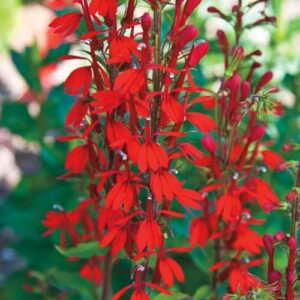
While Trumpet Vine muscles its way up a trellis, Cardinal Flower wins hummingbirds over with quiet persistence. USBrandSeed’s 100-seed pack ($7.99) delivers Lobelia cardinalis, a 2–4 foot perennial with crimson spikes blooming mid-summer into fall.
Hardy across zones 2–9, it favors moist, partially shaded ground — pond edges, rain gardens, streambanks. Skimping on stratification costs you: seeds need 45 days cold and moist before sowing, or germination suffers badly.
| Best For | Rain gardens, pond margins, hummingbird and butterfly habitat |
| Seed Type | Heirloom |
| Maintenance | Low, self-reseeding |
| Drought Tolerance | Poor — needs consistent moisture |
| Price | $7.99 |
| Extras | 45-day stratification, aquatic-compatible, deer-resistant |
That deer resistance matters more than gardeners realize in wildlife-heavy areas.
| Best For | Gardeners with moist, partially shaded spots—like pond edges, rain gardens, or streambanks—who want to draw in hummingbirds and butterflies. |
|---|---|
| Price | $7.99 |
| Plant Form | Seeds |
| Maintenance Level | Low |
| Sun Needs | Partial Shade |
| Non-GMO | Yes |
| Hardiness Zones | 2–9 |
| Additional Features |
|
- Vivid crimson blooms that reliably attract hummingbirds and butterflies from mid-summer into fall
- Low-maintenance, self-reseeding perennial that’s hardy across a wide range (zones 2–9)
- Deer-resistant, making it a solid choice for wildlife-heavy areas
- Requires 45 days of cold, moist stratification before planting, or germination suffers
- Poor drought tolerance—needs consistently moist soil to thrive
- Not suited for full shade or hot, dry climates
8. Home Grown Wildflower Seed Mix
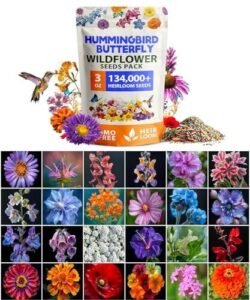
Coverage is the whole point here. 134,000 non-GMO seeds across 23 native varieties, priced at $22.99, turn a bare quarter-acre into an honest meadow rather than a decorative border.
Bloom succession runs spring through fall, layering tubular reds, pinks, and oranges that keep hummingbirds returning as territories shift and migration windows open. Nitrogen-fixing species in the mix also condition your soil as they grow, which established beds rarely offer.
| Best For | Meadow-scale plantings, season-long pollinator habitat |
| Seed Type | Non-GMO, heirloom |
| Plant Form | Seeds |
| Maintenance Level | Low |
| Price | $22.99 |
| Extras | 134,000+ seeds, nitrogen-fixing varieties, 3 oz package |
Full sun or partial shade — either works.
| Best For | Gardeners looking to transform a large outdoor space, like a bare quarter-acre, into a low-maintenance, season-long meadow that attracts pollinators. |
|---|---|
| Price | $22.99 |
| Plant Form | Seeds |
| Maintenance Level | Low |
| Sun Needs | Full Sun/Partial Shade |
| Non-GMO | Yes |
| Hardiness Zones | Varies |
| Additional Features |
|
- Includes over 134,000 non-GMO seeds across 23 varieties for full meadow-scale coverage
- Blooms continuously from spring through fall, drawing bees, butterflies, birds, and hummingbirds
- Nitrogen-fixing species in the mix help condition and improve soil health as they grow
- Meant for outdoor planting only, not suitable for indoor containers
- Needs well-drained soil, since compact or waterlogged conditions can reduce germination
- Being a generic mix, it offers less control over specific colors or species compared to single-variety packs
9. Eastern Red Columbine Starter Plant
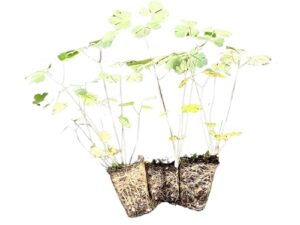
Skip the seed-starting wait entirely — this one arrives as a live plug with foliage already established, root ball intact to ease transplant shock.
Aquilegia canadensis settles fastest into partial shade with well-drained soil, though full sun works if moisture stays consistent. Expect a compact mound, 12–18 inches tall, with fernlike basal leaves that stay attractive long after bloom fades.
Nodding red-and-yellow spurred flowers open in spring, timed almost perfectly with ruby-throated hummingbird migration and early nesting. Each bloom lasts one to two weeks, but the clump keeps producing new stalks through the season.
Self-seeding happens readily — that’s a feature, not a flaw, provided you thin seedlings occasionally. Zones 3–9, minimal fertilizer, division rarely needed once established.
| Best For | Gardeners in eastern North America looking to attract hummingbirds and pollinators to a shaded border, woodland garden, or container with minimal upkeep. |
|---|---|
| Price | N/A |
| Plant Form | Live Plug |
| Maintenance Level | Low |
| Sun Needs | Partial to Full Shade |
| Non-GMO | Yes |
| Hardiness Zones | 3–9 |
| Additional Features |
|
- Attracts hummingbirds, bees, and butterflies with vibrant red-and-yellow blooms
- Thrives in partial to full shade, making it ideal for tricky low-light garden spots
- Low-maintenance and self-seeding, so it fills in naturally once established
- Arrives as a small starter plug, and shipped plants may be dormant or smaller than pictured
- Needs consistently moist, well-drained soil, so it can struggle during drought
- Self-seeding can spread beyond the planting area, requiring occasional thinning
10. Mountain Valley Pollinator Wildflower Seed Mix
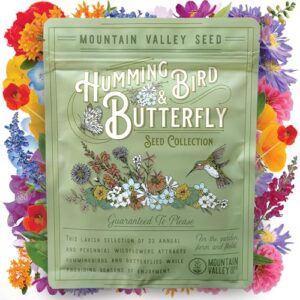
Twenty-three species, one packet, zero guesswork — that’s the pitch behind the Mountain Valley Pollinator Wildflower Seed Mix. You’re getting 80,000-plus non-GMO seeds across roughly 250 square feet, blended to stagger bloom from spring through fall rather than dumping color all at once.
Coneflowers, daisies, and penstemon-type varieties round out the mix, giving hummingbirds nectar sources well beyond the typical red-tube standbys. Sow directly into prepped soil after your last frost, keep moisture consistent through the two-to-four-week germination window, and resist the urge to fuss once seedlings establish.
The resealable envelope matters more than it sounds — leftover seed stays viable for a second sowing. This one’s built for western and mountain climates specifically, so gardeners outside that range should check compatibility before committing a whole bed to it.
| Best For | Gardeners, families, schools, and community groups looking to create a low-effort pollinator habitat that attracts hummingbirds, butterflies, and bees across a sizable planting area. |
|---|---|
| Price | N/A |
| Plant Form | Seeds |
| Maintenance Level | Moderate |
| Sun Needs | Full Sun |
| Non-GMO | Yes |
| Hardiness Zones | Varies |
| Additional Features |
|
- Delivers over 80,000 non-GMO seeds from 23 species, enough to cover about 250 square feet
- Resealable, illustrated packet keeps leftover seed fresh for a future planting
- Simple direct-sow process with germination in just 20–30 days come spring
- May contain fast-spreading non-target species, like Japanese hops, that need to be monitored and removed
- Requires well-draining soil, since water-logged areas can hurt germination rates
- Late frosts or heavy rain after sowing can reduce overall seed performance
Frequently Asked Questions (FAQs)
Do hummingbirds like native plants?
Think of native plants as an old friendship that never faded — hummingbirds evolved alongside them. Yes, they strongly prefer natives: co-evolved blooms match their bill length, nectar needs, and timing far better than most exotic ornamentals ever will.
Which plants are best for hummingbirds?
Cardinal flower, bee balm, and coral honeysuckle rank highest — red tubular blooms, deep nectar tubes, 20-25% sugar content. Add penstemon and wild columbine for staggered blooms, ensuring hummingbirds find reliable nectar from spring through fall migration.
Do hummingbirds pollinate flowering plants?
Absolutely — these tiny dynamos are pollination powerhouses in disguise. As they sip, pollen sticks to their beaks and feathers, transferring between blooms. This cross-pollination boosts genetic diversity, helping tubular, nectar-rich native plants reproduce successfully across entire landscapes.
Do hummingbirds eat native plants?
Nectar is their main fuel, but hummingbirds also eat insects — ants, spiders, flies — for protein. Native plants supply both: energy-rich blooms plus the bugs those flowers attract, making them a complete food source rather than just decoration.
What native flowers attract hummingbirds?
Picture a scarlet trumpet vine climbing your fence, buzzing with visitors by June. Wild columbine, cardinal flower, bee balm, and coral honeysuckle top the list — their tubular, red blooms and nectar-rich sugar content make them irresistible favorites for hungry hummingbirds all season long.
Do hummingbirds return to the same garden yearly?
Yes — hummingbirds show strong site fidelity, returning to the same garden yearly. They memorize feeder locations and bloom patterns, often arriving within days of last year’s date. Keep your nectar sources consistent and your layout stable, and they’ll keep coming home.
Can hummingbirds survive on native flowers alone?
Sugar alone won’t cut it. Hummingbirds need protein from insects, especially while breeding, so nectar covers energy but not survival. Skip pesticides — a chemical-free garden keeps both food sources thriving, letting flowers and bugs work together naturally.
Which predators pose the biggest threat to hummingbirds?
Cats ambush at feeders, while hawks strike mid-flight. Snakes raid nests for eggs and nestlings, and large spiders or mantises trap birds hovering near blooms. Squirrels and raccoons round out the danger list, hitting nests hardest.
How do temperature changes affect hummingbird migration?
Warm springs push arrival dates earlier, syncing birds with early bloom, while cold snaps delay flights and shrink feeding windows.
Temperature also drives torpor use — birds conserve energy in cool weather, burn more fuel foraging through heat waves.
Are native flowers safe for pets and children?
A garden’s charm hides a quiet warning label. Most natives are gentle, but a few — Lily of the Valley, Red Buckeye — carry real toxicity. Keep pets and kids away from unfamiliar blooms, and verify each species before planting near curious noses or little hands.
Conclusion
Plant it and they’ll come. That’s the honest truth behind every native flower hummingbird gardener learns eventually.
Native flowers hummingbirds prefer aren’t a luxury planting choice — they’re the actual fuel line these birds depend on, zone by zone, bloom by bloom.
Skip the showy hybrids. Choose columbine, penstemon, bee balm, cardinal flower, timed across spring, summer, and fall.
Your yard becomes a refueling station on a route older than your property line — and that’s a legacy worth growing.
- https://www.hummingbirdsociety.org/hummingbird-flowers
- https://gardenforwildlife.com/collections/native-plants-for-hummingbirds
- https://dnr.illinois.gov/education/plantlists/plantlisthummingbird.html
- https://www.gardendesign.com/flowers/hummingbirds.html
- https://www.birdsandblooms.com/birding/attracting-hummingbirds/tube-shaped-flowers-that-attract-hummingbirds