This site is supported by our readers. We may earn a commission, at no cost to you, if you purchase through links.

Most bird owners spend hours researching food and cage size—then grab whatever perch looks good at the pet store. That single decision quietly shapes your bird’s joint health, foot strength, and daily stress levels for years.
A perch isn’t furniture; it’s the surface your bird stands on every waking hour.
Get the diameter wrong for your species, pick wood that off-gasses harmful oils, or line up three perches at the same height, and you’re stacking small problems that compound fast.
The good news: bird perches for beginners don’t require guesswork once you know what to look for.
Table Of Contents
- Key Takeaways
- Why Birds Need Perches: Health and Behavior Benefits
- Best Materials for Bird Perches
- How to Choose The Right Perch Size
- Types of Bird Perches for Beginners
- Smart Perch Placement Inside The Cage
- Indoor Vs Outdoor Bird Perch Placement
- How to Clean and Maintain Bird Perches
- Frequently Asked Questions (FAQs)
- Conclusion
Key Takeaways
- Perch diameter is the single most important spec to get right — your bird’s toes should wrap about two‑thirds around it, and mixing several diameters keeps different foot muscles working every day.
- Material matters more than looks: safe picks like manzanita, birch, and oak protect your bird’s health, while cedar, resinous woods, and zinc‑coated hardware can quietly cause serious harm.
- Where you place perches shape your bird’s behavior — vary the heights, keep perches away from food and water dishes, and rotate positions weekly to keep your bird moving and mentally sharp.
- Clean perches daily when you spot droppings, do a deep scrub weekly, and replace any perch showing deep cracks, grip‑less surfaces, or frayed fibers before those issues hurt your bird.
Why Birds Need Perches: Health and Behavior Benefits
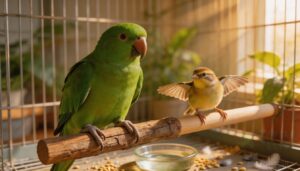
A perch isn’t just a place for your bird to sit — it’s one of the most important tools for keeping them healthy. The right perch works their foot muscles, promotes natural behavior, and can even help prevent painful conditions like arthritis.
For a deeper look at what works best, this guide to bird perches for small birds covers textures, sizing, and placement to keep little feet strong and active.
Here’s a look at exactly how perches do all of that.
How Perches Support Foot Muscle Exercise and Circulation
Every time your bird shifts its weight, something important happens — toe flexion mechanics kick in, cycling through grip and release patterns that keep foot muscles active. Different perch diameters drive this micro‑adjustment stimulus naturally.
Pressure redistribution dynamics prevent sore spots, while thermal conductivity effects from varied materials encourage healthy repositioning. Proper claw alignment benefits follow when perch diameter matches your bird’s foot, supporting circulation and long‑term avian foot health.
The Role of Perches in Natural Behavior and Mental Stimulation
Perches do more than support your bird’s feet — they shape how your bird thinks and behaves.
Social perch dynamics come into play when birds use elevated spots as lookout points, scanning their space and staying mentally alert.
Cognitive enrichment perches with perch novelty rotation and perch angle variation encourage natural habitat simulation, turning simple branch-hopping into genuine bird behavior enrichment and perch-based problem solving every day.
Preventing Arthritis and Pressure Sores Through Perch Variety
Sticking to one perch all day is like wearing the same tight shoes for years — something’s going to give. Mixing textures and diameters keeps your bird’s feet guessing in a healthy way.
Varying your bird’s perch textures and diameters keeps feet healthy — monotony is the enemy
- Texture Rotation breaks repetitive friction patterns
- Variable Diameter Cycling exercises different muscle groups
- Micro Adjustment Benefits come from irregular branch grips
- Pressure Mapping improves with flat platform perches added
- Soft Surface Integration soothes already-sensitive feet
Perch diameter variation and perch texture variety work together for real foot health for birds, preventing foot injuries and arthritis in captive birds long-term.
Rotating perch diameters help prevent bumblefoot.
Best Materials for Bird Perches
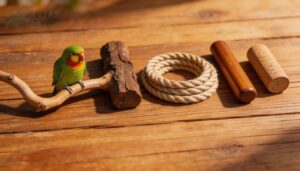
The material you choose for a perch matters more than most beginners expect. Some woods are genuinely safe, while others can quietly harm your bird over time.
Here’s a look at what works, what to skip, and a few alternative materials worth knowing about.
Safe Woods for Bird Perches (Manzanita, Birch, Oak)
Not all wood is created equal — and your bird’s feet know the difference.
Manzanita is a top pick: its natural hardness, insect resistance, and branch curvature make it ideal without extra processing.
Birch is lightweight and easy to source, while hardwood like oak accommodates heavier birds effortlessly.
Stick to nontoxic wood from reputable suppliers, and always confirm safe materials for birds through basic toxicity testing before installing anything new.
Woods and Materials to Avoid
some materials look fine at first glance but can quietly harm your bird.
Cedar’s aromatic oils stress the liver, while mold-prone pine invites respiratory trouble in humid spaces.
soft wood splinters break off easily and cause internal injuries.
For a safer setup, reviewing a guide to bird cage perch materials can help you choose options that won’t splinter or break down under an active chewer.
resinous wood hazards go beyond smell — sticky sap attracts mites.
Always check your hazardous wood list and skip toxic metal finishes and zinc-coated hardware; zinc toxicity is a real risk.
Rope, Bamboo, and Plastic Perch Options Explained
Beyond wood, three other perch types deserve a spot in your cage.
Rope toys offer soft grip and double as a chewing outlet — just don’t let fraying go unchecked.
Bamboo wins on material longevity; it dries fast and resists warping.
Plastic perches score highest for cleaning tips — a quick rinse does it.
Mix all three for real texture variety.
How to Choose The Right Perch Size
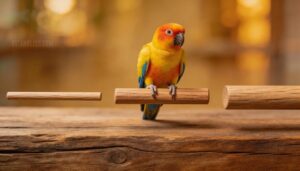
Picking the right perch size makes a bigger difference than most beginners expect. A perch that’s too thin or too thick can strain your bird’s feet over time.
Here’s what you need to know to get it right.
Perch Diameter Guide by Bird Species
Not every bird grips the same — and perch size considerations for different species can make or break your bird’s foot health.
Finch diameter range sits around 3/8 to 1/2 inches, while parrotlet perch size works best at 1/2 to 1 inches.
Follow the conure perch diameter of 3/4 to 1 1/4 inches, and use a macaw diameter guide of 1 to 2 inches.
Bird perch diameter matters — this is your species diameter chart in action.
The Two-Thirds Toe Wrap Rule for Proper Grip
Here’s a simple rule that changes everything: your bird’s toes should wrap about two-thirds around the perch. That’s the sweet spot for grip pressure distribution and healthy toe alignment benefits.
Too thin, and their toes curl under with strain. Too thick, and they can’t grip at all.
Watch for even foot contact — that’s perch ergonomics working in your favor. Bird perch diameter matters more than most beginners expect.
Why Mixing Multiple Diameters Matters
Think of it like cross-training for your bird’s feet. A mix of diameters delivers real biomechanical diversity — each width targets different muscles, reduces pressure point buildup, and enhances weight distribution balance across the whole foot.
That’s adaptive grip training in action.
For young birds, varied sizes also help with growth acclimation.
Bird perch diameter matters every single day.
Types of Bird Perches for Beginners
Not all perches are created equal, and that’s actually a good thing for your bird. Picking the right type comes down to your bird’s size, habits, and what you want to offer them.
Here are the main options worth knowing about.
Natural Branch Perches
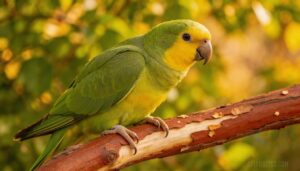
Natural branches are the closest thing to a wild perch your bird will ever know. Branch Harvesting from safe species like manzanita, birch, and oak gives your bird Seasonal Texture Changes and Bark Retention that smooth dowels simply can’t offer. The irregular surfaces act as Foraging Simulation, keeping curious feet and minds busy.
- Choose splinter free wood from a safe perch wood list: manzanita, birch, apple, or oak
- Bake fresh branches at 200°F for one hour to eliminate hidden pests
- Apply non-toxic finishes only if needed — natural wood perches often need nothing extra
- Keep perch size considerations in mind; Branch Aging makes surfaces grippier over time
Wooden Dowel and PVC Perches
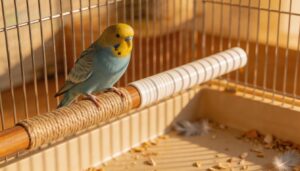
Dowels and PVC perches are the workhorses of any cage setup. They’re uniform, affordable, and accept standard stainless-steel bolts — solid Hardware Compatibility Analysis in one straightforward option.
| Feature | Dowel | PVC |
|---|---|---|
| Cleaning Perches for Birds | Easy | Easiest |
| Texture Options | Wrap or plain | PVC Texture Variants |
| Bird Perch Diameter Control | Custom cut | Pre-sized |
Dowel Wrap Techniques — sisal or vet wrap around a thick dowel — improve grip and support foot health without sacrificing perch placement flexibility.
Rope, Concrete, and Platform Perches
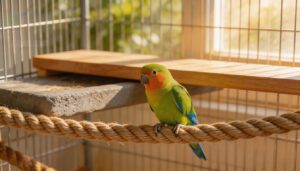
Beyond dowels, three perch types round out a well-balanced cage: rope, concrete, and platform.
Rope perches flex under your bird’s weight, delivering Active Grip Texture that works foot muscles differently each time.
Concrete manages beak wear naturally.
Platform perches offer flat Weight Distribution Design — perfect for rest.
Mix all three for Modular Perch Systems that keep your bird moving, gripping, and thriving.
DIY Plate-and-Dowel and Window-Sill Perches

Want perch that fits exactly where your bird likes to sit? A DIY bird perch plate pairs a flat base plate with a thick dowel — use Secure Hole Alignment so it sits plumb and won’t wobble.
- Choose Base Plate Stability with Anti-Slip Padding underneath
- Use Dowel Length Adjustment to match your window sill height
- Bond with non-toxic wood glue, then sand smooth
- Finish with a Bird-Safe Finish before your bird steps on
A DIY window perch near natural light? Perfect spot.
Smart Perch Placement Inside The Cage
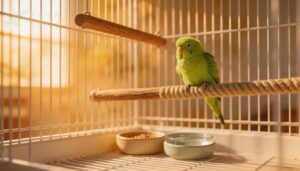
Where you put perches matters just as much as which ones you choose.
A little thought about placement can make your bird’s cage feel more like home and less like a waiting room.
Here’s what to keep in mind when deciding where everything goes.
Varying Perch Heights to Encourage Movement
Think of your cage like a jungle gym — low, mid, and high perches create a climbing gradient design that drives vertical muscle activation all day long. This stepwise perch progression encourages natural bird foot exercise and height stimulated play, turning idle time into real movement.
Elevation enrichment through adjustable perch height and perch height diversity is one of the simplest forms of environmental enrichment you can offer.
Keeping Perches Away From Food and Water Dishes
One easy rule can save your bird from a lot of stomach trouble — never place a perch directly above food or water. Droppings contamination prevention starts with smart perch dish spacing and proper overhead perch clearance.
Mount dishes to the side instead. Side dish placement keeps feeding zones clean and your hygiene perch layout simple.
Aim for at least six inches between any perch and the bowl.
Positioning a Sleep Perch Higher Than Active Perches
Birds instinctively sleep high — it’s their version of locking the front door. Installing your sleep perch at the highest safe point in the cage addresses that natural need for an elevated security view and visual field advantage.
Keep these perch placement details in mind:
- Place it at the top tier, aligned with cage architecture alignment for stability
- Make sure clear headroom space below so your bird can move freely
- Position it away from the cage door for draft minimization during rest
- Match perch height and size to allow a secure two-thirds toe wrap
- Confirm bird safety by checking the mount for ensuring stability and base strength of perch stand
Rotating Perch Locations for Enrichment and Novelty
Swap your perches weekly — that’s your secret weapon for Grip Angle Variation and real Behavioral Enrichment Schedule success.
Move them at least 6 to 12 inches apart in height, shift them front to back for Flight Path Redesign, and try Novelty Perch Pairings near foraging toys.
Engagement Tracking is simple: just notice where your bird spends the most time, then adjust.
Indoor Vs Outdoor Bird Perch Placement
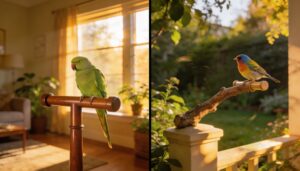
Where you place a perch matters just as much as which perch you choose. Whether your bird spends time inside the house or outside in the fresh air, each setting comes with its own set of rules.
Here’s what to keep in mind for both.
Best Spots for Indoor Perches Near Natural Light
Natural light is a free gift — use it wisely. Position window-side perches 12 to 24 inches from a south or east-facing window for ideal indoor placement. Diffused light zones behind sheer curtains keep brightness comfortable. Try Light Gradient Stairs — a staircase of perches rising toward the brightest window — to encourage natural movement throughout the day.
| Placement Zone | Bird Benefit |
|---|---|
| Bright Corner Placement | Boosts alertness and activity |
| Diffused Light Zone | Reduces eye strain |
| UV-safe Materials near glass | Prevents heat absorption |
| DIY window perch with clamps | Maximizes sunlit perch access |
Perch placement excellence means your indoor bird perch works with the light, not against it.
Outdoor Placement: Shade, Weather, and Predator Protection
Outdoor placement is a different game entirely.
Your perch needs UV Shade Design that blocks 90% of rays between 10 am and 4 pm, plus Weather-Resistant Hardware like stainless steel screws that won’t rust.
Drainage Solutions — slatted floors, elevated bases — keep moisture away.
| Outdoor Challenge | Smart Fix |
|---|---|
| Predator Deterrent Structures | Raised enclosures, clear sightlines |
| Seasonal Perch Adjustment | Shift shade angle as sun path changes |
| Stability and balance | Rubber feet, weighted base |
Safety Considerations for Both Environments
Whether inside or out, safety comes down to the same foundation: the right materials and rock-solid mounting.
| Safety Factor | Indoor | Outdoor |
|---|---|---|
| Hardware | Corrosion-Resistant Hardware | UV-Stable Finishes + rust-proof screws |
| Materials | Non-Toxic Sealants, BPA-free plastic | Temperature-Resistant Materials |
| Stability | Secure Mounting Techniques, rubber feet | Weighted base, predator protection barriers |
How to Clean and Maintain Bird Perches
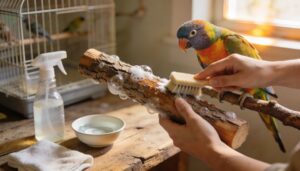
Keeping your bird’s perches clean isn’t just about appearances — it directly affects their health. Droppings, bacteria, and grime build up fast, and a neglected perch can make your bird sick.
what you need to know to stay on top of it.
How Often to Clean Perches and Why It Matters
Clean perches daily when you spot droppings, wet spots, or sticky seed residue.
A weekly deep scrub addresses the buildup you can’t see — dried oils, urine crust buildup, and odor-causing residue that routine wipes miss.
Skipping your cleaning schedule invites mold prevention failures, bacterial contamination risk, and pathogen spread as birds repeatedly step on the same contaminated surfaces.
Safe Cleaning Methods and Products to Use
Once droppings are off, proper disinfection keeps things truly safe.
A soap water wash manages routine grime well.
For deeper cleaning, a hydrogen peroxide solution at 3 percent breaks down into just water and oxygen — no harmful residue.
A citric acid rinse treats mineral deposits, and diluted vinegar dilution works for buildup.
Ethanol spray disinfectant dries fast on small surfaces.
Always rinse thoroughly and use only nontoxic, bird safe materials, and nontoxic sealant when finishing perches.
Inspecting Perches for Splinters, Cracks, and Loose Hardware
After cleaning comes the real safety check. Run a gloved finger down each perch for a Visual Splinter Check — rough snags mean sand, or swap it. Do the Tap Crack Test by tapping lightly; a hollow thud signals internal wood cracks.
Follow a Hardware Tightness Routine every few weeks, jiggling screws and nails for wobble. Wear Pattern Monitoring and Residue Surface Inspection, catch the rest.
When to Replace a Worn or Damaged Perch
Sometimes inspection reveals what cleaning can’t fix. Your Inspection Routine may flag wear that crosses the line from "manageable" into "replace it now." Watch for these Crack Detection and Splinter Risks red flags:
- Deep cracks radiating from the center
- Smooth, grip-less surfaces from heavy use
- Frayed fibers or exposed hardware
Replacement Frequency depends on material — softwoods like pine need swapping every one to three months for active chewers. Checking for wear monthly protects bird health before problems escalate.
Frequently Asked Questions (FAQs)
How do I install a perch on cage bars?
Thread the hanger bolt through the bar gap, add a washer on the inside, then secure with a wing nut outside. Tighten until there’s zero wobble.
Stainless steel hardware resists rust and keeps your bird safe.
Can multiple birds share the same perch safely?
Yes, but only with the right setup. Perch spacing, species compatibility, and bird weight all matter.
Watch for stress signals like hunching or chasing — dominance behavior and dropping hygiene issues can arise fast.
How long should a bird perch be?
Most birds need perches spanning at least their cage’s width. Small species do well with 6–12 inches, while large parrots need 16–24 inches side by side for comfort and activity zone integration.
When should I introduce a new perch to my bird?
Wait until your bird eats, drinks, and steps confidently on existing perches.
Then introduce one new perch at a time, watching closely for stress indicators like gripping hard or avoiding it entirely.
Do perches need to be replaced after an illness?
Not always, but sometimes yes. If mold appears, droppings soaked into porous material, or your vet flags infection transmission risk, replace it.
When in doubt, a deep cleaning with mild soap comes first.
Conclusion
With the right perches, you’ll transform your bird’s world. Strong feet grip sturdy wood, while varied heights spark curiosity.
As you mix materials and diameters, your bird’s exercise and joy multiply. Bird perches for beginners aren’t just accessories; they’re essential tools.
By choosing wisely and caring for each perch, you create a haven where your feathered friend thrives. Your bird’s happy, healthy life starts here, with every perch a stepping stone to well-being.
- https://pawfurever.com/en-ca/blogs/news/the-ultimate-guide-to-choosing-the-perfect-bird-perch-for-your-feathered-friend
- https://birdtricksstore.com/blogs/birdtricks-blog/tips-and-materials-for-do-it-yourself-bird-projects
- https://youtu.be/sJt5mxPCIvg?si=QHFKCHVfyhcaxHij
- https://www.parrots.org/ParrotsAtHome/YourFeatheredFriendsFeet.pdf
- http://www.mdvaden.com/bird_page.shtml