
This site is supported by our readers. We may earn a commission, at no cost to you, if you purchase through links.
A nesting box can sit empty for seasons before a pair of bluebirds finally moves in. Within days, a raccoon finds it.
This isn’t bad luck — it’s biology. Predators actively scan their territory for food sources, and a birdhouse full of eggs or chicks is exactly that. Brown tree snakes can lasso a smooth metal pole with their tails and climb it. Raccoons probe every seam with paws sensitive enough to feel a loose panel in the dark. Squirrels gnaw entrance holes wider over consecutive visits until the opening fits them.
Knowing how predators attack changes everything about how you defend against them. Placement, materials, and the right barriers working together can turn a vulnerable box into one that birds return to year after year.
Table Of Contents
- Key Takeaways
- Common Birdhouse Predators and How They Attack Nests
- Best Birdhouse Placement to Keep Predators Away
- Predator-Resistant Birdhouse Design Tips
- How to Install Birdhouse Baffles and Predator Guards
- Top 7 Birdhouse Predator Guards to Protect Nesting Birds
- Frequently Asked Questions (FAQs)
- What predators target bluebird houses?
- What predators are birds afraid of?
- How do I keep predators away from my bird house?
- How do you keep birds away from a bird house?
- Do bird houses attract predators?
- Do birdhouses need predator guards?
- Are you supposed to clean out bluebird houses every year?
- How to protect bird nest from predators naturally?
- Do bird houses attract snakes?
- Can natural repellents keep predators away from birdhouses?
- Conclusion
Key Takeaways
- Each predator has a distinct attack method — snakes lasso smooth poles with their tails, raccoons probe seams with sensitive paws, squirrels gnaw entrance holes wider, and cats launch from nearby cover — so your defenses need to address all of them, not just one.
- Placement does more heavy lifting than most people expect: mount your box 5–8 feet high on a smooth metal pole, keep a 10-foot open buffer around it, stay 6 feet from fences, and orient the entrance east or southeast to cut off sightlines and scent trails.
- Physical barriers — especially a stovepipe baffle that wobbles freely at 4 feet high, paired with a metal entrance hole guard — are the most reliable way to stop climbers and reach-in raiders before they ever touch the nest.
- NestWatch data backs it up: birdhouses with predator guards show 6.7% higher nest success, and real-world results like a Montana trail manager cutting losses from 40% to near zero prove that treating protection as a system — placement, design, and barriers together — is what actually works.
Common Birdhouse Predators and How They Attack Nests

Knowing your enemy is half the battle for protecting nesting birds. Each predator has its own method — and understanding those methods helps you choose the right defense. Here are the most common threats your birdhouse will face.
Starting with a birdhouse designed with built-in predator protection gives you a strong first line of defense before any threat even arrives.
Snakes Climbing Poles
Snakes are more capable climbers than most people expect. Brown tree snakes use tail lasso locomotion — looping their tail around a pole, then shifting body bends to inch upward. Their ventral scales create friction even on smooth metal. This lasso locomotion technique allows them to ascend vertical surfaces.
Smaller pole diameters make this easier. A stovepipe baffle breaks their grip mid-climb and stops the ascent cold.
Raccoons Prying Open Boxes
Snakes aren’t your only nighttime problem. Raccoons are surprisingly methodical — they use sensitive paw pads to probe seams and latches, then pry panels open with body weight and rapid digit movements. Most attempts happen after dusk.
Simple snap closures won’t hold them. Locking, two-step latches and hardwood construction make entry much harder and slower.
Squirrels Enlarging Entry Holes
Raccoons aren’t the only ones remodeling your nest box. Squirrels chew entrance holes wider — sometimes from 1.5 inches up to 2 inches — using teeth that never stop growing. The gnawing is focused and deliberate, radiating outward in jagged marks.
Their flexible ribcage lets them squeeze through surprisingly tight gaps. Fresh chew marks around the hole are your clearest detection clue. Install a metal entrance hole guard immediately.
Cats Jumping From Cover
Squirrels aren’t the only climbers working against you. Cats are ambush hunters — they crouch behind dense shrubs or low branches, read your bird’s movement, then launch from cover in one explosive burst.
That’s why mounting height matters. A box sitting below 5 feet near any fence or overhanging branch gives a cat exactly the launch point it needs.
Jays and Crows Raiding Nests
Unlike cats or squirrels, jays and crows don’t need physical contact to raid your birdhouse. They memorize nest locations and return daily.
Their tactics include:
- Approaching from hidden angles unseen
- Timing raids during parental absence
- Caching stolen eggs nearby
- Coordinating in small groups
- Returning repeatedly through breeding season
Spring is their peak raiding season. Dense cover around nest boxes helps.
Best Birdhouse Placement to Keep Predators Away
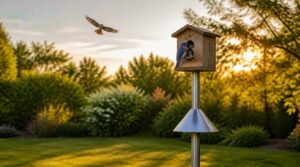
Where you put your birdhouse matters more than most people realize. Placement alone can stop a surprising number of predators before they even get close. Here are the key factors to get right.
Safe Mounting Height
Height is your first line of defense. Mount birdhouses 5 to 8 feet above ground — high enough to stop cats and raccoons, low enough for safe maintenance without a ladder.
In yards with known snake activity, push closer to 8 feet. That single adjustment removes most ground-level threats before you’ve added a single guard.
Smooth Metal Pole Mounts
A smooth metal pole gives predators nothing to grip. Rough wood, plastic, or textured surfaces act like a ladder — metal removes that advantage entirely.
Choose poles based on your environment:
- Stainless steel — best for coastal or humid areas
- Galvanized steel — strong corrosion resistance at lower cost
- Powder-coated aluminum — lightweight with weatherproof finish
Secure clamps prevent rotation. Loose mounts shift over time, creating gaps predators exploit.
10. Foot Clear Buffer
Think of your birdhouse as a watchtower — predators need cover to launch an attack.
Mounting it in an open area with a clear sightline gives birds the early-warning advantage they need — and pairing that with a predator-resistant bluebird house with a proper entrance hole makes the setup even more secure.
Clear ten feet of open ground around the pole. No shrubs, debris, or feeders. Use bare soil, gravel, or short turf — nothing a raccoon or cat can hide behind.
Trim encroaching vegetation monthly. Open sight lines let nesting birds spot threats early and respond fast.
Avoid Fences and Branches
Fences and branches are silent highways for predators.
Keep your birdhouse at least 6 feet from any fence and trim all branches within 10 feet of the entrance. Here’s what to watch for:
- Overhanging limbs
- Dense shrubbery nearby
- Fence edges with climbing grip
- Brush concealing approach routes
Clear these and you eliminate the ambush.
Safer Entrance Direction
Where your entrance hole faces matters more than most people realize.
Orient the opening east or southeast. Morning sun dries moisture fast — wet holes attract the wrong visitors. That same angle keeps you out of prevailing wind lines, so scent and sound don’t advertise the nest. It also breaks the direct sightline from wooded edges, where ground predators stage their approach.
Orient your birdhouse entrance east or southeast — morning sun, favorable winds, and broken sightlines make it naturally harder for predators to find
Predator-Resistant Birdhouse Design Tips
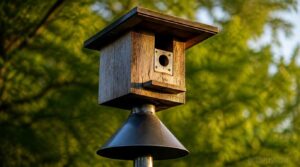
Good placement gets you halfway there — but the box itself has to hold up its end of the deal. A well-designed birdhouse closes off the angles predators rely on before they ever get close. Here are the key design features that make the biggest difference.
Correct Entrance Hole Size
The right hole makes all the difference. Bluebirds need exactly 1½ inches — wide enough for easy entry, tight enough to exclude starlings and house sparrows. Wrens do best with 1-inch openings; chickadees and nuthatches need 1⅛ to 1¼ inches.
Always measure to the outer edge. A snug fit isn’t just preference — it’s your first line of defense.
Chew-Resistant Wood Materials
A snug hole stops entry — but if the wood around it can be gnawed through, you’ve only solved half the problem.
Cedar heartwood and black locust both carry natural extractives — terpenes and phenolics — that actively resist decay and discourage chewing.
Top choices for a durable nesting box:
- Thick cedar (¾-inch minimum)
- Black locust heartwood
- Cypress with tight grain
- Acetylated or heat-treated pine
Secure Roof Overhangs
Wood choice controls gnawing — but the roof grips everything above it.
A 5-inch overhang shields the entrance hole from rain and blocks predators from reaching down into the box. Use corrosion-resistant fasteners and add blocking between rafters to resist wind uplift. A drip edge along the outer edge channels water away from the wall, keeping the nest dry and structurally sound.
Safe Vents and Drainage
A dry nest box is a safe one. Vent holes sized 1/4 to 1/2 inch on each side let moisture escape without inviting mites or insects in.
Pair that with these drainage essentials:
- Drill drainage holes at each floor corner
- Use fine mesh vent screens to block pests
- Inspect monthly — clear debris fast
- Raise the base slightly for ground moisture control
Tight Seams and Panels
Gaps in your birdhouse panels are open invitations. Panel thickness of 12–18mm gives walls enough mass to resist warping and chewing. Keep seam tolerances tight — misalignment over 0.5mm lets determined raccoons find purchase.
Run silicone bead sealant along every joint; it stays flexible down to -20°C. Stainless steel screws with pre-drilled pilot holes won’t rust loose over time.
How to Install Birdhouse Baffles and Predator Guards
Placement and design get you most of the way there, but physical barriers are what close the gap. Baffles and predator guards are the hands-on layer of protection that actually stops climbers, chewers, and reach-in raiders before they get to the nest. Here are the most effective options to install.
Stovepipe Baffle Setup
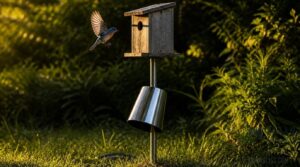
Slide a stovepipe baffle onto your pole before anchoring it. The top edge must clear 4 feet — snakes climb lower than you’d think. Steel baffles resist warping season after season. Keep it wobbling freely; that movement kills climbing traction dead.
- Use 8×24-inch metal baffles
- Maintain free wobble
- Top edge at 4 feet
- Secure with baffle pins
- Inspect for warping yearly
Cone Baffle Placement
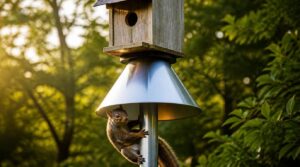
Mount cone baffles with the tip pointing downward — that angle sends predators sliding off before they gain a grip. Position the top rim 6 to 8 inches below the entry hole. Aim for a rim diameter 8 to 12 inches wider than the entrance.
Keep the interior smooth; rough welds give snakes a foothold. Check for rotation after heavy winds.
Metal Entrance Guards
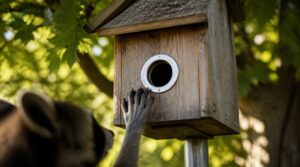
A thin piece of metal can stop a raccoon cold. Slip a stainless steel or aluminum entrance guard flush around the hole — no ledge, no grip. Predators can’t chew through it or pry it loose.
Match the guard to your hole diameter exactly; a loose fit ruins the whole point. Inspect screws every six months and replace any guard showing rust or deformation.
Noel Guard Installation
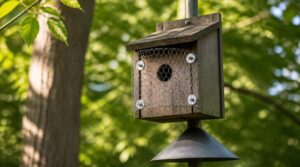
A Noel guard works like a cage tunnel — it pushes predators back before they can reach inside. Paired with a pole baffle, it’s a serious line of defense.
Position the hardware cloth sleeve directly over the entrance hole, keeping the mesh gap consistent all the way around. Drill pilot holes first to avoid splitting the wood, then secure it with corrosion-resistant screws and flat washers.
Slippery Pole Deterrents
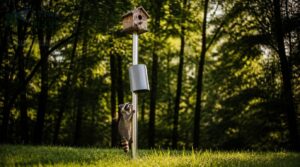
A smooth metal pole alone cuts climbing success a lot — but coating it with a PTFE-based spray pushes deterrence further. These sprays reduce surface friction, leaving raccoons and squirrels with nothing to grip.
Combine that with a stovepipe baffle that spins freely on contact, and most predators give up fast. Reapply coatings every few months — weathering strips slickness quickly.
Top 7 Birdhouse Predator Guards to Protect Nesting Birds
Choosing the right predator guard makes a real difference in whether your nesting birds make it through the season. There’s no shortage of options, but a few stand out for their design, durability, and ease of installation. Here are seven worth considering.
1. Bird Guardian Birdhouse Predator Guard
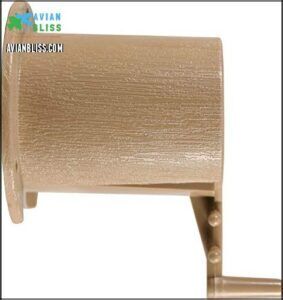
The Bird Guardian works like a tunnel — stretching the entrance outward so predator paws and beaks simply can’t reach eggs or nestlings inside.
It fits openings between 1 and 1.5 inches, making it the right match for bluebirds, chickadees, and titmice. The plastic sleeve extends several inches beyond the hole, and a built-in bird ladder at the base helps adults enter cleanly without hesitation.
Installation is straightforward. Screw it onto the front of your nest box — no drilling required. The neutral beige finish blends well with most wooden boxes.
One thing to watch: remove any existing perch before or after installing it. Predators use perches as a foothold, which ruins the whole point.
At around $13, it’s an easy, affordable upgrade for any backyard setup.
| Best For | Backyard bird enthusiasts who want a simple, affordable way to protect bluebird, chickadee, or titmouse nesting boxes from raccoons, cats, and squirrels. |
|---|---|
| Material | Plastic |
| Hardware Included | Screws |
| Pack Quantity | 1 |
| Predator Protection | Raccoons, Cats, Squirrels |
| Entry Hole Size | 1–1.5 in. |
| Installation Method | Screw-on |
| Additional Features |
|
- Acts as a tunnel extension that keeps predator paws and beaks from reaching eggs or nestlings inside
- Built-in bird ladder makes it easy for adults to enter without hesitation
- Quick screw-on installation with a neutral beige finish that blends naturally with wooden nest boxes
- Some birds may avoid or abandon the nest box during an adjustment period after installation
- Plastic construction may not hold up against determined chewers like squirrels
- May need longer or heavier screws to stay secure against larger, more persistent predators
2. Whitehorse Stainless Steel Birdhouse Guard
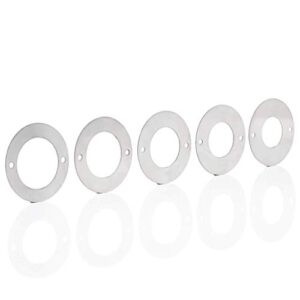
Where the Bird Guardian stretches the entrance outward, the Whitehorse kit blocks it from the outside — a flat stainless-steel plate that stops chewing before it starts.
You get five guards per pack, each with a different hole size. That’s the real advantage here. If you’re running multiple nest boxes for different species, you’re not hunting for a second product.
The steel is corrosion-resistant and holds its shape through rain, frost, and direct sun — no warping, no rust. Squirrels and woodpeckers can’t enlarge what they can’t chew through, so the opening stays exactly as drilled.
Installation takes minutes. Ten screws are included, and you won’t need to remove the box from its pole.
A free maintenance guide comes with the set — useful if you’re new to managing nest boxes.
| Best For | Bird enthusiasts managing multiple nest boxes who want a durable, species-flexible solution to stop squirrels and woodpeckers from damaging entrance holes. |
|---|---|
| Material | Stainless Steel |
| Hardware Included | 10 Screws |
| Pack Quantity | 5 |
| Predator Protection | Squirrels, Woodpeckers |
| Entry Hole Size | Varies by guard |
| Installation Method | Screw-on |
| Additional Features |
|
- Five guards with varying hole sizes in one pack — covers multiple species without buying separate products
- Polished stainless steel resists rust, warping, and chewing, so it holds up through all seasons
- Quick installation with included screws and no need to remove the box from its pole
- The metal gauge may be thin, which could affect long-term durability under persistent chewing
- Flat plate design only blocks the outside of the entrance, so internal damage isn’t addressed
- Manual screw installation is required, which may be fiddly on older or weathered boxes
3. Ensayeer Wooden Birdhouse Predator Guard
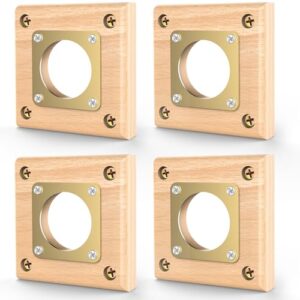
The Whitehorse is all steel and function. The Ensayeer takes a different approach — wood and copper that actually looks like part of the nest box, not something bolted onto it as an afterthought.
Each pack includes four guards, enough to cover a small backyard setup at once. The copper portal locks the entrance at exactly 1.5 inches — right for bluebirds — and holds firm against squirrels that would otherwise chew it wider. Raccoons can’t pry it free either.
Installation is simple. All 32 screws come included — no extra hardware needed.
One thing to watch: bare wood weathers. Check each guard at the start of every nesting season. Seal any soft spots early, before birds move in, and these guards will hold up through several seasons with very little ongoing maintenance.
| Best For | Backyard birders protecting multiple nest boxes |
|---|---|
| Material | Wood and copper |
| Pack Quantity | 4 |
| Entry Hole Size | 1.5" |
| Screws Included | Yes (32) |
| Predator Protection | Raccoons, squirrels |
| Additional Features | Decorative aesthetic, value pack, lock-in portal system |
| Best For | Backyard birders who want functional predator protection that looks great on their nest boxes, especially those covering multiple birdhouses at once. |
|---|---|
| Material | Wood & Copper |
| Hardware Included | 32 Screws |
| Pack Quantity | 4 |
| Predator Protection | Raccoons, Squirrels |
| Entry Hole Size | 1.5 in. |
| Installation Method | Screw-on |
| Additional Features |
|
- Comes in a pack of four, so you can protect your whole backyard setup in one purchase
- The copper portal locks the entrance at a fixed 1.5 inches, keeping out squirrels, raccoons, and larger birds
- Wood and copper construction blends naturally with traditional nest boxes for a clean, attractive look
- Bare wood can weather over time, so guards need a seasonal check and occasional sealing to stay in good shape
- The 1.5-inch opening is ideal for bluebirds but may not suit birdhouses built for other species
- Manual installation is required, which adds a small amount of setup time per box
4. AQKILO Birdhouse Predator Guard
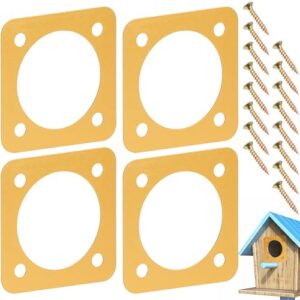
Where the Ensayeer leans on wood and copper, the AQKILO goes pure metal. Four anodized aluminum plates per pack — enough to cover several boxes without a second order.
The plates sit at just 0.04 inches thick, so they won’t crowd the entry or throw off the hole diameter. The 1.5-inch opening fits Eastern Bluebird and Tree Swallow boxes precisely. Squirrels can’t gnaw aluminum wider. Raccoons won’t pry it loose.
One heads-up: the included screws run long on thin-walled boxes. Have shorter replacements ready before you drill.
| Best For | Birders protecting multiple bluebird or small songbird boxes |
|---|---|
| Material | Anodized aluminum |
| Pack Quantity | 4 |
| Entry Hole Size | 1.5" |
| Screws Included | Yes (16) |
| Predator Protection | Raccoons, squirrels, larger birds |
| Additional Features | Ultra-thin profile, corrosion-resistant, rust-free |
| Best For | Birders who need to protect multiple bluebird or small songbird boxes with a durable, no-fuss metal solution. |
|---|---|
| Material | Anodized Aluminum |
| Hardware Included | 16 Screws |
| Pack Quantity | 4 |
| Predator Protection | Raccoons, Squirrels, Birds |
| Entry Hole Size | 1.5 in. |
| Installation Method | Screw-on |
| Additional Features |
|
- Four anodized aluminum plates per pack means you can cover several boxes in one order
- Ultra-thin 0.04-inch profile won’t alter the entry hole size or interfere with birds entering
- Corrosion-resistant and rust-free, so they hold up through rain, humidity, and harsh weather
- Included screws may be too long for thin-walled birdhouses, so you might need to grab shorter replacements
- Mounting holes can be oversized for some standard screws, which may require a trip to the hardware store
- A power drill is required for installation and isn’t included
5. Cedar Alpha Metal Bird House Guard
Five stainless-steel guards for under $12 — the Cedar Alpha Metal Bird House Guard is hard to argue with on value alone.
Each plate measures 3.5 x 3.5 inches with a 1.125-inch precision opening, sized for wrens and smaller cavity nesters. Stainless steel won’t rust out after a wet spring, so you’re not cycling through replacements every season. Screws are included, and installation takes a few minutes with basic tools.
The pack covers five houses — useful if you’re managing a backyard trail.
One thing to check beforehand: that fixed 1.125-inch hole won’t suit bluebird boxes, which need 1.5 inches. Measure your entry holes first. Right fit, right bird, right protection. It’s a small step that keeps the whole system working.
| Best For | Backyard birders who want to protect wren or small cavity-nester houses from squirrels and predators without spending a lot. |
|---|---|
| Material | Stainless Steel |
| Hardware Included | Screws |
| Pack Quantity | 5 |
| Predator Protection | Squirrels, Predators |
| Entry Hole Size | 1.125 in. |
| Installation Method | Screw-on |
| Additional Features |
|
- Made from rust-resistant stainless steel, so it holds up through wet seasons without corroding
- Comes with screws included and installs quickly with basic tools
- Each pack covers two houses, making it easy to protect multiple boxes at once
- The 1.5-inch hole size only works for wrens and similar small species — not suitable for bluebirds or larger cavity nesters
- Finish may only be applied to the front of the plate, which could affect appearance on some birdhouses
- Included perches may need to be removed depending on the species you’re attracting
6. Metal Bluebird House Predator Guard
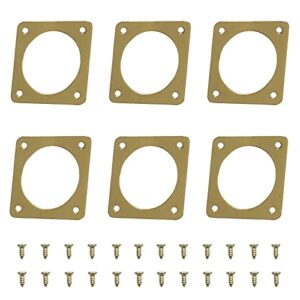
Six guards for under $10 — the Cloud Fragrant Metal Bluebird House Predator Guard is straightforward value for anyone managing multiple boxes.
Each steel plate fits a 1.5-inch entrance hole, which is the correct size for Eastern Bluebirds and similar cavity nesters. You get six guards per pack, plus 24 screws — four per guard — so everything mounts securely without extra hardware runs.
The gold-tone finish looks clean but can initially make birds cautious. Give them a week or two to adjust.
One practical note: steel absorbs heat in direct summer sun, so check nest temperatures on hot days. Inspect screws each season — metal expands and contracts, and fasteners can work loose over time. Simple maintenance keeps protection reliable.
| Best For | Bird enthusiasts managing multiple nest boxes who want affordable, no-fuss protection against squirrels and other predators. |
|---|---|
| Material | Steel |
| Hardware Included | 24 Screws |
| Pack Quantity | 6 |
| Predator Protection | Squirrels, Predators |
| Entry Hole Size | 1.5 in. |
| Installation Method | Screw-on |
| Additional Features |
|
- Great value — six guards and all the screws you need for under $10
- 1.5-inch entrance fits Eastern Bluebirds and similar cavity nesters perfectly
- Durable metal construction stops gnawing damage that wooden holes are prone to
- The shiny gold-tone finish can make birds hesitant at first — expect a short adjustment period
- Metal heats up in direct sun, so nest temperatures may need monitoring on hot summer days
- Screws can loosen over time as the metal expands and contracts with temperature changes
7. Ansonation Bluebird House Predator Guard
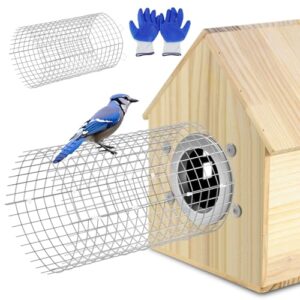
The tube-style design sets the Ansonation apart from flat metal plates. Its 1.5-inch stainless steel opening matches bluebird entry requirements exactly, but the real advantage is the 2.25-inch tube depth — that extra length stops raccoons and squirrels from reaching past the entrance into the nest cavity.
Rust won’t be an issue. Stainless steel holds up through wet winters and humid summers without degrading.
Installation takes two screws and a few minutes. The kit includes a fall-proof support mesh and an anti-intrusion baffle, so nestlings get protection from below and above. Gloves are included for shaping the mesh — a small but appreciated detail.
One catch: it’s currently backordered. Order before nesting season, not during. A single guard per pack, but the build quality justifies it.
| Best For | Bird lovers and backyard wildlife enthusiasts who want reliable, long-lasting protection for bluebird nests against predators like raccoons, squirrels, and snakes. |
|---|---|
| Material | Stainless Steel |
| Hardware Included | Zip Ties & Screws |
| Pack Quantity | 1 |
| Predator Protection | Snakes, Rodents |
| Entry Hole Size | Universal |
| Installation Method | Screws & Zip Ties |
| Additional Features |
|
- Tube-style design with 2.25-inch depth physically prevents predators from reaching into the nest cavity
- Rust-resistant stainless steel holds up in all weather conditions without degrading over time
- Comes with a fall-proof support mesh and anti-intrusion baffle for protection from multiple angles
- Currently backordered, so it needs to be ordered well ahead of nesting season
- Only one guard included per pack
- Wire mesh requires manual shaping during installation, which can be awkward without gloves
Frequently Asked Questions (FAQs)
What predators target bluebird houses?
Raccoons, snakes, squirrels, cats, and corvids like crows and jays are the most frequent threats. House sparrows and European starlings also raid bluebird boxes — killing adults and destroying nests outright.
What predators are birds afraid of?
Birds are wired to fear raptors, ground predators, and snakes. Hawks strike from above without warning. Cats, foxes, and raccoons raid nests directly. Snakes trigger intense alarm — birds will mob them on sight.
How do I keep predators away from my bird house?
Smooth metal poles, fitted baffles, and correctly sized entrance holes stop most threats. Clear nearby branches and check guards regularly — small, consistent steps protect nesting birds far better than any single fix.
How do you keep birds away from a bird house?
Match the entrance hole to your target species. A smaller hole blocks larger, unwanted birds. Skip the outside perch — it gives uninvited visitors an easy foothold and little reason to leave.
Do bird houses attract predators?
Think of a birdhouse as a silent dinner bell. It doesn’t call predators — but the moment one finds eggs or chicks inside, that box is on their mental map forever.
Do birdhouses need predator guards?
Yes, birdhouses need predator guards. NestWatch data shows boxes with guards had 7% higher nest success. No guard stops every threat — but that margin is the difference between an empty box and a fledgling.
Are you supposed to clean out bluebird houses every year?
Clean out your bluebird house at least once a year. Do it right after the young have fledged. Fresh conditions reduce parasites and give the next brood a healthy start.
How to protect bird nest from predators naturally?
No gadgets needed. Smooth metal poles, trimmed branches, and a 10-foot open buffer stop most climbers and jumpers. A sprinkle of cayenne around the base discourages ground predators without putting birds at risk.
Do bird houses attract snakes?
Birdhouses don’t attract snakes on their own. Eggs and nestlings are the real draw — concentrated, easy prey. An active nest signals a reliable food source, pulling snakes in from surrounding vegetation and structures.
Can natural repellents keep predators away from birdhouses?
Natural repellents — peppermint oil, garlic, hot pepper, cinnamon — discourage raccoons, snakes, and cats from approaching. Effective short-term. Reapply after rain. Use them as a supporting layer, not your only defense.
Conclusion
A Montana bluebird trail manager lost 40% of nests one spring — no guards, poles near brush. The following year, stovepipe baffles and a 10-foot clear buffer cut losses to nearly zero. That’s the difference the right setup makes.
Knowing how to keep predators away from birdhouses isn’t complicated once you treat it as a system — placement, design, and barriers working together. Get all three right, and the birds keep coming back.
- https://nesthollow.com/best-baffle-system-for-my-birdhouse
- https://growitbuildit.com/diy-noel-guard-bird-house
- https://green-backyard.com/blogs/how-to-keep-your-birdhouse-safe
- https://www.birdsandblooms.com/birding/attracting-birds/bird-nesting/birdhouse-predator-guard
- http://www.earthdesign.ca/bipr.html