This site is supported by our readers. We may earn a commission, at no cost to you, if you purchase through links.

A hen that jumps six inches too far to reach her nest lands hard—and a cracked egg or a sprained leg follows. Most backyard flock owners obsess over coop size and bedding material, but nesting box height from ground gets treated like an afterthought. It shouldn’t.
The difference between 16 inches and 24 inches changes how often hens actually use the box, how clean your eggs stay, and how much stress your birds carry in their joints over a laying lifetime. Get the height right, and your hens lay consistently in the right spot. Get it wrong, and you’ll spend mornings hunting floor eggs buried in shavings.
Table Of Contents
- Key Takeaways
- Ideal Nesting Box Height Range
- Match Height to Chicken Breed
- Measure Height The Right Way
- Choose The Best Coop Location
- Add Ramps, Steps, or Perches
- Avoid Boxes Too High or Low
- Adjust Height for Cleaner Eggs
- Fix Common Height Placement Problems
- Top 10 Nesting Box Products
- 1. Best Reversible Rollout Nest Box
- 2. DomeStar Wooden Nesting Eggs
- 3. ZenxyHoC Metal Chicken Egg Laying Box
- 4. FEOKUMO Six Compartment Chicken Nesting Box
- 5. Pecking Order Chicken Nest Box Pads
- 6. Eggluuz Green Chicken Nesting Box
- 7. Precision Pet Triple Nesting Box
- 8. Pitalok Plastic Chicken Nesting Box
- 9. Touri Chicken Nesting Boxes
- 10. VEVOR 8 Compartment Chicken Nest Box
- Frequently Asked Questions (FAQs)
- Conclusion
Key Takeaways
- Set your nesting boxes between 18 and 24 inches off the coop floor, but match the exact height to your breed—bantams need 16–18 inches, while giants like Brahmas do best at 22–24 inches.
- Always measure from the bare floor first, then add 2–5 inches for bedding depth, because ignoring bedding turns a perfectly placed box into one that’s effectively too low or too high.
- Boxes set too low collect litter, moisture, and pests; boxes set too high cause landing injuries and cracked shells—both extremes cost you clean eggs and healthy hens.
- When hens avoid a box, start with the basics: drop it 2–3 inches, add a ramp or perch just below the entry lip, and place a decoy egg inside to trigger natural laying behavior.
Ideal Nesting Box Height Range

Getting the height right is one of those details that quietly makes everything easier — for you and your hens. The sweet spot for most coops falls between 18 and 24 inches off the floor, but a few factors shift where exactly you land within that range.
The same logic applies to your birds’ water setup — a bird bath with mister sized 18–24 inches wide keeps things comfortable without overwhelming a smaller flock.
Here’s what shapes that number.
Standard Height: 18–24 Inches Off The Floor
Set your nest boxes at 18 to 24 inches off the coop floor.
That’s the sweet spot for nest box height — high enough for moisture prevention and predator deterrence, low enough for hen mobility.
This chicken nesting box height guideline protects egg shell protection during entry and exit, and keeps nest box placement practical for your daily inspection visibility without straining your back or theirs.
Why This Range Works for Most Laying Hens
The 18 to 24 inches range hits the mark for ideal nesting box height for chickens because it facilitates Behavioral Naturalness — hens crouch, settle, and exit the way they’re built to.
It reduces Joint Stress Reduction risks from hard landings, protects Egg Shell Integrity during exit, and provides Thermal Comfort away from floor drafts. Hen comfort stays high.
Predator Deterrence improves automatically.
environmental enrichment improves health.
When to Stay Closer to 18 Inches
Not every hen is a confident jumper. Young Hen Accessibility matters most when your flock includes pullets, recovering birds, or older hens needing Limited Mobility Support.
Keep nest box height at 18 inches from the floor when you have:
- Small or bantam breeds under 4 pounds
- Pullets in their first laying season
- Hens with bumblefoot or joint issues
- Flocks in cold climates needing Egg Cooling Prevention
- Coops with compacted litter raising base height
Lower placement also helps Bacterial Growth Control by reducing cracked shells from awkward landings.
When 24 Inches Makes More Sense
larger breeds need more room. Extra-large hens like Jersey Giants or Brahmas move best when nest box height sits at 22–24 inches.
Coop floor drainage also pushes boxes higher — raised placement facilitates Predator Access Prevention and keeps bedding dry. Seasonal Temperature Effects and Egg Size Variability in bigger birds make the ideal nesting box height for chickens non‑negotiable at this range.
Include Bedding Depth in Final Height
Don’t forget bedding when you measure nesting box height. Straw or wood shavings add 2–5 inches, and Bedding Compression Rates vary by material — rice hulls hold height longer than shredded paper.
Seasonal Moisture Impact can compress bedding fast, so check levels weekly.
For best nesting box placement, plan Consistent Bedding Depth across all boxes. Adjustable Nest Height options help you correct for Material Height Variability without rebuilding anything.
Match Height to Chicken Breed

Not every hen is the same size, and that gap matters more than most keepers expect. A box that works perfectly for a Jersey Giant will feel like a loft apartment to a Pekin bantam.
Here’s how height breaks down by breed.
16–18 Inches for Bantam Breeds
Bantam chickens need nesting boxes set at 16 to 18 inches — no higher. Bantam leg length is short, and anything above 18 inches forces awkward jumps that risk injury and crack eggs.
Egg shell integrity suffers fast when landings are rough. Start at 17 inches, add your bedding depth, and adjust by one inch based on what your birds actually do.
18–20 Inches for Medium Breeds
Medium breeds — Leghorns, Ameraucanas, Rhode Island Reds — hit their stride at 18 to 20 inches. That range nails the Shoulder Box Ratio, matching the hen’s height so the entry feels natural.
Smart nesting box height guidelines for standard breeds consider:
- Mobility Needs by age
- Age Adjustments for older hens
- Egg Quality from smooth exits
- Thermal Comfort in sheltered placement
Aim for 19 inches as your baseline.
20–22 Inches for Large Breeds
Large breeds like Orpingtons and Plymouth Rocks need 20 to 22 inches. extra height isn’t arbitrary — it directly helps joint health by reducing the strain of crouching into a low box.
nests cleaner, which matters for egg cleanliness preservation.
Follow chicken nesting box height guidelines and breed-specific coop design specs here.
Twenty-one inches works as your reliable starting point.
22–24 Inches for Extra-large Breeds
Extra-large breeds like Brahmas and Jersey Giants need 22 to 24 inches — that’s your comfort zone for birds this size. At that height, breast height fit is natural, jump reduction is real, and egg integrity stays intact because hens step in cleanly rather than crash-landing.
Follow nesting box height guidelines for large breeds, and 23 inches hits the sweet spot every time.
Adjust for Age, Agility, and Mobility
Age changes everything. A 3-year-old hen isn’t the same athlete she was at 18 months — muscle loss and joint stiffness are real.
A 3-year-old hen is not the athlete she was at 18 months — age brings real muscle loss and joint stiffness
Drop your boxes to the lower end of your breed’s range and add these nest box accessibility solutions:
- Low Entry Lips and Wider Openings reduce strain on stiff joints
- Gentle Ramp Slopes with Soft Bedding cushion each landing
- Adjustable Height lets you dial in the ideal nesting box height for chickens as your flock ages
Measure Height The Right Way
Getting the height right starts with measuring correctly, not just eyeballing it. A few small details — like bedding depth and entry lip clearance — can throw off your whole setup if you skip them.
Here’s exactly what to check before you mount that box for good.
Measure From The Coop Floor

Start with a fixed reference point — the bare coop floor, not bedding, not a nest pad. Tape measure tips: hook it at floor level and pull straight up to the bottom of the nest opening.
laser distance tool makes this faster in tight coops.
Use the floor marking method to log your measurement before adjusting anything.
Account for 2–5 Inches of Bedding
Bedding changes everything. A 2-inch layer barely shifts things, but 5 inches of straw can raise a hen’s footing enough to matter. That’s why bedding consistency isn’t optional — it’s part of your measurement.
For ideal nesting box height for chickens, apply these depth adjustment techniques:
- Measure bare floor first, then add your bedding depth
- Keep bedding material impact in mind — straw compacts, shavings don’t
- Follow lip exposure guidelines: leave 1 inch of nest floor visible
- Commit to regular bedding maintenance to prevent height creep
Check Entry Lip and Box Opening Height

Now check your lip positioning and opening clearance. The entry lip should sit 0.75 to 1.25 inches below the nest opening, with 0.25 to 0.5 inches of headroom above the hen’s back.
A smooth finish prevents feather snags.
For visibility contrast, light-colored lips help guide hens in low light — a small detail that genuinely improves nesting box accessibility.
Re-measure After Adding Nest Pads

Nest pads change your numbers. Once pads are in place, re-measure from the coop floor to the pad surface — not the box floor. Pad Thickness Inclusion matters here because even 1 inch shifts your ideal nesting box height for chickens.
- Surface Level Check confirms the pad sits flush and level
- Bedding Interaction can raise the surface if material settles unevenly
- Height Log Update records the final measurement for future reference
Test Access Before Permanent Installation

Before you bolt anything down, run a Trial Box Placement test. Set up a Temporary Setup Test using adjustable nesting boxes at your target height, then watch.
A Hen Entry Walkthrough tells you everything — hesitation, awkward stepping, or refusal means the height is off. This Access Observation guides any Adjustable Height Trial before you commit to permanent nesting box placement or DIY chicken coop modifications.
Choose The Best Coop Location

Where you put your nesting boxes matters more than most keepers realize. The right spot keeps hens calm, eggs clean, and your daily collection quick.
Here’s what to look for when picking the best location in your coop.
Place Boxes in Dim, Quiet Areas
Hens lay best where they feel safe and hidden. shadowed corner placement — at least 1.5 meters from the door — gives them that.
Pair it with soft ambient lighting, never direct bulbs, and sound-absorbing walls to muffle coop traffic. Low foot traffic matters too.
nesting box placement doubles as nesting box privacy enhancements, directly supporting the ideal nesting box height for chickens to function as intended.
Keep Boxes Away From Drafts
Even a light breeze can make a hen skip her favorite box. Face openings away from prevailing wind, and use Draft Stopping Materials like weatherstripping or foam seals to seal entry gaps.
chicken coop ventilation balance matters — air should move, not blast. Tuck boxes against interior walls for natural insulation techniques.
Smart windward box orientation keeps nesting box placement working as intended.
Avoid Damp or Muddy Floor Zones
Damp floors are a quiet enemy of clean eggs. Keep boxes elevated off the ground and away from low wet zones using solid Barrier Placement — bright tape or removable dividers block hen access while floors dry.
- Moisture-Absorbing Bedding: use 2–5 inches of wood shavings
- Floor Drainage Systems: slope floors toward a drain
- Ventilation Enhancements: keep humidity under 70 percent
- Drying Protocols: blot, replace, repeat after rain
Leave Enough Space for Easy Entry
A crowded entry is a broken egg waiting to happen. Give each box an Entryway Width of at least 12 inches and keep an Obstruction-Free Zone around the lip. That Feather-Friendly Gap prevents snagged feathers during Multiple Bird Access rushes.
| Factor | Minimum | Ideal |
|---|---|---|
| Entryway Width | 12 inches | 14 inches |
| Clearance Around Lip | 2 inches | 4 inches |
| Feather-Friendly Gap | 1 inch | 2 inches |
Position Boxes for Simple Egg Collection
Position your boxes so egg collection doesn’t wreck your back. Good Collector Ergonomics means building Simplified Retrieval into the design from day one — not as an afterthought. Skip Floor-Level Collection setups entirely. Use external access doors when possible.
- Align Box Orientation toward the coop’s exterior wall
- Keep Hens Pathways clear of feed bins and waterers
- Follow ideal nesting box height for chickens: 18–24 inches
- Apply egg collection best practices: reach without bending
- Use nesting box accessibility solutions like side-hinged doors
Add Ramps, Steps, or Perches

Not every hen will hop right into a box on her own — some need a little help getting there. A ramp, step, or well-placed perch can make all the difference, especially for heavier breeds or older birds with stiff joints.
Here’s what to keep in mind when adding access support to your nesting setup.
When Hens Need Extra Climbing Support
Some hens need extra help reaching the nest — older birds, short-legged bantams, or any hen recovering from foot issues.
Ramp for chickens and nest box accessibility solutions, like staggered step boxes, reduce jumping strain considerably.
Scented navigation aids can guide nervous hens to the entrance.
Foot health support matters too: watch for soreness signaling the climb is too demanding.
Seasonal height rotation helps match access to changing flock needs.
Best Ramp Angle for Safe Access
A good ramp for chickens follows a gentle slope ratio of 1:12 — one inch of rise per twelve inches of run.
That angle keeps entry smooth and reduces slipping.
Aim for sufficient ramp width of 8–12 inches, add foot grip enhancements like crosshatched treads, and use a dimmer lighting path to guide hens confidently.
Routine angle inspection keeps everything safe long-term.
Using Staggered Boxes Like Steps
Ramps help, but a Tiered Box Arrangement works even better. Staggered tiers act like built-in stairs — no extra hardware needed.
Here’s how Box Elevation Sequencing improves Hen Navigation Path:
- Start the lowest box at 16 inches
- Set the middle tier at 20 inches
- Place the top box at 24 inches
- Space each level 4 inches apart
This Stepwise Access Flow gives every hen a comfortable launch point, boosting nest box accessibility solutions without crowding any single tier.
Perch Placement Below The Nest Entrance
Once your tiers are set, add a perch just below each nest entrance. The Perch Height Ratio that works best puts it 2–3 inches under the entry lip — close enough to guide hens in, far enough for Perch Gap Clearance so they don’t snag on exit.
A 25–30 mm diameter wood perch gives solid Perch Material Grip.
Run a Perch Safety Inspection weekly.
Prevent Slips With Textured Surfaces
Slippery surfaces send hens tumbling — and that’s a fast track to injury.
Use Optimized Grip Flooring on every ramp and step near your nesting box placement zones. Durable Traction Materials, like rubberized tiles and Anti-Slip Coatings keep footing safe year-round.
For Texture Maintenance, clean weekly without abrasives.
- Micro-Patterned Tiles for ramp surfaces
- Rubberized mats at nest entrances
- Crosshatch grip on step edges
- Anti-Slip Coatings on wood ramps
- Regular Texture Maintenance checks
Avoid Boxes Too High or Low

Getting the height wrong doesn’t just inconvenience your hens — it can lead to real injuries, dirty eggs, and boxes that go unused. Both extremes cause problems, and the signs are usually obvious once you know what to look for.
Here’s what happens when boxes are placed too high or too low, and how to fix it.
Why Overly High Boxes Cause Jumping Injuries
box set too high doesn’t just inconvenience your hens — it injures them. Every jump creates landing impact that strains ankles, knees, and hips.
Repeated attempts cause fatigue accumulation and gait alteration, making each landing sloppier than the last. Slip risk increases with elevation.
For ideal nesting box height for chickens, stay within breed-specific ranges to protect leg health and long-term hen mobility.
How Low Boxes Attract Dirt and Pests
Placing boxes too close to the ground turns your coop into a pest magnet.
Here’s what happens when nesting box height drops too low:
- Soil Particle Deposition coats bedding fast, triggering Mold Spore Proliferation.
- Bacterial Growth Hotspots form where moisture and droppings combine.
- Ant Invasion Pathways open through floor-level gaps and seams.
- Egg Contamination Risks spike from dirty, damp nest surfaces.
Proper nest box placement and moisture control start at 18 inches minimum.
Signs Hens Dislike The Current Height
Your hens will tell you when something’s off — you just have to read the signs. Watch for head bobbing near the box entrance, restless clucking during laying time, or frequent poising without settling. Hesitant entry and pecking at the lip signal discomfort.
These chicken behavior cues mean your ideal nesting box height for chickens needs adjusting before problems escalate.
Broken Eggs Linked to Poor Placement
Broken eggs often trace back to one thing: wrong box placement.
Egg Impact Stress happens when a hen drops from too high — that Drop Height Damage adds up fast.
Improper Box Angle tips eggs into hard corners.
Insufficient Bedding Cushion means shells hit bare wood.
Nest Entry Obstruction forces awkward landings.
Fix nest box placement and height now, and egg breakage, egg cleanliness, and egg safety and protection all improve — automatically.
Simple Fixes for Incorrect Box Height
Wrong height? Fix it fast with these five adjustments:
- Add adjustable box legs to raise or lower without rebuilding.
- Slide leveling shims under the base to correct uneven coop floors.
- Swap in swappable nest trays at a better depth for your breed.
- Install a hinged lid mechanism for easier access during repositioning.
- Apply height indicator stickers to track your ideal nesting box height long-term.
Adjust Height for Cleaner Eggs

Box height isn’t just about hen comfort — it directly affects how clean your eggs come out.
Get it right and you’ll deal with far less mess, cracked shells, and contaminated bedding.
Here’s how the right height adjustments make a real difference.
Raise Boxes Above Litter Contamination
Keep your nesting box at least 18 inches off the coop floor — that gap is your first line of defense against litter contamination. An Elevated Platform Design with Moisture Barrier Materials underneath keeps droppings and wet bedding away from eggs. A small Ventilation Gap beneath the box also discourages moisture buildup. Think of it as a Litter-Free Perimeter, your hens will actually use.
| Height Range | Contamination Risk |
|---|---|
| Below 12 inches | Very high |
| 12–17 inches | Moderate |
| 18–20 inches | Low |
| 20–22 inches | Very low |
| 22–24 inches | Minimal |
Anti-Soil Flooring and proper nesting box placement together make ideal nesting box height for chickens a real, practical win.
Reduce Moisture, Mold, and Droppings
Moisture is the quiet enemy. Once it gets into the nest, mold follows fast.
Keeping boxes at 18–24 inches uses elevation as natural pest and moisture control via elevation — separating nests from wet litter below.
Pair that with Moisture-Absorbing Bedding, Anti-Mold Coatings on wood surfaces, Ventilation Enhancements, and Floor Drainage Systems underneath.
Regular Nest Cleaning seals ideal nesting box height for chickens, into real nest box hygiene practices.
Protect Shells During Entry and Exit
Height isn’t just about access — it’s about protecting what comes out.
A Cushioned Entry Lip softens the push-in, while a Rounded Exit Rim stops shells from catching on hard edges during exit.
Use a Textured Interior Surface to prevent slips, a Fine Bedding Layer of 2–3 inches to cushion landings, and Shell-safe Coatings on interior walls to cut friction.
Improve Visibility for Nest Checks
Good shell protection sets you up for the next step: actually seeing what’s in the box.
Set your box mouth at 18–24 inches — that’s ideal nesting box height for chickens and puts the interior at eye level. Pair that with these nesting box accessibility solutions:
- LED Lighting near the entrance for clear, calm illumination.
- Transparent Panels on box sides for daytime checks.
- Mirror Aids to see inside without opening the box.
- Color Contrast liners so eggs stand out instantly.
- Camera Monitoring system for remote, zero-disturbance checks.
Support Faster Daily Cleaning Routines
Daily cleaning moves faster when your boxes work with you. At 18–24 inches — the ideal nesting box height for chickens — you get clear access without awkward bending.
| Feature | Benefit |
|---|---|
| Slide-out Trays | Full litter removal in seconds |
| Quick Wipe Surfaces | One-pass interior cleaning |
| Color-coded Tags | Spot dirty boxes instantly |
Lightweight Lids flip open easily. Hygiene maintenance in nesting areas stays simple when coop sanitation tools are built right in.
Fix Common Height Placement Problems

Sometimes the setup looks right on paper but the hens still won’t cooperate. A few small fixes — things you can do this weekend — usually solve the problem fast.
Here’s what to check when the boxes aren’t working the way they should.
Lower Boxes Hens Refuse to Use
Sometimes a hen just won’t use a box — and the height isn’t always the culprit.
Check these four common reasons:
- Sharp entry lip scrapes legs on entry, so hens avoid it
- Wet litter floor beneath the box signals unsafe ground
- Insufficient bedding makes sitting uncomfortable
- Lighting glare or predator visibility near the opening creates stress
Lower the box 2–3 inches and reassess.
Use Decoy Eggs to Encourage Laying
Place a ceramic or wooden egg in the center of each box — this visual cue placement triggers natural chicken nesting behavior. Golf balls in nests work too.
For decoy material choice, ceramic beats plastic: it’s easy to clean and lasts longer. Swap them out every few weeks as part of your decoy rotation schedule. Fresh, clean decoys keep egg laying encouragement high.
Improve Privacy With Nest Curtains
A dark, quiet nest is half the battle. Nest box curtains block up to 90% of light — that’s real Light Blocking Efficiency working in your favor.
For ideal nesting box placement, hang curtains that also offer Sound Dampening Benefits:
- Choose heavy blackout fabric for Curtain Material Choice
- Use hook-and-loop fasteners for Installation Ease
- Wipe surfaces weekly for Maintenance Tips
- Align with nesting box size openings
- Reinforce hems against pecking damage
Check for Mites or Other Disturbances
Mites don’t announce themselves — you find them through careful Surface Inspection. Check corners, seams, and the underside of nest pads with a flashlight. Watch for Bedding Disturbance signs like dark specks or sticky clumps. Hen Behavior tells you plenty too: avoidance, extra scratching, or quick exits signal trouble. Good Egg Hygiene and a Post‑Clean Recheck keep parasite control in chicken coops effective.
| Sign | Location | Action |
|---|---|---|
| Dark specks or droppings | Bedding, corners | Replace bedding immediately |
| Hen avoids one box | Entry area | Inspect for mites, treat surfaces |
| Sticky or oily clumps | Nest pad underside | Deep clean, recheck next day |
| Shell dust or residue | Egg contact zone | Improve egg hygiene routine |
| Moisture or mustiness | Box floor | Raise box, improve ventilation |
Reposition Boxes if Traffic is Too Busy
Too many hens fighting over one box slows everything down. Traffic Flow Mapping shows you which spots get hit hardest — then Adaptive Box Rotation fixes it.
- Shift boxes 12–18 inches horizontally to spread Hens Movement Patterns
- Apply Temporal Box Shifting during peak hours to reduce Crowd Placement pressure
- Keep 18–24 inches between boxes for ideal nesting box placement
- Install ramps to support nest box accessibility after moves
- Monitor two weeks post-change; revert if laying drops
Top 10 Nesting Box Products
Getting the height right is only half the job — the box itself matters just as much. Some boxes make egg collection easy, others make your hens feel right at home, and a few manage to do both.
Here are ten options worth looking at.
1. Best Reversible Rollout Nest Box
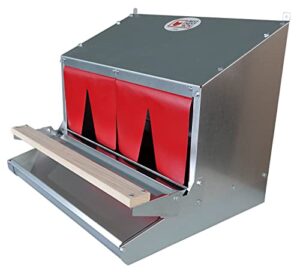
If you’re serious about keeping eggs clean and unbroken, the Best Nest Box delivers. It holds up to 20 hens and uses a rollaway egg tray that moves eggs away from the flock immediately after laying.
The reversible design lets you collect from the front or rear — useful when coop layout is tight.
It’s built from galvanized and stainless steel, so it lasts.
Hens usually adjust within a week. Skip the straw inside; it blocks the rollout function.
| Best For | Backyard chicken keepers who want clean, unbroken eggs with minimal daily effort and a durable long-term setup. |
|---|---|
| Material | Galvanized & stainless steel |
| Capacity | Up to 20 hens |
| Weight | 23 lbs |
| Indoor/Outdoor Use | Indoor/coop |
| Ease of Cleaning | Removable polyethylene pad |
| Assembly Effort | Moderate |
| Additional Features |
|
- Rollaway tray moves eggs away from hens right after laying, cutting down on breakage and contamination
- Reversible front or rear egg collection gives you flexibility based on your coop layout
- Galvanized and stainless steel build means it’ll hold up for years without rusting out
- Price is noticeably higher than basic nest boxes or going the DIY route
- Hens can take up to a week to get comfortable with the new setup
- Using straw or bedding inside blocks the rollout function, so you have to skip what many hens prefer
2. DomeStar Wooden Nesting Eggs

Wood works where plastic fails. DomeStar’s nesting eggs are smooth, unfinished pine — no paint, no scent — so hens don’t reject them.
You get 8 eggs per set, enough to cover multiple boxes at once. Each one measures about 2.5 inches and sits toward the back of the compartment to mimic where hens naturally deposit.
They train new layers and break egg-eating habits without chemicals. Wipe clean with a damp cloth. Don’t soak them, or the wood swells.
| Best For | Backyard chicken keepers training new hens, families doing Easter crafts, or anyone after simple rustic home decor. |
|---|---|
| Material | Wood |
| Capacity | 8 eggs (decorative/training) |
| Weight | 0.52 lbs |
| Indoor/Outdoor Use | Indoor/outdoor |
| Ease of Cleaning | Smooth wood surface |
| Assembly Effort | No assembly |
| Additional Features |
|
- Natural wood feel and scent-free finish means hens accept them without fuss
- Eight eggs per set gives you solid coverage across multiple nesting boxes
- Smooth, unpainted surface is ready to decorate however you like
- Lighter than real eggs, so they won’t fool every hen or work for every display idea
- Hard wood makes carving a pain — stick to painting or markers
- Wood can swell if soaked, so you have to be careful when cleaning
3. ZenxyHoC Metal Chicken Egg Laying Box
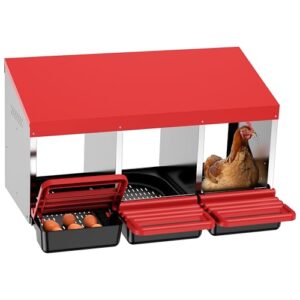
If you want metal that lasts, the ZenxyHoC is worth a look. It’s galvanized steel — three compartments, each about 9–10 inches wide, with a sloped floor that rolls eggs forward into a removable front tray.
That means no crushed shells, no pecking damage. The side vents keep air moving so nests stay dry.
It mounts to the wall, saving floor space. At 31×20×20 inches, it fits most standard coops and holds up against rust and coop cleaning products.
| Best For | Backyard flock owners who want a durable, low-maintenance nesting box that keeps eggs clean and saves space in a smaller coop. |
|---|---|
| Material | Galvanized steel & plastic |
| Capacity | Multi-hen |
| Weight | 21.5 lbs |
| Indoor/Outdoor Use | Indoor (wall-mount) |
| Ease of Cleaning | Removable plastic trays |
| Assembly Effort | Challenging |
| Additional Features |
|
- Galvanized steel holds up against rust and harsh cleaning products way better than wood
- The rollout floor moves eggs into a front tray automatically — no crushed shells, no pecking damage
- Wall-mounted design keeps the floor clear, which is a real win in tighter coops
- Assembly can be frustrating — small parts and instructions that aren’t always clear
- Needs to be mounted at the right angle or the rollout feature won’t work properly
- Some plastic components (like the trays) may wear down faster under daily heavy use
4. FEOKUMO Six Compartment Chicken Nesting Box
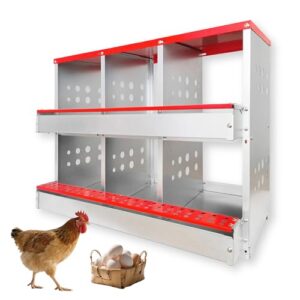
The FEOKUMO takes things up a notch — six compartments instead of three, all in a single-layer layout at 32.6" L x 16.9" W x 24.4" H. It’s galvanized steel, so rust isn’t a concern.
Each bay has a sloped floor that rolls eggs into a shared collection tray.
The hinged waterproof lid protects against rain and predators.
Elevating legs keep it off damp ground.
Note: compartments run tight for larger breeds like Rhode Island Reds, so measure before you buy.
| Best For | Backyard flock owners with multiple birds who want a low-maintenance, weather-resistant nesting setup that keeps eggs clean and intact. |
|---|---|
| Material | Galvanized steel |
| Capacity | Up to 6 hens |
| Weight | 28.1 lbs |
| Indoor/Outdoor Use | Outdoor/coop |
| Ease of Cleaning | Ventilated bays |
| Assembly Effort | Time-consuming |
| Additional Features |
|
- Six compartments handle larger flocks without crowding, and the roll-away tray makes egg collection genuinely easy
- Galvanized steel holds up in all weather — no rotting, warping, or rust like you’d get with wood
- Elevated legs and a waterproof lid add practical protection from moisture and predators
- Assembly can be a hassle, especially solo — budget extra time and maybe a second pair of hands
- Tight fit for bigger breeds like Rhode Island Reds, so double-check your birds’ size before ordering
- A few design quirks to watch for: sharp edges, alignment issues, and the egg-rolling system doesn’t always play nice with thicker bedding
5. Pecking Order Chicken Nest Box Pads
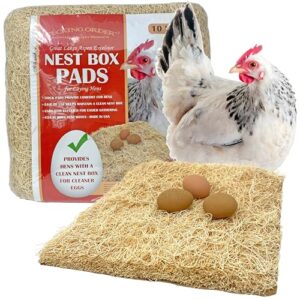
Nest pads aren’t a box — but they belong in this list.
Pecking Order’s excelsior wood fiber pads fit standard 13×13 inch boxes and do real work: they wick moisture away, cushion eggs on landing, and keep hens above wet litter.
The kraft paper backing holds the fibers together even with scratching.
Replacement takes seconds, which beats scooping loose shavings every time.
One heads-up — secure them with double-sided tape in plastic boxes or your hens will rearrange them before breakfast.
| Best For | Backyard chicken keepers who want cleaner eggs and an easier nesting box routine without dealing with loose bedding. |
|---|---|
| Material | Aspen excelsior & kraft paper |
| Capacity | 10 pads (single boxes) |
| Weight | 5.78 lbs |
| Indoor/Outdoor Use | Indoor/coop |
| Ease of Cleaning | Replaceable fiber pads |
| Assembly Effort | No assembly |
| Additional Features |
|
- Cushions eggs on landing and keeps them cleaner with a raised fiber structure that separates hens from droppings
- Kraft paper backing holds everything together even when hens scratch around
- Swapping out a pad takes seconds — way faster than digging out old shavings
- Aggressive scratchers can shred the fibers over time, shortening the pad’s lifespan
- May slide around in plastic boxes unless you secure them with double-sided tape
- Some hens take a while to adjust and might rip the pads apart at first
6. Eggluuz Green Chicken Nesting Box
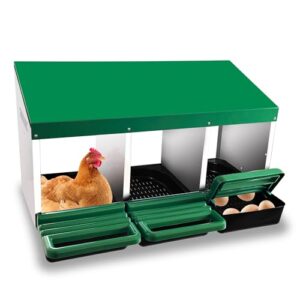
The Eggluuz Green Nesting Box gives you six compartments, galvanized steel framing, and an inclined egg roll design that guides eggs into a front collection tray without you reaching inside.
Mount it at 18 to 20 inches off the floor and standard hens step in clean.
The removable plastic trays rinse off fast.
Interior dividers cut down on pecking between birds.
It fits most backyard coops and the green enamel finish holds up outdoors without fading quickly.
| Best For | Backyard chicken keepers who want a low-maintenance nesting setup that keeps eggs clean and reduces breakage without daily hands-on effort. |
|---|---|
| Material | Alloy steel & ABS plastic |
| Capacity | Multi-hen |
| Weight | 21.55 lbs |
| Indoor/Outdoor Use | Indoor/outdoor |
| Ease of Cleaning | Removable ABS trays |
| Assembly Effort | Moderate |
| Additional Features |
|
- The rollout design guides eggs to the front tray automatically, so you’re not fishing around in the nest box or dealing with cracked eggs
- Galvanized steel framing holds up well outdoors and resists rust, making it a solid long-term investment for most coops
- Removable plastic trays make cleanup quick — just pull them out and rinse
- The plastic trays can get brittle or hard to remove over time, especially with frequent use
- Needs to be mounted at a specific height (18–20 inches) to work properly, so placement matters more than with a standard box
- Larger breeds like Brahmas may find the compartments a tight squeeze
7. Precision Pet Triple Nesting Box
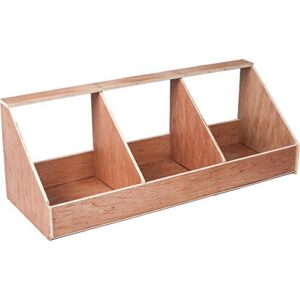
The Precision Pet Triple Nesting Box is a solid budget pick for small flocks. It’s made from thin press-plywood and assembles in about 5 to 10 minutes using pre-drilled holes.
Mount it at 18 to 24 inches off the coop floor, and most standard hens step right in.
Keep it indoors or under cover — it won’t hold up long in rain. The construction is fragile, so skip the power tools and reinforce weak joints with wood glue before your hens move in.
| Best For | Small flock owners who need a quick, affordable way to add nesting space inside their coop. |
|---|---|
| Material | Wood (press-plywood) |
| Capacity | Up to 3 hens |
| Weight | 9.43 lbs |
| Indoor/Outdoor Use | Indoor/covered |
| Ease of Cleaning | Basic open design |
| Assembly Effort | 5–10 minutes |
| Additional Features |
|
- Fast 5–10 minute assembly with pre-drilled holes
- Triple-nest design reduces hens fighting over the same spot
- Works inside or outside the coop, giving you flexible placement options
- Thin plywood splits and splinters easily — handle it gently during assembly
- Not weather-resistant, so rain will wreck it fast
- Instructions are vague, so expect a little trial and error to get it together
8. Pitalok Plastic Chicken Nesting Box
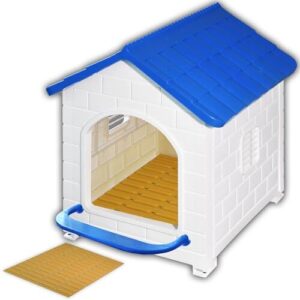
The Pitalok Plastic Nesting Box is built for coops that stay wet or dirty. It’s made from high-density polyethylene — no rust, no rot, and easy to wipe clean with soap and water.
Mount it 18 to 24 inches off the floor, and the built-in perch helps hens land cleanly before entering.
The snap-together design takes about 5 minutes.
One thing to watch: check for gaps near the base where toes can catch.
| Best For | Backyard flock owners and small farm operators who need a low-maintenance, easy-to-clean nesting box that holds up in wet or humid conditions. |
|---|---|
| Material | Plastic |
| Capacity | 2–3 hens |
| Weight | 5 lbs |
| Indoor/Outdoor Use | Indoor/outdoor |
| Ease of Cleaning | Washable nesting pad |
| Assembly Effort | 5 minutes (tool-free) |
| Additional Features |
|
- Snaps together in about 5 minutes — no tools needed
- Plastic construction won’t rust or rot, and wipes clean easily
- Works for both egg-laying hens and smaller animals like rabbits
- Some units feel flimsy, with parts that don’t always fit together well
- Gaps near the base can catch chicken toes, which is a real safety concern
- Pricier than similar options on the market
9. Touri Chicken Nesting Boxes
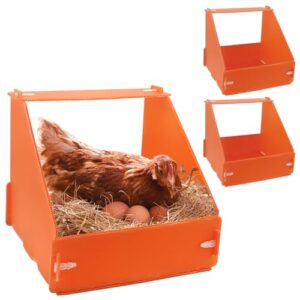
The Touri Chicken Nesting Boxes come as a set of three polypropylene units, each measuring 14.25 x 12.5 x 12.25 inches.
Mount them 18 to 24 inches off the floor for most laying hens.
They’re lightweight at 2.6 pounds each and snap together without tools using Velcro attachments.
The smooth interior surfaces clean up fast with a hose and mild soap.
One heads-up: the corrugated plastic won’t last as long as solid wood in permanent outdoor setups.
| Best For | Small flock owners who want a quick, no-fuss nesting solution for hens or ducks, indoors or out. |
|---|---|
| Material | Polypropylene (PP) |
| Capacity | 3 boxes included |
| Weight | 2.6 lbs per box |
| Indoor/Outdoor Use | Indoor/outdoor |
| Ease of Cleaning | Easy-clean PP surface |
| Assembly Effort | Tool-free (Velcro) |
| Additional Features |
|
- Snaps together in minutes with Velcro — no tools, no hassle
- Easy to clean and light enough to move around the coop as needed
- The bright orange color actually helps kick-start egg laying
- Corrugated plastic won’t hold up as long as wood in permanent outdoor setups
- Some chickens take a while to warm up to them — don’t expect instant results from every bird
- May need a few DIY tweaks (think duct tape or a box cutter) to get the fit just right
10. VEVOR 8 Compartment Chicken Nest Box
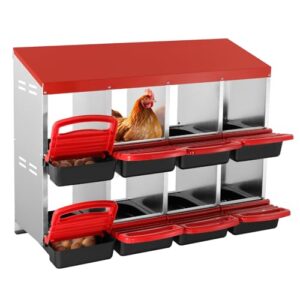
The VEVOR 8 Compartment Chicken Nest Box measures 41.7 x 20.6 x 31.4 inches and weighs 33.25 pounds.
Mount it 18 to 24 inches off the coop floor for standard breeds.
The inclined design rolls eggs forward into a covered storage area, which cuts breakage and simplifies collection. Galvanized steel resists rust and ammonia damage over time. Removable trays make cleaning straightforward.
Some users report misaligned holes during assembly, so keep a drill handy.
It’s a solid pick for flocks of eight or more hens.
| Best For | Flock owners with eight or more hens who want hands-off egg collection and a weather-resistant setup that holds up outdoors. |
|---|---|
| Material | Galvanized steel & PP plastic |
| Capacity | Up to 8 hens |
| Weight | 33.25 lbs |
| Indoor/Outdoor Use | Outdoor |
| Ease of Cleaning | Removable trays & drainage |
| Assembly Effort | Challenging |
| Additional Features |
|
- The inclined design rolls eggs into a covered compartment automatically, so breakage drops and collection takes seconds.
- Galvanized steel and PP plastic shrug off rust, ammonia, and wet weather without much maintenance.
- Removable trays make cleaning quick — no awkward scrubbing in tight corners.
- Assembly can be frustrating, with reports of misaligned holes, sharp edges, and warped plastic parts.
- It’s priced higher than many alternatives, and not everyone feels the build quality justifies the cost.
- Some chickens just won’t use the boxes, so you may still need a backup nesting spot.
Frequently Asked Questions (FAQs)
Can nesting boxes be mounted on exterior coop walls?
Yes, you can mount nesting boxes on exterior coop walls.
Use weather-resistant brackets, a watertight seal, and rot-resistant lumber.
Position them below the eaves to block rain and direct sun from the nest opening.
How often should nesting box height be reassessed?
Reassess nesting box height whenever your flock changes — new birds, aging hens, or seasonal shifts all matter.
Check every six months at minimum, and immediately after any hen shows signs of avoiding the box.
Should nesting boxes face a specific coop direction?
Face nesting boxes north to northeast. Morning light reaches the entrance, but harsh afternoon sun stays out. This keeps hens calm and eggs cool during daily checks.
Conclusion
nesting box height from ground right isn’t guesswork—it’s the quiet difference between a hen that lays clean eggs every morning and one that drops them on the floor.
Think of it like setting a table: everything in reach, everything steady.
Measure from the coop floor, account for bedding, match the height to your breed, and add a ramp if needed.
Do that, and your hens will do the rest.