This site is supported by our readers. We may earn a commission, at no cost to you, if you purchase through links.

A birdhouse sitting in full afternoon sun can hit 110°F inside—hot enough to kill eggs or stress nestlings within hours.
Most backyard birders pick a spot based on what looks nice or what’s convenient, never suspecting the placement is working against them. The shaded vs sunny birdhouse location debate isn’t just preference; it’s the difference between a thriving nest and an abandoned one.
Species like bluebirds actually need open sun to warm early clutches, while wrens seek canopy cover to dodge afternoon heat spikes.
Getting this balance right comes down to orientation, timing, and a few smart landscaping moves.
Table Of Contents
- Key Takeaways
- Should a Birdhouse Be in The Sun or Shade?
- How Sunlight Affects Birdhouse Interior Temperature
- Best Sun and Shade Balance for Birdhouses
- Does Birdhouse Direction Affect Nesting Success?
- Which Direction Should a Birdhouse Face?
- Should a Birdhouse Face Away From Prevailing Winds?
- Species-Specific Sun and Shade Preferences
- How Far Apart Should Birdhouses Be?
- Using Landscaping to Control Birdhouse Sun Exposure
- Ventilation and Materials That Support Shade Benefits
- Frequently Asked Questions (FAQs)
- Which direction should a bird house be facing?
- Should a bird house face away from prevailing winds?
- Does bird house direction affect nesting success?
- How far apart should a birdhouse be?
- Should a birdhouse be in the sun or shade?
- Why put a potato in your bird feeder?
- How high should a birdhouse be mounted?
- What predator guards work best for birdhouses?
- How often should birdhouses be cleaned each season?
- Does birdhouse color affect bird attraction rates?
- Conclusion
Key Takeaways
- A birdhouse in full afternoon sun can hit 110°F inside, which is hot enough to kill eggs or stress chicks within hours, so placement isn’t just preference—it’s survival.
- Facing your birdhouse east gives you the best of both worlds: gentle morning warmth for incubation and natural afternoon shade before temperatures peak.
- Different birds have different needs—bluebirds thrive with open sun and need boxes at least 100 feet apart, while wrens do best tucked near dense shrubs with an east-facing entrance.
- Light-colored roofs, top ventilation holes, and natural wood like cedar work together to keep interior temps safe even when shade isn’t perfect.
Should a Birdhouse Be in The Sun or Shade?
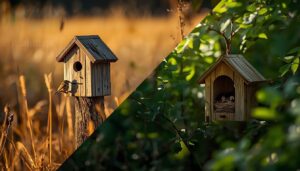
Where you hang a birdhouse matters more than most people realize. Sun and shade both play a role in keeping eggs safe and chicks healthy.
Too much direct sun can overheat a nest fast, which is why placement tips in this birdhouse location and sun exposure guide can save you a lot of guesswork.
what you need to know before you pick a spot.
Why Placement Affects Nesting Success
Where hang a birdhouse matters more than most people realize. The right spot manages nest temperature regulation, cuts predator visibility, and keeps humidity regulation in check — all without you doing much extra work. Research shows that nest cooling timing can differ by orientation, with some nests cooling up to 1.6 °C hr⁻¹ faster.
- sun and shade balance for birdhouses stabilizes warmth throughout the day
- Microclimate diversity across your yard gives birds safe nesting options
- Nest material dryness improves when heat stress prevention is built into placement
The Core Tradeoff Between Warmth and Overheating
Warmth helps chicks grow faster, but too much heat works against them. That’s the insulation tradeoff every birdhouse placement involves.
When insulation traps summer heat, interior temps can spike sharply — stressing metabolic rate and cutting fledging success. Thermal buffering through partial shade can drop peak temperatures 5–10°F, keeping birds within safe thermal limits. Smart sunlight exposure management and birdhouse orientation to avoid harsh afternoon sun are your best temperature regulation strategies.
| Condition | Interior Effect | Risk Level |
|---|---|---|
| Full afternoon sun | Temp spikes above 100°F | High |
| Partial shade | Drops peak temp 5–10°F | Low |
| Morning sun only | Gradual warmth, stable range | Ideal |
How Sun and Shade Impact Egg and Chick Survival
Sunlight exposure management makes or breaks a clutch. Too much afternoon heat drives egg temperature regulation out of safe range, speeding dehydration and triggering heat stress mortality before chicks even hatch. Shade keeps the thermal microclimate effects gentle and steady.
- Shaded nests hold moisture better, reducing chick dehydration risk
- Humidity control limits mold that threatens nestling comfort
- Morning sun aids temperature regulation without spiking peak heat
How Sunlight Affects Birdhouse Interior Temperature
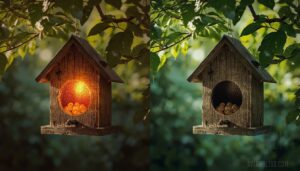
Sunlight does more inside a birdhouse than you might expect. a few degrees of difference can mean everything for eggs and growing chicks. Here’s how sun exposure shapes interior temperature throughout the season.
Direct Sun Can Push Interior Temps Above 100°F
A birdhouse in direct sunlight can quietly become a danger zone. Solar radiation gain through unshaded walls drives the temperature inside a birdhouse past 100°F — sometimes hitting 110°F — even when outside air feels comfortable.
A birdhouse in direct sun can silently reach 110°F, even on a comfortable day
Box wall insulation slows it, but heat spike timing peaks mid‑afternoon, when it hits hardest. That crosses the egg viability threshold, and heat stress indicators appear fast.
Ventilation holes help, but placement matters more.
Morning Sun Vs. Afternoon Sun Exposure Differences
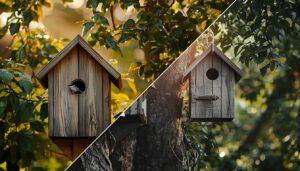
Not all sunlight hits the same. Morning sun offers gentle warmth that helps incubation timing without spiking interior temps — that’s your morning light benefits sweet spot.
Afternoon heat risks are a different story. The thermal gradient inside a box can climb fast after noon, creating real heat stress. Afternoon shade for temperature regulation isn’t optional; it’s how you keep things balanced.
Seasonal Temperature Shifts and Their Nesting Impact
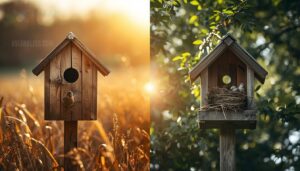
Seasons don’t stay predictable anymore. Spring heat waves can push interior nest temperatures past safe levels before you’ve even thought about adjusting placement. Meanwhile, autumn cold snaps slow chick development right when it matters most.
Temperature lag effects mean your birdhouse microclimate reacts slowly to sudden shifts — creating a phenology mismatch where food availability timing and hatching fall out of sync.
Shade and sun balance, paired with ventilation holes, helps buffer those seasonal temperature fluctuations and reduce heat stress in birds.
Best Sun and Shade Balance for Birdhouses
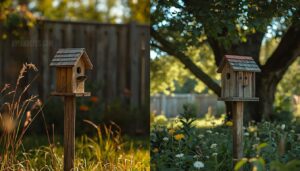
Getting the light balance right doesn’t have to be complicated. A few simple adjustments to where and how you position your birdhouse can make a real difference for nesting birds.
Pairing good placement with the right structure also matters — tile birdhouses built for different climates naturally handle light and heat far better than standard wood designs.
Here’s what works best depending on your setup and climate.
Morning Sun and Afternoon Shade as The Ideal Formula
Think of it like a cozy morning coffee spot — warm early, cool by noon.
Morning sun gives nestlings microclimate comfort and helps adult birds start foraging sooner, while afternoon shade kicks in before heat peaks.
This seasonal exposure pattern creates microclimate stability through natural thermal regulation and thermal inertia, keeping interior temperatures safe without any extra effort on your part.
How Partial Shade Reduces Mold and Mildew Buildup
Partial shade quietly does a lot of heavy lifting against mold and mildew. When afternoon shade keeps interior surfaces cooler, moisture evaporation happens more evenly — no sudden dampness spikes that fungus loves.
Here’s what that balanced shade-induced drying actually does for your birdhouse:
- Airflow Enhancement — shade paired with open surroundings boosts natural ventilation around the box.
- Humidity Regulation — interior humidity stays below the 60% mold threshold more consistently.
- Moisture Evaporation — surfaces dry between rain events instead of staying persistently damp.
- Mold-Resistant Finishes — mildew-resistant sealants perform better in partial shade than in full sun or deep shadow.
- Ventilation Holes — top-placed openings work with natural airflow to carry humid air out before it settles.
Adjusting Exposure Based on Local Climate Conditions
Your local climate is the starting point for every placement decision. In hot southern climates, prioritize shade — afternoon temps inside a sun-baked box can exceed 100°F.
Cooler northern regions need more sunlight exposure, especially in early spring.
Use deciduous tree timing to your advantage: bare branches let in winter warmth, summer leaves block afternoon heat.
Microclimate monitoring, latitude sun angle, and seasonal shade cloths help fine-tune balancing sunlight and shade for nesting success.
Does Birdhouse Direction Affect Nesting Success?
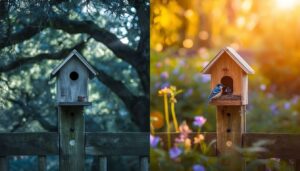
Yes, direction really does matter — more than most people realize. The way your birdhouse faces shapes everything from morning warmth to rain exposure and summer heat stress.
Here’s what you need to know about the three key orientation factors that directly affect nesting success.
East and Southeast Facing Entrances Explained
Facing your birdhouse east or southeast is one of the simplest wins in nest microclimate control. An east-facing birdhouse catches dawn light benefits — gentle morning sun that dries overnight moisture and warms the cavity early — while afternoon shade keeps things cool when heat peaks.
Seasonal sun angle stays favorable, too.
That’s your ideal sun and shade balance for birdhouses, with natural entrance wind shielding built right in.
Why West-facing Birdhouses Cause Heat Stress
West-facing birdhouses are a different story. Westward Radiant Heat hits hardest during afternoon hours — exactly when temperatures peak.
Without a natural cooling effect, the temperature inside birdhouse cavities can push past 100°F. Urban Heat Amplification, shade structure deficiency, and heat retention materials all compound the problem.
Here’s what looks like in practice:
- Eggs and chicks overheat fast
- Ventilation alone can’t keep up
- Surface albedo impact worsens without light-colored roofs
How Orientation Affects Rain and Wind Protection
Orientation does double duty — it manages rain too, not just heat. An east-facing entrance stays sheltered from afternoon wind gusts that drive rain sideways into the box.
A proper Roof Pitch Angle and Rain Splash Guard channel water away cleanly. Add Entry Recess Depth and Sidewall Baffles, and you’ve cut rain intrusion by roughly 30 percent during heavy showers.
Which Direction Should a Birdhouse Face?
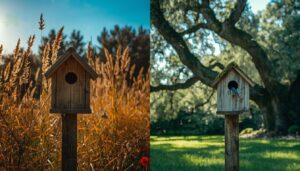
Once you know the right balance of sun and shade, direction becomes the next piece of the puzzle. The way your birdhouse faces can make a real difference depending on where you live.
Here’s works best for different climates.
North or East Facing for Hot Southern Climates
If you live in a hot southern climate, a north-facing or east-facing birdhouse is your best bet.
North-facing placement uses natural albedo materials and thermal mass reduction to limit heat gain during peak hours.
East-facing birdhouses catch gentle morning sun, then benefit from a natural cooling effect all afternoon.
Simple sun path analysis and microclimate mapping help you dial in the ideal orientation angle optimization for your yard.
South Facing to Retain Warmth in Cooler Regions
In cooler regions, a south-facing birdhouse works like passive solar design — it pulls in steady winter sun and holds warmth longer. Materials like natural wood support heat-retaining qualities, and south wall insulation keep nest temps stable overnight.
A bit of temperature monitoring helps you catch cold spells early. For most birds, that extra warmth makes a real difference during early spring nesting.
Adding Overhangs to Reinforce Directional Protection
Even the best birdhouse orientation gets a boost from a well-placed overhang. A 6–18 inch overhang blocks rain and cuts sun exposure at the entrance — that’s angle optimization working quietly in your favor.
Choose durable, light-colored wood for material durability and wind uplift resistance.
Check fasteners each season for overhang maintenance, and consider adjustable designs for seasonal adjustability as shade needs shift.
Should a Birdhouse Face Away From Prevailing Winds?

Wind direction matters more than most people think when placing a birdhouse. A poorly positioned entrance can turn a cozy nest into a cold, damp one — fast.
Here’s what to think about when working with the wind instead of against it.
Positioning The Entrance Opposite Wind Direction
Facing the entrance away from prevailing winds is one of the simplest birdhouse direction wins you can make. Think of it as Entrance Shielding Geometry — your box becomes its own windbreak. This Draft Minimization Strategy keeps the nest cavity calmer and warmer without extra effort.
- Reduces direct gusts hitting the doorway
- Lowers wind pressure differential inside the cavity
- Maintains stable interior temperatures year-round
- Allows Seasonal Wind Adaptation with flexible mounting angles
- Pairs well with Structural Reinforcement Details like small overhangs
How Wind Exposure Increases Interior Moisture
Wind exposure does more than chill a nest — it drives moisture straight through gaps and joints. That’s pressure infiltration at work.
Windborne moisture sneaks past any envelope leakage around the entrance, raising the humidity inside and creating real condensation risk. A heavy moisture load soaks nesting material, which harms eggs and chicks.
Wind exposure reduction is essential for ventilation and humidity control in birdhouses.
Using Vegetation and Structures as Natural Windbreaks
Think of your yard as a puzzle — trees, shrubs, and fences are the pieces that lock wind out. Layered planting using evergreen hedge density up front and a shrub middle row gives you reliable wind exposure reduction year‑round.
Porous fence design and berm‑shrub integration extend that shelter further. Structural overhangs add a finishing layer, while vegetative cover delivers natural cooling effects that improve birdhouse placement dramatically.
Species-Specific Sun and Shade Preferences
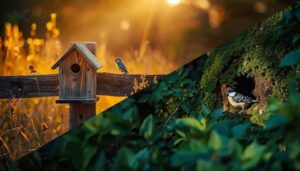
Not every bird wants the same real estate. Some species love full sun while others would rather nest in the cool shade of a shrub.
Here’s how a few common backyard birds stack up regarding sun and shade preferences.
Bluebirds Thrive in Sunny, Open Field Placement
Bluebirds are true sun lovers. They need open areas with short grass, scattered perches, and clear sight lines — classic sunlit foraging zones where insects are easy to spot and snag.
Morning sun warms the box early, supporting thermal development in nestlings and steadier incubation rhythms.
field perch availability and open habitat thermoregulation even influence clutch size variation across the season.
Aim for an sun and shade balance, but lean sunny.
Wrens Prefer Shaded Spots Near Dense Shrubs
Wrens are wired differently than bluebirds. They want cover, not open sky.
Place wren houses 5–8 feet high, tucked within 3–8 feet of dense vegetation for shade canopy and birdhouse placement that works with their instincts:
- Dense vegetation provides leaf litter habitat and escape perches
- Shade canopy helps nest humidity control during warm afternoons
- Microclimate creation for nesting comfort reduces temperature spikes
Face entrances east, and keep territorial spacing at a minimum of 25 feet.
Purple Martins and Swallows Need Open Sun Exposure
Unlike wrens, purple martins and swallows live for the open sky. Both thrive with full sun exposure — it drives sun-driven nest initiation in spring and delivers early morning warmth that gets colonies moving fast.
That open sky preference also creates an insect foraging boost around the house.
Place boxes in open areas, south-facing birdhouse style, and let colony heat dynamics do the rest.
How Far Apart Should Birdhouses Be?
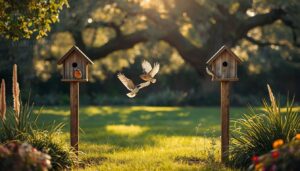
Spacing your birdhouses right distance apart can make or break your backyard nesting season. Too close together, and birds start fighting over territory instead of raising chicks.
Here’s what works for the most common setups.
25–30 Ft Minimum Spacing for Most Species
For most cavity-nesting species, keeping birdhouses 25 to 30 feet apart is the sweet spot. That gap prevents territory overlap, cuts down on disease transmission between neighboring pairs, and promotes microhabitat diversity around each box.
Good birdhouse spacing also simplifies occupancy mapping during your seasonal checks. Think of it as giving each pair their own little neighborhood — spacing strategies to reduce territorial conflicts really do make a difference.
Bluebirds Require at Least 100 Ft Between Boxes
territory size, bluebirds play by stricter rules. Each pair needs at least 100 feet between boxes — some enthusiasts push that to 150–300 feet in open fields.
Here’s why birdhouse spacing matters so much for bluebirds:
- High pair density increases competition pressure at feeding and nesting sites.
- Closer boxes often let one dominant pair claim multiple boxes.
- Proper spacing strategies to reduce territorial conflicts boost breeding success.
- Habitat connectivity improves when each pair has room to forage freely.
- Best sun and shade balance for birdhouses works best when sunlight exposure isn’t shared across crowded territory.
Colony Nesters Like Purple Martins Follow Different Rules
Purple Martins flip the spacing rulebook entirely. While bluebirds need elbow room, colony nesting requirements for purple martins mean houses clustered about 60 feet apart work best. Colony hierarchy determines who gets prime cavities, so cavity competition is healthy here — expected, even managed.
| Purple Martin Placement | Guideline |
|---|---|
| Spacing between houses | ~60 ft apart |
| Predator exclusion | Baffles and guards required |
| Landlord monitoring | Weekly nest checks |
| Nest turnover | Clean between broods |
| Best sun exposure | Full open sun |
Using Landscaping to Control Birdhouse Sun Exposure
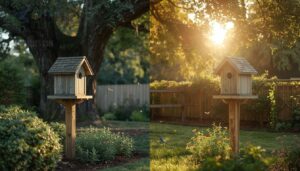
Your yard itself can do a lot of the heavy lifting regarding managing sun exposure. A few smart landscaping choices — natural or built — can make a real difference in how comfortable your birdhouse stays throughout the day.
Here are three practical ways to take control of the light.
Planting Shrubs and Trees to Create Afternoon Shade
Strategically planted trees and shrubs do the heavy lifting for afternoon shade.
Place deciduous canopy layering along your southwest edge — native maples or oaks work beautifully.
Use layered shrub heights, mixing 6–8 ft shrubs beneath taller trees for dense vegetation coverage.
Root-friendly tree placement keeps foundations safe.
Mulch moisture retention promotes healthy growth, and seasonal leaf timing ensures natural shading from the sun exactly when nestlings need it most.
Using Artificial Shade Structures Like Shade Sails
When trees aren’t an option, shade sails get the job done. Fabric UV Rating matters here — choose high-density polyethylene with at least 90% UV blockage.
Follow Sail Tension Guidelines (minimum 30-degree pull) to prevent flapping near your birdhouse. Good Installation Geometry keeps shade consistent during peak afternoon hours.
Use Hardware Corrosion Resistance-rated steel fasteners, and don’t forget Seasonal Sail Adjustment — remove sails in winter to extend fabric life.
Evaluating Sun Exposure at Different Times of Day
Walk your yard at three key times — 8 a.m., noon, and 3 p.m. — and note where direct sunlight falls on your birdhouse. Sun angle variations shift quickly, so what looks shaded at breakfast can turn into an oven by afternoon.
Morning sun is fine, but afternoon shade is what keeps interior temps from hitting that dangerous 100°F mark.
Ventilation and Materials That Support Shade Benefits
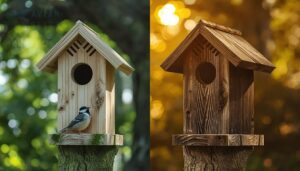
Shade from trees and structures helps a lot, but the birdhouse itself can do some of the heavy lifting too. A few smart material and design choices go a long way toward keeping things cool inside.
Here’s what actually has an impact.
Light-colored Roofs to Reflect Solar Heat
The color of the birdhouse roof matters more than most people realize. Light-colored roofs bounce back solar gain before it ever builds up inside, keeping nestlings safer on hot days.
- Albedo benefits drop interior temps considerably
- Reflective coatings work on existing roofs — no full replacement needed
- Roof material choices like white TPO offer lasting heat mitigation
- Some regions offer cool roof incentives worth checking
Ventilation Holes Near The Top for Heat Escape
Hot air rises — so put that to work. Upper vent positioning uses natural convection airflow design, letting heat escape right where it builds up most.
Small hole size calibration keeps predators out while still moving air efficiently.
On breezy days, wind-driven exhaust kicks in automatically.
Some builders even add adjustable vent shutters to fine-tune airflow when temperatures swing.
Choosing Wood Over Dark Metals for Natural Insulation
Wood is your best friend here — cedar and redwood are renewable materials that naturally insulate far better than dark metals. Wood’s cellular structure slows heat transfer, keeping interiors cooler during peak sun exposure. It also facilitates moisture management by breathing without trapping humidity.
Pair that with reflective roofs, and you’ve got a setup that manages thermal mass and carbon storage without any extra effort.
Frequently Asked Questions (FAQs)
Which direction should a bird house be facing?
Face your birdhouse east. That single choice captures gentle morning sun without the brutal afternoon heat. East-facing birdhouses warm nests gradually, supporting healthier incubation from the first light of day.
Should a bird house face away from prevailing winds?
Yes, face the entrance away from prevailing winds.
This simple shift blocks cold drafts, keeps rain out, and helps maintain nest microclimate consistency — giving eggs and chicks a steadier, safer environment through every season.
Does bird house direction affect nesting success?
Direction isn’t just a small detail — it’s the whole ballgame. Birdhouse direction directly shapes nesting success rate by controlling sunlight exposure, predator exposure, and thermal gradient inside the box.
How far apart should a birdhouse be?
Most birdhouses should be spaced at least 25 feet apart. That distance respects territorial spacing and reduces competition. Bluebirds need 100 feet. Purple Martins, colony nesters, do well at 50–60 feet between houses.
Should a birdhouse be in the sun or shade?
Both too much sun and too much shade can hurt nesting birds.
The sweet spot is morning sunlight with afternoon shade — that balance keeps interior temperatures safe and stable for eggs and chicks.
Why put a potato in your bird feeder?
Cooked potatoes offer cold weather support through high energy density and vitamin enrichment. Plain, bite-sized pieces attract species variety safely. Just skip the butter — feeding safety means plain food only.
How high should a birdhouse be mounted?
Think of birdhouse height like a Goldilocks problem — too low invites predators, too high makes cleaning a headache. For most species, 5 to 10 feet hits the sweet spot.
What predator guards work best for birdhouses?
Cylinder baffles and cone guard designs stop most climbers cold. Add an entrance hole reducer to block bigger threats.
Stainless steel or galvanized guard materials last longest.
spiked landing platform and proper baffle height complete your predator deterrence techniques.
How often should birdhouses be cleaned each season?
Clean your birdhouse at least twice a year: once as a Spring Pre‑Season Clean before nesting begins, and once as an Autumn Deep Clean after breeding ends.
Post‑Brood Cleanup between broods keeps things fresh.
Does birdhouse color affect bird attraction rates?
Yes, color of the birdhouse does matter.
Bluebirds favor blue-gray tones, wrens prefer neutral shades near shrubs, and matte vs glossy finishes affect heat buildup and camouflage predation risk differently across bird species’ preferences.
Conclusion
The birdhouse has been up for weeks—but something’s off. No birds.
The entrance faces west, catching every blast of afternoon heat. That single detail could be the whole problem.
Nailing the shaded vs sunny birdhouse location comes down to small, deliberate choices: morning sun, afternoon shade, east-facing entrance, and materials that work with the weather. Get those right, and birds won’t just visit—they’ll stay, nest, and raise young in a spot you built for them.