This site is supported by our readers. We may earn a commission, at no cost to you, if you purchase through links.
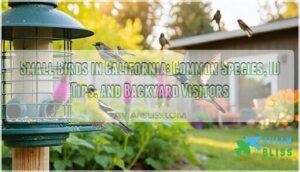 California’s small birds transform your backyard into a living theater.
You’ll spot year-round residents like American Goldfinches with their bright yellow feathers, House Wrens singing from fence posts, and tiny Calliope Hummingbirds—the state’s smallest bird at just 3 inches long.
Song Sparrows hop through gardens while House Sparrows gather in flocks.
These small birds in California include finches, wrens, sparrows, and kinglets, each with unique colors and behaviors that make identification easier once you know what to look for.
The right feeders, native plants, and water sources can turn your yard into a magnet for these feathered gems.
Table Of Contents
- Key Takeaways
- Common Small Birds in California
- Identifying Small Birds in California
- Attracting Small Birds to Your Yard
- Hummingbirds
- Small Birds That Visit Backyards in California
- Small Birds That Are Common in California
- Interesting Facts About Small Birds in California
- Bird Feeders for Small Birds in California
- How to Support Small Birds in California
- Frequently Asked Questions (FAQs)
- What is the tiny bird in California?
- What are the small birds in my yard?
- What does a California finch look like?
- What are the most common backyard birds in California?
- What are some common backyard birds in Los Angeles?
- Are there birds in California?
- Are there brown birds in California?
- Where can I go birdwatching in California?
- What is the state bird of California?
- What types of hummingbirds can be found in California?
- Conclusion
Key Takeaways
- You’ll spot California’s small birds like finches, wrens, sparrows, and hummingbirds by watching for unique colors, songs, and habits right in your backyard.
- You can attract more of these birds by providing the right feeders, planting native species, offering water sources, and letting some brush or long grass grow for shelter.
- Identifying small birds is easier if you pay attention to their size, shape, color patterns, behaviors, and the habitats they prefer.
- Creating a bird-friendly yard with native plants, fresh water, and hiding spots not only supports local bird populations but also gives you front-row seats to nature’s daily show.
Common Small Birds in California
You’ll spot a surprising variety of small birds in California, with each species showing off its own colors, songs, and habits.
California’s small birds light up the landscape with bursts of color, lively songs, and captivating backyard antics.
Whether you’re watching an Anna’s Hummingbird dash to a blossom or a Song Sparrow searching for seeds, these tiny neighbors are busy making the state come alive with their unique characteristics and habits.
Year-Round Residents
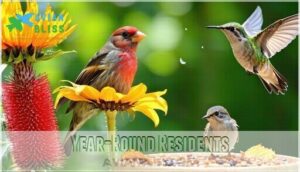
California’s year-round residents are the backbone of backyard birding.
These small birds California enthusiasts love include:
- House Finch: Males sport rosy faces while females stay brown-streaked
- Anna’s Hummingbird: Tiny powerhouses with iridescent red heads on males
- California Towhee: Ground-loving birds that explore urban habitats religiously
- House Sparrow: Aggressive at feeders but common small birds everywhere
These California birds show remarkable resident adaptations to diverse environments.
Sparrows and finches represent the largest group visiting feeders in California.
Summer Residents

Summer brings vibrant small birds to California’s landscapes.
These seasonal visitors arrive during breeding season, displaying unique nesting habits and migration patterns.
You’ll find them exploring diverse food sources across varied habitat preferences.
The American Goldfinch diet consists exclusively of seeds.
| Species | Nesting Habits | Food Sources |
|---|---|---|
| Yellow-billed Cuckoo | Dense leafy groves | Insects, caterpillars |
| Least Tern | Beach dunes | Fish, invertebrates |
| Elegant Tern | Coastal colonies | Schooling fish |
Small bird identification becomes easier as these California bird species establish territories for raising young.
Winter Residents
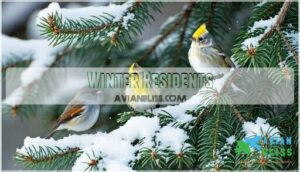
Winter brings a fascinating shift in California’s bird population as migrating species arrive seeking warmer climates.
Look for the Dark-eyed Junco, Golden-crowned Sparrow, and White-crowned Sparrow – these winter residents have mastered cold adaptations for survival.
Food scarcity drives their migration patterns, making your bird identification guide essential for spotting these visitors.
Their shelter needs include dense shrubs and evergreen trees that protect them from harsh weather conditions.
Identifying Small Birds in California
You can identify California’s small birds by examining four key features that work together like pieces of a puzzle.
Start with size and shape to narrow down the possibilities, then use color patterns, behavior, and habitat preferences to confirm your identification.
Size and Shape
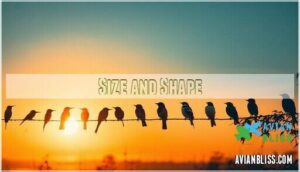
Looking at bird sizes starts with examining their overall silhouette and proportions.
Small birds California offers amazing diversity in shapes:
- Wingspan Variation – From tiny Bushtit’s 4-inch span to Northern Flicker’s 20-inch spread
- Bill Shape – Finches have thick seed-cracking bills, while hummingbirds sport needle-like beaks
- Tail Length – California Quail’s square tail versus Bushtit’s long, rounded tail
- Body Proportions – Compact sparrows contrast with elongated wrens
- Plumage Density – Fluffy winter feathers make birds appear larger
These features help distinguish species during bird identification, making your bird watching adventures more rewarding.
Color Pattern
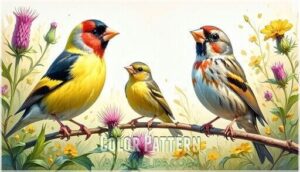
Three key color patterns help identify small birds CA instantly.
Male plumage often showcases vibrant hues while female plumage remains subdued for camouflage colors.
Seasonal variation transforms appearances—goldfinches shift from bright yellow to olive tones.
Iridescent feathers create stunning displays in starlings and hummingbirds.
| Bird Species | Male Colors | Female Colors | Key Markings |
|---|---|---|---|
| American Goldfinch | Bright yellow, black cap | Pale yellow-olive | Black wings, white bars |
| House Finch | Rosy red face/breast | Brown streaked | Streaky brown overall |
| Lesser Goldfinch | Black cap, yellow body | Olive-yellow | White wing patches |
| California Quail | Bold facial patterns | Plain brown | Distinctive head plume |
Behavior
Bird behavior reveals their identity through distinct patterns you can observe in your backyard:
- Foraging strategies – House Finches crack seeds while Yellow-rumped Warblers glean insects from leaves
- Vocalizations – Song Sparrows sing constantly during breeding season, mockingbirds mimic other species
- Social hierarchies – European Starlings form noisy flocks, while Anna’s Hummingbirds fiercely defend territory
- Migration patterns – Ruby-crowned Kinglets appear only in winter, House Finches stay year-round
These bird behavior patterns help distinguish species better than color alone.
Habitat

Once you understand how small birds behave, you’ll want to know where they actually live.
California’s diverse bird habitats offer something for every species. Urban habitats like parks and backyards support House Finches and sparrows. Forest habitats shelter Oak Titmice in oak woodlands, while coastal habitats host California Gnatcatchers in sage scrub.
Unfortunately, habitat loss threatens many species, making habitat restoration efforts essential for conservation.
- Oak woodlands – Oak Titmice thrive in these specialized forest habitats throughout California’s drier slopes
- Brushy areas – California Towhees adapt well to chaparral hillsides and urban gardens alike
- Coastal sage scrub – California Gnatcatchers depend entirely on this specific coastal habitat type
- Semi-open woodlands – Nuttall’s Woodpeckers prefer mixed tree coverage with open spaces for foraging
- Urban environments – House Finches and House Sparrows excel in human-modified bird habitats California
Attracting Small Birds to Your Yard

If you want small birds to visit your yard, offer a mix of feeders, water, and native plants.
Sometimes just leaving a brush pile gives them a place to hide, and you might be surprised who shows up for a snack.
Providing Bird Feeders
Now that you know how to ID those small birds CA, let’s talk food! Providing bird feeders California is a great bird attraction tip.
Different feeder types attract different small birds CA. Many people purchase specialized bird feeders for smaller species.
| Feeder Type | Seed Variety | Feeder Placement |
|---|---|---|
| Tube | Sunflower | High, Open |
| Platform | Mixed Seed | Ground, Table |
| Suet | Suet Cakes | Tree, Pole |
Don’t forget squirrel proofing and cleaning feeders. You’ll have a flurry of feathers in no time!
Water Features and Birdbaths
Consider harmony when adding water features.
- Select shallow water
- Make certain easy access
- Place in quiet areas
- Maintain freshness
Vary depth with rocks for backyard birds CA, attracting them with birdbaths and small bird baths. You can find various small bird bath models online.
Growing Native Plants
You can attract birds by growing native plants, which provide food and shelter.
You can find bird-friendly native plants online.
Check local nurseries for plant selection and design a native habitat in your backyard to attract small birds in California, enhancing your garden’s beauty and supporting local bird species.
Brush Piles and Long Grass
You create a welcoming nesting habitat by adding brush piles and long grass, offering predator protection and an insect source.
This setup also aids in seed dispersal and provides winter shelter for common small birds like sparrows and finches in California, aligning with their bird habitat preferences.
Hummingbirds
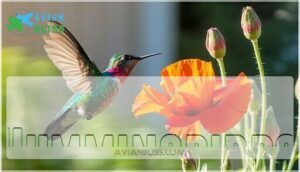
You’re likely familiar with hummingbirds, as they’re common visitors to California backyards.
As you learn more about these small birds, you’ll discover that species like Anna’s Hummingbird are year-round residents, with males sporting iridescent reddish-pink heads.
The Calliope Hummingbird is The Smallest Bird in California
Adding bird feeders sparked your curiosity about the natural wonders in California.
Did you know the Calliope Hummingbird‘s the tiniest of small birds California?
At just 3-3.5 inches long, it’s petite.
Fascinating, right?
To support these tiny hummingbirds, understand their life:
- Adaptive flights for survival.
- Incredible Calliope Migration across seasons.
- Unique Calliope Diet, sipping nectar but enjoying insects.
Consider a specialized Hummingbird Nectar Feeder near Calliope Habitat.
Calliope Nesting and Calliope Conservation are essential.
Other Small Hummingbirds in California
Broaden your hummingbird encounters beyond Calliope.
Watch for Rufous Hummingbird’s fiery colors, Allens Hummingbird with its coppery glow, and Black-chinned Hummingbird flashing purple.
Costas Hummingbird thrives in California deserts.
Each slightly bigger than Annas Hummingbird, but all dazzle with iridescence.
Keep feeders filled and eyes sharp for these small birds’ high-speed canopy antics.
| Common Name | Color Highlight | Favorite Habitat |
|---|---|---|
| Rufous Hummingbird | Fiery orange | Coastal chaparral |
| Costas Hummingbird | Purple throat flare | California deserts |
| Black-chinned Hummingbird | Glossy black chin | Forest glades |
Small Birds That Visit Backyards in California
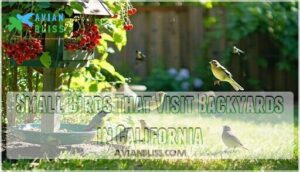
You’ll find plenty of small birds visiting California backyards, from chatty sparrows to energetic finches and curious kinglets.
Keep an eye out—these tiny guests love bird feeders and native shrubs, sometimes acting as if your garden was made just for them, enjoying the native shrubs.
Finches
Every backyard has its share of traffic, but finches always steal the show.
You’ll recognize a House Finch or American Goldfinch feasting on seeds, especially sunflower.
Listen for their cheerful finch sounds.
These small birds adapt to many finch habitats and sometimes migrate in flocks.
Look for messy finch nests tucked in shrubs—like tiny fortresses for their young, and note their ability to thrive in various finch habitats.
Wrens
The charm of wrens lies in their bold personalities packed into tiny bodies.
These small birds bring life to California backyards with their curious nature and impressive vocal range.
Here’s what makes wrens special backyard visitors:
- Wren Songs – House Wrens deliver loud, bubbling melodies that seem too big for their small size
- Wren Nests – They’ll build homes in birdhouses, old boots, or any cozy cavity they discover
- Wren Diets – These insectivores hunt spiders and bugs in dense vegetation and brush piles
- Wren Habitats – Bewick’s Wrens prefer yards with thick understory and natural cover for foraging
Sparrows
Sparrows hop through your yard with purpose, searching for seeds and insects beneath feeders.
The Song Sparrow stands out with brown streaks and constant singing during spring.
You’ll spot them in shrubby areas and open spaces, where their cheerful songs fill the air.
These small birds prefer ground foraging, making sparrow identification easier through their distinctive behaviors and sparrow habitats.
Kinglets
Ruby-crowned Kinglets frequently dart through California backyards, flashing their brilliant red crowns while hunting insects.
These tiny birds weigh just 0.2 ounces but pack remarkable energy into their olive-green bodies.
Kinglet identification becomes easier when you spot their distinctive wing bars and eye rings.
Kinglet behavior includes constant movement through shrubs and lower tree branches.
Their kinglet diet consists mainly of spiders and small insects.
Kinglet habitat preferences include areas with thick foliage for nesting.
Kinglet conservation status remains stable across California’s diverse small birds communities.
Small Birds That Are Common in California
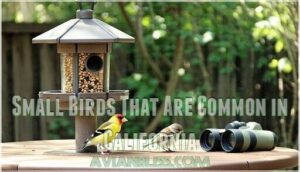
You’ll spot small birds like the American Goldfinch, House Sparrow, Song Sparrow, and House Wren in many parks, gardens, and neighborhoods across California.
These species are easy to identify, and they often show up in groups, so keep your binoculars handy—you might even catch one stealing a snack from your bird feeder.
American Goldfinch
How do you recognize American Goldfinch in California’s small birds? Males sport vibrant yellow plumage with black wings, while females display duller tones.
This finch undergoes complete molting annually, creating dramatic plumage variation between seasons. Their migration patterns take them from mid-Alberta to Mexico.
Nesting peaks in late summer for these birds.
- Diet Specifics: Prefers thistle and sunflower seeds
- Molting Process: Complete annual molt transforms appearance
- Conservation Status: Stable populations throughout California
These finches thrive in suburban areas with proper bird identification skills.
House Sparrow
Looking beyond flashy songbirds, you’ll find House Sparrows thriving in California’s urban landscapes.
These brown and grey birds aren’t native, but they’ve mastered city living. Males sport distinctive black bibs, while females show streaked brown plumage.
You’ll spot them year-round hopping around sidewalks, parks, and shopping centers. Their omnivorous sparrow diet includes seeds, insects, and food scraps.
They nest in building crevices, making sparrow control challenging for property owners. Despite their sparrow impact on native species, these adaptable small birds demonstrate remarkable survival skills in human-dominated environments.
Identification Tips
Presence in CA
Song Sparrow
You’ll spot Song Sparrows by their brown-streaked plumage and melodious Song Sparrow song that rings through wet, shrubby areas.
These small brown birds CA residents thrive in diverse Song Sparrow habitat from marshes to backyards.
Their Song Sparrow diet includes insects and seeds, making them frequent backyard visitors.
Watch for their Song Sparrow nesting in dense vegetation during spring breeding season.
House Wren
Your backyard might host these energetic House Wrens zipping through dense shrubs while hunting insects.
These small birds CA residents love sport brown plumage and surprisingly loud, bubbly songs with unique wren song variations.
Their wren diet focuses entirely on insects, making them excellent pest controllers.
House Wren habitat includes brushy areas near homes.
Wren nesting habits involve creative spots like old boots or mailboxes.
Wren conservation status remains stable throughout California.
Interesting Facts About Small Birds in California
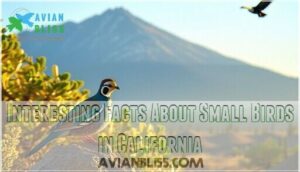
You’ll find that California’s small birds have some remarkable characteristics beyond their size and beauty.
The California Quail serves as the state bird, while the California Condor holds the distinction of being the largest bird species in the state.
The California Quail is The State Bird
Although small, the California Quail stands tall as your state bird, easily recognized by its unique topknot that dips with each step.
Adaptable to city parks and gardens, these native birds show off their social behavior by traveling in coveys and sharing lively "chi-ca-go" calls.
As the official state bird, it has been legally protected since 1931.
Want to connect? Try mimicking their whistle during bird watching in California.
Here are five quick facts:
- Crest function: signals mood
- Quail diet: seeds and insects
- Social birds: flock together
- Conservation efforts: fight habitat decline
- Represents California wildlife
The California Condor is The Biggest Bird in California
California’s skies aren’t just filled with tiny songbirds—they’re also home to the colossal California Condor. With a Condor Size that can reach a 9.5-foot wingspan, this bird’s shadow alone could surprise you on a sunny hike.
Check out this quick guide:
| Condor Habitat | Condor Diet |
|---|---|
| Coastal & inland | Carrion (dead animals) |
| Rocky cliffs, forests | Large mammals, fish |
Despite their size, these giants face serious Condor Threats, making Condor Conservation essential for California bird diversity and bird watching California.
Bird Feeders for Small Birds in California
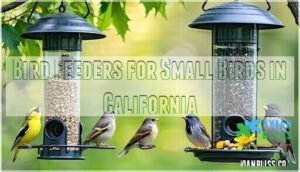
A good bird feeder can turn any yard into a mini-wildlife sanctuary, teeming with small birds keen for a snack.
If you want to boost bird attraction in CA, start with these essentials:
- Feeder Types: Tube feeders are great for finches and chickadees, letting them cling and eat with ease.
- Seed Variety and Feeder Placement: Nyjer seeds attract goldfinches; black oil sunflower seeds offer a solid bird diet for most small birds.
- Feeder Hygiene and Squirrel Proofing: Clean each feeder every few weeks to cut down disease.
Use baffles or metal cages to try a bit of squirrel-proofing. To prevent window strikes, consider applying window decals.
Try a simple DIY project—coat a pine cone in peanut butter, roll it in seeds, and enjoy easy bird feeding!
How to Support Small Birds in California
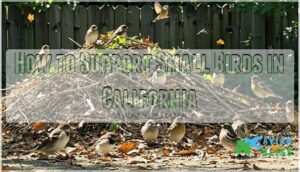
You can give California’s small birds an edge by planting native plants, setting out birdbaths, and making your yard safe.
Even a few changes—like leaving fallen leaves or adding a brush pile—turn your space into a busy bird hangout, though you might need to warn the neighborhood cat, and create a busy bird environment.
Planting Native Plants
Swapping store-bought birdseed for native plants sets the gold standard in bird attraction tips.
These plants act as all-you-can-eat bird buffets and safe havens for small birds. Head to local nurseries for the best plant selection and advice.
Check out the table below for quick ideas:
| Plant Selection | Native Benefits |
|---|---|
| Toyon | Winter berries, shelter |
| Manzanita | Nectar, nesting sites |
| California wildflower | Seeds for small birds |
| Elderberry | Attracting birds CA |
The use of local nurseries and selection of plants like Toyon and Manzanita can greatly enhance the bird attraction experience.
Providing Water Sources
Native plants set the stage, but every bird garden in CA needs water. A well-placed water source—think shallow birdbaths—quickly becomes the local hotspot.
Keep your setup interesting with moving water; birds can’t resist a bubbling fountain. Remember, cleaning bird baths keeps flocks coming back, even in winter.
Try varying water depth for all-size guests. Here’s how to boost birdwatching and attraction:
- Water source types
- Cleaning bird baths
- Winter water
- Natural sources
- Water depth
Creating a Bird-Friendly Habitat
Building a bird-friendly habitat is all about layering the right elements.
Tuck bird houses for small birds five to ten feet above ground, facing away from strong winds.
Mix in native plants for birds—they’re nature’s all-you-can-eat buffet and give reliable shelter options.
Brush piles in quiet corners act like hideaways for sparrows California and even those shy warblers California admires.
Water sources keep visitors returning, but skip chemicals for true safety.
You’ll soon spot more small yellow birds thriving in your yard.
Frequently Asked Questions (FAQs)
What is the tiny bird in California?
Despite "tiny" being subjective, California’s smallest bird is the Bushtit at just 8-1 inches long and weighing only 1-2 ounces.
You’ll spot these soft gray birds with long tails in open woodlands and backyards.
What are the small birds in my yard?
You’ll likely spot House Finches, Anna’s Hummingbirds, Song Sparrows, and European Starlings in your yard. These common California birds frequent backyard feeders and gardens year-round, creating delightful daily entertainment.
What does a California finch look like?
House Finches appear on 48% of summer checklists. Males display bright red heads and breasts, while females show brown-streaked patterns. You’ll spot their sturdy 5-inch frames at backyard feeders.
What are the most common backyard birds in California?
You’ll spot House Finches most often—they’re year-round residents with males showing red heads and breasts. Anna’s Hummingbirds, Song Sparrows, and European Starlings also frequent California backyards regularly.
What are some common backyard birds in Los Angeles?
Like a feathered neighborhood watch, you’ll find House Finches with their red-headed males.
Anna’s Hummingbirds hovering at feeders, Song Sparrows singing constantly, and European Starlings gathering in noisy flocks throughout Los Angeles backyards are also common sights.
Are there birds in California?
Yes, California hosts hundreds of bird species year-round. You’ll find House Finches, Anna’s Hummingbirds, Song Sparrows, and many others in backyards, parks, and wild areas throughout the state.
Are there brown birds in California?
While vibrant hummingbirds flash emerald and ruby, California’s brown birds offer subtle beauty.
You’ll find Song Sparrows, House Finches, European Starlings, and California Towhees displaying various brown tones throughout the state year-round, with California being a key location for these observations.
Where can I go birdwatching in California?
California offers fantastic birdwatching spots.
Visit Point Reyes for coastal species, Monterey Bay for diverse habitats, Central Valley wetlands for waterfowl, and local parks with feeders for backyard birds like finches and hummingbirds.
What is the state bird of California?
Legend has it, the California quail wears a fancy topknot like a crown.
You’ll spot these round, plump birds running in groups, calling “chi-ca-go!”
Their gentle personalities and family ties make them a beloved California symbol.
What types of hummingbirds can be found in California?
You’ll spot Anna’s Hummingbirds with their flashy pink heads darting among flowers.
Sometimes, you might catch a Rufous or Allen’s Hummingbird, buzzing like little jewels.
Keep sugar water out, and you’ll have feathered visitors.
Conclusion
Imagine your backyard as a stage where small birds in California perform daily.
By learning to spot finches, wrens, and hummingbirds, you become both audience and caretaker.
Use the right feeders, native plants, and water features, and you’ll see the cast grow.
Their songs, flutters, and colors turn ordinary spaces into vibrant habitats.
Stay observant, and remember—each visit is a new scene in nature’s play, making every yard a miniature wildlife sanctuary with small birds in California, creating a unique experience with their daily performances, which can be enhanced by the right environment, ultimately turning your yard into a place where you can enjoy nature’s play.
- https://www.audubon.org/news/get-know-bee-hummingbird-worlds-smallest-bird
- https://www.allaboutbirds.org/guide/Calliope_Hummingbird/overview
- https://www.nytimes.com/2023/04/17/us/california-biodiversity-conservation.html
- https://ebird.org/region/US/regions
- https://ca.audubon.org/news/hummingbirds-pacific-flyway-0