This site is supported by our readers. We may earn a commission, at no cost to you, if you purchase through links.
 Cardinals fly into windows because they’re either attacking their own reflection, thinking it’s a rival bird invading their territory, or they simply can’t see the glass barrier.
This behavior peaks during breeding season when territorial instincts run high. Your cardinal isn’t being stubborn – it genuinely perceives that reflection as a threat that needs defending.
Modern homes with large, reflective windows create perfect conditions for these collisions. Cardinals have sharp vision for spotting food and predators, but transparent and reflective surfaces throw them off completely.
The simple solutions involve breaking up those reflections and making your windows more bird-visible.
Table Of Contents
- Key Takeaways
- Cardinal Behavior and Perception
- Why Cardinals Fly Into Windows
- Preventing Cardinal Collisions With Windows
- Minimizing Reflection to Prevent Attacks
- Consequences of Cardinal-Window Collisions
- Reducing Future Collisions and Responding to Strikes
- Frequently Asked Questions (FAQs)
- Why do Cardinals fly at windows?
- Why do Cardinals fly into glass?
- Why do Cardinals attack Windows?
- Why does a cardinal keep flying?
- Why do Cardinals stare at windows?
- Why do cardinal birds collide with Windows?
- What does it mean when a red cardinal appears at your window?
- How to keep cardinals from attacking car windows?
- How to prevent cardinals from flying into Windows?
- Do Cardinals fly into car windows?
- Conclusion
Key Takeaways
- You’re dealing with territorial behavior, not stupidity – Cardinals can’t tell their reflection from a rival bird, so they’ll aggressively attack windows, thinking they’re defending their territory from an intruder.
- Your clear windows create invisible death traps – Cardinals see straight through glass as open flight paths, especially when windows reflect sky or vegetation that looks like safe passage.
- Simple solutions work better than expensive ones – You can prevent most collisions by closing blinds during breeding season, applying tape strips 4 inches apart, or repositioning bird feeders within 3 feet or beyond 30 feet of windows.
- Timing matters most for prevention – Cardinal window strikes peak during spring and summer breeding season, when territorial instincts run highest, so focus your prevention efforts during these critical months.
Cardinal Behavior and Perception
You’ve probably watched a cardinal repeatedly crash into your window and wondered what drives this puzzling behavior.
Cardinals can’t distinguish between their reflection and an actual rival bird, triggering their strong territorial instincts to defend their space.
Territorial Defense Instincts
Cardinals possess territorial instincts that transform them into fierce defenders during breeding season.
These birds will aggressively protect their claimed territory, which can span several acres, from any perceived intruders.
Here’s what triggers their defensive behavior:
- Territory size – Males defend up to 4 acres of prime real estate
- Breeding season aggression – Hormonal surges intensify their protective responses
- Resource competition – They’ll battle for food sources and nesting sites
This territorial defense creates the perfect storm for window attacks.
Reflection Confusion in Cardinals
When a reflection causes confusion in a cardinal’s mind, they mistake their own image for an intruder threatening their space.
Window clarity creates these bird window collisions because glass barriers remain invisible to their perception. Birds can’t distinguish between reflective surface dangers and actual territory threats, leading to window reflection problems and bird vision issues.
Reflection Type Cardinal Response Prevention Method
Visual deterrents help break these bird window reflection confusion patterns effectively.
Seasonal Patterns in Cardinal-window Interactions
You’ll notice these window encounters follow nature’s calendar with predictable intensity. Breeding season triggers the most aggressive territorial behavior, while migration patterns create additional collision risks throughout the year.
- Spring peak: Males defend territory with fierce window strikes
- Summer persistence: Continued aggression around active nests
- Fall migration: Increased collision risks during travel periods
- Winter feeding: More window visits near food sources
- Dawn/dusk activity: Seasonal bird behavior peaks during low-light hours
Impact of Window Placement on Collision Frequency
Location matters most in the context of window placement and cardinal collisions.
Ground-level windows near bird feeders create dangerous collision zones, especially when feeders sit 5-30 feet away.
Research shows buildings with higher glass percentages experience substantially more bird window collisions, with one study finding a 57% glass building responsible for 71% of strikes.
Windows facing open spaces or reflecting vegetation pose the greatest risks to cardinal vision.
Glass barriers become invisible obstacles when positioned near trees or shrubs that attract territorial birds.
Urban planning increasingly considers bird visibility factors when designing window-heavy structures.
Strategic window collision causes include proximity to habitat, feeder placement, and reflection angles that confuse cardinals into perceiving safe passages where solid barriers exist.
Understanding bird strike causes is vital to mitigating these collisions.
Cardinal Vision and Perception of Glass Barriers
Despite sharp eyesight perfect for spotting predators, cardinal vision struggles with glass barriers. Their brains evolved for natural environments, not transparent surfaces that create window reflections.
Glass perception fails because:
- Windows appear as open flyways to cardinal sight
- Visual cues from reflections trigger territorial responses
- Bird vision can’t distinguish glass from sky
This window collision causes tragedy for these beautiful birds. Cardinals exhibit aggressive behavior due to territorial defense mechanisms triggered by reflections.
Why Cardinals Fly Into Windows
You might wonder why these bright red birds keep attacking your windows with such determination.
Cardinals fly into windows for several specific reasons, from territorial instincts to simple confusion about what they’re seeing.
They’re Attacking Their Own Reflections
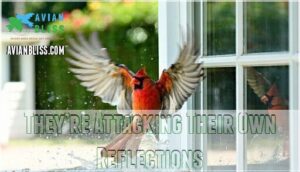
Cardinals mistake their own reflection for an intruding rival and launch aggressive window strikes to defend their territory.
This bird behavior stems from powerful territorial instincts that kick into overdrive during breeding season.
Your glass windows create perfect mirrors that trigger these territorial defense responses.
Male and female cardinals can’t distinguish between their reflection and an actual threat, leading to persistent bird window collisions.
These reflection attacks often continue for weeks as the cardinal attempts to drive away what it perceives as a competitor invading its space, due to its strong breeding season instincts.
They Don’t See a Physical Barrier
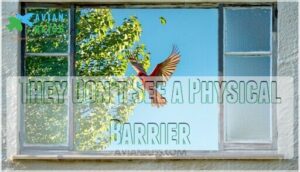
Unlike us, glass transparency issues create invisible barriers that cardinals simply can’t detect.
Your crystal-clear windows appear as open flight paths to these red birds, not solid surfaces.
Their bird vision system excels at spotting movement and bright colors but struggles with transparent materials.
Glass perception becomes nearly impossible when windows reflect sky or trees, creating perfect optical illusions.
Cardinals experience window reflections as extensions of their natural environment.
This visual barrier confusion explains why bird window collisions occur even without territorial behavior.
Cardinal attacks often result from this fundamental bird window safety challenge.
They Might Be Disoriented
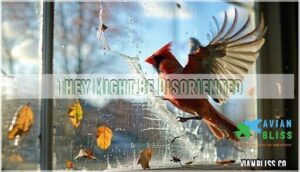
When disorientation strikes during migration or harsh weather, cardinals can’t distinguish between open sky and window clarity.
When harsh weather hits, cardinals become disoriented wanderers who can’t tell glass from open sky.
These flight patterns become erratic as bird navigation problems intensify.
Disorientation causes include:
- Weather conditions – Storms and poor lighting disrupt natural bird navigation systems
- Migration fatigue – Exhausted cardinals make poor judgment calls about reflections
- Light pollution – Artificial lighting confuses their internal compass during dawn and dusk
- Reflection effects – Glass surfaces create misleading visual cues that appear as open flight paths
Urban Areas and Window Attacks

City environments create a maze of glass barriers that challenge cardinals daily.
Urban planning often prioritizes aesthetics over bird safety, leading to countless reflective surfaces that confuse these territorial birds.
Your city’s towering buildings and modern window design amplify collision risks substantially.
Consider these urban hazards that affect cardinal bird behavior:
- Skyscrapers creating endless reflective corridors that trap migrating birds
- Street lighting disrupting natural navigation patterns during dawn flights
- Glass walkways forming invisible death traps in city habitats
- Reflective office buildings multiplying territorial threats through endless mirrors
- Modern architecture lacking bird deterrents despite known window collision risks, creating a significant urban hazard.
The combination of these factors results in a substantial risk to the birds, highlighting the need for bird safety measures in urban planning to mitigate the impact of reflective surfaces.
Environmental Factors Influencing Cardinal Window Strikes
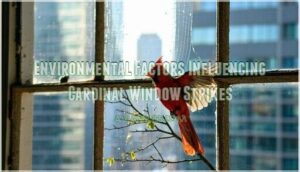
Several environmental factors create collision risks for cardinals at your windows.
Light pollution disrupts their natural navigation patterns, while glass clarity creates invisible barriers they can’t detect.
Weather conditions and seasonal changes increase territorial behavior, making window strikes more likely.
Urban planning that places reflective surfaces near bird habitats compounds these environmental factors.
Understanding these collision risks helps you implement effective bird collision prevention strategies around your home’s window reflection points, considering the impact of light pollution and the importance of natural navigation.
Preventing Cardinal Collisions With Windows
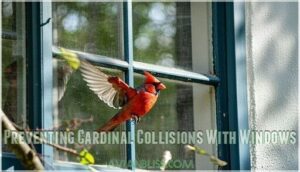
You can take several effective steps to prevent cardinals from colliding with your windows and protect these beautiful birds.
These methods focus on breaking up reflections and creating visual barriers that help cardinals recognize glass as a solid surface, using techniques to help them understand the glass is not a fly-through zone.
Window Treatments to Reduce Reflections
Glass films and window decals transform your home’s reflective surfaces into bird-safe barriers.
When cardinals see their reflection, they perceive a territorial rival that must be driven away.
Window strike prevention starts with disrupting these mirror-like illusions that confuse our feathered friends.
The use of window decals can be an effective solution to reduce bird collisions.
Here are effective window safety measures to protect cardinals:
- Window Decals with UV patterns create visible barriers while maintaining your view
- Reflective Tape applied in vertical strips breaks up window reflections effectively
- Glass Films reduce glare and make windows more visible to approaching birds
- Netting Solutions installed 2-3 inches from glass provide a safe bounce-back barrier
These bird friendly windows modifications work because they eliminate the optical illusion that triggers aggressive behavior, keeping cardinals safe while preserving your home’s appearance.
Bird-friendly Landscaping Techniques
Smart landscaping transforms your yard into a bird-friendly environment that naturally prevents window collisions.
Plant native plants like Eastern Red Cedar and Sweet Bay Magnolia as dense buffers 15-20 feet from windows, creating natural flight corridors.
Position bird baths and wildlife habitat features over 30 feet away from reflective surfaces.
This eco landscaping approach supports birdfriendly landscaping while implementing effective bird collision prevention strategies for your garden design.
Placement and Design of Bird Feeders
Feeder Placement transforms your yard into a cardinal sanctuary while preventing dangerous bird window collisions. Position bird feeders strategically to minimize collision prevention risks and reduce troublesome window reflections.
Smart feeder designs and window proximity planning protect cardinal flight habits with these birdfriendly solutions:
- Place feeders within 3 feet of windows to prevent momentum buildup
- Position feeders beyond 30 feet to avoid collision zones entirely
- Choose non-reflective, matte bird attractants that won’t confuse cardinals
Understanding key feeder placement tips is vital for creating a safe environment.
Use of Visual Deterrents on Windows
Visual deterrents transform your windows into bird-safe zones without blocking your view.
Window decals, bird stickers, and glass films placed four inches apart create visual barriers that stop cardinals mid-flight.
Reflective tape and window markings using bright chartreuse highlighters work as birdfriendly solutions.
These visual deterrents eliminate window reflections that trigger attacks, preventing bird window collisions while maintaining your home’s aesthetic appeal.
The use of window decals can be an effective method to prevent bird collisions.
Modifying Window Structures to Minimize Collisions
When you’re serious about stopping window collisions, structural modifications offer lasting solutions.
Installing exterior screens creates netting barriers that physically block impacts while preserving your view.
Bird-safe windows with built-in glass patterns or UV markings make glass visible to cardinals without affecting human sight.
Window films with frosted finishes provide affordable alternatives.
These frame designs and window markings transform dangerous surfaces into birdsafe windows, effectively reducing bird window collisions through permanent bird window deterrence.
Minimizing Reflection to Prevent Attacks
Reflections in your windows make cardinals think they’re seeing rival birds that need to be driven away from their territory.
You can stop these attacks by reducing or eliminating the reflections that trigger their aggressive behavior.
Place Bird Feeders in Locations Away From Windows

Strategic feeder placement transforms your yard into a cardinal-safe haven.
Position bird feeders within three feet of windows or beyond thirty feet to prevent dangerous window collisions.
Close placement reduces impact velocity, while distant feeder location minimizes reflection confusion.
This collision prevention strategy leverages bird behavior patterns, creating effective window safety without sacrificing your bird feeding enjoyment.
Keep The Drapes or Blinds Closed
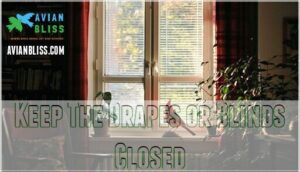
Closing drapes or blinds during peak territorial seasons effectively stops bird window strikes by eliminating window reflections that trigger aggressive responses.
This simple window blocking strategy requires no special equipment or permanent modifications to your home.
- Curtain placement during morning hours reduces reflection-based territoriality when cardinals are most active
- Shade adjustment throughout breeding season provides consistent light reduction without compromising indoor comfort
- Blind installation with light-filtering materials maintains visibility while preventing bird window collisions
Draw Invisible Lines With a Highlighter on The Window
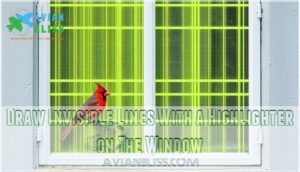
Try marking your windows with yellow highlighter lines – this trick breaks up bird window reflections while staying nearly invisible to you.
Cardinals spot these highlighter marks easily, preventing dangerous bird window strikes. Draw vertical lines four inches apart or create grid patterns for maximum effectiveness as bird deterrents.
Using a window highlighter tool can help create these patterns.
| Pattern Type | Effectiveness |
|---|---|
| Vertical Lines | High |
| Horizontal Lines | High |
| Grid Pattern | Highest |
| Diagonal Lines | Medium |
| Random Marks | Low |
These simple glass patterns work better than expensive window decals while protecting cardinals from harmful bird collisions.
Strategically Place Outdoor Plants in Front of Windows

Three strategic outdoor landscaping approaches create effective window barriers that prevent bird window collisions. Dense evergreen shrubs positioned two to three feet from windows disrupt reflections while maintaining your home’s curb appeal.
Native climbing vines on trellises offer year-round protection and attract cardinals to safer feeding areas away from glass surfaces.
Here are five plant placement strategies for birdfriendly design:
- Position tall ornamental grasses that sway naturally, breaking up static reflections
- Install container gardens with native plants for portable, seasonal protection zones
- Use dense shrub clusters to create visual depth between birds and windows
- Plant climbing vines on window-adjacent trellises for natural bird deterrents
- Arrange layered plantings at varying heights to eliminate clear flight paths to glass.
These strategies can help create a safe environment for birds and reduce the risk of bird window collisions, making your home more bird-friendly.
Cover The Window in Anti-Collision Decals

Anti-collision decals transform windows into visible barriers that stop bird window collisions.
Apply Visual Deterrents no more than 4 inches apart vertically or 2 inches horizontally for effective Collision Prevention. Bird Decals featuring butterflies, feathers, or leaves blend with your home’s style while preventing window collisions.
| Decal Type | Best Placement |
|---|---|
| Butterfly designs | Outside surface, eye level |
| Feather patterns | Full window coverage |
| Geometric shapes | Strategic spacing only |
| Reflective strips | Maximum visibility areas |
Window Films and anti-collision decals work best on exterior surfaces where cardinals spot them easily, ending those exhausting reflection battles.
Understanding bird safety measures is vital to reduce the number of bird window collisions effectively.
Consequences of Cardinal-Window Collisions
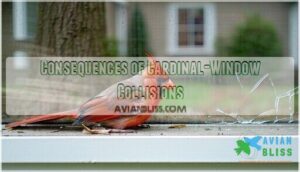
When cardinals repeatedly strike your windows, the consequences extend far beyond a simple bump. These collisions can result in serious injuries, ecological disruption, and even unexpected costs for homeowners.
Physical Injuries Sustained by Cardinals
Window strikes can cause devastating head trauma and concussions that leave cardinals stunned or unconscious.
These incidents can also result in broken wings that prevent flight, while beak damage makes feeding impossible.
Internal bleeding from blunt force trauma often proves fatal even when birds appear to recover initially.
These avian window collisions result in serious bird injuries that require immediate attention for survival.
Impact on Cardinal Populations and Ecosystems
Beyond single bird fatalities, bird window collisions trigger widespread ecosystem disruption through population decline.
Cardinals serve as vital seed dispersers and pest controllers—their loss creates cascading effects throughout local food webs.
Habitat loss compounds collision impacts, making conservation efforts essential for species survival.
Reduced cardinal numbers disrupt bird migration patterns, affecting regional biodiversity and bird conservation initiatives nationwide.
Psychological Effects on Surviving Cardinals
Cardinals experience significant trauma impact following bird window collisions, with lasting effects on bird brain function and behavior.
Stress response patterns alter their natural instincts, creating bird reflection confusion that persists long after initial incidents.
Surviving cardinals show distinct behavioral changes including:
- Avoidance patterns – steering clear of previously safe feeding areas
- Hypervigilance – constant scanning for perceived threats near reflective surfaces
- Social withdrawal – reduced interaction with other cardinals during recovery patterns
These social effects disrupt normal bird behavior, affecting everything from territory selection to mating success in future seasons.
Property Damage From Repeated Collisions
Repeated bird window collisions create measurable property damage that homeowners often underestimate.
Window repair costs mount quickly when cardinals persistently attack the same glass surfaces, causing chips, cracks, and frame deterioration.
Collision costs include glass replacement, paint touch-ups, and seal repairs.
Consider damage assessment for insurance claims when bird collisions prevention becomes necessary to protect your investment and home’s appearance.
Understanding bird window strikes is essential to implementing effective prevention measures and minimizing property damage.
Legal Implications of Bird Strikes
Federal laws protect cardinals under strict Liability Laws, making property owners potentially responsible for bird deaths.
Bird Strike Regulations require reasonable prevention efforts to avoid legal consequences.
Consider these protection steps:
- Install Window Safety Standards compliant deterrents
- Document prevention efforts for Collision Insurance claims
- Follow Avian Protection Policies in your area
Proactive bird collision prevention shields you from legal implications.
Reducing Future Collisions and Responding to Strikes
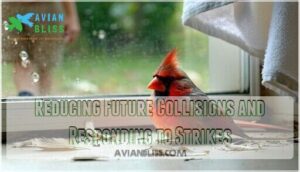
When a cardinal strikes your window, you’ll need to act quickly to help the injured bird and prevent future incidents.
Taking immediate steps for rescue and implementing long-term prevention strategies can save both individual cardinals and reduce ongoing collisions at your home, which involves considering complete concepts for effective solutions.
Immediate Actions for Injured Cardinals
When you discover an injured cardinal after a window strike, time matters.
Gently place the bird in a small, ventilated box lined with soft towels. Keep it in a quiet, dark, warm location away from pets and children.
Don’t handle the bird unnecessarily or offer food or water. Monitor for injury assessment signs like bleeding, wing drooping, or labored breathing.
This first aid approach gives injured cardinals the best chance for emergency care recovery.
Contacting Wildlife Rehabilitation Centers
When dealing with injured cardinals, wildlife rehabilitation centers serve as your lifeline for expert Bird Rescue services.
These Wildlife Care specialists operate 24/7 hotlines to guide your Injury Response efforts immediately. Contact your local Rehab Center before attempting any handling – they’ll assess whether the bird needs professional treatment or can recover naturally.
Keep their numbers saved now, not later. Most centers also support Conservation Efforts through community education about bird window collision prevention and bird safety measures.
Understanding bird injury assessment is essential for providing the right care and increasing the bird’s chances of survival.
Proper Handling and Transport of Injured Birds
When you find an injured cardinal after a bird window collision, proper handling becomes your lifeline to bird rescue success.
Wildlife rehabilitation centers need you to act fast but smart.
Safe Transport Methods:
- Capture carefully – Use a towel to gently place the bird in a ventilated cardboard box
- Keep it dark and quiet – Cover the container to reduce stress during transport
- No food or water – Injury assessment requires professionals; forced feeding can harm
- Handle minimally – Less contact means better survival odds
Bird safety measures start with your gentle touch.
These rehabilitation techniques give injured cardinals their best shot at recovery.
Transport the box flat and steady – no sudden movements that could worsen bird strikes damage.
Long-term Strategies for Reducing Future Collisions
Three key strategies protect cardinals long-term: permanent window treatments, strategic environmental design, and consistent maintenance.
Bird decals and window films offer lasting solutions, while net barriers provide foolproof collision prevention.
| Solution Type | Installation | Maintenance |
|---|---|---|
| Window Films | One-time application | Annual inspection |
| Bird Decals | Monthly replacement | Weather monitoring |
| Net Barriers | Professional setup | Seasonal adjustment |
| Glass Markings | DIY friendly | Touch-up needed |
| Collision Sensors | Technical install | Battery replacement |
Smart homeowners combine multiple bird window deterrents for maximum effectiveness.
Window collision prevention works best when you maintain these systems year-round, especially during peak migration periods when cardinals need protection most.
Community Education on Cardinal Conservation Efforts
Community awareness creates lasting change for bird conservation efforts and cardinal habitat protection.
Share window collision prevention tips with neighbors, organize workshops featuring window decals and bird window deterrents, or start social media campaigns about cardinal migration patterns.
Your education outreach and conservation strategies multiply when others adopt bird safety measures, creating networks of protected spaces where cardinals can thrive safely.
Frequently Asked Questions (FAQs)
Why do Cardinals fly at windows?
Cardinals fly at windows because they see their reflection and mistake it for a rival bird invading their territory.
This territorial aggression intensifies during breeding season when they’re protecting their nesting areas.
Why do Cardinals fly into glass?
Imagine this scenario: you’re enjoying your morning coffee when suddenly a flash of red crashes into your patio door.
Cardinals fly into glass because they can’t distinguish transparent barriers from open space, mistaking reflections for rival birds during territorial disputes, which is a key issue as they can’t distinguish transparent barriers from open space.
Why do Cardinals attack Windows?
You’ll notice aggressive territorial behavior when cardinals mistake their reflection for rival birds.
During breeding season, they’ll repeatedly attack windows, thinking they’re defending their territory from intruders that don’t actually exist.
Why does a cardinal keep flying?
You’re likely seeing territorial behavior during breeding season.
Cardinals can’t distinguish their reflection from rival birds, so they’ll persistently attack windows, mistaking their own image for an intruder in their territory, exhibiting a classic example of territorial behavior where they persistently attack.
Why do Cardinals stare at windows?
Your feathered visitor isn’t window shopping—they’re seeing a rival! Cardinals stare at windows because their reflection triggers territorial instincts. They’ll guard against this "intruder" relentlessly, especially during breeding season.
Why do cardinal birds collide with Windows?
Cardinals collide with windows because they’re defending their territory from what they perceive as rival birds.
They can’t recognize their own reflection, so they attack the "intruder" in the glass repeatedly.
What does it mean when a red cardinal appears at your window?
You’re witnessing nature’s comedy of errors—that red cardinal isn’t delivering divine messages, just attacking its own reflection out of territorial rage, mistaking your window for a feathered foe.
How to keep cardinals from attacking car windows?
Move your car away from the cardinal’s territory or cover side mirrors with cloth bags.
You can also apply tape strips to car windows or park in a different location until breeding season ends.
How to prevent cardinals from flying into Windows?
Sometimes life throws you a curveball when you’re least expecting it.
Apply colorful tape strips four inches apart on your window’s exterior, use anti-collision decals, or hang reflective ribbons nearby to break up those tricky reflections that confuse these bright red visitors.
Do Cardinals fly into car windows?
Yes, cardinals absolutely attack car windows and mirrors. They’ll aggressively peck at your vehicle’s reflective surfaces, mistaking their own reflection for territorial rivals during breeding season.
Conclusion
Nearly one billion birds die from window collisions annually in North America, with cardinals among the most frequent victims.
Understanding why do cardinals fly into windows helps you protect these vibrant birds from unnecessary harm.
Cardinals attack reflections during breeding season, mistaking their image for territorial threats.
They also can’t distinguish transparent glass as a solid barrier.
Simple solutions like closing blinds, adding decals, or repositioning feeders dramatically reduce collisions.
Your small changes can save countless cardinals from injury while preserving their natural behaviors.
- https://www.allaboutbirds.org/news/a-bird-keeps-flying-into-my-window-or-car-mirror-on-purpose-what-should-i-do/
- https://www.johnson.k-state.edu/programs/natural-resources/agent-articles/wildlife/stop-aggressive-cardinals.html
- https://www.wbu.com/window-strikes/
- https://www.massaudubon.org/nature-wildlife/birds/bird-window-collisions
- https://www.audubon.org/news/reducing-collisions-glass