This site is supported by our readers. We may earn a commission, at no cost to you, if you purchase through links.

Michigan hosts more than 30 species that flash yellow plumage—from the American Goldfinch perched at your feeder on a January morning to the endangered Kirtland’s Warbler tucked inside a jack‑pine stand that few birders ever find. That’s a wider cast than most people expect from a state known more for its winters than its warblers.
Yellow cuts through the green canopy the way few colors do, making these birds some of the most rewarding to spot once you know what to look for.
Whether you’re scanning a cattail marsh in May or filling your nyjer feeder before the first frost, knowing your species changes everything you notice.
Table Of Contents
- Key Takeaways
- Common Yellow Birds in Michigan
- Rare Yellow Birds in Michigan
- How to Identify Yellow Birds
- Where to Find Yellow Birds
- Seasonal Patterns and Birding Tips
- Frequently Asked Questions (FAQs)
- What bird is yellow in Michigan?
- Do goldfinches stay in Michigan all year?
- What is the most common yellow bird?
- What color is a Yellow Warbler?
- Are there yellow warblers in Michigan?
- Are yellow birds common in Michigan?
- What does a yellow bird look like in summer?
- What Michigan birds are yellow?
- What color is a yellow warbler?
- What kind of bird in Michigan is yellow?
- Conclusion
Key Takeaways
- Michigan is home to over 30 yellow bird species year-round, from the backyard-friendly American Goldfinch to the rare Kirtland’s Warbler (Setophaga kirtlandii), which staged a remarkable comeback from 167 males to roughly 2,300 breeding pairs after its 2019 delisting.
- Identifying yellow birds comes down to a handful of reliable clues — plumage pattern, bill shape, size, and behavior — since a seed‑cracker’s stubby bill and a warbler’s needle-thin one tell you almost everything before you even check the field guide.
- May is Michigan’s prime birding month, when spring migration pushes waves of warblers through hotspots like Tawas Point State Park, where the Lake Huron peninsula acts as a natural funnel for tired migrants.
- You can attract yellow birds to your yard year-round by pairing nyjer and black oil sunflower feeders with native plantings like serviceberry, little bluestem, and coneflower — food sources that outperform most commercial seed mixes.
Common Yellow Birds in Michigan
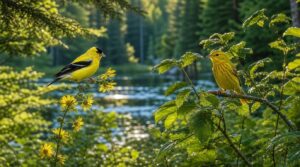
Michigan is home to some genuinely eye-catching yellow birds, and a handful of them show up so regularly that you’ll start recognizing them like old neighbors.
From the bright flash of a goldfinch at your feeder to a yellow warbler singing in the shrubs, Michigan’s most recognizable backyard birds have a way of turning an ordinary morning into something worth pausing for.
Whether you’re watching a feeder, walking a trail, or just glancing out the window, these species are the ones you’re most likely to spot.
Here are eight common yellow birds worth knowing.
American Goldfinch
If you’ve ever spotted a flash of bright yellow at your feeder, chances are it was an American Goldfinch (Spinus tristis) — Michigan’s most cheerful year-round resident.
Watch for these five field traits:
- Vivid yellow plumage with black wings
- Molt Timing shifts color dramatically each spring
- White wingbars visible mid‑flight
- Conical bill built for a strict seed diet
- Flock Dynamics peak at winter feeders
Fat Accumulation before migration keeps them going strong, and their Nest Construction uses plant fibers woven tight as fabric.
bouncy undulating flight helps them maneuver through open fields.
Yellow Warbler
Where the Goldfinch stays put, the Yellow Warbler (Setophaga petechia) is a seasonal traveler.
It breeds across Michigan’s willow thickets and wet stream edges — classic breeding habitat. Males defend territory with a bright, cheerful song.
Migration timing peaks in May, and nesting success depends heavily on dense, shrubby cover. Climate impact is shifting arrival dates earlier each year.
Common Yellowthroat
If Yellow Warbler loves streamside thickets, the Common Yellowthroat (Geothlypis trichas) takes that habitat preference one step further — this small warbler practically lives inside the marsh. Any field guide for Michigan birdwatchers lists wetland edges as prime habitat for these yellow birds.
Males wear a bold black mask and belt out that unmistakable witchety-witchety-witchety song, a territorial display you’ll hear long before spotting them.
Eastern Meadowlark
From marsh edges, step out into open country — that’s where the Eastern Meadowlark (Sturnella magna) thrives. A field guide for Michigan birdwatchers will point you straight to grassland habitat: farmland, hayfields, open meadows.
That bold yellow chest with its black "V" is hard to miss.
During breeding season, males sing flute-like whistles from fence posts — birdwatching in Michigan during spring migration doesn’t get much better.
Baltimore Oriole
One of Michigan’s most striking summer arrivals, the Baltimore Oriole (Icterus galbula) brings serious color to the canopy. That fiery orange comes straight from carotenoid pigmentation in the bird’s diet — not unlike how flamingos get their pink.
- Males dazzle with black-and-orange plumage during a courtship display
- Females weave a impressive hanging nest construction in tall deciduous trees
- Young birds show juvenile plumage development, gradually brightening each season
They winter on southern wintering grounds but reliably return to Michigan every May.
Cedar Waxwing
Few Michigan birds pull off "sleek" quite like the Cedar Waxwing (Bombycilla cedrorum). That pale yellow belly, waxy red wingtip detail, and bold black mask make it one of the more polished-looking yellow birds in your backyard.
| Cedar Waxwing Trait | Details |
|---|---|
| Berry Preference Shifts | Summer: insects + serviceberry; Winter: cedar, juniper |
| Urban Roosting Patterns | Flocks fruiting trees in suburban neighborhoods |
| Courtship Flight Displays | Males pass berries to females mid-perch |
| Nest Construction Materials | Grass, twigs, pine needles, plant fibers |
| Seasonal Molting Timing | Post-breeding, before fall migration begins |
Their habitat preferences of yellow-colored birds like waxwings lean heavily toward berry-rich edges — making fruiting shrubs your best backyard attractants to lure yellow bird species all season.
Yellow-Rumped Warbler
If you spot a flash of yellow rump darting through treetops during migration, that’s likely the Yellow-rumped Warbler (Setophaga coronata) — one of Michigan’s most dependable yellow birds. Seasonal migration patterns of yellow songbirds like this one peak in May and fall.
Habitat preferences of yellow warblers here favor mixed forests and shrubby edges.
Hybridization zones between Myrtle and Audubon’s subspecies produce fascinatingly varied plumage.
Palm Warbler
The Palm Warbler (Setophaga palmarum) is the warbler that walks. Ground foraging is its signature move — watch that constant tail wiggle as it picks through leaf litter and grass edges.
During a migration stopover in Michigan, you’ll find it in open fields and marsh borders, not treetops. Its fine, pointed bill morphology suits small insects perfectly.
Winter field preferences lean toward weedy, open cover.
Rare Yellow Birds in Michigan
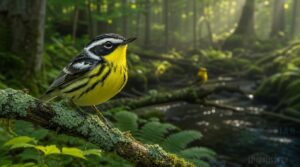
Not every yellow bird in Michigan is an easy find — some take real patience, a good map, and maybe a little luck. A handful of species show up only in specific corners of the state, during narrow windows of time, or in habitats most birders don’t stumble into by accident.
Here are the rare ones worth knowing.
Kirtland’s Warbler
Few birds have a comeback story quite like the Kirtland’s Warbler (Setophaga kirtlandii). This bold, yellow-breasted Michigan specialty was delisted in 2019 after decades of conservation work.
The Kirtland’s Warbler’s delisting in 2019 stands as one of conservation’s most remarkable comeback stories
Its habitat preferences are narrow — young jack pine age matters enormously, with stands between 5–20 years being ideal.
Territory mapping and cowbird control turned the tide, growing populations from 167 males to roughly 2,300 breeding pairs.
Prothonotary Warbler
The Prothonotary Warbler (Protonotaria citrea) looks almost tropical — that blazing golden-yellow head against blue-gray wings feels out of place in a Michigan swamp. Yet this species thrives in wetland habitat, showing strong territory fidelity year after year.
Its aquatic insect diet ties it closely to flooded bottomlands, and nest box design programs have genuinely helped. Weather-driven migration brings it back each April.
Hooded Warbler
The Hooded Warbler (Setophaga citrina) takes that wetland-warbler energy a step further into forest understory habitats. Males wear a striking black hood framing vivid yellow cheeks — hard to miss.
Watch for the signature tail flick display revealing white outer feathers.
Its insectivorous foraging stays low, hunting caterpillars through dense understory.
Migration timing peaks in May, making spring your best window.
Yellow-Breasted Chat
Now here’s a bird with serious personality — the Yellow-Breasted Chat (Icteria virens) is unlike any warbler you’ll encounter.
- Territory Display — males sing non-stop from dense brush using Mimicry Behavior, blending whistles, chuckles, and gurgles.
- Nest Site Selection — females build low nests inside tangled thickets near water.
- Winter Habitat Use — birds retreat to Central America after breeding.
- Population Monitoring — tricky, given its skulking habits.
- Yellow bird identification guide for Michigan — look for bold yellow chest, white eye rings, and stout bill.
A genuinely useful Birdwatching tip: trust your ears first.
Dickcissel
If the Yellow‑Breasted Chat tests your patience with its skulking ways, the Dickcissel (Spiza americana) rewards you with pure grassland drama.
| Feature | Details | Michigan Notes |
|---|---|---|
| Plumage | Yellow breast, black V‑throat patch | Males vivid; females paler |
| Habitat Preferences | Tallgrass prairies, hayfields, open pastures | Southern Lower Peninsula mostly |
| Flock Size | Hundreds to thousands during migration | Rare at Migration Stopovers here |
| Breeding Ecology of Michigan Yellow Birds | Polygynous; ground‑level cup nests | Sporadic; peripheral range |
| Conservation | Habitat Fragmentation Effects + Grassland Management key threats | Conservation Partnerships needed |
Spot it by ear first — its buzzy dick‑dick‑ciss‑ciss song carries far across open fields. For your bird identification guide, look for that bold chest V.
Habitat Fragmentation Effects push these grassland birds toward larger tracts, so check southern Michigan’s open farmland edges in early summer.
Yellow-Headed Blackbird
From open grasslands, shift your gaze to the marsh.
The Yellow-headed Blackbird (Xanthocephalus xanthocephalus) is one of Michigan’s most striking yellow bird species, with that blazing golden head against jet-black body.
Watch for Reed Nest Architecture over cattails, a Seasonal Diet Shift from insects to grain, and a raspy Territorial Song.
Wetland Roosting flocks and Migration Stopover Sites make this a memorable wetland habitats find.
Evening Grosbeak
Few Michigan winter visitors cause as much feeder chaos as the Evening Grosbeak (Coccothraustes vespertinus). Its Bill Morphology Adaptations — that thick, powerful beak — make short work of sunflower seeds.
Driven by Conifer Seed Preference and Irregular Winter Movements, Fluctuating Flock Sizes can swing from a handful to dozens overnight.
Check your range map in November; these chunky finches nest high, with Nest Height Variability reaching 100 feet.
Cape May Warbler
Spot a Cape May Warbler (Setophaga tigrina) during migration, and you’ve earned bragging rights. This boreal spruce habitat specialist passes through Michigan briefly, fueling up between its Canadian breeding season grounds and Caribbean wintering spots.
Its spruce budworm diet makes it boom-or-bust common. Watch for these five field marks:
- Bold yellow underparts with dark streaking
- Chestnut cheek patch on males
- Mossy green back for conifer camouflage
- Night migration timing peaks late April–June
- Thin, high-pitched territorial song structure
How to Identify Yellow Birds
So you’ve spotted a yellow bird — now what? Michigan has over 50 yellow-plumaged species, and telling them apart comes down to a handful of reliable clues. Here’s what to look for.
Yellow Plumage Patterns and Markings
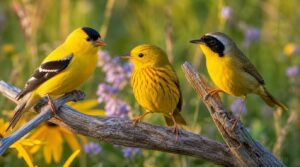
Not all yellow is created equal — and that’s actually good news for your identification skills. Yellow plumage in Michigan’s bird species runs from pale lemon to deep canary, with an iridescent yellow hue shifting depending on sunlight and seasonal molting shift.
Look for underwing yellow patches, head stripe patterns, and UV reflectance patterns to separate similar species.
This identification guide for yellow bird species in Michigan starts with pattern, not just color.
Male Vs. Female Color Differences
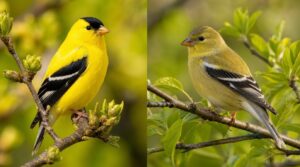
Sex is one of the easiest clues in your identification guide for yellow bird species in Michigan. Sexual dimorphism in birds means males usually wear brighter courtship plumage — think vivid canary yellow — while females carry muted tones that blend into nesting cover.
Seasonal color shift intensifies male brightness during spring. That contrast alone can settle your ID fast.
Size, Shape, and Bill Type
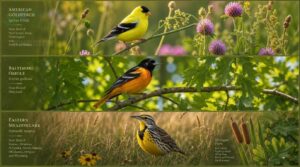
Size tells you a lot before you even raise your binoculars. In any identification guide for yellow bird species in Michigan, body proportion ratios are your first filter:
- Small (Goldfinch, warblers): 4–5 inches, chunky or slim
- Medium (Orioles): 6–7 inches, sleek build
- Large (Meadowlark): 7–9 inches, rounded
Bill length variation clinches it — seed crackers are stubby, insect catchers are needle‑thin.
Wing Bars, Eye Rings, and Masks
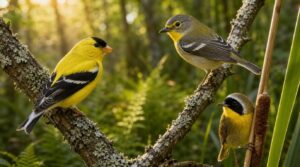
Once you’ve nailed size and bill shape, the details make the difference. Wing Bar Alignment — how pale bands sit across a folded wing — shifts between perched and flying birds, so always check both. Eye Ring Visibility depends on Ring Color Variation: American Goldfinch shows subtle rings, while Yellow‑throated Vireo flashes bold yellow ones.
| Feature | What to Check |
|---|---|
| Bar Contrast | Dark vs. pale wing panel |
| Mask Seasonal Changes | Broader in breeding males |
| Eye Ring | Yellow, white, or absent |
Mask Seasonal Changes catch many birders off guard — a Common Yellowthroat’s mask deepens noticeably in spring.
Tail, Rump, and Throat Color
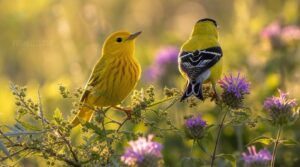
After masks and eye rings, shift your gaze lower — tail, rump, and throat color seal the deal.
- Yellow Warbler glows with a bright yellow throat, intensifying with seasonal intensity in throat color during breeding.
- American Goldfinch flashes diagnostic tail patches and a consistent yellow rump.
- Molting color changes dull rump patches during winter.
- Age-dependent hues leave juveniles looking washed-out, compared to vivid adults.
- Regional plumage variations subtly influence overall coloration.
Distinctive Songs and Calls
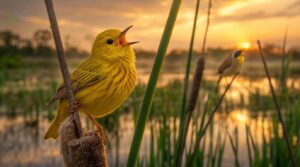
Once you’ve checked the tail and rump, let your ears do the rest.
The Yellow Warbler’s sweet, fluttering sweet-swee-swee and the Common Yellowthroat’s punchy whick-er-wick are practically name tags.
Territorial trills, mating duets, and alarm calls shift with the seasons — those seasonal vocal shifts are real.
Pull up bird vocalization recordings and flute-like whistles for Eastern Meadowlark will click immediately.
Behavior and Feeding Style
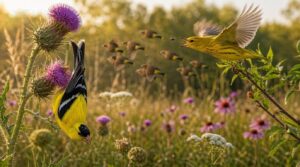
Watch how a bird moves — it tells you almost as much as its colors.
- Goldfinches use classic Seed Foraging Techniques, hanging upside-down on thistle heads.
- Warblers show Insect Hawking Behavior, snatching bugs mid-air.
- Meadowlarks display Territory Defense Behaviors through song and posture.
- Waxwings show Flocking Roost Dynamics, moving in tight, synchronized groups.
- Most species show Seasonal Diet Shifts — insects in summer, fruit or seeds later.
Similar Species to Compare
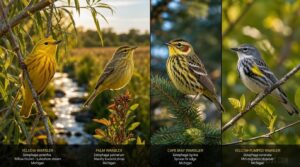
Once you’ve got behavior down, size and song help seal the deal.
Yellow Warbler and Palm Warbler look nearly identical in flight, but their habitats tell them apart — riparian thickets versus brushy lowlands.
Cape May and Yellow-rumped overlap during migration, but differ in chest streaking.
Common Yellowthroat’s sharp witchy-witchy call cuts through any warbler identification guide confusion fast.
Where to Find Yellow Birds
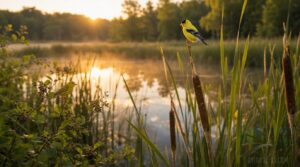
Michigan gives you a lot of ground to cover, but yellow birds aren’t hiding — they’re just waiting in the right spots. Once you know their favorite haunts, finding them gets a whole lot easier.
Here’s a look at the best places to start your search.
Backyard Feeders and Suburban Parks
Thistle feeders stocked with nyjer attract American Goldfinches reliably, while black oil sunflower seeds broaden the welcome mat to other birds.
Strategic feeder placement—near dense shrubs for cover—helps birds feel safe. Adding a shallow birdbath and keeping cats indoors further ensures a secure environment.
Let native plantings like asters do quiet, season-long work attracting yellow visitors, complementing feeders with natural resources.
Open Fields and Grasslands
Open fields and grasslands are where the Eastern Meadowlark truly shines — strutting through tall native grasses like big bluestem and Indian grass.
Grassland habitat covering roughly 20 percent of Michigan hosts rich insect food webs that feed yellow bird species of Michigan year‑round.
Seasonal fire regimes and prescribed burning maintain native grass diversity and edge habitat value, keeping American Goldfinches and meadowlarks coming back.
Wetlands, Marshes, and Stream Edges
Wetlands, marshes, and stream edges are some of Michigan’s richest birdwatching hotspots for yellow warblers and finches. Yellow Warbler and Prothonotary Warbler thrive where marsh plant communities meet slow water — shrubby thickets buzzing with edge invertebrate diversity.
Flood pulse ecology drives water level fluctuations that keep these habitats productive.
Watch for wetland-dependent birds along cattail margins, especially where invasive species control efforts have restored native vegetation.
diversity. Not might okay.
Jack Pine Habitat in Northern Michigan
Few birding destinations in Michigan feel quite as wild as the jack pine forests of the northern Lower Peninsula. These stands, rooted in acidic sandy soils with pH hovering around 4.5–5.5, thrive because of fire regimes that crack open serotinous cones and reset stand age — creating the habitat mosaic Kirtland’s Warbler depends on.
Here’s what makes this habitat tick:
- Stand age matters — young jack pines aged 4–15 years offer the open understory warblers need for nesting
- Seed banks persist through fire, fueling rapid regeneration on mineral soil after prescribed burns
- Soil acidity limits competing vegetation, keeping ground cover sparse enough for ground-nesting birds
Kirtland’s Warbler (Setophaga kirtlandii) is the headline act, but Yellow Warbler occasionally appears along shrubby edges nearby. Understanding the habitat preferences of these yellow-plumaged birds here means appreciating how fire, soil, and stand age work together.
Forest Edges and Shrubby Thickets
Forest edges are where the action is — and yellow birds know it. The edge microclimate influence creates warmer, sunlit pockets where insect abundance spikes, drawing warblers in quickly.
Shrub layer structure, with viburnum and dogwood reaching one to three meters, offers perfect nesting site selection cover. Edge disturbance regimes keep thickets open enough for habitat preferences of yellow warblers like Common Yellowthroat to thrive.
Farmland and Meadow Nesting Areas
Farmland might not look exciting, but it’s prime real estate for Eastern Meadowlarks and American Goldfinches. Edge habitat management — like field margin plantings with native grasses and wildflowers — quietly transforms ordinary crop borders into thriving grassland bird communities.
Mowing timing matters too; delaying it five to six weeks protects nesting chicks.
Pair that with predator deterrence strategies and nest success monitoring, and you’re genuinely supporting habitat preferences of yellow-colored birds.
Migration Hotspots Like Tawas Point
Beyond farm edges, migration is where things get really exciting. Tawas Point State Park is one of Michigan’s best birdwatching hotspots for yellow warblers and finches — the peninsula juts into Lake Huron, creating a natural Lake Huron Funnel that traps weary migrants mid‑flight.
Here’s what makes it worth your morning drive:
- Shoreline Habitat draws Yellow Warblers and Palm Warblers during peak migratory pulse in late April and May.
- Boardwalk Observation near the feeding station puts you within arm’s reach of active warbler flocks.
- Raptor Watch opportunities spike in fall, when Merlins and Cooper’s Hawks track the coastline hunting songbirds.
- Seasonal migration patterns of yellow songbirds shift daily with wind direction — north winds push the biggest fallouts.
Your identification guide for yellow bird species in Michigan gets a serious workout here.
Best Places for Spring Warbler Watching
Spring migration peaks in May, and a few spots rise above the rest. Riparian Woodlands along the Clinton River, Dune Scrub at Sleeping Bear Dunes National Lakeshore, and River Valley Thickets at Kensington Metropark all concentrate warblers beautifully.
| Location | Habitat Type | Yellow Birds Expected |
|---|---|---|
| Tawas Point State Park | Lake Shoreline | Palm, Yellow Warbler |
| Sleeping Bear Dunes | Dune Scrub | Yellow-rumped, Common Yellowthroat |
| Kensington Metropark | Prairie Margins | Common Yellowthroat, Goldfinch |
| Clinton River Corridor | Riparian Woodlands | Prothonotary, Yellow Warbler |
Birdwatching hotspots for yellow warblers and finches in Michigan reward early risers the most.
Seasonal Patterns and Birding Tips
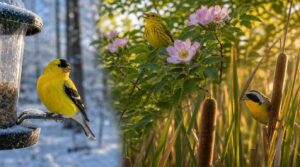
Michigan’s yellow birds don’t all follow the same calendar, and knowing when to look makes all the difference. Whether you’re stocking your feeder in January or heading out with binoculars in May, there’s always something worth watching for.
Here’s a breakdown of seasonal patterns and practical tips to help you find more yellow birds all year long.
Year-Round Yellow Birds in Michigan
A handful of yellow birds stick around Michigan all year — no suitcase needed. The American Goldfinch tops the list of yellow birds of Michigan for winter feeder visits, and citizen science reporting through eBird confirms Cedar Waxwings and Yellow-rumped Warblers follow suit.
Their cold weather behavior shifts with urban yard plantings like berry shrubs, revealing fascinating microhabitat selection tied to climate impact trends.
Summer Breeding Yellow Bird Species
When winter loosens its grip, Michigan’s summer breeders claim their territories fast. These species define the field guide to Michigan’s warblers and orioles:
- Yellow Warbler — weaves plant fibers into cup nests along stream edges
- Common Yellowthroat — defends breeding territory size with persistent song
- Baltimore Oriole — courtship display behaviors include elaborate song and posturing
- Eastern Meadowlark — parental care strategies include ground-nest brooding in tall grass
Spring and Fall Migrating Warblers
Migration transforms Michigan twice a year.
Males lead the charge in spring — that’s protandry timing at work — riding southerly winds north, while females follow days later.
Warbler migration patterns peak in May, when birdwatching hotspots like Tawas Point fill with movement.
Fall migration peak runs August through October.
Either way, stopover habitat matters enormously: birds need fat accumulation before crossing any serious ecological barrier.
Winter Yellow Birds at Feeders
Even in January, yellow doesn’t disappear from Michigan. American Goldfinches stay year-round, and feeder placement near shrubby cover gives wintering birds a safe perch.
nyjer and sunflower draw them reliably. Add a heated bird bath for winter timing, and you’ve covered the basics.
clear sightline helps with predator deterrence too, keeping backyard attractants genuinely useful.
Best Months to See Yellow Birds
May is the undisputed highlight for yellow birds in Michigan — Spring Migration Peaks bring waves of warblers through riparian thickets almost overnight. But the seasonal migration of yellow birds really spans more months than most birders expect:
- Spring Migration Peak: Late April through early June
- Early Summer Surge: June–July breeding activity peaks
- Late Summer Holdover: August lingerers before southbound push
- Winter Feeder Visits: December–February goldfinches at feeders
Foods That Attract Yellow Birds
The right food makes all the difference. Stock your feeders with a Nyjer Seed Mix for goldfinches, a Safflower Blend to reduce waste, and black oil sunflower seeds for broader appeal.
Add Mealworm Platforms for warblers craving protein, Sunflower Suet during cooler months, and Berry Sprays to pull in orioles and waxwings. These backyard attractants reliably lure yellow bird species all season.
Native Plants for Berries and Seeds
Think of your yard as a living pantry.
Berry shrubs like serviceberry and red osier dogwood deliver early fruit trees’ bounty right at your doorstep, while seed grasses such as little bluestem keep goldfinches busy well into fall.
Edge plantings of wild sunflower and coneflower round things out nicely — offering berries and sunflower seeds that beat most bird feeder seed types, hands down.
Conservation Tips for Rare Yellow Birds
Rare yellow birds don’t need much — just the right habitat and a little help from you. Here’s where to start:
- Habitat Restoration — Clear invasive species to recover native understory where warblers breed.
- Nest Box Installation — Place boxes near wetlands for Prothonotary Warblers.
- Community Monitoring — Join local counts to track water quality management and conservation status of Michigan’s yellow bird species.
Frequently Asked Questions (FAQs)
What bird is yellow in Michigan?
Michigan hosts 52 yellow-plumaged species, from the American Goldfinch to the Eastern Meadowlark. Statewide survey data and citizen science contributions confirm year-round sightings across forests, wetlands, and backyard feeders.
Do goldfinches stay in Michigan all year?
Yes — American Goldfinches are practically glued to Michigan year-round.
Winter residency varies by region, but feeder dependence and seed availability keep most around. Temperature influence and regional variation determine who stays or drifts south.
What is the most common yellow bird?
The American Goldfinch tops statewide survey results, appearing on 45% of summer eBird checklists across Michigan — making it the clear frontrunner for most common yellow bird you’ll spot here.
What color is a Yellow Warbler?
Picture tiny sun with wings.
The American Yellow Warbler blazes bright yellow overall, with olive-yellow back feather tone, soft underpart shade from throat to belly, and reddish chest streak hue on breeding males.
Are there yellow warblers in Michigan?
Absolutely — Yellow Warblers (Setophaga petechia) are a reliable Michigan presence.
They breed across the state from late May through August, favoring willow thickets and wetland edges throughout their warbler habitat range.
Are yellow birds common in Michigan?
Bright, radiant, and beautifully widespread — Michigan hosts 52 yellow-plumaged species, with Feeder Survey Data and Citizen Science Reporting confirming goldfinches and warblers appear on nearly half of all seasonal checklists statewide.
What does a yellow bird look like in summer?
In summer, males blaze with golden belly and lemon throat, often showing a bright head patch or feather sheen. Seasonal plumage peaks now — females stay softer, paler yellow.
What Michigan birds are yellow?
Michigan hosts over 52 yellow-plumaged species — from the year-round American Goldfinch to migrating warblers following ancient migration routes each May, painting the state gold.
What color is a yellow warbler?
Yellow Warbler is almost entirely bright yellow — think sunshine with wings. Males add chestnut breast streaks for contrast, while females stay softer and plainer.
That bold dark eye really pops against the pale face.
What kind of bird in Michigan is yellow?
From tiny warblers to bold orioles, you’ll find 52 yellow-plumaged species here — an extensive list of yellow-colored birds found in Michigan, spanning wide size variations, bill morphology differences, and plumage dimorphism across habitats.
Conclusion
Like a field guide that finally clicks into place, spotting yellow birds in Michigan transforms from a lucky accident into something you can actually plan for. You know the habitats, the seasons, the subtle field marks that separate a Pine Warbler from a Yellow-rumped on a cold October morning.
That knowledge sticks with you on every walk. Michigan’s yellow birds aren’t hiding—they’re waiting for someone patient enough to look.