This site is supported by our readers. We may earn a commission, at no cost to you, if you purchase through links.
Georgia hosts more than 30 species that flash yellow at some point during the year—a number that surprises most people who think of the state as songbird country rather than warbler territory.
Walk a pine ridge in January, and a Pine Warbler (Setophaga pinus) will work the cones overhead, as yellow as anything you’d see in May. Drive a rural highway in February, and an American Goldfinch flock will scatter from the roadside weeds like scattered sparks.
Knowing which species appears when, and where, turns a casual backyard sighting into something you can actually predict—and that changes the whole experience.
Table Of Contents
- Key Takeaways
- Common Yellow Birds in Georgia
- Year-Round Yellow Birds
- Summer Yellow Birds
- Winter Yellow Birds
- Migratory Yellow Birds
- Yellow Bird Identification Tips
- Yellow Birds by Habitat
- Feeding and Foraging Habits
- Attracting Yellow Birds to Yards
- Frequently Asked Questions (FAQs)
- Are goldfinches rare in Georgia?
- What is a yellow bird in Georgia?
- Are there Red Birds in Georgia?
- How do you identify birds in Georgia?
- Are bluebirds spotted all year in Georgia?
- What does a yellow bird look like in summer?
- Are black birds in Georgia migratory?
- How do I identify baby yellow birds?
- What are yellow birds predators?
- Which yellow birds nest in cavities?
- Conclusion
Key Takeaways
- Georgia hosts 30+ yellow bird species year-round, and knowing each species’ habitat — pine ridge, flooded swamp, open meadow — lets you predict sightings instead of stumbling into them.
- Seasonal and sex-based plumage shifts (like the goldfinch’s olive-to-lemon molt or the washed-out female Pine Warbler) are your fastest field clues, so learning what "dull" looks like matters as much as knowing the bright breeding colors.
- Migration brings bonus species like the Canada Warbler and Cape May Warbler through Georgia’s river corridors and barrier islands, with cold fronts and berry availability driving the timing more reliably than the calendar does.
- A backyard stocked with Nyjer feeders, native berry shrubs like serviceberry and dogwood, and a shallow birdbath can pull in goldfinches, Pine Warblers, and Cedar Waxwings without ever leaving home.
Common Yellow Birds in Georgia
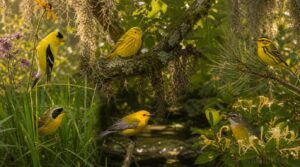
Georgia is home to a surprising number of yellow birds, and some of them don’t require a special trip — they’re right outside your window. Whether you’re new to birding or just trying to put a name to a flash of yellow in the trees, knowing the regulars is a great place to start.
From tiny warblers to bold goldfinches, Georgia’s most common backyard birds include ten regulars worth knowing by sight and sound.
Here are six yellow birds you’re most likely to encounter across the state.
American Goldfinch
Few backyard visitors make as bold an entrance as the American Goldfinch (Spinus tristis). Males undergo a dramatic molt timing shift—dull olive in winter, blazing lemon-yellow by breeding season—making them your own built-in identification guide to yellow birds in Georgia.
Their distinctive bright yellow plumage helps birdwatchers confirm identification.
Stock your seed feeders with nyjer or sunflower seeds, and they’ll come to you.
Pine Warbler
If goldfinches are the showboats of Georgia’s feeders, the Pine Warbler (Setophaga pinus) is the quiet local — always around, easy to overlook. This year-round resident sticks almost exclusively to pine forests across low and mid elevations.
Its steady canopy song is your best clue. Winter diet shifts to seeds and berries, making it a rare warbler you’ll actually spot at suet feeders.
Yellow-rumped Warbler
Now meet the one warbler that actually stays put. The Yellow-rumped Warbler (Setophaga coronata) — "butter butt" to birders — winters across Georgia in good numbers. Its Rump Patch Display is unmistakable in flight.
Here’s what to watch for:
- Myrtle Form — white throat, eastern Georgia standard
- Audubon Form — yellow throat, rare western stray
- Winter Fruit Forage — dogwood, wax myrtle, serviceberry
- Song Variation — soft, rising trill
Eastern Meadowlark
Unlike the forest-hugging warblers, the Eastern Meadowlark (Sturnella magna) dominates wide-open spaces. Its bold black V-shaped chest against vivid yellow underparts marks it as a true grassland species. Males deliver their flute-like Territory Song from fenceposts during Courtship Display—a sound that is unmistakable.
Birdwatching tips for spotting yellow birds in Georgia’s pastures: Look low and listen first.
Population trends, unfortunately, show a steady decline.
Cedar Waxwing
Here’s a bird that bends the rules a bit. The Cedar Waxwing (Bombycilla cedrorum) isn’t drenched in yellow, but those butter-yellow tail tips and pale yellow underparts earn it a spot in any identification guide for yellow birds in Georgia. Watch for social flocking behavior — these birds rarely travel alone.
- Wax Tip Display — bright red wingtip droplets, visible up close
- Fruit Migration Triggers — berry availability drives their movement more than temperature
- Winter Roosting — large communal roosts form in fruiting suburban trees
- Breeding Phenology — nesting runs June through August, late for a songbird
Yellow-throated Warbler
The Yellow-throated Warbler (Setophaga dominica) is one of Georgia’s most elegant canopy specialists. Its bright yellow throat, bold black mask, and crisp white wing bars make identification of this yellow bird species in Georgia refreshingly straightforward.
Known for its high-canopy calls and insect gleaning technique — probing bark and pine needles with surgical precision — this warbler shows impressive seasonal range stability. Often, it skips long migrations entirely.
Year-Round Yellow Birds
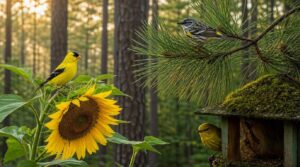
Some yellow birds don’t wait for a season — they’re simply always around. Georgia hosts a handful of species that stick close year-round, showing up in backyards, pine forests, and open fields no matter the month.
Here’s a look at the ones you can count on seeing any time you step outside.
American Goldfinch in Backyards and Fields
American Goldfinches (Spinus tristis) are probably already visiting your yard — you just might not recognize them in winter’s duller plumage.
These year-round Georgia residents reward smart feeder placement near open branches, where they practice predator awareness between feeding bouts.
Offer a seasonal seed mix heavy on nyjer and sunflower seeds. They’re ground-foraging opportunists too, gleaning dropped seeds beneath feeders.
Pine Warbler in Pine Forests
Pine Warblers (Setophaga pinus) practically live in the treetops — Georgia’s pine forest resident yellow birds rarely come down.
Watch for deliberate cone probing along high branches; that methodical foraging style is a key field-identification tip for yellow plumage. Their nesting substrate is a tidy cup wedged at a pine fork.
Understory density also matters — open stands with mature pines are prime territory.
That rich, flute-like warbler song seals the ID.
Eastern Meadowlark in Open Grasslands
Open fields are where the Eastern Meadowlark (Sturnella magna) truly owns the landscape. Its bold black V-shaped chest mark against sunshine-yellow underparts makes identification of yellow bird species in Georgia almost simple.
Three things help this grassland species thrive:
- Grass Height Mosaic — Mixed short and tall growth aids both foraging and nest camouflage.
- Mowing Timing — Avoiding cuts from March to July protects active nests.
- Predator Management — Maintaining dense litter deters ground predators.
Pair bonding starts early in the spring.
Yellow-rumped Warbler in Northern Georgia
Few winter visitors pull off a wardrobe change quite like the Yellow-rumped Warbler (Setophaga coronata). In Northern Georgia, it’s one of the most reliable cold-weather sightings you can expect.
| Feature | Winter | Spring |
|---|---|---|
| Plumage Seasonal Shift | Pale gray overall | Brighter yellow patches |
| Elevation Range | 300–1,000 m | Moves higher |
| Conifer Habitat | Dense mixed stands | Open canopies |
| Mixed Flock Dynamics | Dozens of birds | Pairs breaking off |
| Stopover Nutrition | Berries and suet | Insects dominate |
Resident Versus Seasonal Populations
Not every yellow bird you see in January is a year-round neighbor — some are just passing through. Resident species like the American Goldfinch and Pine Warbler maintain year-round territory with strong feeding site fidelity, returning to familiar backyards season after season. Seasonal migrants follow loose stopover sites along Georgia’s valleys.
Citizen science tracking helps reveal how resident survival rates and seasonal migration patterns of yellow birds shift each year.
Summer Yellow Birds
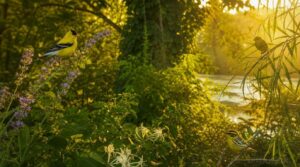
Summer is when Georgia’s yellow bird scene really takes off. Several striking species fly in to breed, filling forests, wetlands, and thickets with color and song.
Here’s a look at the ones most worth knowing.
Yellow Warbler
When spring arrives in Georgia, the Yellow Warbler (Setophaga petechia) follows close behind. This bright, lemon-yellow bird favors riparian woodlands and willow thickets near water — its habitat preferences are specific and reliable.
Males sing sharp, rising whistles for territory defense, and nest construction begins soon after.
Seasonal plumage peaks vividly in summer before juveniles develop independence, and the whole family heads south.
Hooded Warbler
Another summer standout is the Hooded Warbler (Setophaga citrina) — bold black hood, bright yellow face, roughly 4.7 inches of pure personality.
Its understory preference keeps it low in dense hardwood forests, where its territory calls ring out clearly. Watch for the tail flick display that flashes white outer feathers.
Come fall, it’s Mexico-bound until next season.
Prothonotary Warbler
If the Hooded Warbler owns the understory, the Prothonotary Warbler (Protonotaria citrea) rules the swamp. This wetland species glows orange-gold — almost unreal against dark water. It’s a cavity-nesting rarity among warblers, using hollow snags and nest boxes near floodplain habitat edges.
The Prothonotary Warbler, a cavity-nesting rarity, glows orange-gold against Georgia’s dark swamp water
Watch for these three field markers:
- Vivid yellow-orange head and breast
- Blue-gray wings, no wing bars
- Dark eye on an unmarked face
Its insect diet fuels a demanding migration schedule — arriving in Georgia by late March, then migrating south by fall.
Prairie Warbler
The Prairie Warbler (Setophaga discolor) thrives along the regeneration edge — clearcuts, young pine scrub, and brushy overgrowth across Georgia’s Piedmont and Coastal Plain. At just 4.5 inches, it punches above its weight with a buzzy, rising song that carries well through dense cover.
Males show strong territory fidelity, returning yearly. Their insect preference drives everything: foraging, timing, and migration patterns, including those of warblers in Georgia.
Yellow-breasted Chat
The Yellow-breasted Chat (Icteria virens) is Georgia’s oddball summer resident — too big, too loud, and too theatrical to ignore in any bird identification guide.
Birdwatching in Georgia gets genuinely exciting when one surfaces from a blackberry tangle.
- Male Song Variability ranges from hoots to chuckles mid-performance
- Harrier Flight and Wing Thump Display mark dramatic territorial boundaries
- Territory Harassment Calls signal nest site selection in dense shrub edges
Summer Breeding Habitats
Each summer, species stake out their own corners of Georgia. Hooded Warblers claim forest edges and dense thickets, while Prothonotary Warblers work cypress swamp margins and riparian canopy near still water. Prairie Warblers prefer lowland savannah glades and scrubby growth.
These summer breeding grounds for yellow warblers overlap surprisingly little. Their habitat preferences keep competition low and nesting success high.
Winter Yellow Birds
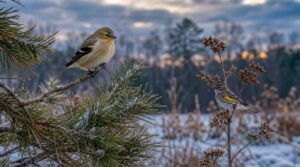
Winter doesn’t clear Georgia’s skies of yellow birds — it just changes the cast a little. A few familiar species stick around, some in subtler colors than you’d expect.
Here’s what you’re likely to spot and where to look for them.
American Goldfinch in Duller Plumage
Don’t let the drab winter look fool you — the American Goldfinch (Spinus tristis) is still around, just wearing its off-season disguise. Molt timing shifts males from lemon-yellow to olive-brown each fall, a seasonal color shift that’s all about camouflage benefits among dried seed heads.
Even in dull plumage, look for:
- Conical bill shape — that thick, seed-cracking bill never changes
- White wing bars — visible in flight, winter or summer
- Compact size — roughly 4.5–5 inches, traveling in tight winter flocks
- Flock dynamics — small, chattering groups give them away near backyard bird feeders
Pine Warbler at Winter Feeders
Pine Warblers (Setophaga pinus) are reliable winter feeder visitors — if your backyard sits near mature pines. Suet preference runs strong with this species, and peanut butter smeared on a pine block works surprisingly well. Winter visit peaks hit hardest December through February. Smart feeder placement near evergreen cover matters too. They’ll often arrive alongside Eastern Bluebirds, making for a striking mixed flock.
Best Winter Birdwatching Locations
Georgia’s best winter birdwatching spots aren’t hard to find once you know where yellow birds actually overwinter. Hit the Piedmont pine edge trails for Yellow-rumped Warblers (Setophaga coronata) and goldfinches, or check urban parks and reservoir shores along the Gulf Coast flyway.
These Georgia birding hotspots for yellow species reward patience — especially when winter food sources like berry shrubs and seed feeders are nearby.
Migratory Yellow Birds
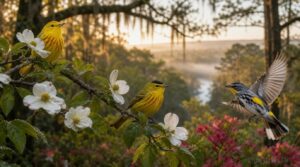
Not every yellow bird you spot in Georgia actually lives there — some are just passing through. Migration brings a fresh wave of species in spring and fall, and a few of them are rare enough to stop you in your tracks. Here are the migratory yellow birds worth watching for across the state.
Blue-winged Warbler During Migration
Spot the Bluewinged Warbler (Vermivora cyanoptera) during spring migration — usually late March through early May — when it passes through Georgia en route north.
Watch dense hedgerows and shrubby fields, as stopover shrub use is critical for fat accumulation before their wind-driven flights continue.
Traveling in small, vocal flocks, flock vocalizations help locate them quickly.
Hybrid zone influence near the Great Lakes can complicate identification, so note those crisp wing bars carefully.
Canada Warbler Passing Through Georgia
Another sharp migrant worth watching is the Canada Warbler (Cardellina canadensis). Banding data confirm it moves through Georgia’s river corridor stops—such as Savannah and Oconee riparian zones—twice yearly. Those necklace field marks make it unmistakable.
Watch for:
- Late April to early May arrivals
- Understory refueling in dense, moist thickets
- Frontal weather influence pushing birds into daytime foraging
Cape May Warbler Migration Sightings
Cape May Warblers (Setophaga tigrina) are the rare gems of warbler migration routes through Georgia. Early May arrivals—especially after cold fronts—push these birds into coastal stopovers along the barrier islands. Wind-assisted travel concentrates them briefly in canopy foragers and riparian corridors. Citizen-science reports confirm these sporadic yet confirmed migration patterns in Georgia.
| Migration Window | What to Watch For |
|---|---|
| Late April | Warm-spell early arrivals |
| Early May | Peak coastal sightings |
| After cold fronts | Concentrated stopover activity |
| September | Fall southward movement |
| October | Lingering coastal individuals |
Check berry shrubs and conifers for insect refueling stops. Field identification tips highlight yellow plumage, bold breast streaking, and the distinctive chestnut cheek patch to confirm the ID quickly.
Wilson’s Warbler as a Rare Migrant
Wilson’s Warbler (Cardellina pusilla) is one of those birds that rewards patience. It’s genuinely rare here — a handful of confirmed sightings each year, mostly in April and September along Coastal Plain stopover zones and riparian corridors.
Isotope analysis shows these migrants originate from broad boreal breeding grounds. Weather influences everything; cold fronts concentrate them briefly in dense thickets.
Watch for that bold black cap and jinking flight.
Spring Versus Fall Migration Timing
Spring migration moves fast. Most yellow warblers hit their peak passage windows in March and April, pushed north by warm southerly winds. Migration speed differences are real, with birds covering more ground per day and keeping stopover durations tight.
Fall is slower, with September and October seeing heavy movement. This seasonal contrast reflects distinct pressures: spring’s urgency versus fall’s more gradual pace.
Weather-driven timing and insect availability shape both seasons, but spring always feels urgent. The race to breeding grounds sharpens the focus, while fall’s journey unfolds with less haste.
Yellow Bird Identification Tips
Spotting a yellow bird is one thing — knowing exactly which yellow bird it is takes a sharper eye. Georgia has enough look-alike species to make even experienced birders pause.
These key identification features will help you tell them apart with confidence.
Bright Yellow Plumage Patterns
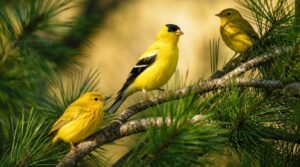
That vivid lemon-yellow you spot flashing through a Georgia pine isn’t random — it’s biology at work. Yellow plumage in birds is produced through carotenoid diet, with pigments deposited directly into growing feathers during molt.
Field identification tips for yellow plumage birds start here:
- Lemon to canary tones signal diet quality
- Molt timing shifts brightness seasonally
- Feather microstructure amplifies intensity
- Habitat light interaction — open sun versus pine shade — changes how yellow reads in the field
Identifying yellow birds in Georgia, such as the Yellow Warbler or Yellow-rumped Warbler, becomes easier once you understand these visual signal functions.
Black Caps, Masks, and Hoods
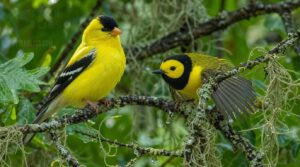
Once you’ve noticed the yellow, look at the face. Cap color variation tells a story — the American Goldfinch (Spinus tristis) wears a sharp black cap in breeding season, but that cap fades through fall.
Mask functionality goes beyond looks; the Hooded Warbler’s (Setophaga citrina) bold hood signals territory. Juveniles show softer, duller hood development stages — noticeably less crisp than adults.
Wing Bars and Rump Patches
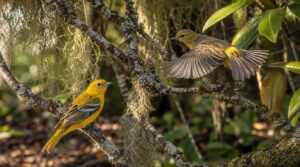
Two small details build a lot of field confidence: wing bars and rump patches. For yellow birds in Georgia, these marks cut through tricky look-alikes fast.
- Seasonal bar intensity and wing bar wear make Yellow Warbler bars bolder in spring, duller by fall
- Rump patch dimorphism means male Yellow-rumped Warblers (Setophaga coronata) flash brighter yellow than females
- molt-driven patch change and juvenile bar contrast shifts avian plumage variation noticeably through the year
Train your eye here — bird identification gets easier quickly.
Size, Shape, and Posture
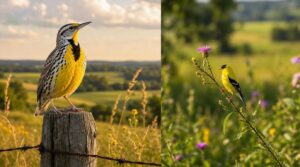
Eastern Meadowlark (Sturnella magna) measures 9–11 inches — nearly twice the American Goldfinch’s 4.3–5.5 inches. Size alone provides critical insights for identification.
Body length comparisons, bill shape variations, and perching posture differences offer rapid birdwatching cues, even before color is noticeable. These structural features are foundational for distinguishing species efficiently.
Flight silhouette profiles and wing proportions further solidify identification, serving as confirmatory tools once initial observations are made.
Any solid field guide or ornithology resource covers these fundamentals, making them indispensable for beginners in bird identification.
Male Versus Female Plumage
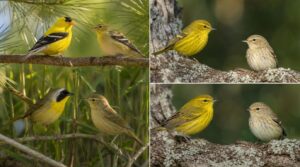
Male and female yellow birds do not have the same appearance—and that gap is your fastest field clue. Males rely on carotenoid and melanin pigments for courtship brightness, while females lean toward camouflage contrast for nesting safety. Dietary color influences and seasonal color shifts also play a role.
- American Goldfinch: males are lemon-yellow; females are olive-dull
- Common Yellowthroat: males wear bold black masks; females show plain faces
- Hooded Warbler: males have black hoods; females show faint outlines
- Pine Warbler: males are vivid yellow; females are washed-out buff
Summer Versus Winter Plumage
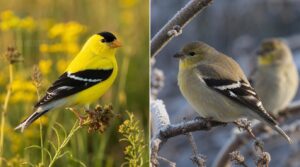
Beyond sex differences, seasonal plumage tells its own story. Summer brings peak color contrast — vivid yellows, crisp wing bars, fresh feathers after molt timing peaks in late winter. Winter plumage shows feather wear and muted tones, partly shaped by habitat lighting in shadowed woods. Age differences matter too — first-year birds stay duller longer, even in July.
Yellow Birds by Habitat
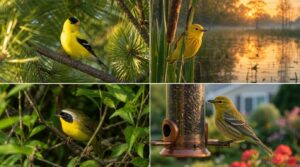
Yellow birds in Georgia depends almost entirely on the landscape around you.
Each species has carved out its own niche, from dense pine canopies to backyard feeders to soggy swamp edges.
Here’s a breakdown of the main habitats and the yellow birds most likely to show up in each.
Pine Forest Birds
Deep in Georgia’s pine forests, the Pine Warbler (Setophaga pinus) practically owns the canopy. It’s one of the few yellow birds that genuinely thrives here year-round.
Fire management effects shape stand density, which directly influences understory arthropod abundance. More bugs mean more warblers.
Edge habitat utilization draws species like the Yellow Warbler during migration.
Watch for cone crop dynamics driving seasonal bird numbers up or down.
Wetland and Swamp Birds
Swap pine needles for cattails, and the yellow bird changes too. Georgia’s wetlands are prime territory for the Prothonotary Warbler (Protonotaria citrea), a blazing gold gem of wooded swamps.
It nests in tree cavities near still water, hunts aquatic invertebrate prey along mudflat edges, and responds sharply to water level dynamics.
A marsh boardwalk’s observation post makes spotting this wetland species genuinely rewarding.
Field and Meadow Birds
Open fields are gold mines for yellow birds in Georgia. The Eastern Meadowlark (Sturnella magna) inhabits these grasslands year-round, while the Dickcissel passes through seasonally.
Three things that make meadow birding click:
- Ground nest camouflage hides eggs in plain sight
- Insect peak timing drives dawn and dusk foraging bursts
- Early successional management keeps grass seed availability high
Backyard and Suburban Birds
Your backyard can be a hub for yellow birds if you set it up right. American Goldfinches (Spinus tristis) and Pine Warblers (Setophaga pinus) respond well to feeder placement tips like mounting nyjer feeders near evergreens. Seasonal plantings of native asters and serviceberry double as food and shelter. Add predator proofing with baffle poles, and you’ve got a year-round feeding station worth watching.
Forest Edge and Thicket Birds
Where forest meets field, forest edge habitat becomes a hotspot for yellow birds. Yellow Warblers (Setophaga petechia) and Pine Warblers exploit microhabitat complexity — foraging twig tips for caterpillars, then ducking into thicket nesting density for cover.
Seasonal edge use shifts as migrants move through. Edge fruit availability draws late-season birds, while edge predator dynamics push nests slightly interior.
Smart habitat, smart birds.
Riparian and Berry-Shrub Habitats
Riparian zones — those lush river woods where willow-dogwood buffers crowd the banks — are magnets for yellow birds. Cedar Waxwings descend on elderberry winter food supplies, and you’ll spot them perching on snowberry shrubs between berry runs.
Streamside insect bursts draw warblers hard. That riparian corridor connectivity links habitats across miles, so native plantings for birds along wetland edges genuinely pay off.
Feeding and Foraging Habits
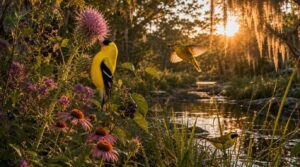
What a yellow bird eats shapes where you’ll find it — and knowing that changes everything about how you look for one.
Georgia’s yellow species run the full menu, from tiny seeds and flying insects to ripe berries and suet blocks. Here’s a closer look at how each foraging style breaks down.
Seed-Eating Yellow Birds
Not all yellow birds are chasing bugs — some are serious seed specialists. American Goldfinch (Spinus tristis) and Pine Warbler rely heavily on seed feeding for finch-style foraging year-round. Beak morphology tells the story: goldfinches have short, conical bills built for cracking nyjer and sunflower seeds, while Pine Warblers use stout bills to pry seeds from pine cones.
- American Goldfinch caches seeds in scattered spots — smart seed caching strategies for cold snaps
- Pine Warbler stores seeds under loose bark, using tree crevices as a personal pantry
- Yellow-rumped Warbler drops and caches seeds along forest edges during migration
- Cedar Waxwing maintains diverse seed reserves from berry shrubs as year-round seed sources
- Yellow-throated Warbler picks seeds from goldenrods near water, managing seed competition dynamics carefully
Your bird feeders stocked with nyjer and sunflower attract goldfinches all winter. Nursery seed plantings — think asters, thistles, and native sunflowers — keep seed-eating birds coming back naturally. (Pine Siskin occasionally joins the party too, if you’re lucky.)
Insect-Eating Warblers
Most warblers are insect hunters, and their bill morphology says everything. Those narrow, pointed beaks aren’t accidental — they’re precision tools for gleaning caterpillars, beetles, and spiders from leaves. Gape feeding lets them pry into tight bark crevices for hidden prey.
Watch how habitat partitioning works: Hooded Warblers hunt low in the understory while Pine Warblers work the canopy above.
During nestling provisioning, parents deliver pure protein — no seeds, just bugs.
Berry-Eating Cedar Waxwings
Cedar Waxwings (Bombycilla cedrorum) run almost entirely on fruit. Their Large Flock Dynamics are something else — hundreds descend on serviceberry or dogwood and strip it clean with surprising speed.
Berry Crop Timing drives their movement more than cold weather does.
Fermented Berry Intoxication is real, too — tipsy Waxwings occasionally wobble on branches.
Their Long-distance Fruit Foraging and Seed Dispersal Impact quietly reshape Georgia’s shrubby edges all winter.
Suet and Mealworm Visitors
Not every yellow bird is chasing berries. Pine Warblers and Great Crested Flycatchers respond well to suet and mealworms — high-fat, high-protein options that match their energy requirements, especially in cold months.
Suet log placement near tree trunks mimics natural foraging. Mealworm seasonal peaks hit hardest in early spring.
Hybrid suet mixes with insects boost visits noticeably. Keep feeder hygiene tight — fresh feeders win every time.
Canopy Foraging Versus Ground Foraging
Where a bird feeds is just as telling as what it eats. Vertical niche partitioning shapes how yellow birds in Georgia divide up the forest — Pine Warblers work the canopy while Eastern Meadowlarks sweep grassland surfaces.
Feeding strategies for yellow songbirds reflect foraging microhabitat selection refined over generations. Canopy-dwelling birds exploit sunlit insect patches 8–25 meters up; forest understory and grassland species stay low, practicing smart predator avoidance strategies.
Seasonal Diet Changes
Diet doesn’t stay the same all year — and neither do your chances of spotting certain behaviors. As seasons turn, feeding habits of yellow songbirds shift dramatically.
- Seed Shift Winter — Goldfinches rely heavily on thistle and stored seeds when insects disappear.
- Insect Surge Spring — Warblers rapidly increase their insect foraging, fueling molting and migration.
- Protein Needs Breeding — Chick-rearing demands caterpillars and soft prey over a vegetarian diet.
- Berry Availability Summer — Cedar Waxwings switch almost entirely to ripe fruits.
- Foraging Technique Adaptation — Winter food sources for yellow birds require more bark-probing and ground-gleaning than warmer months demand.
Attracting Yellow Birds to Yards
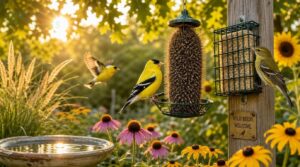
Getting yellow birds into your yard doesn’t take much — just the right setup. A few smart choices in feeders, plants, and water can turn an ordinary backyard into a reliable stop for goldfinches, Pine Warblers, and Cedar Waxwings.
Here’s what actually works.
Best Bird Feeders for Yellow Birds
Squirrel-proof mechanisms on elevated hopper designs keep goldfinches and pine warblers feeding undisturbed, positioned 5–6 feet up to discourage predators.
Weather-resistant tubes with seed-specific portals let multiple species access food simultaneously — that’s multi-species access working exactly as intended.
Backyard feeders built from all-metal construction handle Georgia’s humid summers without warping, giving you reliable, year-round visits.
Nyjer, Sunflower, Millet, and Suet
Four seeds do most of the heavy lifting here.
Nyjer feeder placement matters — mount tube feeders at chest height so American Goldfinches (Spinus tristis) can cling comfortably.
A sunflower seed mix draws Pine Warblers year-round.
Scatter millet ground spread for Yellow-rumped Warblers passing through.
Suet block longevity drops quickly in Georgia heat, so swap blocks weekly.
Seasonal feed preferences shift — adjust accordingly.
Native Flowers for Insects and Seeds
Native flowers pull double duty — first feeding insects, then feeding birds. Aster pollinator nectar draws late-season insects that warblers chase through the understory. Coreopsis bee bloom and Bergamot butterfly draw keep insect foraging active all summer.
Coneflower seed reward lingers past frost, giving finches something to work through winter. Goldenrod winter seeds are virtually a finch buffet.
Native vegetation quietly runs the whole operation.
Berry Shrubs Like Dogwood and Serviceberry
Two shrubs do more work than most people expect. Dogwood fruit — those vivid red-to-blue-black drupes — and serviceberry seasonal berries keep Cedar Waxwings and warblers returning reliably.
Their contrasting leaf morphology makes them easy to tell apart at the nursery.
- Dogwood drupes ripen in late summer, providing a peak winter wildlife food source.
- Serviceberry berries range tart to sweet, persisting into late summer.
- Both offer spring blooms that support the insects yellow warblers depend on.
- Shrub planting tips: Cluster both shrubs near edges, mimicking natural thicket structure.
- Native vegetation remains central to habitat preferences of yellow birds year-round.
Bird Baths and Water Sources
Water is the secret handshake of backyard birding. Bath Depth Guidelines matter — keep basins 1–2 inches deep so goldfinches and warblers don’t struggle. A gentle fountain addresses Fountain Placement Tips and Seasonal Water Heating needs simultaneously, attracting even wetland species like the Prothonotary Warbler during migration.
Follow a simple Cleanliness Maintenance Routine: rinse every 1–2 days, scrub with vinegar weekly. This ensures a safe, inviting environment for birds year-round.
Safe Shelter and Nesting Cover
Think of your yard as a layered neighborhood. Layered Vegetation — from ground cover to mid-story shrubs — provides yellow warblers and cavity-nesting birds in Georgia with protected perches and concealed nest sites. These habitat preferences of yellow warblers mirror those of a natural forest edge habitat perfectly.
Add Ground Brush Piles in corners, Evergreen Cover for year-round shelter, and Nest Box Placement at 6–12 feet with Predator-Guarding poles. These elements collectively recreate the structural diversity and safety of a forest edge, fulfilling the birds’ ecological needs.
Frequently Asked Questions (FAQs)
Are goldfinches rare in Georgia?
The American Goldfinch (Spinus tristis) is one of Georgia’s most reliable year-round residents.
Winter surges bring northern flocks straight to your feeders, making population trends consistently strong statewide.
What is a yellow bird in Georgia?
Georgia hosts a surprising variety of yellow birds, from the bold American Goldfinch (Spinus tristis) to delicate warblers — each tied to specific habitats, seasons, and ecological roles worth knowing.
Are there Red Birds in Georgia?
Yes, red birds thrive in Georgia. Northern Cardinals dominate Cardinal feeders year-round. Scarlet Tanager and Summer Tanager hotspots include forested refuges. Painted Bunting breeding peaks in southeastern counties each spring.
How do you identify birds in Georgia?
Identifying birds in Georgia could fill a lifetime of field notebooks.
Focus on bill morphology, tail shape, and flight silhouette first — then layer in seasonal plumage shifts and habitat clues to confirm what you’re seeing.
Are bluebirds spotted all year in Georgia?
Eastern Bluebirds (Sialia sialis) are year-round residents in Georgia, supported by nest box availability and winter food sources like dogwood berries. These resources keep them active during colder months.
Their presence is particularly notable across the Piedmont and coastal plain, where such conditions are prevalent.
What does a yellow bird look like in summer?
In summer, yellow birds in Georgia flash their boldest colors.
Expect a golden crown hue, bright belly patch, vivid feather sheen texture, sharp bill coloration, and crisp contrast eye ring on most males.
Are black birds in Georgia migratory?
Most black birds in Georgia are migratory.
Red-winged Blackbirds and Common Grackles peak at wetland stopovers during winter, utilizing these sites as roosts, with migration timing driven by food availability and cold-weather movements.
How do I identify baby yellow birds?
Baby yellow birds show downy plumage, a compact body, and soft wingbars still forming. Watch for wide gape and quiet begging near the nest — juvenile plumage looks olive, not bold.
What are yellow birds predators?
Who’s out to get these colorful birds? Raccoon nest raids, weasel egg predation, snake ground ambush, hawk aerial attacks, and cat urban threat all keep yellow birds on constant alert.
Which yellow birds nest in cavities?
A few yellow birds in Georgia nest in cavities. The Prothonotary Warbler (Setophaga citrina) favors tree holes near water, while American Goldfinches occasionally use nest boxes with 5-inch entrance holes.
Conclusion
Once you learn to read the landscape, yellow birds in Georgia stop being lucky accidents and start being something you can count on. A pine ridge in January almost guarantees a Pine Warbler. A flooded swamp in June means Prothonotary Warblers. The more you understand their habitats, seasons, and habits, the more the state’s birdlife opens up to you—not as a checklist, but as a living calendar you carry into every field, forest, and backyard you visit.