This site is supported by our readers. We may earn a commission, at no cost to you, if you purchase through links.
You’ve spotted them countless times—dozens of birds perched in neat rows along power lines, seemingly oblivious to the electrical current humming beneath their feet. Most people assume these gatherings happen by chance, but ornithologists have documented something far more deliberate.
Birds choose power lines with exceptional precision, treating these human-made structures as prime real estate for warmth, safety, and strategic hunting. The reasons behind why birds sit on power lines reveal fascinating adaptations that turn our electrical infrastructure into an unexpected wildlife corridor.
Table Of Contents
- Key Takeaways
- Why Do Birds Sit on Power Lines?
- How Power Lines Offer Safety to Birds
- What Makes Power Lines Attractive Perches?
- Do Birds Use Power Lines for Hunting?
- How Do Birds Avoid Electrocution?
- Which Birds Are Commonly Seen on Power Lines?
- What Risks Do Power Lines Pose to Birds?
- How Are Power Companies Protecting Birds?
- What is The Environmental Impact of Bird Perching?
- How Can Bird-Friendly Power Lines Be Designed?
- Frequently Asked Questions (FAQs)
- What happens if a bird sits on a power line?
- Why do birds relax on power lines?
- Why do birds sit on high-voltage lines?
- Why does a bird eat a power line?
- Do birds travel through power lines?
- Why do birds flock to power lines?
- What does it mean when a lot of birds are on a power line?
- Why can birds sit on power lines without being electrocuted?
- What attracts birds to power lines?
- Why do birds sit on wires instead of trees?
- Conclusion
Key Takeaways
- Birds strategically choose power lines as elevated perches in landscapes where natural trees have vanished, using them as hunting platforms, thermal refuges, and predator-safe roosting spots that offer unobstructed sightlines across open terrain.
- The same infrastructure that supports avian survival also poses deadly threats—between 12 and 64 million birds die annually in the U.S. from electrocution and collisions, with large raptors disproportionately affected when their wingspans bridge multiple wires.
- Birds avoid electrocution on single wires because they don’t complete an electrical circuit to ground, but the physics changes dangerously when they simultaneously contact two conductors or touch a wire while grounded.
- Modern engineering solutions like insulation retrofits, wire spacing modifications, and deterrent systems can reduce bird mortality by 70-90%, proving that utilities can protect wildlife without sacrificing grid reliability.
Why Do Birds Sit on Power Lines?
You’ve probably noticed birds lined up on power lines like they’re holding a neighborhood meeting. But they’re not just hanging out for fun—they’re solving real problems that come with living in a modern landscape.
Power lines offer birds three key advantages that make them worth the risk: convenience, comfort, and protection.
Perching Convenience in Open Areas
In landscapes stripped of trees, where cropland sprawls and hedgerows vanish, you’ll find birds claiming power lines as their go-to perch. These elevated structures form linear networks across open habitats, offering roosting and nesting spots where natural options have disappeared.
Raptors, corvids, and passerines exploit these corridors as convenient stepping-stones, transforming utility infrastructure into essential pathways through otherwise perch-starved terrain. The presence of power lines can lead to significant bird mortality rates, affecting various species in different ways.
Warmth From Power Lines
Beyond perch availability, power lines offer a subtle thermal advantage you mightn’t expect. Live conductors dissipate resistive heat—often reaching temperatures tens of degrees above ambient air—creating localized microclimate effects that reduce your energetic costs for avian thermoregulation.
In winter, birds congregate on energized spans rather than cold, inactive wires, exploiting these linear heat islands to conserve precious body warmth during cold snaps. This behavior is related to their overall heat tolerance mechanisms that help them survive in various environments.
Safety From Ground Predators
Power lines function as elevated refuges, placing you well above terrestrial hunters like cats and coyotes. This aerial safety turns ordinary wire into prime real estate for predator evasion. Research shows elevated perching cuts ground-based predation odds by 6.6% per 100 meters of height—a survival advantage that explains why birds choose these exposed perches despite minimal shelter.
Key Roosting Strategies for Visual Surveillance:
- Unobstructed sightlines allow earlier threat detection across open terrain
- Faster escape response through immediate flight from elevated locations
- Communal roosting reduces individual risk up to eightfold compared to solitary birds
How Power Lines Offer Safety to Birds
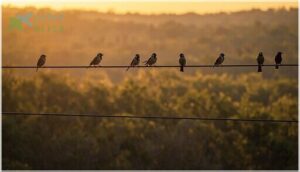
When you think about where birds choose to rest, safety ranks just as high as comfort. Power lines aren’t just convenient perches—they’re strategic lookout posts that help birds stay one step ahead of danger.
Here’s how these elevated wires create a refuge from the threats lurking below.
Elevated Roosting Spots
Elevated structures become critical survival tools when natural roosts disappear. In Portugal, 25% of white storks now nest on transmission towers—a dramatic shift from just 1% in 1958. These artificial perches stand 18–40 meters high, offering commanding views that trees once provided.
In treeless South African regions, 57% of pied crows rely entirely on power lines for roosting, demonstrating how birds adapt when their natural habitat vanishes beneath urban sprawl.
Predator Avoidance
Invisibility from below transforms power lines into aerial fortresses. When you watch birds choosing their perch, you’re seeing calculated survival instincts at work. Here’s how elevated wires shield them from danger:
- Ground safety increases dramatically—cats, coyotes, and foxes can’t reach birds 30 feet overhead
- Nest protection improves as rat snakes show 28% lower predation near lines
- Roosting strategies shift to avoid coachwhip snakes hunting below
- Aerial predator hawks use lines as hunting posts
- Perch selection by raptors creates complex predator-prey dynamics
What Makes Power Lines Attractive Perches?
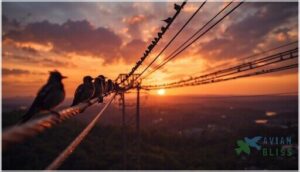
You’ve seen birds lined up on power lines like they’re attending some kind of aerial town meeting. But what draws them to these wires in the first place?
Let’s look at the specific features that make power lines such appealing perches for birds traversing both natural and human-altered landscapes.
Clear Vantage Points for Scanning
When you’re a bird, choosing where to sit isn’t random—it’s strategic. Power lines place birds 5 to 40 meters above ground, dramatically expanding their scanning range.
Raptors perched on wires achieve 25–60% larger visual fields than natural perches, while European Rollers show 2.6-fold increased foraging activity near power lines.
This elevated surveillance translates to scanning efficiency: birds detect prey and predators faster, rotating their heads 2.3 times more frequently than on trees.
Lack of Natural Perches in Urban Areas
Sprawling cities have stripped away nature’s perching posts. Between 2000 and 2020, urbanization slashed tree canopy cover by 40% across major U.S. cities, while 32% of green spaces vanished under pavement and buildings.
This habitat shift forces birds to adapt:
- 75% of urban-adapted species now rely on utility infrastructure for roosting
- Only 10% of bird species remain in heavily developed zones like Los Angeles
- Power lines become default perches where natural options drop below 50 per hectare
You’re witnessing urban wildlife adaptation in real time.
Opportunities for Rest and Migration Stops
When you’re migrating thousands of miles, every rest stop counts. Power lines serve as critical stopover habitats for exhausted travelers—satellite tracking reveals birds now cluster at these artificial perches along migration routes where natural cover has dwindled.
Swallows, starlings, and raptors form massive roosting congregations on wires, conserving energy while maintaining vigilance. These elevated rest stops maximize migration efficiency, letting weary flocks recover between overnight flights.
Do Birds Use Power Lines for Hunting?
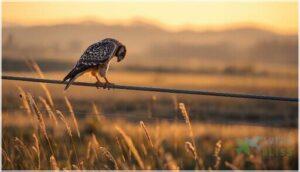
Power lines aren’t just resting spots—they’re strategic hunting perches that give birds a serious advantage.
From high above the ground, you’ll find everything from sharp-eyed raptors to quick insect-catchers using these wires as observation posts.
Let’s look at how different birds turn power lines into their personal hunting grounds.
Spotting Prey From Above
When you’re perched on a power line, the ground becomes an open book. Elevated Perches transform ordinary wires into command posts for Aerial Hunting, where Visual Scanning meets opportunity. Studies reveal impressive advantages:
- Little owls achieved 100% better Prey Detection from height
- Raptors attack from up to 20 meters away on elevated perches
- Hawks and owls boost hunting success to 47% using power lines
Bird Surveillance from above isn’t luck—it’s strategic advantage for bird species mastering their environment.
Hunting Strategies of Raptors
Aerial Hunting masters like American kestrels perch-hunt 88% of the time with a striking 76% success rate. You’ll see these raptors using power lines as hunting platforms, alternating between Perch Tactics and Flight Patterns.
Broad-winged Hawks rely on perches 92% of hunting time, achieving 71% success—far better than the 18% from flapping flight alone. Prey Selection matters: hawks capture small mammals at 57% efficiency, while Raptor Migration routes follow these productive perching corridors where bird behavior meets opportunity.
Benefits for Insect-Eating Birds
Small insectivores gain even more from power lines through specialized Foraging Strategies. You’ll notice these birds catching Insect Prey at striking rates:
- 60% higher foraging success – European starlings capture 1.4 times more insects per hour from wires than fence posts
- 50% shorter hunting flights – barn swallows conserve energy during Bird Migration
- 400+ insect species – Power Line Corridors harbor abundant prey beneath
This advantage aids Avian Conservation by enhancing habitat quality in open landscapes.
How Do Birds Avoid Electrocution?
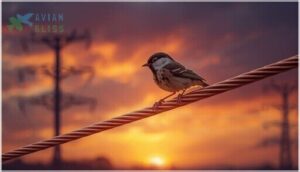
You’ve probably wondered how birds can perch on power lines without getting zapped. The answer comes down to basic physics and how electricity moves through circuits.
Let’s break down the three key factors that keep birds safe—and when things can go dangerously wrong.
Single Wire Contact and Circuit Incompletion
When you see a bird perched comfortably on a power line, you’re witnessing electrical safety in action. The bird’s body contacts only a single wire, leaving the circuit incomplete—no electricity flows through its body.
Electrocution risks arise only when birds simultaneously touch two wires or a wire and grounded structure, completing the circuit. Wire spacing in power line design directly influences bird safety, which is why smaller birds rarely face electrocution on high-voltage transmission lines.
Lack of Grounding
Grounding provides the critical return path electricity needs—and birds don’t supply it. When you’re standing on a single wire, you’re basically floating in electrical terms. No connection to Earth means no circuit completion, no current flow, and no electrocution.
Power line design deliberately separates grounded infrastructure from perching spots, though failures in this spacing account for the majority of avian electrocutions on distribution lines with voltages below 60 kilovolts.
Risks With Multiple Wire Contact
But size changes everything. Large raptors with wingspans reaching 2.3 meters can easily bridge the gap between closely spaced conductors, completing that deadly circuit. Transmission lines with phase-to-phase spacing under 60 inches horizontally create serious electrocution risk—touch two wires simultaneously, and you’re dead.
Large raptors with wide wingspans can bridge closely spaced power lines, completing a deadly circuit in an instant
Over 10 million birds die globally each year from these multiple wire contact incidents.
Which Birds Are Commonly Seen on Power Lines?
If you’ve ever looked up at a row of birds on a wire, you might’ve wondered which species are drawn to these perches. The answer depends on habitat, size, and behavior—some birds are regulars, while others stop by during specific seasons.
Let’s look at the species you’re most likely to spot and what brings them there.
Species Like Doves, Pigeons, and Swallows
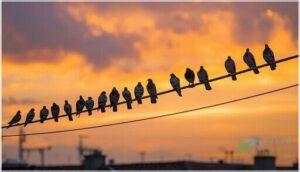
If you’ve ever watched birds on wires, you’ve probably spotted the usual suspects: doves, pigeons, and swallows dominate these avian social clubs.
Rock pigeons show up on power lines in 68% of urban bird counts, while Eurasian collared doves use overhead wires in over 83% of observations.
Barn swallows? They’re perching champions during migration, appearing at 74% of stopover sites lacking natural perches—a proof of their power line adaptation skills.
Raptors and Large Birds
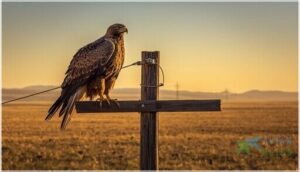
Large raptors like eagles, kestrels, and hawks dominate elevated perches—exactly what power lines offer in treeless landscapes.
In Mongolian grasslands, raptor perching density can exceed several birds per kilometer on distribution poles, where prey is abundant. Yet this convenience comes at a steep cost: electrocution kills an estimated 0.9–11.6 million birds annually in the U.S., with raptors disproportionately affected due to their wingspan and tendency to bridge dangerous pole configurations.
Seasonal and Migratory Patterns
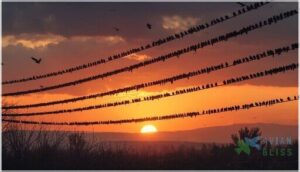
Migration routes transform power lines into seasonal highways, with up to 65% of bird mortalities occurring during autumn passage alone. You’ll notice dramatic shifts in species composition as flyway patterns converge on these artificial perches, creating bird congregations numbering in the thousands during spring and fall.
Seasonal roosting behaviors vary markedly:
- Night-migrating species rest on power lines between flights, exploiting elevated safety
- Communal roosts form along major flyways, supporting energy conservation during migration
- Winter months attract non-migratory birds in vegetation-scarce regions, altering local avian ecology
What Risks Do Power Lines Pose to Birds?
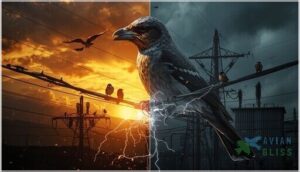
While power lines offer birds a convenient perch, they aren’t without danger. The same infrastructure that attracts these feathered visitors can pose serious threats to their survival.
Let’s examine the three main risks birds face when they interact with power lines.
Electrocution Incidents
You’ve probably seen birds line up fearlessly on those wires, but here’s the grim reality: between 900,000 and 11.6 million birds die annually from power line electrocution in the U.S. alone. Raptors face the highest avian mortality rates because their wingspans bridge electrical gaps. When a bird touches two wires simultaneously, it completes the circuit—electrocuted instantly.
Conservation efforts now prioritize electrical safety for birds through insulation and electrocution prevention measures.
Collisions and Injuries
Beyond electrocution, power lines claim over a billion birds annually through collision-related bird mortality worldwide. You won’t always see the carnage—scavengers remove evidence quickly—but collision rates paint a stark picture of these power line hazards:
- Birds sustain crushed bones, ruptured organs, and severe avian trauma resembling vehicle strikes
- Thin ground wires cause most fatalities, particularly during low-visibility conditions like fog
- Injury patterns show fractures and tissue damage leading to necrosis if untreated
- Raptors and migratory species collide most frequently in open areas near water sources
- Detection studies reveal massive underreporting due to scavenger removal and observer limitations
Survivors rarely regain full flight capability after these devastating encounters.
Effects on Bird Populations
Between 12 and 64 million birds die annually in the United States from power line-related bird mortality—numbers that reshape population trends and avian ecology across continents.
You’re witnessing habitat loss amplified by infrastructure, where critically endangered species like Egyptian vultures lose two-thirds of their population to electrocution.
These ecological impacts demand urgent wildlife conservation action, as current bird species face extinction pressures that conservation efforts are only beginning to address.
How Are Power Companies Protecting Birds?
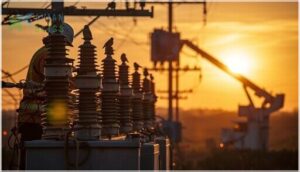
Power companies aren’t just watching birds get zapped anymore—they’re actually doing something about it. From redesigning infrastructure to partnering with wildlife experts, utilities are rolling out practical solutions that save lives and keep the lights on.
Let’s look at the key strategies they’re using to make power lines safer for our feathered friends.
Insulation and Spacing of Wires
To reduce electrocution risks, power companies now retrofit poles with insulation on exposed wires and electrical hardware—a practice that cuts bird deaths by up to 80%. They’re also spacing conductors at least 60 inches apart in raptor-sensitive zones, following Avian Power Line Interaction Committee standards.
These electrical engineering upgrades prevent birds from contacting multiple wires simultaneously, making power line configurations far safer for avian visitors.
Nesting Platforms and Deterrents
Beyond insulation, utilities install dedicated nesting platforms—like the 5×5-foot structure that attracted breeding bald eagles in New Jersey—to guide birds away from hazardous wires.
You’ll also see rotating “flapper” deterrents that cut collision deaths by 70%.
In Iran, nest boxes dropped electrocution rates for Eurasian kestrels by nearly 58%, proving smart power line modifications protect both birds and grid reliability.
Research and Monitoring Programs
Hardware fixes matter, but avian research drives real progress. The Avian Power Line Interaction Committee funds wildlife monitoring and ecological studies that track bird behavior along transmission routes.
Utilities conduct annual bird surveys—like U.S. Fish & Wildlife’s migratory counts—to pinpoint collision hotspots.
These conservation efforts merge engineering with avian ecology, turning power line safety data into actionable solutions that protect vulnerable species.
What is The Environmental Impact of Bird Perching?

When birds flock to power lines, they don’t just change the view—they can shake up the entire system. Large congregations create ripple effects that touch everything from your local power grid to the ecological balance in your neighborhood.
You’ll see how these feathered gatherings influence outages, shift bird communities, and challenge infrastructure maintenance.
Power Outages From Large Roosts
When bird congregations turn power lines into communal roosting spots, they can trigger widespread blackouts that ripple through entire regions. Birds cause more power outages than any other animal in the United States, with utilities in some countries reporting that 70-80% of all overhead line failures stem from avian activity.
Large roosts create serious challenges:
- Migrating flocks simultaneously contacting multiple wires create short-circuit paths
- Wet birds and nesting materials act as conductive bridges between energized components
- Bird-induced outages cost utilities $15,000 to $200,000 per incident in repairs alone
- Wildlife management programs can reduce outage frequency by over 60%
You’re witnessing nature colliding with infrastructure in ways that demand thoughtful solutions.
Changes in Local Bird Communities
Power lines reshape bird communities in ways you wouldn’t expect. Ground-nesting species are pushed out within 100 meters of transmission corridors, while some predators thrive on the hunting perches. This habitat fragmentation disrupts species interactions and ecological balance, creating winners and losers in the avian world.
| Impact Type | Observed Effect |
|---|---|
| Breeding Density | Lowest within 100m of lines for most ground-nesters |
| Species Composition | Displacement of sensitive species; unchanged richness overall |
| Forest Birds | Increased nest predation and brood parasitism rates |
You’re witnessing community dynamics shift as power grids alter natural landscapes, challenging wildlife conservation efforts. These efforts aim to protect bird behavior and habitat while recognizing that infrastructure realities demand bird-friendly solutions rooted in avian ecology and safety.
Infrastructure Maintenance Challenges
Across the power grid, birds add over $10 billion in annual maintenance costs—50% of all wildlife-induced outages trace back to avian activity. You’re looking at corroded insulators from droppings, flashovers during storms, and crews dispatched for nest removal.
Electrical insulation degrades faster, utility poles require early replacement, and power poles become hazardous workspaces.
These infrastructure reliability challenges demand wildlife mitigation strategies that balance electrical accidents prevention with grid operations.
How Can Bird-Friendly Power Lines Be Designed?
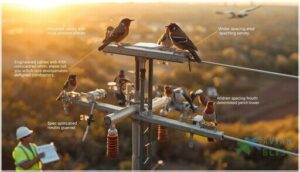
Protecting birds from power lines doesn’t mean choosing between reliable electricity and wildlife conservation—you can have both. Engineers and conservationists have developed practical solutions that reduce electrocution risks while keeping the grid functional.
Let’s look at three approaches that are making power lines safer for our feathered neighbors.
Engineering Solutions for Avian Safety
You’ll find that modern electrical engineering has transformed power grid safety through targeted avian collision systems and bird-friendly designs. Insulation retrofits cut electrocution prevention incidents by 75%, while spacing modifications drop mortality over 90%.
Wildlife engineering solutions like horizontal post insulators reduce fatalities by 80%. These power line safety measures prove that electricity transmission infrastructure can coexist with nature when avian safety drives design.
Collaboration With Wildlife Experts
When utilities team up with wildlife conservation efforts, bird-friendly designs become reality. You’ll see this wildlife partnerships approach work through:
- Avian research teams mapping high-risk zones where birds and power lines intersect
- Ornithologists guiding wire spacing and perch deterrent placement
- Monitoring programs tracking bird behavior and power line safety improvements
These conservation efforts merge avian ecology and safety with engineering, proving birdwatching data drives protection strategies.
Public Awareness and Conservation Efforts
Real change happens when communities step up. Public education and awareness campaigns are transforming how people view birds and power lines. Conservation strategies work because wildlife protection becomes everyone’s mission—from utility workers to birdwatchers tracking bird species and migration.
| Initiative Type | Conservation Impact | Community Role |
|---|---|---|
| Visibility markers on 123 km of lines | 1,374 fewer bird deaths yearly | Local monitoring participation |
| APLIC guidelines adoption | 68% of utilities now bird-friendly | Public pressure drives change |
| Lithuania LIFE project | Mortality reduced 1.2-4x | Citizen science involvement |
These wildlife conservation efforts prove the environmental impact of power lines can be minimized through collective action in avian ecology and safety.
Frequently Asked Questions (FAQs)
What happens if a bird sits on a power line?
Picture a tightrope walker balanced perfectly on a single wire—that’s your bird on power lines. When perched on one conductor, no circuit completes, so current doesn’t flow through its body.
Electrocution risks only emerge when bridging two wires.
Why do birds relax on power lines?
Birds relax on power lines because these elevated perches offer convenient roosting spots with thermal warmth, predator protection, and unobstructed scanning views.
These factors are key in avian behavior, supporting rest, vigilance, and energy conservation in modern landscapes.
Why do birds sit on high-voltage lines?
You’d think birds would avoid high-voltage lines—too industrial, too dangerous. Yet they don’t. These massive transmission structures offer unparalleled perching convenience, predator-free elevation, and strategic hunting vantage points across open landscapes where natural perches vanish.
Why does a bird eat a power line?
Birds don’t eat power lines. No verified cases exist of wild birds consuming wire as food.
Captive parrots may chew exposed wiring out of curiosity or beak maintenance, not ingestion, creating avian toxicity and electrocution risks.
Do birds travel through power lines?
You’ve probably wondered if current flows through roosting birds—it doesn’t. Power line safety depends on single-wire contact: birds perch safely without circuit completion.
Electrocution risks emerge only when wingspan bridges conductors, disrupting avian safety through energy transfer.
Why do birds flock to power lines?
Flocking behavior draws birds to power lines during migration and roosting periods, creating large congregations on elevated structures.
These gatherings provide thermal benefits, social cohesion, and collective vigilance against predators in open landscapes.
What does it mean when a lot of birds are on a power line?
When you spot dozens of birds gathered on a wire, you’re witnessing flocking behavior—often signaling migration, communal roosting, or abundant nearby food sources.
Their avian gathering indicates safety, social bonding, and strategic rest stops along travel corridors.
Why can birds sit on power lines without being electrocuted?
Birds remain safe on power lines because they perch on a single wire. Their bodies don’t complete an electrical circuit to the ground, preventing current flow and avoiding electrocution despite high voltage.
What attracts birds to power lines?
You’ll find power lines irresistible if you’re a bird needing elevated vantage points, predator-free roosting, and hunting perches—especially where natural trees are scarce.
Thermal attraction, clear visibility, and abundant perch availability drive this behavior.
Why do birds sit on wires instead of trees?
In landscapes stripped of tall vegetation, you’ll notice overhead wires become the dominant elevated perches—offering unobstructed sightlines, predator safety, and hunting vantage points that dense tree canopies can’t match.
Conclusion
Power lines have become unexpected lifelines in landscapes stripped of natural perches—a proof to birds’ exceptional adaptability.
You’ve now seen why birds sit on power lines: they’re hunting platforms, safe havens, and migration waypoints all woven into one convenient cable.
As engineers design bird-friendly infrastructure and conservationists monitor these aerial highways, we’re learning that coexistence doesn’t require choosing between progress and nature—it demands we engineer smarter solutions that honor both.
- https://www.facebook.com/groups/844328992292674/posts/6587084824683700/
- https://www.midsunikm.com/post/power-lines-major-threat-to-migratory-birds
- https://www.reddit.com/r/explainlikeimfive/comments/is9y5t/eli5_why_do_birds_like_to_sit_on_power_lines/
- https://engineering.mit.edu/engage/ask-an-engineer/how-do-birds-sit-on-high-voltage-power-lines-without-getting-electrocuted/
- https://pubmed.ncbi.nlm.nih.gov/24033371/