This site is supported by our readers. We may earn a commission, at no cost to you, if you purchase through links.
Of the roughly 140 bird species that evolved in Hawaii over millions of years, more than half are now extinct. That’s not a distant ecological footnote—it’s the backdrop to every forest walk you’ll take on these islands.
The birds of Hawaii that survived carry that weight in their biology: bills curved precisely for specific flowers, immune systems tested by disease, territories shrunk to mountain elevations where mosquitoes can’t yet reach.
Some species cling to a few thousand individuals. Others have clawed back from the edge through decades of careful human intervention.
Knowing who’s out there—and why they matter—changes everything about how you see Hawaii.
Table Of Contents
- Key Takeaways
- Native and Endemic Birds of Hawaii
- Common Invasive Bird Species in Hawaii
- Waterbirds, Seabirds, and Shorebirds of Hawaii
- Biggest Threats Facing Hawaii’s Birds
- Birdwatching and Conservation in Hawaii
- Frequently Asked Questions (FAQs)
- What’s your nationality if you were born in Hawaiʻi?
- What bird species live in Hawaii?
- How many bird species are there in Hawaii?
- Are there forest birds in Hawaii?
- What is the state bird of Hawaii?
- What is the most famous bird in Hawaii?
- Where can you see birds in Hawaii?
- What bird is common to Hawaiʻi?
- What are the national birds of Hawaiʻi?
- What is the rarest bird in Hawaiʻi?
- Conclusion
Key Takeaways
- More than half of Hawaii’s 140 native bird species are extinct, and the survivors cling to high elevations where mosquitoes—carriers of deadly avian malaria—can’t yet reach.
- Species like the ʻIʻiwi and Palila are so specialized that losing a single native tree or gaining a few degrees of warmth can push them toward the edge of extinction.
- Invasive predators, non-native birds, and diseases like avian pox work together against native wildlife, making predator control and habitat restoration the most critical tools conservationists have.
- Recovery is possible—the Nēnē bounced back from 60 individuals to over 2,500 wild birds—but it takes decades of deliberate human effort, and your involvement in local conservation programs genuinely moves the needle.
Native and Endemic Birds of Hawaii
Hawaii is home to some of the world’s most unusual birds found nowhere else on Earth. Many evolved in total isolation, developing unique traits over millions of years.
From remote volcanic slopes to coastal wetlands, Hawaii’s birds have stories worth chasing—top bird photography travel locations can help you plan where to witness them in the wild.
Here are the native and endemic species that make these islands truly special.
Hawaiian Goose (Nēnē) – Hawaii’s State Bird
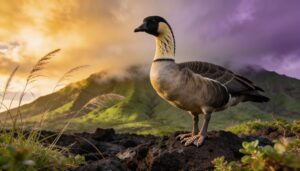
The Hawaiian Goose, or Nēnē (Branta sandvicensis), carries deep cultural significance as Hawaii’s state bird — a title it’s held since 1957. Its reduced toe webbing is a clever adaptation for traversing lava terrain.
Once pushed to the brink by hunting and invasive predators, breeding success through captive programs has driven a notable population recovery.
Today, you’ll find Nēnē grazing across Maui, Kauai, and Hawaii Island.
The species benefits from a dedicated captive‑breeding program that aids reintroduction efforts.
‘I’iwi – The Scarlet Honeycreeper
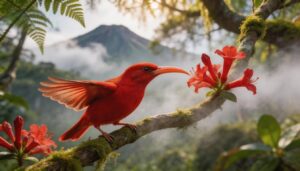
Few birds stop you in your tracks like the ʻIʻiwi (Drepanis coccinea). That fiery scarlet plumage is unmistakable — but its curved bill morphology is the real story. Shaped over millennia for nectar specialization, it fits perfectly into native ʻōhiʻa lehua blooms.
Here’s what defines this endemic Hawaiian bird species:
- High-elevation range — found above 1,250 meters, where avian malaria mosquitoes can’t yet reach
- Curved bill — evolved specifically to probe tubular native flowers
- Territorial display — breeding pairs defend canopy territories aggressively each spring
- Threatened status — climate change pushes disease vectors upslope, shrinking safe habitat fast
Hawai’i ‘Amakihi
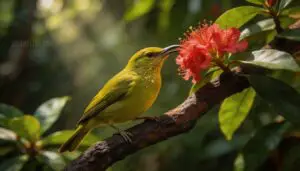
The Hawaiʻi ʻAmakihi (Chlorodrepanis virens) surprises even seasoned birders as one of the few Hawaiian honeycreepers showing genuine disease resistance to avian malaria at lower elevations. Unlike many native birds, it thrives without needing mountaintop refuge.
Its habitat flexibility spans from sea level to 8,000 feet, covering endemic species hotspots on Hawaiʻi, Maui, and Molokaʻi. This broad elevational range, combined with traits like nectar feeding on ʻōhiʻa and māmane blooms, aids native pollination. The species also exhibits multi-brood breeding with a spring peak, enhancing its reproductive resilience.
| Trait | Detail | Significance |
|---|---|---|
| Elevational Range | Sea level – 8,000 ft | Broadest among honeycreepers |
| Nectar Feeding | ʻŌhiʻa, māmane blooms | Aids native pollination |
| Breeding Seasonality | Multi-brood, spring peak | Higher reproductive resilience |
Conservation status remains cautiously stable — a rare bright spot amid ongoing threats to Hawaiian avifauna.
‘Ōma’o (Hawaiian Thrush)
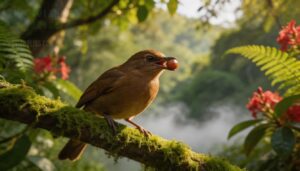
Unlike the ‘Amakihi’s adaptability, the ‘Ōma’o (Myadestes obscurus) keeps things closer to home — it’s found only on Hawaiʻi Island. This endemic thrush depends on ohia and koa forest birds’ thrush habitat between 600 and 2,000 meters, making its elevational range both its strength and vulnerability.
Three things define this bird:
- Fruit foraging drives most of its diet, supporting seed dispersal across native understory plants.
- Skylarking courtship — dramatic aerial displays by males — marks breeding season.
- Cup nesting in tree ferns reflects careful, deliberate parenting by both adults.
Its conservation status is vulnerable, shaped by habitat loss and introduced predators.
Hawaiian Hawk (‘Io)
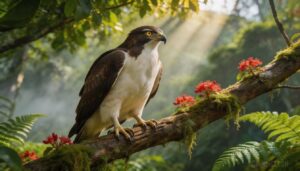
Meet the ‘Io (Buteo solitarius), Hawaii’s only native hawk and a true symbol of island royalty.
This endemic raptor shows striking morph variation — dark or light-phased plumage — and defends its territory with fierce territorial behavior.
Prey selection shifts by season and altitude, targeting whatever the forest offers.
Population monitoring remains critical, as habitat loss continues threatening this culturally significant bird’s future.
Hawaiian Petrel

The Hawaiian Petrel (Pterodroma sandwichensis) is one of Hawaii’s most secretive endemic birds. It nests inland on Kauaʻi, Maui, and Hawaiʻi, returning to the same burrows each season. Here’s what makes this seabird notable:
- Seasonal Migration spans the entire North Pacific
- Chick Development takes 110–140 days after hatching
- Acoustic Monitoring detects nocturnal calls at colony sites
- Burrow Protection reduces predator access during nesting
- Habitat Restoration helps declining seabird colonies
Hawaiian Duck (Koloa Maoli)

Quiet and easy to miss, the Koloa Maoli (Anas wyvilliana) is a Hawaiian Duck found in freshwater marshes, taro fields, and montane streams. Habitat loss and invasive species impacts have pushed it toward endangered status. Hybridization threat from introduced Mallards remains its biggest challenge, eroding genetic identity.
Conservation efforts also consider duck pairing and mating behaviors when designing programs to manage hybridization and protect the Koloa Maoli’s genetic integrity.
| Feature | Detail | Concern |
|---|---|---|
| Island Migration | Kauai to Niihau movements | Habitat fragmentation |
| Nest Site Protection | Concealed wetland cover | Predator pressure |
| Population Monitoring | Conservation tracking programs | Declining numbers |
Wetland restoration and native bird conservation efforts are slowly helping this shy bird recover.
Palila
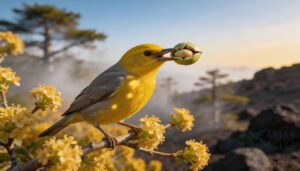
The Palila (Loxioides bailleui) is basically a bird built around one tree. Its bill morphology adaptation — thick, stout, perfectly shaped — exists to crack open tough mamane seed pods.
You’ll find this endangered honeycreeper only on Mauna Kea’s high slopes, where elevational range limits above 6,000 feet define its entire world.
Mamane forest restoration and fire management strategies are now critical to its survival, while population monitoring techniques track every fragile step toward recovery.
Hawai’i ‘Ākepa
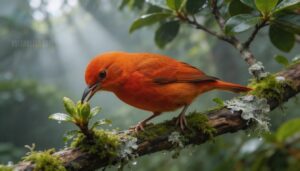
The Hawai’i ‘Ākepa (Loxia coccinea) is one of Hawaii’s most specialized forest birds. Here’s what makes it stand out:
- Males flash vivid breeding plumage — bright orange-red across the body.
- It relies on cavity nesting inside old-growth koa and ʻōhiʻa trees.
- Vertical foraging drives its daily routine, prying insects from bark and leaf buds.
- It survives only in high elevation forest above 1,800 meters.
- Population fragmentation makes every individual critical to the species.
Common Invasive Bird Species in Hawaii
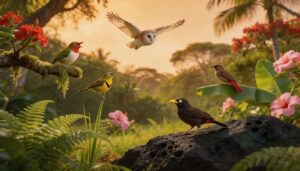
Not every bird you spot in Hawaii belongs there. Over the decades, dozens of non-native species have made themselves at home across the islands, often at the expense of native wildlife.
Here are six of the most common invasive birds you’re likely to encounter.
Red-crested Cardinal
Few birds stop you in your tracks like the Red‑crested Cardinal (Paroaria coronata). Introduced to Hawaii in the 1930s, this South American native is now a fixture of Oahu’s parks and gardens — a textbook invasive species thriving in urban habitat preference zones.
| Feature | Detail |
|---|---|
| Bill shape | Short, stout — built for seed eating adaptations |
| Crest display behavior | Raised when threatened or excited |
| Territorial song patterns | Clear, melodious calls to defend territory |
Its nest architecture is a tidy cup of plant material, tucked in shrubs. Don’t let its beauty fool you — it competes directly with native birds.
Zebra Dove
invasive birds are not all loud and flashy. Zebra Dove (Geopelia striata) introduced in 1922, blends quietly into Hawaii’s urban foraging scene — parks, gardens, sidewalks.
Its soft, rhythmic cooing and courtship display of bowing and vocalizing seem almost harmless.
But its population spread across Kauai, Oahu, and Maui signals real pressure on native ground-feeding species.
Common Myna
Unlike the quiet Zebra Dove, the Common Myna (Acridotheres tristis) makes no effort to go unnoticed. Introduced in 1865, this bold invasive bird species thrives through territorial aggression, dietary adaptation, and urban roosting in noisy communal flocks.
It competes fiercely for nesting sites, displacing native birds.
Control strategies remain an ongoing challenge across the islands.
Western Cattle Egret
Another bold addition to Hawaii’s invasive roster, Bubulcus ibis — Western Cattle Egret — arrived in the 1950s to control livestock flies.
It worked, but at a cost. This stocky white bird practices cattle-following foraging, shadowing large animals to snatch disturbed insects.
Its colonial nesting behavior and insectivorous diet help it thrive island-wide, threatening native waterbirds like the Hawaiian Duck and Coot.
Red-vented Bulbul
Pycnonotus cafer, the Red-vented Bulbul, slipped into Hawaii through illegal pet releases in the 1950s. Its habitat preference leans toward open scrub and gardens — exactly what Oahu offers.
Flock behavior makes it especially disruptive, as groups strip fruits and alter seed dispersal. Its dietary flexibility lets it exploit almost anything available.
Management strategies remain difficult, and its ecological impact on native species is ongoing.
Red Junglefowl
The Red Junglefowl (Gallus gallus) has roamed Hawaii’s forest edges since Polynesian arrival. Here’s sets it apart:
- Vivid iridescent plumage on males
- Elaborate courtship displays to attract mates
- Leg spur weaponry used in territorial fights
- Strong habitat preference for disturbed, edge environments
- Hybridization risks with domestic chickens threaten wild genetics
Its cultural significance runs deep — this bird literally gave us the chicken.
Waterbirds, Seabirds, and Shorebirds of Hawaii

Hawaii’s birds aren’t just found in forests — the islands’ coastlines, wetlands, and open ocean support some equally impressive species. From stilts wading in shallow marshes to albatrosses gliding over deep Pacific waters, each one has a distinct story.
Here are the waterbirds, seabirds, and shorebirds worth knowing.
Hawaiian Stilt (Ae’o)
The Hawaiian Stilt (Himantopus mexicanus knudseni), or Ae’o, stands out in any wetland — literally. Its pink leg morphology makes it unmistakable along shorelines and mudflats.
| Feature | Detail |
|---|---|
| Legs | Strikingly pink |
| Bill | Long, straight, black |
| Habitat | Shallow wetlands |
| Nesting Season | March–August |
| Conservation Status | Endangered |
Wetland degradation, habitat loss, and invasive species push this species closer to crisis daily.
Hawaiian Coot (Fulica Alai)
Meet Fulica alai, the Hawaiian Coot — a slate-gray endemic bird built for wetland life. Its lobed feet act like built-in paddles, perfect for traversing freshwater marshes and brackish lagoons.
Breeding behavior depends heavily on stable water levels and healthy vegetation. Predator management and wetland restoration are critical for its survival, as invasive species and habitat loss keep threatening this native bird conservation priority.
Black-crowned Night Heron (‘Auku’u)
The ‘Auku’u (Nycticorax nycticorax) breaks the rulebook for night herons — unlike its mainland relatives, this native Hawaiian bird shows strong diurnal foraging behavior, hunting fish and crustaceans in broad daylight.
Watch for its prey vibration technique, where it disturbs water to flush out food.
Tree-nesting colonies form over wetlands, and breeding plumage plumes trail elegantly behind adults in flight.
Laysan Albatross (Moli)
Few seabirds command the open Pacific like the Laysan Albatross (Phoebastria immutabilis), or Moli. With a wingspan reaching 2.5 meters, it masters efficient soaring across vast stretches of ocean, riding wind currents while barely flapping.
Breeding colonies concentrate on Midway Atoll, where pairs bond for life.
Nighttime foraging keeps them far offshore, but longline bycatch and plastic ingestion continue greatly threatening these native and endemic Hawaiian birds.
Pacific Golden Plover
Every fall, the Pacific Golden Plover (Pluvialis fulva) completes one of nature’s most impressive feats — a nonstop transoceanic flight from Alaska or Siberia to Hawaii. Its wing morphology enables these impressive journeys across thousands of kilometers.
Breeding plumage shows striking gold‑spangled wings with a dark face and bib. Staging grounds in coastal grasslands and lawns make population monitoring relatively accessible for researchers.
Great Frigatebird
If the Pacific Golden Plover masters the marathon, the Great Frigatebird (Fregata minor) masters the art of gliding. Its wing morphology — long, narrow wings spanning up to 230 centimeters — makes thermal soaring almost smooth.
Here’s what makes this seabird impressive:
- It rarely lands on water, spending days aloft on marine thermals
- Kleptoparasitic feeding means it steals meals from other birds mid‑flight
- Breeding colony sites on remote Hawaiian islands are carefully tracked through conservation monitoring
- Only one egg is laid per season, making each chick critical to population health
- Invasive species impact on nesting sites remains a serious conservation concern
Wedge-tailed Shearwater
Another master of open water, the Wedge-tailed Shearwater (Puffinus pacificus) brings something quieter but equally impressive to Hawaii’s seabird colonies. Through contact dipping — skimming the surface to snatch fish mid‑flight — it feeds with smooth precision.
Burrow nesting pairs return to the same colony site each season, a behavior called site fidelity. Long‑distance migration and climate breeding effects increasingly threaten these dedicated nesters across the Hawaiian Islands.
Biggest Threats Facing Hawaii’s Birds
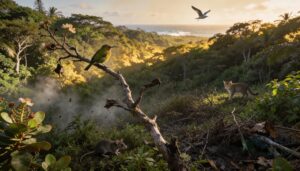
Hawaii’s birds are in trouble, and the causes go deeper than most people realize. Several forces are working against native species at once, from the ground up and the sky down.
Here’s a look at the biggest threats putting these birds at risk.
Habitat Loss and Deforestation
Habitat loss hits Hawaii’s forest birds harder than almost anywhere else on Earth. When native trees disappear, so does everything that depends on them.
- Fragmented forest patches create edge effects that expose nests to predators and wind.
- Soil erosion strips away the nutrients that native plants need to regrow.
- Microclimate change eliminates cool, shaded refuges that forest birds rely on.
Lost habitat connectivity means species like the ‘I’iwi simply run out of room.
Invasive Predators and Non-Native Species
Lost forests open the door to something just as damaging: introduced predators moving in.
Feral cat impacts on ground-nesting seabirds are well-documented, and rats, mongooses, and barn owls hit eggs and chicks hard during breeding season.
Invasive plant fires clear habitat, giving invasive species easier access.
Predator trapping programs, biosecurity screening measures, and public reporting initiatives are slowing the damage — but vigilance can’t stop.
Avian Diseases – Malaria and Pox
What’s silently wiping out Hawaii’s forest birds isn’t just predators — it’s invisible. Avian malaria and avian pox, both vector-borne diseases spread through mosquito bites, devastate native species with little warning.
Hawaii’s forest birds face an invisible killer: mosquito-borne avian malaria and pox devastate native species without warning
Mosquito Vector Dynamics push Disease Transmission Zones upward as temperatures rise.
Malaria destroys red blood cells; pox causes lesions and breathing difficulties.
Disease Management Strategies remain central to protecting Hawaii’s fragile native bird diversity and endemism.
Climate Change and Sea-Level Rise
Climate change is reshaping Hawaii’s coastlines faster than many birds can adapt.
Rising seas drive Coastal Habitat Migration, pushing wetland bird communities in Hawaii inland — or underwater. Saltwater Intrusion poisons freshwater marshes that Hawaiian Coots and Stilts depend on.
Storm Surge Amplification batters seabird breeding and nesting habits in Hawaii, while Coral Reef Erosion and Mangrove Loss strip away natural buffers, accelerating climate change effects on birds across every island.
Pollution and Human Disturbance
Pollution quietly stacks the odds against Hawaii’s birds from multiple directions.
Oil spills coat feathers and destroy buoyancy, while plastic ingestion poisons seabirds from the inside out.
Airborne contaminants and noise stress disrupt breeding cycles, and light disruption throws off nocturnal shorebirds entirely.
Combined with habitat loss and invasive species impact, these human-mediated pressures push already fragile conservation status deeper into crisis territory.
Birdwatching and Conservation in Hawaii
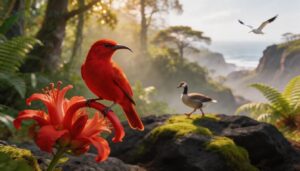
Hawaii is one of the best places in the world to go birdwatching, and knowing where to look makes all the difference.
Whether you’re hoping to spot a scarlet ‘I’iwi in the forest canopy or a Nēnē grazing along a volcanic slope, the islands have something for every birder.
Here’s what you need to know about the top spots, the organizations protecting these birds, and how you can get involved.
Top Birding Locations Across The Islands
Hawaii rewards the patient birder at every turn. Walk Haleakalā Forest Trails at dawn and you’ll likely spot honeycreepers feeding in the canopy.
Kīlauea Point delivers stunning coastal bird habitats with red-footed boobies overhead. Puʻu Makaʻala Forest shelters endemic forest bird species on the Big Island.
Kokee Canyon Vistas and Waimea Valley Wetlands round out your list — each supporting rich wetland bird communities worth every early morning.
Conservation Programs and Leading Organizations
Real change for Hawaii’s birds takes a village — and thankfully, that village is organized.
Groups like Audubon, The Nature Conservancy, and Conservation International lead Habitat Restoration Partnerships that replant native forests and protect critical corridors.
Predator Control Programs reduce feral cats and rats threatening nests.
Citizen Science Initiatives let you help monitor populations daily.
Funding and Grants from NWF and Policy Advocacy Efforts keep conservation moving forward.
Endangered Species Recovery Efforts
Recovery for Hawaii’s most endangered birds doesn’t happen by accident — it’s built on years of careful science.
- Captive Breeding maintains genetically diverse colonies of species like the Hawaiian Crow (ʻAlalā) and Akikiki (Oreomystis bairdi)
- Predator-Free Zones give vulnerable birds like Akekee (Loxops caeruleirostris) space to nest safely
- Habitat Corridors reconnect isolated populations through restored native forest patches
Community Monitoring and Genetic Management keep each program on track.
How to Support Hawaiian Bird Conservation
Science saves birds, but so do people like you.
Support habitat restoration by joining Community Habitat Planting events that replace invasive plants with native koa and ōhiʻa.
Advocate for Predator Free Fencing and Mosquito Control Programs in vulnerable forest zones.
Participate in Citizen Science Monitoring walks, and help fund captive breeding efforts.
Traditional Ecological Knowledge guides it all — your involvement genuinely matters.
Frequently Asked Questions (FAQs)
What’s your nationality if you were born in Hawaiʻi?
Just like the Nēnē carries its Hawaiian roots everywhere it roams, so do you — legally, you’re a US citizen. Native Hawaiian identity is cultural, not a separate legal nationality.
What bird species live in Hawaii?
Hawaii hosts impressive taxonomic diversity — over 340 recorded species spanning elevational ranges from coastal wetlands to mountain forests, including 64 endemic birds found nowhere else on Earth.
How many bird species are there in Hawaii?
Around 340 recorded bird species call the Hawaiian Islands home. Of those, 64 are endemic — found nowhere else on Earth. Roughly 52 were introduced, and over 30 endemic species have vanished entirely.
Are there forest birds in Hawaii?
Yes, Hawaii’s forests are alive with endemic species. Honeycreepers, thrushes, flycatchers, and warblers thrive in high-elevation habitats, relying on native tree restoration and forest canopy nesting sites to survive.
What is the state bird of Hawaii?
The Nēnē, or Hawaiian Goose (Branta sandvicensis), is Hawaii’s state bird — designated in This endemic species recovered from just 60 individuals to over 2,500 wild birds today through dedicated conservation efforts.
What is the most famous bird in Hawaii?
The ʻIʻiwi wins that title easily.
Its iconic red plumage, cultural symbolism, and birdsong recognition make it a tourist photo favorite — more visually striking than even the State bird of Hawaii, Nēnē.
Where can you see birds in Hawaii?
As the old saying goes, birds of a feather flock together — and in Hawaii, you’ll find them almost everywhere.
Urban Parks, Coastal Cliffs, High Elevation Forests, and Freshwater Wetlands each host distinct communities worth exploring.
What bird is common to Hawaiʻi?
The Common Myna and Red-crested Cardinal are among Hawaii’s most recognizable common resident species, thriving as urban bird sightings and garden feeder species across parks and backyards statewide.
What are the national birds of Hawaiʻi?
Hawaii has one state bird, not a national one — the Nēnē (Hawaiian Goose).
Designated in 1957, this endemic species carries deep Cultural Symbolism and Legal Protection as Hawaii’s official National Emblem.
What is the rarest bird in Hawaiʻi?
The Maui Parrotbill (Pseudonestor xanthophrys) holds that grim title, with fewer than 200 individuals surviving in high-elevation forest. Captive breeding and predator-free fencing offer its best chance at survival.
Conclusion
Like a forest awakening from a long slumber, Hawaii’s birdlife stirs, fragile yet resilient. As you explore these islands, the birds of Hawaii become your guides, revealing a world of adaptation and survival.
With fewer than 40 native species remaining, conservation efforts are essential. By supporting local initiatives and respecting habitats, you can help protect these avian treasures.
The outlook for Hawaii’s birds depends on our collective actions, and every small step counts.