This site is supported by our readers. We may earn a commission, at no cost to you, if you purchase through links.
Most birdwatchers walk right past them. Green herons crouch motionless along pond edges and stream banks, their compact bodies blending into vegetation while they wait for fish to swim within striking range.
Unlike their taller heron cousins that wade openly through shallow water, these crow-sized hunters prefer shadows and stealth. You’ll find them perched on low branches over wetlands from southern Canada to Panama, where their dark greenish backs and chestnut necks create subtle camouflage among reeds and lily pads.
What makes them notable isn’t just their appearance—green herons use tools to catch prey, dropping insects on the water’s surface as bait. Understanding their identification markers, habitat preferences, and surprising behaviors helps you spot these secretive wetland residents.
Table Of Contents
- Key Takeaways
- Green Heron Identification and Features
- Habitat and Distribution of Green Herons
- Green Heron Behavior and Adaptations
- Diet and Feeding Habits of Green Herons
- Conservation Status and Protection Efforts
- Frequently Asked Questions (FAQs)
- Where do green herons live?
- What is the difference between a green heron and a blue heron?
- How rare is it to see a green heron?
- What is the difference between a green heron and a night heron?
- How rare are Green Herons?
- How do you identify a Green Heron?
- In what states do Green Herons live?
- What is the difference between a blue heron and a Green Heron?
- What does a green heron sound like?
- What does a green heron look like?
- Conclusion
Key Takeaways
- Green herons stand 16 to 18 inches tall with dark greenish-black backs and chestnut necks, hunting along quiet freshwater edges from southern Canada to Panama, where their compact build and stealth tactics distinguish them from larger wading birds.
- These solitary hunters use tools to catch prey by dropping insects, twigs, or feathers onto water surfaces as bait, demonstrating intelligence rare among bird species and executing strikes in under 0.2 seconds once fish approach.
- You’ll find green herons in wetlands with dense shoreline vegetation where they nest 4 to 12 meters high in willows and maples, preferring shallow zones with submerged logs that create ambush points for fish, crayfish, and amphibians.
- While classified as Least Concern globally, regional populations face decline from habitat fragmentation and wetland loss, making conservation efforts focused on protecting riparian corridors and maintaining water quality essential for their survival.
Green Heron Identification and Features
You can’t mistake a Green Heron once you know what to look for. This compact wader carries a striking palette of deep greens and rich chestnuts that set it apart from other waterbirds.
Its downward-curved bill and long yellowish legs also help distinguish it from the similarly sized White Ibis, which favors coastal marshes over wooded wetlands.
Let’s break down the key features that’ll help you identify this secretive hunter in the field.
Size, Shape, and Plumage Characteristics
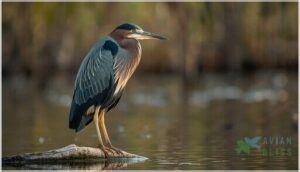
You’ll recognize the Green Heron by its compact, crow-sized body proportions—standing 16 to 17 inches tall with a slender frame and short, rounded wing structures.
The bird’s plumage patterns reveal dark greenish-black upperparts with subtle iridescence, while underparts stay pale to buff. Its relatively long neck folds tightly when perched, creating a distinctive stocky silhouette.
The stout beak shapes and compact tarsus complete this heron’s unmistakable profile for bird identification. Understanding the variety of plumage patterns in birds can provide deeper insight into identifying species like the Green Heron.
Distinctive Color Patterns (Green Back, Chestnut Neck)
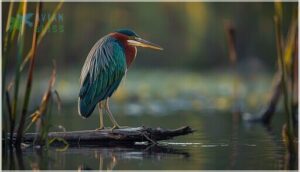
Beyond the compact Size Shape you’ve just observed, you’ll notice the Green Heron’s stunning Color Pattern makes bird identification straightforward. The deep green back—showing Green Hue Variations with metallic Iridescence Effects—contrasts beautifully against the warm chestnut neck.
- Green back feathers provide Feather Camouflage among wetland reeds
- Chestnut Neck Color Contrast creates a collar-like appearance
- Color Pattern Evolution stays consistent year-round for reliable heron characteristics recognition
For those interested in a broader context, essential tools like the Color Key identification system have aided generations of birders in recognizing North American species.
Differences Between Adults and Juveniles
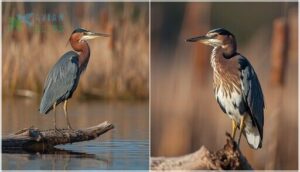
You’ll spot clear Maturity Signs when comparing Adult and juvenile Green Heron Plumage Development. Adults showcase richer Color Pattern with smooth slate backs and deep chestnut necks, while juveniles appear duller with streaked breast Feather Patterns.
Size Variations exist too—adults have longer bills and fuller heron characteristics. These Coloration Changes help you distinguish age groups, especially noting juveniles’ finer neck markings versus adults’ solid crowns.
Comparison With Similar Heron Species

When comparing Heron Species, you’ll notice the Green Heron stands apart from Herons Egrets Bitterns by its compact build and unique Feather Analysis markers.
The Black-crowned Night-Heron shows stockier proportions but lacks the chestnut neck, while the Little Blue Heron grows taller with slender Beak Structure. Least Bittern appears smaller still, and Bird Comparison reveals distinct Wing Patterns across each species.
Habitat and Distribution of Green Herons
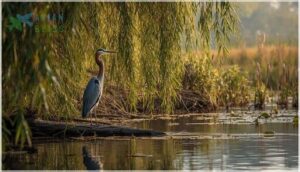
Green Herons aren’t picky about where they set up quiet freshwater shop, as long as there’s water nearby. You’ll find them scattered across a surprisingly wide range, from coastal marshes, and their movements shift with the seasons.
They’re equally at home near wooded ponds, slow-moving streams, and urban parks, much like the adaptable Carolina Chickadee that thrives in diverse settings.
Let’s break down where these secretive birds live, hunt, and raise their young.
Preferred Wetlands and Water Bodies
You’ll find Green Herons haunting still or slow-moving freshwater wetlands like ponds, small lakes, and marshy edges rich with aquatic vegetation. They favor shallow zones where submerged logs and emergent plants create ambush points for fish and amphibians.
In coastal regions, they venture into brackish backwater bays and saltwater wetlands. Water quality and habitat fragmentation directly shape their hunting success and long-term presence.
Geographic Range in North and Central America
From southern Canada down to Panama, you’ll encounter Green Herons across wetland mosaics spanning both coastal habitats and inland rivers.
The Americas host these herons along the Atlantic and Gulf coasts, with range maps showing breeding populations concentrated in the eastern United States and Central America’s lowlands. Regional distribution reveals slight geographic variations in size and plumage, while conservation status monitoring tracks their presence across this broad wetland ecology network.
Seasonal Migration and Year-Round Locations
During migration, you’ll trace Green Herons along flyway routes that follow river systems and coastlines linking breeding grounds to wintering sites in Mexico and Central America.
Range maps reveal that some populations show partial bird migration, with individuals remaining year-round in mild climates where habitat connectivity and climate adaptation support stable prey availability.
Migration patterns shift with water levels and temperature, influencing seasonal movements across their range.
Nesting Sites and Vegetation Preferences
When you’re scouting for Green Heron nests, look where riparian woodlands meet quiet water—usually within 10 meters of the shoreline. Nest tree selection favors sturdy forks in willows, maples, and alders positioned 4 to 12 meters high.
- Dense shoreline vegetation provides predator concealment and wind protection
- Water proximity allows quick hunting access from nest perches
- Nesting materials include sticks placed in live trees or dead snags
- Vegetation dynamics through nesting season maintain protective cover for Butorides virescens
Preserving these habitat features aids bird conservation efforts.
Green Heron Behavior and Adaptations
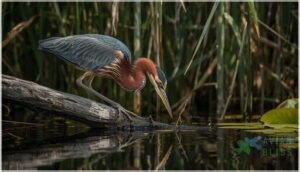
Green Herons aren’t your typical wading birds that stand out in the open waiting for prey to pass by. These solitary hunters have developed a notable toolkit of behaviors that set them apart from other herons, including techniques you won’t see in most bird species.
Let’s look at the key adaptations that make Green Herons such effective and fascinating predators.
Solitary and Secretive Habits
You’ll rarely catch green herons in a crowd—they’re the loners of the heron world. These birds stick to secretive nesting spots tucked in dense cover, where camouflage techniques keep them invisible against tangled branches.
Their solitary behavior peaks during breeding season, when they guard territory like sentries. Outside nesting, they forage alone in shallow water, practicing stealth hunting through ambush tactics that rely on absolute stillness and patience.
Perching, Stalking, and Hunting Techniques
You’ll spot green herons hunting from elevated perches 5 to 15 meters from water, blending with foliage to track prey below. Their stalking methods involve slow, deliberate steps along shorelines, neck retracted and body low to minimize ripples.
When fish come within range, they execute lightning-fast strikes with compact neck snaps, repositioning quickly to swallow prey head-first—ambush strategies perfected through patience and precision.
Tool Use and Bait Fishing Strategies
Beyond passive strikes, you’ll witness green herons practicing bait fishing strategies—dropping insects, twigs, or feathers onto the water to lure curious fish within range. This tool adaptation shows impressive prey manipulation, as they test different objects and adjust presentation based on water conditions.
Green herons drop insects and twigs onto water as bait, luring fish within striking range through impressive tool use
Their foraging strategies demonstrate complex bird behavior, making them standout subjects for wildlife conservation and avian biology research focused on intelligent hunting tactics.
Vocalizations and Communication
While green herons hunt in silence, their songs and calls reveal hidden bird behavior during flight and breeding. You’ll hear the explosive “skeow” alarm call when one flushes from cover, plus aggressive “raah” territorial signals during feeding disputes. Courtship displays include deep “aaroo” notes paired with visual cues like raised plumes, while nestling begging fills nesting areas with persistent screechy calls that coordinate family feeding.
- The harsh “skeow” call pattern functions as both alarm calls and flight announcements over open water
- Males perform Stretch displays with “aaroo” vocalizations, raising back plumes during early courtship displays
- Territorial encounters combine “raah” calls with open red mouths and flared crests to warn intruders
- Nestlings produce repetitive begging calls that help parents locate chicks in cluttered vegetation
- Visual cues like bill snapping, tail flicking, and neck stretching enhance vocal signals during avian behavior exchanges
Diet and Feeding Habits of Green Herons

Green herons don’t wait around for dinner to swim by—they’re active hunters with surprisingly varied tastes. These birds feed on fish, crayfish, insects, and amphibians, and they’ve developed some clever techniques to catch their meals.
Understanding what they eat and how they hunt reveals their important place in wetland food webs.
Primary Prey: Fish, Crayfish, Insects, Amphibians
You’ll find green herons thriving on a wild buffet that shifts with the seasons and habitat. Fish predation targets minnows and sunfish between 2 and 6 inches, seized in lightning strikes under 0.2 seconds. Crayfish hunting along muddy shores delivers high-fat fuel for migration. Insect foraging on larvae and beetles buffers lean times, while amphibian capture of tadpoles and froglets rounds out their opportunistic diet.
| Prey Type | Common Species | Size Range | Habitat Zone | Seasonal Peak |
|---|---|---|---|---|
| Fish | Minnows, sunfish | 2-6 inches | Shallow edges | Spring spawning |
| Crayfish | Channel crayfish | 1-3 inches | Muddy shores | Nocturnal activity |
| Insects | Water beetles, mayfly nymphs | Few millimeters | Vegetation mats | Warm months |
| Amphibians | Tadpoles, froglets | Millimeters to centimeters | Pond margins | Spring breeding |
| Invertebrates | Aquatic larvae | Variable | Emergent plants | Year-round |
This prey adaptations strategy showcases notable bird behavior and habitat intelligence, supporting wildlife conservation and ecology efforts while advancing ornithology research into how herons balance nutrition across changing wetland conditions.
Unique Feeding Behaviors and Tool Use
What makes green herons stand out is their clever prey luring tactics. You’ll spot them dropping feathers, twigs, or insects onto the water’s surface as bait fishing tools to draw curious fish within striking range.
This tool adaptation showcases impressive foraging techniques and species behavior that few other bird species demonstrate. Their feeding strategies blend patience with innovation, reflecting complex avian ecology and bird behavior and habitat intelligence that facilitates broader wildlife conservation and ecology understanding.
Role in Aquatic Ecosystems
You’ll see green herons function as ecosystem engineering agents that reshape wetland dynamics through predation and nutrient cycling. Their foraging maintains balance in aquatic food webs while supporting biodiversity across wetland habitats.
- Control prey populations of small fish and invertebrates, preventing overabundance in shallow waters
- Redistribute nitrogen and phosphorus through excreta, enriching aquatic ecosystems
- Signal healthy habitat quality for conservation efforts targeting wildlife ecology
Conservation Status and Protection Efforts
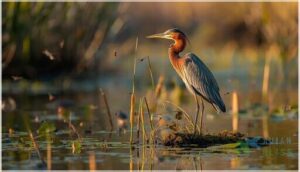
Green Herons aren’t facing extinction, but they’re not exactly in the clear either. Their survival depends on wetlands that are disappearing faster than most people realize, and climate shifts are rewriting the rules for where these birds can thrive.
Understanding their current status and what’s being done to protect them helps you see what’s really at stake for this clever little heron.
Current Population Trends and Threats
You might think this stalker of the shallows is thriving everywhere, but the picture isn’t quite so simple. While the IUCN Red List marks the conservation status as stable overall, regional population decline tells a different story. Human impact through habitat destruction and fragmentation chips away at breeding grounds, and climate shifts scramble migration patterns.
Here’s what threatens these clever fishers:
| Threat Category | Primary Impact | Affected Life Stage |
|---|---|---|
| Habitat Fragmentation | Reduces nesting sites in bottomland forests | Breeding adults |
| Predation Pressure | Higher mortality in isolated wetlands | Juveniles |
| Prey Availability | Drought reduces shallow water foraging | All stages |
Conservation efforts now target wetland preservation to counter biodiversity loss and protect these resourceful herons.
Impact of Habitat Loss and Climate Change
When wetland degradation shrinks foraging zones, you’ll see fewer fledglings survive harsh seasons.
Habitat fragmentation blocks green herons from reaching prime fishing spots, while climate shifts scramble rainfall patterns and dry up shallow pools.
Environmental impact compounds as habitat destruction erodes ecosystem balance, reducing prey diversity and nesting cover.
This ecosystem disruption drives biodiversity loss across connected aquatic habitats.
Conservation Strategies for Wetland Preservation
You can turn the tide for green herons by backing habitat protection plans that safeguard wetland areas where these birds thrive. Wetland restoration and climate resilience strategies rebuild ecosystem services while advancing biodiversity conservation.
- Push for legally protected wetland reserves with buffer zones
- Support water quality improvements through pollution controls
- Advocate for habitat connectivity linking fragmented wetlands
- Champion species protection policies aligned with watershed planning
How Birdwatchers Can Support Green Heron Conservation
You can bolster conservation efforts by joining citizen science projects that track green heron characteristics and map wetland corridors across migratory routes.
Advocate for bird friendly policies that protect buffer zones and reduce pesticide runoff in critical habitats. Participate in habitat restoration events to recreate shallow margins these birds need, and support species protection policies that preserve natural hydrology and limit drainage in essential wetland preservation areas.
Frequently Asked Questions (FAQs)
Where do green herons live?
You’ll find these stocky hunters across North America’s aquatic environments, from quiet freshwater habitats like marshes and ponds to coastal ecosystems with mangroves, where they stake out vegetation-dense water edges for prey.
What is the difference between a green heron and a blue heron?
You’ll notice the Great Blue Heron towers over the Green Heron—reaching 38 to 54 inches versus 16 to 18 inches.
These heron species differ dramatically in size, color patterns, and nesting habits within the heron family.
How rare is it to see a green heron?
You won’t catch green herons strutting in the spotlight—they’re widespread across wetlands but secretive by nature.
Habitat quality and conservation efforts affect sighting frequency, so patient birdwatchers near quiet ponds often succeed.
What is the difference between a green heron and a night heron?
Night herons are stockier with shorter necks and different head patterns—black caps with white cheek patches.
Green herons show glossy greenish backs, chestnut necks, and more compact silhouettes, making species classification straightforward for bird watching tips.
How rare are Green Herons?
You’ll spot Green Herons across eastern North America fairly regularly, though habitat loss fragments local populations.
They’re classified as Least Concern globally, with stable population trends despite seasonal migration patterns and ongoing conservation challenges.
How do you identify a Green Heron?
You’ll recognize this compact heron by its glossy green back, chestnut neck with pale throat stripe, yellow legs, dark daggerlike beak, and raised crest when alert—key plumage patterns for bird identification.
In what states do Green Herons live?
You’ll find breeding grounds across the eastern United States, from southern Canada to the Gulf Coast, with strong populations in southeastern states and along the Mississippi River valley during migration patterns toward wintering sites.
What is the difference between a blue heron and a Green Heron?
Great Blue Herons tower up to four feet tall with pale gray plumage and long legs, while Green Herons measure just sixteen to eighteen inches, displaying dark green backs, chestnut necks, and compact bodies built for stealthy hunting.
What does a green heron sound like?
You’ll hear a sharp, nasal “skeow” or piercing “kyow” when green herons feel threatened—their most distinctive auditory signal.
During territorial disputes, they produce harsh, raspy “fraarnk” calls that echo across wetlands.
What does a green heron look like?
You’ll spot a bird that blends boldness with stealth: glossy greenish-black cap, chestnut neck streaked with pale lines, compact body measuring 41 to 56 centimeters, and yellow-orange legs beneath dark, iridescent wings.
Conclusion
Still waters run deep—and green herons prove it. These secretive hunters won’t announce themselves with size or showiness, but their tool-using intelligence and patient ambush tactics reveal a master class in adaptation.
When you protect the quiet wetlands they inhabit, you’re preserving more than habitat. You’re safeguarding a living reminder that survival belongs to those who observe, adapt, and wait for precisely the right moment to strike.