
This site is supported by our readers. We may earn a commission, at no cost to you, if you purchase through links.

A single bird bath can transform your yard into a neighborhood hub for dozens of species—warblers, robins, finches, even the elusive cedar waxwing stopping mid-migration for a drink. What most gardeners don’t realize is that birds detect water by sound and movement long before they see it, which means a still, silent basin often goes completely ignored.
The right bird bathing water feature does more than hold water; it creates a living microhabitat that draws wildlife in reliably, season after season. Choosing well means understanding materials, placement, and motion—and this guide covers all of it.
Table Of Contents
- Key Takeaways
- Best Bird Bathing Water Features
- Types of Bird Water Features
- Bird-Friendly Design Features
- Moving Water Attraction Benefits
- Best Materials for Bird Baths
- Placement and Safety Tips
- Maintenance and Seasonal Care
- Frequently Asked Questions (FAQs)
- Why put a penny in your birdbath?
- Is a bird bath a water feature?
- How do I select the right location for a bird bath?
- Can bird baths attract unwanted wildlife or pests?
- What materials are most durable for outdoor bird baths?
- How can I protect birds from predators near water features?
- Which bird species visit water features most often?
- How do bird baths attract birds to new gardens?
- Can bird baths double as insect or wildlife habitats?
- How often do birds typically bathe each day?
- Conclusion
Key Takeaways
- Birds detect water by sound and movement before they see it, so adding a dripper, wiggler, or fountain to your bath will attract far more visitors than a still, silent basin ever will.
- The best bird bath design keeps water under two inches deep, with gently sloping, textured sides that give small songbirds confident footing and a safe way in and out.
- Placement matters as much as the bath itself — position yours in open ground with morning sun, at least ten feet from feeders, and within five feet of a tree birds can dart to if trouble arrives.
- Seasonal care is simple but essential: change the water every one to three days, scrub with a diluted vinegar solution to prevent algae, and either winterize ceramic or stone baths before the first hard freeze or add a thermostat-controlled heater to keep water liquid through the cold months.
Best Bird Bathing Water Features
Finding the right bird bath comes down to more than just looks — it’s about what actually works for the birds in your yard. The options below cover everything from solar-powered fountains to winter heaters, offering practical solutions for any setup.
If you’re in a colder climate, knowing how to keep a bird bath from freezing can make all the difference in keeping birds hydrated through the winter months.
Here are eight water features worth considering in 2026, each designed to enhance your yard’s functionality for avian visitors.
1. VIVOHOME Solar Bird Bath Fountain
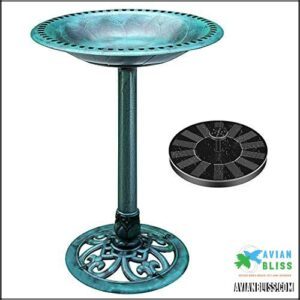
The VIVOHOME Solar Bird Bath Fountain offers a practical solution for adding moving water to your yard without electrical cords. Its 20-inch basin sits at a comfortable height of 27.99 inches, with a 2.4-inch depth designed to ensure safety for small songbirds.
Four interchangeable nozzles allow customization of the water spray pattern, catering to cautious visitors. This flexibility enhances the fountain’s appeal for attracting diverse bird species.
Pump reliability may vary, but maintaining a filled basin and keeping the solar panel clean significantly improves performance. Regular upkeep ensures consistent operation and longevity.
| Best For | Backyard bird lovers who want a low-maintenance, cord-free water feature for their garden, patio, or balcony. |
|---|---|
| Price | $55.99 |
| Material | Polyresin |
| Weight | 4.4 lb |
| Assembly | Tool-free, 4 parts |
| Weather Resistance | Sun, rain, frost |
| Maintenance Level | Periodic cleaning |
| Additional Features |
|
- Runs completely on solar power — no outlets needed, no added electricity costs
- Four swappable nozzles let you mix up the spray pattern depending on what your birds prefer
- Lightweight and easy to move around, so you can chase the best sunlight throughout the day
- Cloudy days and shady spots will kill the fountain’s performance pretty quickly
- The pump has a tendency to drift around in the bowl and may need rocks or sand to stay put
- Some users have reported the pump losing flow or giving out entirely within just a few weeks
2. Alpine 3 Tier Outdoor Fountain
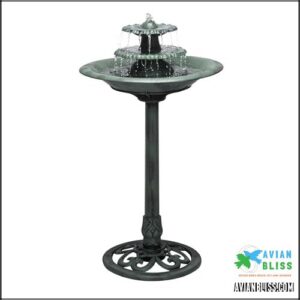
If cord-free simplicity appeals to you, the Alpine 3 Tier Outdoor Fountain offers a dramatic alternative, embracing classic garden drama. Its three cascading tiers create a continuous waterfall effect, visible and audible from afar, naturally attracting birds.
Built from weather-resistant resin with a stone-like finish, the fountain stands 35 inches tall yet weighs only 6 pounds, making seasonal repositioning effortless.
Priced at $53.98, it serves as a charming, affordable focal point for any outdoor space.
| Best For | Gardeners and outdoor enthusiasts who want an eye-catching, budget-friendly water feature that doubles as a birdbath without breaking the bank. |
|---|---|
| Price | $53.98 |
| Material | Resin/Plastic |
| Weight | 6 lb |
| Assembly | Tool-free, minimal |
| Weather Resistance | Weather-resistant |
| Maintenance Level | Occasional cleaning |
| Additional Features |
|
- Three cascading tiers create a relaxing waterfall sound and look great as a garden centerpiece.
- Super lightweight at just 6 lbs, so moving it around or storing it off-season is a breeze.
- At $53.98, it delivers solid visual impact for a fraction of what stone or metal fountains cost.
- The light weight works against it on windy days — it can tip over easily without anchoring.
- Small tier size and slippery edges can be risky for little birds, raising some drowning concerns.
- A few buyers have run into pump assembly headaches and occasional defects out of the box.
3. Hanizi Deck Mounted Bird Bath
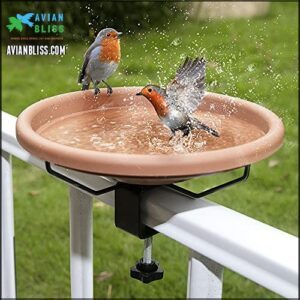
Not everyone has a yard to work with, and that’s where the Hanizi Deck Mounted Bird Bath quietly earns its place. It clamps onto railings up to 2 inches thick without drilling, offering a reliable water stop for birds in small outdoor spaces. This makes it ideal for renters and balcony gardeners seeking practical solutions.
The detachable plastic bowl snaps in and out cleanly, simplifying refills and rinses. Its design ensures hassle-free maintenance, catering to users prioritizing convenience.
At just $22.99 and roughly one pound, the product delivers an honest, no-fuss solution. Its lightweight build and affordability address the needs of compact environments without compromising functionality.
| Best For | Renters, balcony dwellers, and urban gardeners who want to attract birds without a yard or any drilling. |
|---|---|
| Price | $22.99 |
| Material | Plastic/Steel |
| Weight | ~1 lb |
| Assembly | Tool-free, clamp |
| Weather Resistance | Rust-preventive coat |
| Maintenance Level | Easy detach/clean |
| Additional Features |
|
- Clamps on in seconds — no tools, no damage to your railing (well, mostly — more on that below)
- The bowl pops out cleanly for quick refills and rinses
- At $22.99 and one pound, it’s about as low-effort as bird baths get
- The plastic bowl can crack after a winter or two, so it’s not a long-term cold-weather solution
- The depth is way shallower than advertised — closer to 3.5 cm, not 15 cm — which rules out solar fountain add-ons
- The clamp can scuff or chip railing paint if you don’t add some padding first
4. Alpine Ceramic Turquoise Pedestal Bird Bath
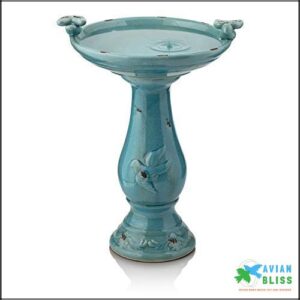
If you want something that doubles as a garden centerpiece, the Alpine Ceramic Turquoise Pedestal Bird Bath is hard to overlook. Its antique turquoise glaze and twin bird figurines give it real visual character.
The wide, shallow bowl—under 2 inches deep—keeps smaller songbirds comfortable and safe.
Standing 25 inches tall at 19.5 pounds, it’s sturdy enough for most garden beds. Just bring it in before hard freezes; ceramic and ice don’t get along well.
| Best For | Gardeners and bird lovers who want a bath that doubles as a decorative focal point for a patio, deck, or backyard. |
|---|---|
| Price | $86.99 |
| Material | Ceramic |
| Weight | 19.5 lb |
| Assembly | Tool-free, no screws |
| Weather Resistance | Cracks if frozen |
| Maintenance Level | Easy seasonal removal |
| Additional Features |
|
- The antique turquoise glaze and twin bird figurines make it a genuine eye-catcher—not just a functional piece, but a real garden accent.
- The wide, shallow bowl is comfortable for smaller songbirds, and setup is a breeze since the top just sits on without any screws.
- At under $87, you’re getting a solid ceramic bath with decent heft and a 1-year manufacturer warranty thrown in.
- Ceramic and freezing temps are a bad combo—you’ll need to bring it inside before winter hits, or risk cracks the warranty won’t cover.
- The bowl-to-pedestal connection is glued, not anchored, so a rough storm or a heavy bump could separate them.
- At 19.5 pounds, it sounds hefty, but it may still need extra anchoring in consistently windy spots to stay upright.
5. Yellow Glass Sunflower Bird Bath
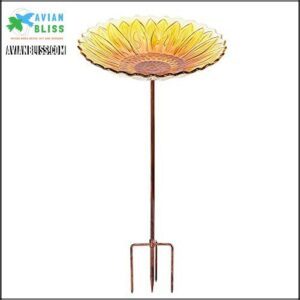
The Yellow Glass Sunflower Bird Bath delivers both charm and function at just $29.61, making it an ideal cheerful focal point for any garden.
The hand-blown glass bowl, painted with bright yellow petals and a brown center, catches sunlight beautifully throughout the day. Its vibrant design adds artistic flair to outdoor spaces.
Standing approximately 20 inches tall on a stainless-steel stake, this bird bath is easy to position in flower beds or patio corners. The bowl measures roughly 10.5 inches wide, accommodating one or two small birds comfortably at a time.
To ensure longevity, drain the bowl before winter to prevent cracking in freezing temperatures. This simple maintenance step protects your investment year-round.
| Best For | Gardeners and bird lovers who want a charming, low-cost water feature for a small backyard, patio, or flower bed. |
|---|---|
| Price | $29.61 |
| Material | Glass/Steel |
| Weight | N/A |
| Assembly | Insert-and-fill |
| Weather Resistance | Drain before winter |
| Maintenance Level | Basic rinse |
| Additional Features |
|
- Gorgeous hand-blown glass bowl with a sunflower design that genuinely catches the eye in any outdoor space.
- Super easy setup — just push the stake in the ground, fill the bowl, and you’re done.
- At $29.61, it’s an affordable way to attract backyard birds without breaking the bank.
- The bowl-to-post connection can be wobbly, and some users have had the bowl detach after a season or two.
- Small bowl size won’t work well with solar fountains or if you’re hoping to attract a crowd of birds at once.
- Glass can crack if water freezes inside, so you’ll need to remember to drain it before winter hits.
6. Antique Copper Garden Bird Bath
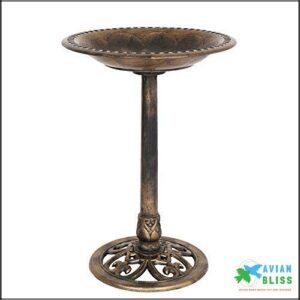
The Antique Copper Garden Bird Bath brings old-world charm to your backyard without demanding much in return. Its high-density resin body mimics a genuine bronzed patina, complete with fleur-de-lis accents that feel handcrafted rather than mass-produced.
At just $29.99, it’s surprisingly sturdy—fill the hollow base with sand or rocks, and it holds its own against moderate winds. Rim perforations provide birds with secure footing while draining excess water naturally.
Assembly takes under a minute, with no tools required, ensuring effortless setup and maintenance.
| Best For | Backyard bird lovers who want an attractive, low-maintenance water feature without spending a lot or hauling around heavy stone or cement. |
|---|---|
| Price | $29.99 |
| Material | Resin |
| Weight | 4 lb |
| Assembly | Tool-free, 4 parts |
| Weather Resistance | Frost and UV resistant |
| Maintenance Level | Tip-and-drain |
| Additional Features |
|
- Looks genuinely antique — the bronzed patina and fleur-de-lis detailing give it a handcrafted feel at a budget-friendly price
- Super easy to set up and clean — no tools, snaps together in seconds, and you can tip the bowl to drain it just as fast
- Flexible anchoring options (sand, rocks, water, or stakes) mean you can keep it stable without a lot of fuss
- Lightweight design can tip over in strong winds if you skip the anchoring step
- The color reads more bronze than copper in person, so it might not match if you’re going for a true copper look
- The threaded joint can be stubborn to assemble — a little coconut oil or similar lubricant helps a lot
7. AISITIN Solar Bird Bath Fountain
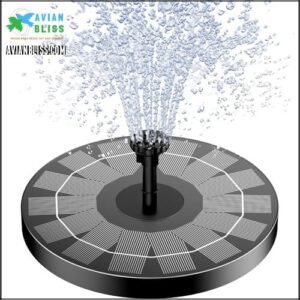
The AISITIN Solar Bird Bath Fountain eliminates electricity costs by utilizing a built-in 2.5W solar panel to power a pump with six interchangeable nozzles, offering water patterns from a gentle mist to a lively jet.
Weighing only 0.53 pounds, the fountain floats effortlessly in any basin and requires minimal setup time.
For optimal performance, place it in direct sun, as cloud cover significantly reduces water flow.
| Best For | Backyard bird enthusiasts and eco-conscious gardeners who want a low-maintenance, cord-free way to keep a bird bath or small pond moving on sunny days. |
|---|---|
| Price | N/A |
| Material | ABS Plastic |
| Weight | 0.53 lb |
| Assembly | Plug-and-play |
| Weather Resistance | UV-resistant housing |
| Maintenance Level | Removable rotor |
| Additional Features |
|
- Six nozzle options let you dial in the right spray — from a calm mist to a lively jet — depending on what your birds prefer.
- Zero wiring, zero batteries. Just drop it in water on a sunny day and it runs itself.
- The rotor pops out for easy cleaning, which is a real plus if your basin collects leaves or algae.
- Cloud cover kills performance fast — don’t count on it during overcast stretches or in shaded spots.
- Some units have had moisture sneak into the panel cover over time, causing early failure — occasionally within the first year.
- It’s light enough to drift around, so you may need to weigh it down with stones if the straws don’t hold it steady.
8. KH Ice Eliminator Bird Bath Heater
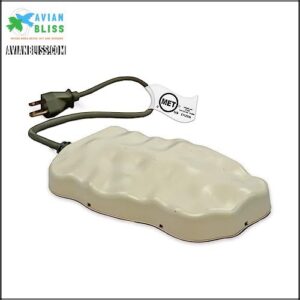
The KH Ice Eliminator ensures your birdbath remains ice-free in winter, keeping water liquid down to -20°F using a thermostatically controlled 80-watt heating element that activates only when necessary. Its energy-efficient design prevents freezing without constant power use.
The unit features a compact, enamel-coated rock-like housing that blends seamlessly into most birdbaths, requiring no permanent installation. Its non-porous surface simplifies cleaning, wiping free of debris with minimal effort.
To maximize longevity, ensure the device remains fully submerged; exposure to air risks damage. Pair it with a GFCI outlet and weatherproof extension cord for safe, reliable winter use, safeguarding both the product and local wildlife.
| Best For | Bird lovers, backyard wildlife enthusiasts, and small-flock chicken keepers who want a simple, low-cost way to keep water accessible for animals during cold winters. |
|---|---|
| Price | N/A |
| Material | Enamel |
| Weight | 1.23 lb |
| Assembly | Submersible drop-in |
| Weather Resistance | Rated to -20°F |
| Maintenance Level | Wipe clean surface |
| Additional Features |
|
- Thermostat-controlled so it only runs when needed — keeps your electricity bill from spiking all winter.
- Rock-like enamel design blends right into most birdbaths and can even be painted to match.
- MET Labs certified and built to handle temps down to -20°F, so it holds up through serious cold snaps.
- The cord is only about 18 inches long, so you’ll almost certainly need a weatherproof extension cord and a GFCI outlet nearby.
- It has to stay fully underwater — if any part is exposed to air, it can overheat and burn out early.
- After a few winters, users have reported paint chipping and a drop in performance, so don’t expect it to last forever.
Types of Bird Water Features
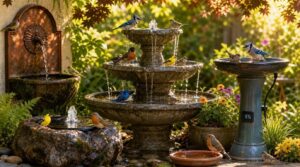
Bird water features come in more styles than most people expect, and the right one can genuinely change how much activity you see in your garden.
Each type works a little differently — some attract birds through sound, heat, or steady flow. Here’s a look at the main options worth considering.
Solar-powered Bird Bath Fountains
A solar-powered bird bath runs entirely on sunlight, making it one of the most energy-efficient water feature options for your garden. Here’s what makes them worth it:
- Quiet pump design keeps the atmosphere peaceful
- UV-resistant materials handle years of sun exposure
- Battery backup strategies maintain flow on cloudy days
The system’s battery backup capability ensures operation during low-light periods.
Face the solar panel true south, and you’ll rarely need to adjust it again.
Cascading Garden Fountains
A cascading garden fountain does more than look beautiful — it creates a whole microhabitat in one structure. The tier geometry and spill edge design control flow at each level, giving birds distinct sipping and bathing zones.
Pump energy efficiency keeps running costs low, while nighttime illumination and soundscape tuning make this a truly eco-friendly garden water installation that birds won’t ignore.
Deck-mounted Bird Bath Bowls
Not everyone has a sprawling garden — and that’s perfectly fine. A deckmount bird bath fits snugly onto your railing using a clamp mechanism that tightens by hand, requiring no tools.
Rail adaptability ensures compatibility with most standard decks, while angle adjustment allows you to tilt the bowl for optimal bird visibility.
- Quick-release bowls detach swiftly for effortless cleaning.
- Weight capacity remains manageable thanks to shallow, water-conserving basins.
- Smart placement strategies for attracting birds include positioning near a potted shrub for cover.
Pedestal Bird Baths
Classic stone pedestal baths suit gardens that deserve a proper centerpiece. Standing 30–36 inches tall, their pedestal-style design naturally deters prowling cats while keeping birds in clear sightlines.
Look for features like adjustable bowl height, an integrated perch, or even a solar-powered pedestal with a self-cleaning mechanism. These elements enhance functionality and maintenance.
Size and placement matter — wider bases ensure steadier footing for splashy bathers, prioritizing stability in garden settings.
Hanging Glass Bird Baths
Where pedestal baths anchor a garden’s center, hanging glass bird baths bring a lighter, more intimate kind of beauty.
The Mumtop Hanging Glass Bird Bath, for instance, uses reflective light attraction to shimmer and catch a bird’s eye from surprising distances. It’s a compact bird bath for small spaces — just secure it with rust-resistant mounting anchor materials, and you’ve solved most wind stability concerns instantly.
Heated Winter Bird Baths
Where heated bird baths bring something birds genuinely need in winter — open water — they rely on a frost sensor function to engage automatically at 36–40°F. Thermostat calibration ensures water remains drinkable without energy waste.
Look for critical safety features: GFCI protection, cables rated for outdoor durability, and an enclosed heating element that safely prevents water from freezing. These elements prioritize both functionality and bird safety.
Water Wigglers and Ripple Makers
Moving water is usually the answer when wondering why some baths attract crowds while others are ignored. Water wigglers and ripple makers offer an easy solution—dropping directly into existing basins without requiring plumbing. Their simple installation mimics a trickling stream’s wave pattern, enhancing bird enjoyment while deterring mosquitoes.
These devices provide quiet operation and impressive battery longevity, often featuring seasonal adjustability. By delivering the benefits of natural water movement, they create an inviting environment for birds without the drawbacks of stagnant water.
Shallow Basin Water Features
Shallow basins might be the most underrated of all bird-friendly water features — simple in shape, but thoughtful in design. Wide ovals or gentle circles invite multiple birds at once, creating inclusive spaces for diverse species.
Gently sloping sides guide even the smallest songbirds safely in and out, prioritizing accessibility. This intentional design ensures birds of all sizes can approach water with confidence.
Keep these details in mind:
- Water depth stays under 2 inches, giving sparrows and warblers confident footing
- UV-Resistant Coatings and Color-Contrast Appeal help birds spot water quickly
- Low-Impact Water Recycling and Acoustic Ripple Tuning keep shallow water fresh and inviting
Bird-Friendly Design Features
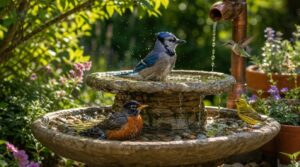
Not every bird bath draws a crowd — the ones that do are built with the bird in mind, not just the garden. A few thoughtful design choices can mean the difference between a bath that sits empty and one that’s busy from sunrise.
Here’s what to look for when choosing a water feature your feathered visitors will actually use.
Water Depth Under 2 Inches
Keep your bird bath water under two inches deep — that sweet spot enables safe bird bathing, natural invertebrate feeding near the surface, and algae suppression by limiting light penetration below.
Shallow water warms quickly, which speeds evaporation and encourages quick water renewal, so you’ll need to refill it often.
Following these depth guidelines for bird water sources gives small songbirds confident, comfortable access to your bird-friendly water feature.
Sloped Edges for Safe Wading
A gently sloping edge serves as a welcoming ramp for birds to access water features safely. By adhering to a Gentle Slope Ratio of 3:1, birds can wade confidently without risking stumbles from sudden drops. This design integrates Edge Drainage principles with sloped edges to create a harmonious and functional system. Key features include:
- Safety Shelf Width of 8–12 inches, providing ample space for multiple birds to rest and preen on a stable Ledge Resting Surface.
- Under-edge Substrate composed of compacted gravel, ensuring erosion resistance and structural stability for gently sloping sides.
- Adherence to depth guidelines for bird water sources, maintaining water levels below 2 inches at the center to prevent hazards.
- Clear sightlines along shallow edges, enabling birds to detect potential threats quickly and enhancing overall safety.
- Smooth shelf-to-basin transitions, eliminating tripping risks near bird-friendly water features for uninterrupted access.
Textured Surfaces for Secure Footing
A smooth basin is basically a slip-and-slide for small birds. That’s why textured surfaces matter so much. Dimples and Microchannels channel water away, while Cross-Hatch Grip and Hexagonal Tessellation patterns boost traction on gently sloping sides.
Conical Bumps mimic natural perches, and Fine Grit coatings add reliable grip without snagging feathers.
Your bird bath’s durable construction truly comes alive when the surface keeps every visitor sure-footed.
Wide Basins for Multiple Birds
Think of a wide basin as a neighborhood gathering spot — one where Social Bathing Patterns naturally unfold. A diameter of at least 24 inches provides generous Water Surface Area, supporting three or more birds at once without crowding.
Circular shapes eliminate tight corners, while shallow water depth and textured slopes enhance Predator Vigilance Zones, Heat Retention Capacity, and Enhanced Visibility. These design choices create a bird-friendly water feature that is genuinely irresistible.
Nearby Perches for Preening
After bathing, birds don’t just fly off — they need a safe spot to preen. Placing perches within 12 inches of your bird bath makes a real difference.
Consider these design ideas for microhabitat perch clusters around your bird-friendly water features:
- Use textured timber for natural grip
- Add adjustable perch angles for comfortable posture
- Choose seasonal perch materials like bark-covered branches in winter
- Install stable mounting bases to prevent wobbling
- Position predator-visible perches near open sightlines for safety
Shallow Zones for Small Songbirds
Small songbirds won’t wade where they can’t stand. That’s why shallow zones — ideally 1 to 2 inches deep — are non-negotiable for attracting songbirds to your bird bath. Sunlit shallow areas warm quickly and invite more frequent visits.
Gentle water pulses and micro-mist zones add movement without overwhelming shy species.
Seasonal depth adjustment keeps your bird drinking stations welcoming year-round, supporting smart feather moisture management.
| Feature | Ideal Spec | Bird Benefit |
|---|---|---|
| Water Depth | 1–2 inches | Safe standing and bathing |
| Impact of water depth on bird usage | Gentle slope | Easier entry, less hesitation |
| Micro-Mist Zones | Low-flow mist | Cooling and feather hydration |
Stable Bases and Secure Mounting
A wobbly bath sends birds flying before they even dip a toe in. Pedestal bases with a 14-inch footprint and anti-tip collars keep everything grounded, while weighted ballast adds real lateral resistance. Quick-release mounts and adjustable fixing rods allow easy repositioning, and the mount adjusts to fit most railings. Crafted from weather-resistant polyresin, the bath remains lightweight yet durable, frostproof, and worry-free.
- Peace of mind knowing your bath won’t topple in a summer storm
- Confidence that anchored bases with proper anchor depth protect visiting birds year-round
- Pride in a setup that’s both beautiful and genuinely secure
Clear Sightlines for Predator Awareness
Security goes hand in hand with stability. Birds won’t linger where they can’t see trouble coming. That’s why clear sightlines matter — keep an open ground buffer of at least six feet around the bath, maintain a low vegetation fringe, and use light-colored boundaries like pale fencing to help spot approaching predators.
A smooth water surface reflects movement clearly, and strategic perimeter lighting at dawn gives birds every advantage.
Moving Water Attraction Benefits
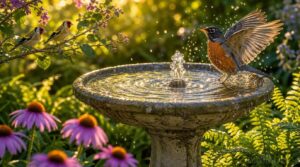
Still water is easy to overlook, but moving water is almost impossible for birds to ignore. A gentle ripple or soft drip changes everything about how birds interact with your garden.
Still water is easily ignored, but a gentle ripple turns any bird bath into something birds simply cannot pass by
Here’s a closer look at the specific ways moving water works in your favor.
Why Birds Notice Moving Water Faster
Birds find moving water almost instantly — and there’s real science behind it. Shimmering reflections catch their eye from a distance, while rhythmic drip sounds carry through the garden like a quiet invitation. Turbulence signals fresh, non-stagnant water, further drawing birds in. These benefits of moving water make attracting birds with garden water features surprisingly straightforward:
- Shimmering reflections draw curious eyes from treetops and flyways
- Varied depth zones let multiple species bathe without crowding
- Predator-safe ripples give birds a clear view of approaching threats
When optimizing water flow for bird attraction, even a gentle trickle outperforms a still basin every time.
Drippers for Gentle Sound and Motion
A well-placed dripper turns your bath into something birds can’t ignore. With Droplet Texture Design and Flow Silence Optimization built into modern Modular Drip Attachments, each drop lands softly — creating a Minimalist Soundscape that carries through the garden.
These features ensure a tranquil auditory experience while maintaining functionality. Weatherproof Drip Housing and Copper Bird Dripper styles blend naturally into your landscape, enhancing both durability and aesthetic appeal.
The combination of innovative design and material choices results in birdfriendly water features that are both practical and quietly beautiful.
Misters for Cooling and Bathing
Watching a mist fountain do its work is one of gardening’s quiet pleasures. Fine droplets — shaped by pump pressure and UV tubing — cool the air around your bird bath through gentle temperature regulation.
That’s what makes a BirdFriendly Mist Fountain so effective: droplet size stays small enough for safe bathing, mist safety stays high, and BirdFriendly water features like these deliver real energy savings through smart outdoor water circulation.
Solar Pumps for Eco-friendly Circulation
A solar-powered bird bath does more than save on your electricity bill — it quietly nurtures the garden ecosystem you’re building.
With MPPT tracking, your pump adjusts its variable speed to match shifting sunlight, ensuring water movement even on partly cloudy afternoons.
Good panel tilt and pump head matching optimize energy efficiency, maximizing the utility of every drop.
A small battery buffer smooths out gaps, maintaining consistent operation during intermittent sunlight.
Genuinely eco-friendly water features don’t get much simpler.
Ripples That Discourage Mosquitoes
Moving water does something mosquitoes genuinely hate — it never stays still long enough to welcome them. Consistent ripple frequency and micro‑eddy patterns create surface disturbance that disrupts mosquito oviposition, making your bird bath a poor choice for egg laying.
This oxygen circulation also prevents water stagnation, supporting bird health naturally. Mosquito control, it turns out, is just another quiet benefit of moving water.
Tiered Water Levels for Drinking
A tiered cascading fountain does more than look beautiful — it quietly solves a real problem. Different water levels give cautious birds their own safe sipping spots, reducing crowding and stress. Think of each tier as its own small microhabitat, each with its own monitoring frequency for cleanliness and safety thresholds for depth.
- Smaller songbirds prefer the shallow upper tiers
- Larger birds gravitate toward deeper lower basins
- Multiple levels mean more birds visit without conflict
Flow Strength for Cautious Birds
Not every bird is bold. Some will watch from a branch for minutes before hopping in — and that hesitation often comes down to flow strength.
A Gentle Ripple Rate, with Low Intensity Currents and Uniform Surface Shear, reassures wary visitors that the water won’t knock them off balance. Adjustable water flow lets you dial things back for nervous species.
| Flow Feature | Bird Benefit |
|---|---|
| Edge Flow Gradients | Calm rim entry for cautious birds |
| Gradual Flow Adjustment | Builds trust with neophobic species |
| Low Intensity Currents | Prevents water stagnation for bird health |
| Uniform Surface Shear | Ensures safe footing mid-bath |
These bird-friendly water features quietly work in your favor — offering safety features for avian visitors while showcasing the real benefits of moving water for birds.
Garden Ambiance From Water Sounds
Water doesn’t just attract birds — it transforms your whole garden. A Cascading Rock Waterfall or Bamboo Spout Fountain hums at Soothing Decibel Levels around 35–40 decibels, creating Natural Acoustic Zones that feel genuinely peaceful.
Pairing that Meditative Water Rhythm with grasses or ferns for Soundscape Plant Pairings that shift with Seasonal Audio Texture.
The result? A tranquil garden oasis with living, breathing sound.
Best Materials for Bird Baths
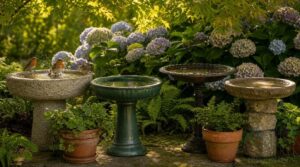
The material your bird bath is made from shapes everything — how long it lasts, how safe it feels underfoot, and how well it holds up through changing seasons.
Some materials are naturally rough and grippy, while others look beautiful but send birds sliding. Here’s a closer look at what each material brings to your garden setup.
Concrete Bird Baths for Durability
Few garden accessories hold up as reliably as a concrete bird bath. Here’s why it earns its place:
- Weight Stability — Dense concrete, often exceeding 80 pounds, resists tipping in the wind.
- Compressive Strength — Withstands freeze-thaw cycles without cracking.
- Thermal Mass — Keeps water cooler on hot afternoons.
- Sealant Longevity — Proper sealing extends freeze resistance and durability for years.
Ceramic Basins and Footing Concerns
Ceramic bird baths bring real beauty to a garden, but their glazed finish comes with trade-offs worth knowing. Glaze Porosity matters more than most realize — a poorly vitrified surface absorbs water, weakening footing alignment over time.
| Concern | What to Watch For |
|---|---|
| Mounting Bracket Load | Check 50–60 psi capacity |
| Thermal Gap Allowance | Leave room for expansion |
| Sealant Flexibility | Use flexible, not rigid sealant |
| Glaze Porosity | Look for uniform glaze thickness |
Resin Bird Baths for Lightweight Placement
Resin bird baths are a smart pick when you want flexibility without the backache.
Their hollow pedestal design keeps weight low, while a sand base or gravel stabilization adds stability on windy days. Weather-resistant polyresin withstands freeze-thaw cycles surprisingly well, and snap-fit assembly means setup takes minutes.
- Portable design you can reposition every season
- Detachable design simplifies scrubbing and drying
- Low-maintenance garden water solution for busy schedules
- Easy-to-clean design resists algae buildup naturally
- Lightweight enough to move without help
Metal Baths and Heat Risks
Metal baths look sharp in a garden, but sun exposure turn them into something closer to a stovetop. Their high thermal conductivity means water heats faster than expected — sometimes exceeding the safe 70–90°F range for small songbirds.
| Risk Factor | Smart Fix |
|---|---|
| Overheating in direct sun | Shade solutions like canopy cloth |
| Hot rims burning feet | Insulated liners for cooler surfaces |
Temperature monitoring safeguards birds’ health throughout the season.
Glass Bird Baths for Decorative Gardens
Few garden accents catch the eye quite like a glass bird bath. Hand-blown artistic glass patterns refract colorful light across nearby foliage, creating a mirror-like effect design that changes with the sun’s angle.
A hanging or suspended glass bird bath adds dimension to tighter spaces, offering both functionality and aesthetic charm.
Integrated LED illumination transforms seasonal glass decor into a nighttime focal point, blending garden aesthetics with genuine outdoor decor appeal.
Stone-look Fountains for Natural Landscaping
Stone-look fountains bring something genuinely grounding to a garden — they feel like they’ve always belonged there. A lightweight resin stone or natural rock fountain with a weathered stone finish and embedded pebble accents blends seamlessly into woodland plantings or cottage garden beds without competing for attention.
Here’s what makes them worth considering:
- Tiered cascade designs create multiple splash zones birds actually use
- Hidden water channels keep pumps invisible and the look natural
- Pebble water basins offer textured footing small songbirds appreciate
- Granite water spheres add sculptural weight without the maintenance of real stone
- Natural stone boulder bird baths anchor larger garden beds as a living focal point
Sustainable materials in outdoor décor matter too — UV-resistant finishes on quality resin hold their color for years without fading.
Freeze-resistant Materials for Winter
Winter is where lesser bird baths simply give up. Your best defense is choosing the right material from the start — one built to flex, not fracture.
| Material | Winter Strength | Key Benefit |
|---|---|---|
| Air Entrained Concrete | Absorbs ice expansion | Freeze-proof bird bath durability |
| Vitrified Ceramic with frost-resistant glaze | Low thermal shock | Weather-resistant bird bath finish |
| Polypropylene Flexibility | Stays pliable at -40°C | Crack-proof in deep freezes |
Powder-coated aluminum and sophisticated sealant technologies round out your options for heated bird baths, supporting winter wildlife beautifully.
Detachable Bowls for Easier Cleaning
Cleaning a bird bath shouldn’t feel like a chore. Detachable bowl designs make it genuinely simple — just snap off the basin, scrub it, and you’re done. Models featuring stainless steel bowls or BPA‑free plastics resist staining and odors remarkably well.
Dishwasher safe design and color-coded sets take garden water feature maintenance a step further, cutting cleaning time and keeping your low‑maintenance garden accessories looking their best.
Placement and Safety Tips
Where you place your bird bath matters just as much as which one you choose.
A poorly positioned bath can leave birds vulnerable to predators or cause unnecessary window collisions — no matter how beautiful the setup looks.
Here are the key placement and safety tips to keep your feathered visitors safe and coming back.
Distance From Shrubs and Hiding Predators
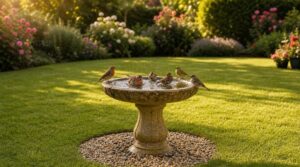
Shrubs may feel cozy, but they’re one of the sneakiest threats to your bird bath setup. Keeping a clear Shrub Buffer Zone of 10–12 feet between dense plantings and your basin gives birds the Visibility Perimeter they need to spot approaching cats or raccoons. Think of it as personal space — birds need room to see trouble coming.
To implement this effectively:
- Clear a 3-foot Ground Cover Minimalism ring directly around the basin
- Maintain at least 10 feet of Predator Concealment Distance from low shrubs
- Follow Perch Proximity Rules — place perches 6–12 inches from the water’s edge
- Trim shrubs regularly to preserve open sightlines year-round
- Favor gravel or short lawn over dense grass for predator safety near the basin
Nearby Trees for Quick Escape Routes

Trees are your birds’ best insurance policy. Position a medium or large tree within 5 feet of your bath — one with canopy density thick enough to shield quick retreats and branch spacing of 15–30 cm for easy hopping.
Root stability matters too; a wobbly tree won’t reassure nervous birds.
| Tree Feature | Why It Matters |
|---|---|
| Tree height over 6 meters | Offers multi-level escape branches |
| Wind orientation upwind | Gives momentum during fast retreats |
Keeping Baths Away From Feeders
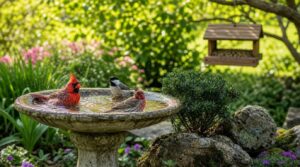
Just as you’d keep your kitchen separate from your bathroom, your bird bath placement should stay at least 10 feet from any bird feeding station. Seed hulls, droppings, and shadow separation issues make proximity a recipe for murky water quickly. A simple visual barrier—a rock, small shrub, or screen placement—works beautifully.
Rotate your bath location occasionally for an extra proximity buffer, preventing disease in garden water sources naturally.
Window Clearance to Reduce Collisions
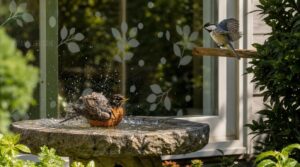
Glass can be genuinely dangerous for birds, especially near a bath where activity spikes. Exterior visual decals and etched window film—spaced 2 to 4 inches apart—signal that glass is a barrier, not open sky. Seasonal shading helps during peak morning light.
Consider these safety features for avian visitors:
- Apply exterior decals covering at least 5% of glass
- Use etched window film for a low-profile fix
- Install artificial perches to redirect flight paths
- Practicing feeder relocation away from reflective panes
Pedestal Height for Predator Protection
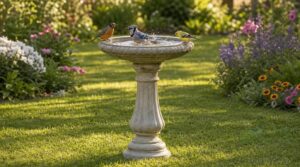
Height is your first line of defense. A pedestal-style design set between 36 and 42 inches delivers reliable cat deterrent height while preserving landing zone clearance, allowing birds to approach confidently. Adjustable elevation enables fine-tuning based on your yard’s predator pressure.
Pair that with an open surrounding area for sharp predator detection. Stable, wind-resistant construction ensures security during blustery days, maintaining a safe and undisturbed feeding environment.
Deck-mounted Placement for Small Spaces
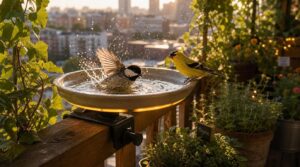
When a compact balcony is all you have, deck-mounted bird baths make every inch count. Rail clamping hardware locks the basin securely against wind load, while a low-profile design keeps things tidy under railings.
The Audubon by WoodLink DeckMount Bird Bath pairs seasonal detachability with integrated lighting for evening visits. Its solar-powered and low-maintenance design ensures practicality without compromising functionality.
Stable Installation on Level Ground
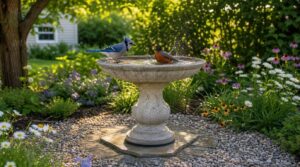
A wobbly bird bath does more harm than good — birds need a steady, reliable spot to drink and bathe.
Start with base compaction: remove two inches of topsoil, then pack the subgrade firmly beneath a paver or gravel bed.
Use shim leveling to correct uneven ground, add a rubber liner to prevent shifting, and secure anchoring brackets around the pedestal.
Run through a quick leveling checklist after filling — water weight shifts things more than you’d expect.
Adding Rocks, Logs, and Landing Spots
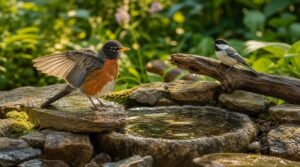
Think of rocks, logs, and landing spots as the living room furniture of your bird habitat — places where visitors settle in, dry off, and feel safe. Flat, sun-warmed rocks create natural Rock Heat Zones for basking, while rough bark benefits birds by providing wet feet a secure grip.
Elevated Log Paths and Strategic Gap Design let birds move freely, preen comfortably, and escape quickly.
Maintenance and Seasonal Care
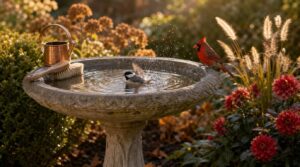
A beautiful bird bath doesn’t stay that way on its own — it needs regular attention to stay safe and inviting for your feathered visitors. The good news is that keeping it in great shape is simpler than you might think, especially when you know what to look for.
Here’s what to focus on throughout the year.
Changing Bird Bath Water Regularly
Fresh water is the heartbeat of a thriving bird bath. Change frequency should follow the season: every day during summer heat, every two to three days in mild weather, and every three to four days when it’s cool.
Always perform a quick debris inspection routine when refilling, and use temperature-safe refills to maintain an inviting water source for birds year-round.
Cleaning With Mild Vinegar Solution
A simple equal-parts vinegar and water solution is one of the smartest tools in your bird bath maintenance kit. It cuts through mineral deposits on ceramic surfaces, restores stainless steel shine, and leaves glass streak-free without harsh chemicals.
- Mix equal parts white vinegar and water for safe surface testing before broad application
- Let the solution sit briefly for ceramic mineral removal before rinsing thoroughly
- Use it for pet area deodorizing around ground-level baths
- Never mix with bleach — harmful gases follow
- Rinse porous basins completely to preserve water quality and easy-to-clean design
Preventing Algae and Biofilm Buildup
Even after a good vinegar rinse, algae can creep back fast. Preventing water stagnation for bird health starts with movement — a well-chosen pump keeps water circulating and discourages biofilm from settling. Light shading slows photosynthetic growth, while filtered water limits the nutrients algae feed on.
| Algae Control Method | Why It Works |
|---|---|
| Anti-fouling coatings | Repel microbial attachment on basin surfaces |
| Micro-textured finishes | Make algae adhesion harder to establish |
| Solar pump selection | Maintains gentle, stagnation-preventing circulation |
| Light shading placement | Reduces photosynthetic algae fuel |
| Filtered water use | Removes nutrients that feed biofilm |
Removing Seed Hulls and Droppings
Algae is not your only cleanup concern — seed hulls and droppings accumulate rapidly, especially near feeders.
Brushing dislodges stubborn debris from basin textures, while sieving techniques efficiently sort hull fragments. Separating droppings prevents contamination spread.
- Use a stiff brush to scrub settled hulls
- Sieve loose debris before rinsing
- Hand-pick visible droppings from the basin surface
- Rinse with a mild vinegar or hydrogen peroxide solution for chemical sanitizing
- Air-dry fully before refilling to support bird health
Inspecting Pumps, Tubing, and Solar Panels
Once the basin is clean, turn your attention to the mechanics keeping your solar-powered water pump running smoothly.
| Inspection Task | What to Look For |
|---|---|
| Pump Leak Checks | Cracks, drips, worn inlet seals |
| Tubing Kink Prevention | Sharp bends, slack pooling, slippage |
| Solar Panel Cleaning | Debris, cracks, tilting angle |
| Electrical Fuse Inspection | Fraying wires, tripped breakers |
Catching impeller wear early keeps adjustable water flow steady, preventing water stagnation, which is crucial for bird health.
Winterizing Fountains and Ceramic Basins
When winter closes in, your fountain needs the same care you gave those pump seals.
Begin with proper drainage procedures: empty the basin completely, let it dry, then apply a penetrating sealant to ceramic surfaces.
Use insulated lids and a weatherproof cover to keep moisture out.
Store pumps indoors to prevent damage.
A freeze-proof bird bath setup protects your investment and supports winter bird care, season after season.
Using Bird Bath Heaters Safely
A good bird bath heater keeps water liquid when temperatures plummet, but safe use matters just as much as warmth.
Plug yours into a GFCI protection outlet, and always check thermostat settings at the start of the season. Cord inspection each month catches wear before it becomes a hazard.
Confirm heater compatibility with your basin material — ceramic and concrete work best — and watch water level monitoring closely, since exposed elements can overheat.
Avoiding Antifreeze and Harmful Additives
Whatever you do, don’t reach for antifreeze — even a small amount is toxic to birds and can mat their feathers beyond recovery.
If you’re using heated bird baths for winter wildlife, stick to non-toxic materials and non-toxic inhibitors only. Propylene glycol is far safer than ethylene glycol if spill containment is ever a concern.
Regular water testing and proper storage of any additives keep your setup genuinely bird-friendly all season.
Frequently Asked Questions (FAQs)
Why put a penny in your birdbath?
Dropping a few pre-1982 pennies into your bird bath is a surprisingly effective, low-cost water clarity trick.
Their copper ions act as a natural eco-friendly algicide, slowing algae without harming birds.
Is a bird bath a water feature?
Yes — a bird bath is absolutely a water feature. By functional definition and design intent, it serves as both a landscape focal point and a small ecological habitat.
This dual purpose draws life into your garden, enhancing its vitality while fulfilling its intended role.
How do I select the right location for a bird bath?
Start with morning sun and afternoon shade. Keep a visible landing nearby, maintain a feeder gap of ten feet, and choose open spots that double as a predator shield.
Can bird baths attract unwanted wildlife or pests?
Bird baths bring life to your garden, but still water can invite mosquito breeding, rodent attraction, and pathogen growth.
Regular water changes and movement features keep pests away while protecting bird safety.
What materials are most durable for outdoor bird baths?
Fiber-reinforced concrete and sealed cast stone outlast most alternatives, handling freeze-thaw cycles with ease.
Powder-coated metal and frost-resistant glaze ceramics also hold up well, maintaining durability in harsh conditions.
UV-stabilized acrylic resists fading without cracking, ensuring long-term resilience against environmental stressors.
How can I protect birds from predators near water features?
Ironically, the safest bathing spot can become a trap without smart planning.
Use elevated perches, barrier shrubs, motion-activated sprinklers, and angled fencing to keep your feathered visitors secure near any water feature.
Which bird species visit water features most often?
From mallards and great blue herons to winter robins and spring swallows, your feathered friends naturally gravitate toward water.
Shorebird stopovers, avian species diversity, and year-round wildlife watering make bird-friendly water features a birdwatching reward.
How do bird baths attract birds to new gardens?
Even the Romans knew a fountain in the courtyard drew life to it.
Fresh water in a visible location, paired with contrasting colors and quiet surroundings, signals safety and pulls birds straight in.
Can bird baths double as insect or wildlife habitats?
With shallow edges and textured bases, your bird bath becomes a microhabitat for insect larval zones, amphibian splash spots, and butterfly puddling stations.
This design quietly doubles as genuine wildlife habitat and beneficial bug attractors.
How often do birds typically bathe each day?
Funny how birds don’t wait for a schedule — they bathe when life demands it.
Most bathe several times weekly, with frequency increasing to daily during heat.
Morning bathing timing and rainfall bath spikes significantly influence seasonal bathing rates.
Conclusion
What happens next in your yard depends entirely on one decision. The birds are already listening—scanning the air for the faint trickle that means safety, a drink, a place to rest mid-flight.
The right bird bathing water feature closes that gap between a yard they pass over and one they return to, season after season.
Choose moving water, place it thoughtfully, and keep it clean. They’ll find you.
- https://www.allaboutbirds.org/news/attract-birds-with-birdbaths/
- https://waterfountainonline.com/blogs/inspiration-guides/bird-bath-depth-material-pet-safety-guide?srsltid=AfmBOoqiybYR_Yr01I_xA7z65LcledpMdxsicx094WnXRxy5B9HOFhTS
- https://connectnest.net/bird-bath-depth/
- https://www.perkypet.com/articles/8-things-you-should-know-before-installing-a-bird-bath?srsltid=AfmBOooqR4iUU9DTlggsE57fDXHQr-cbFYl8_LuVKiBMHJHg_7igJFfD
- https://dev.welcomewildlife.com/make-water-move/