This site is supported by our readers. We may earn a commission, at no cost to you, if you purchase through links.
Most seabirds reveal themselves readily—gulls squawk overhead, pelicans patrol the surf line—but the marbled murrelet defies easy observation. This palm-sized enigma spends its days diving through cold Pacific waters for small fish, then vanishes at dusk into coastal fog, flying miles inland to nest on moss-covered branches in ancient forest canopies where few humans venture.
Scientists didn’t confirm a nest location until 1974, nearly two centuries after the species was first described, making it one of North America’s last ornithological mysteries to yield its secrets. That dual existence between ocean and old-growth forest now threatens its survival, as logging fragments the towering ecosystems it depends on for reproduction while changing ocean conditions disrupt the prey base sustaining its marine foraging.
Table Of Contents
- Key Takeaways
- What is The Marbled Murrelet?
- Habitat and Geographic Range
- Diet and Foraging Habits
- Nesting and Life Cycle
- Conservation Status and Threats
- Frequently Asked Questions (FAQs)
- Why are marbled murrelet endangered?
- Where can I see marbled murrelet?
- Can marbled murrelets fly?
- What is a marbled murrelet?
- How many marbled murrelets are left?
- What is the difference between marbled murrelets and common murres?
- How many marbled murrelet are left in the world?
- Why is the marbled murrelet endangered?
- Do marbled murrelets mate for life?
- Why is the marbled murrelet declining?
- Conclusion
Key Takeaways
- The marbled murrelet‘s survival depends on maintaining both old-growth coastal forests for nesting (on moss-covered branches 20-60 meters high in trees over 150 years old) and productive Pacific marine ecosystems for foraging, making it uniquely vulnerable to habitat loss in either environment.
- Scientists didn’t confirm this seabird’s nest location until 1974—nearly 200 years after the initial species description—because murrelets fly miles inland at dusk to nest high in ancient forest canopies where few humans venture, representing one of North America’s last major ornithological mysteries.
- Population decline stems from converging threats, including logging that fragments essential old-growth nesting habitat, climate-driven changes in ocean conditions that disrupt prey availability (primarily Pacific herring, anchovy, and sand lance), plus additional pressures from oil spills, fishing bycatch, and increased nest predation.
- Current population estimates indicate that only 400-470 individuals remain in U.S. conservation zones, with global populations measured in the low tens of thousands, reflecting substantial species decline that demands comprehensive conservation addressing both marine and terrestrial habitats simultaneously rather than protecting either realm alone.
What is The Marbled Murrelet?
The marbled murrelet stands apart as one of North America’s most enigmatic seabirds, a species that kept its nesting secrets hidden from scientists until the 1970s despite inhabiting coastlines where humans had lived for millennia.
Like other species with unique nesting habits of birds, the marbled murrelet evolved strategies that helped it evade detection for generations.
These robin-sized diving birds split their lives between two radically different worlds: the cold waters of the Pacific Ocean where they feed and rest, and the towering old-growth forests where they raise their young on moss-covered branches hundreds of feet above the ground.
Marbled murrelets live split lives between Pacific waters and old-growth canopies, nesting on moss-covered branches hundreds of feet high
Understanding this species requires examining the physical traits that define it, the features you’ll use to identify it in the field, and the unusual behaviors that set it apart from other seabirds.
Physical Characteristics
The marbled murrelet (Brachyramphus marmoratus), a robin-sized member of the Auks Murres Puffins family, weighs 180 to 350 grams with a compact body designed for seabird ecology. You’ll notice its dark gray-brown back displaying subtle marbled feather patterns, pale underparts, and a slender dark beak with a pale base.
Wing shape remains narrow and pointed, spanning 36 to 41 centimeters—perfect for agile coastal flight in avian biology.
Identification Features
You’ll distinguish this species through distinctive markings that shift with breeding cycles—reddish brown eyes with pale iris edges, a white throat patch contrasting against the dark cap, and barred back patterns unique to Brachyramphus marmoratus.
Plumage patterns show scalloped feather textures on upperparts, while visual cues include white wing patches during flight. The small black beak features a pale base, essential for avian biology field identification in seabird ecology contexts.
Unique Behaviors
Beyond static features, you’ll observe adaptive Foraging Strategies that reveal this species’ ecological adaptations. Courtship Displays involve synchronized head bobbing and soft nasal calls between pairs, while Nocturnal Feeding patterns intensify at dawn and dusk when prey schools surge near the surface.
- Diving Techniques: Birds plunge from flight, skimming 1-6 meters deep before surfacing with rapid wing flaps
- Energy Conservation: Wind-riding along shorelines reduces metabolic costs during inland nesting behavior flights
- Acoustic hunting: Hovering murrelets tilt heads to align ear openings, detecting fish movement beneath waves
These behaviors highlight critical seabird habitat preservation needs in Marbled Murrelet conservation and avian conservation biology frameworks.
While wild seabird populations require specialized coastal ecosystems, domestic bird owners can apply similar habitat principles by learning how to set up a bird cage properly to create safe, species-appropriate environments.
Habitat and Geographic Range
The marbled murrelet lives a dual existence between two dramatically different ecosystems, spending most of its time foraging in Pacific marine waters while depending entirely on ancient coastal forests for reproduction.
This split lifestyle makes the species particularly vulnerable to habitat disruption in either environment, as both marine and terrestrial areas must remain intact for population survival. Understanding where these birds occur throughout the year reveals the complex geographic requirements that shape their conservation needs.
Marine Environments
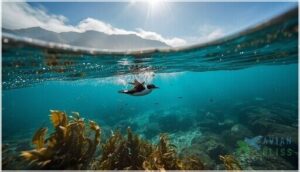
You’ll find marbled murrelets in the open ocean and coastal ecosystems where they spend most of their lives foraging for prey. These seabirds inhabit near-shore waters usually less than 100 feet deep, where ocean currents concentrate small schooling fish and invertebrates.
Their foraging behavior reflects marine ecology principles: they’re opportunistic feeders that maintain ecosystem balance while remaining vulnerable to marine pollution and coastal erosion impacts threatening their survival. Understanding marbled murrelet habitats can be enhanced by exploring marine ecosystem components, which detail the interplay of biotic and abiotic factors in coastal environments.
Old-Growth Forest Nesting

You’ll discover that old-growth forests provide essential nesting habitat for marbled murrelets, where forest canopy density and nest tree selection determine reproductive success. These nesting microhabitats require trees exceeding 100 years in age with sturdy limbs located high in the canopy—usually several tens of meters above ground.
Habitat fragmentation from logging threatens old growth ecology, reducing wildlife habitat preservation efforts critical for forest ecology and management. Recent research underlines that extends to over a thousand bird and mammal species that rely on them for nesting cavities.
Breeding and Wintering Areas

You’ll find marbled murrelets breeding in old-growth forests along the Pacific Coast from Alaska to central California, nesting 200 to 900 meters above sea level on moss-covered branches in trees often exceeding 200 years old.
During winter, migration patterns shift these seabirds to temperate marine ecosystems featuring productive upwelling zones, where sea surface temperatures between 8 and 14 degrees Celsius support abundant prey aggregations essential for habitat preservation and coastal conservation efforts.
Diet and Foraging Habits

Understanding what marbled murrelets eat and how they hunt reveals the critical connection between healthy marine ecosystems and their survival. These opportunistic feeders have adapted specialized diving techniques that allow them to exploit shallow coastal waters where prey concentrates in abundance.
The following sections examine their primary food sources, underwater foraging strategies, and how their diet shifts with seasonal availability of marine resources.
Primary Prey Species
Your understanding of marbled murrelet survival depends on recognizing their prey: schooling fish like Pacific herring, Pacific anchovy, candlefish, and Pacific sand lance drive foraging success.
Forage biomass in nearshore waters directly influences breeding outcomes, with prey size usually ranging from a few centimeters to roughly 10 centimeters.
When fish availability declines, krill supplement the diet, underscoring the species’ adaptive strategies critical for seabird conservation efforts.
Foraging Techniques
You’ll witness marbled murrelet foraging strategies in action when these birds alternate between surface scanning and plunge diving to depths of 20 meters, targeting Pacific herring and Pacific anchovy through rapid wing propulsion underwater.
Their hunting tactics rely on:
- Visual scanning across offshore grids to pinpoint prey schools beneath wave surfaces
- Quick bill strikes while skimming to seize individual fish during surface feeding
- Aerodynamically optimized body orientation that minimizes water resistance during deep-water pursuit dives
- Tidal rhythm timing that maximizes prey visibility and capture success rates
- Kelp patch exploitation near upwelling zones where nutrient-rich currents concentrate forage fish
These dive patterns and feeding behaviors directly support seabird conservation and marine ecosystem management priorities.
Seasonal Diet Variations
Your observations of marbled murrelet feeding patterns reveal significant seasonal foraging shifts driven by prey availability cycles—Pacific herring and Pacific sand lance dominate spring diets when spawning aggregations peak, while candlefish and Pacific anchovy comprise summer selections during upwelling intensification periods.
These dietary adaptations reflect nutrient shifts in coastal ecosystems, with birds adjusting feeding patterns to exploit fluctuating forage fish abundances across breeding and wintering ranges.
Nesting and Life Cycle

The marbled murrelet’s reproductive strategy breaks every conventional seabird rule, nesting high in coastal forest canopies rather than in colonial cliff sites where most alcids gather.
This dual-habitat dependency—requiring both productive marine waters and old-growth forest structure—creates unique challenges you won’t find in other Pacific seabirds.
Understanding how these birds select nest sites, raise their single chick, and coordinate parental duties reveals why protecting both ecosystems matters for their survival.
Nest Site Selection
You’ll find marbled murrelet nest tree selection follows predictable patterns within oldgrowth forests—birds target mature conifers averaging 150 to 300 years old, selecting sturdy branches 20 to 60 meters above ground that offer mossy nest platforms near the canopy.
Site fidelity is strong when habitat features align with foraging corridors, though habitat loss increasingly disrupts these nesting habits and threatens forest ecology connections essential for reproduction.
Chick Development
Once the egg forms at the selected nest site, you’re looking at a 28- to 30-day incubation period before embryo growth transitions into active chick morphogenesis—the single hatchling emerges semi-altricial, covered in downy feathers, requiring extended parental provisioning that directly influences nesting success and fledgling survival rates critical to seabirds like the marbled murrelet within wildlife conservation efforts targeting avian ecology restoration.
Parental Care
After hatching, both parents demonstrate intense nest attendance, alternating incubation duties while fasting as needed to maintain egg warmth and chick temperature—this shared responsibility directly enhances brood survival and parental bonding essential to marbled murrelet conservation efforts within avian ecology frameworks prioritizing bird species preservation through wildlife conservation efforts targeting chick rearing success via coordinated feeding strategies.
- Adults regurgitate prey items sized to the chick’s developmental stage
- Nest site microclimate is moderated through parental shielding from wind and rain
- Provisioning frequency peaks during initial post-hatch weeks, tapering as fledging approaches
- Thermal regulation occurs through close contact, especially during storms or cold conditions
Conservation Status and Threats

The marbled murrelet’s population has been declining for decades, and understanding the forces behind this trend is essential if you want to grasp the urgency of conservation efforts.
Habitat destruction, predation pressure, and marine threats have converged to push this species toward endangered status across much of its range.
Below, you’ll find the primary factors driving population decline, the specifics of habitat loss and fragmentation, and the conservation initiatives working to reverse these troubling patterns.
Population Decline Causes
You’re witnessing a perfect storm of threats driving Marbled Murrelet populations downward. Habitat destruction through logging removes essential old-growth nesting sites, while climate change impacts on wildlife alter oceanic conditions and prey distribution.
Food scarcity emerges as a key issue as fish populations decline, compounded by pollution effects that accumulate in foraging zones. Human impact through recreational disturbance and fisheries bycatch further stresses these endangered species, creating cascading effects across their range.
Habitat Loss and Fragmentation
Among the most insidious threats you’ll observe is habitat fragmentation, where logging and urban expansion shatter continuous old-growth forest into isolated patches. These forest fragmentation events trigger edge effects—warming microclimates, increasing predator access, and disrupting habitat connectivity between nesting and foraging zones.
Ecosystem degradation through timber roads and clearcuts eliminates the landscape-scale integrity Marbled Murrelets require, fragmenting their world into disconnected remnants that undermine population viability.
Conservation Initiatives and Research
You can join conservation strategies through community engagement initiatives that pair acoustic monitoring with aerial surveys to track nesting success.
Research methods now integrate habitat restoration projects—reforestation with native conifers reconnects fragmented landscapes—while marine protected areas safeguard foraging zones.
Species monitoring through data portals and volunteer networks strengthens Marbled Murrelet conservation efforts, turning biodiversity preservation from abstract policy into collaborative action for environmental conservation and protection.
Frequently Asked Questions (FAQs)
Why are marbled murrelet endangered?
You’re watching one of North America’s rarest dramas unfold: habitat loss from logging has stripped away old-growth nesting sites, while ocean warming disrupts prey availability—converging threats that pushed marbled murrelets onto the Endangered Species Act list.
Where can I see marbled murrelet?
You’ll find these seabirds along Pacific Northwest and California coastlines during specialized marine tours or whale-watching expeditions, particularly from Alaska’s Aleutian Islands southward, where calm offshore conditions provide ideal coastal birding and oceanic wildlife viewing opportunities.
Can marbled murrelets fly?
Yes, you’ll find marbled murrelets are strong fliers with rapid wingbeats exceeding 100 kilometers per hour.
Their flight patterns showcase aerial maneuvers and wing structure adaptations enabling both swift ocean-to-forest travel and underwater dive speed.
What is a marbled murrelet?
You’re looking at a small, chunky alcid—about 25 centimeters long—that spends most of its life at sea but nests high in coastal old-growth forests, a seabird with notable dual-habitat ecology.
How many marbled murrelets are left?
Ironically, counting seabirds that vanish into fog proves challenging—current surveys estimate just 400–470 individuals remain in U.S. conservation zones, reflecting decades of habitat preservation failures and ongoing population trends threatening this Endangered Species Act-listed species.
What is the difference between marbled murrelets and common murres?
These two alcids differ dramatically in nesting habits—common murres colonize coastal cliffs while marbled murrelets nest in old-growth forest canopies—and their plumage comparison reveals mottled brown versus stark black-and-white patterns.
How many marbled murrelet are left in the world?
Despite decades of wildlife conservation efforts, precise global estimates remain elusive—you’ll find populations now measure in the low tens of thousands, representing substantial species decline across their Pacific range.
Demanding urgent biodiversity and species preservation through ecological conservation and thorough threat assessment initiatives.
Why is the marbled murrelet endangered?
You’ll find this endangered species facing habitat destruction through old-growth forest logging, oil spills causing pollution effects, fisheries bycatch, ecosystem disruption from climate change, and human impact through coastal development—all driving wildlife conservation efforts today.
Do marbled murrelets mate for life?
The phrase “Birds of a feather flock together” rings especially true for marbled murrelets—these alcids form long-term pair bonds that often persist across multiple breeding seasons, demonstrating noteworthy monogamy uncommon in avian research on seabird mating rituals and mate selection.
Why is the marbled murrelet declining?
Habitat loss from logging old-growth forest, wildlife habitat fragmentation, and preservation failures combine to threaten Marbled Murrelet populations.
Ocean changes reducing prey, nest predation by corvids, oil spill risks, fishing bycatch, and slow forest management recovery also threaten Marbled Murrelet populations.
Conclusion
Without old-growth giants towering three hundred feet above the forest floor, without fog-shrouded boughs draped in centuries-old moss, the marbled murrelet simply can’t persist—its fate is inextricably bound to ecosystems that took millennia to develop yet can vanish within a single human generation.
You’re witnessing a species caught between two worlds, ocean and canopy, where protecting either habitat alone won’t suffice. Only thorough conservation addressing both realms offers genuine hope for survival.