This site is supported by our readers. We may earn a commission, at no cost to you, if you purchase through links.

A chicken scratching in the dirt shares more genetic heritage with a crocodile than a crocodile does with a turtle. That fact trips up almost everyone who first encounters it, but the science is irrefutable—birds aren’t just related to reptiles; they are reptiles, sitting right inside that family tree alongside their scaly cousins.
The confusion stems from outdated classification systems that grouped animals by superficial traits like “has feathers” or “is cold-blooded,” ignoring the evolutionary ancestry that truly defines living things.
Modern phylogenetic taxonomy rewrote the rules by tracing genetic lineages backward through time, revealing that every robin, eagle, and penguin descended from feathered dinosaurs that survived when most other reptiles perished. Understanding why this reclassification happened unlocks a clearer picture of evolution, reshapes how we protect endangered species, and connects the dots between fossils, DNA, and the backyard birds you see every morning.
Table Of Contents
- Key Takeaways
- Why Are Birds Classified as Reptiles?
- The Evolutionary Link Between Birds and Reptiles
- Key Evidence Connecting Birds and Reptiles
- Distinctive Traits: Birds Vs. Traditional Reptiles
- Why Accurate Classification Matters in Biology
- Frequently Asked Questions (FAQs)
- When did birds become classified as reptiles?
- Are birds technically flying reptiles?
- What is the connection between reptiles and birds?
- Why are dinosaurs reptiles but not birds?
- Why are birds considered flying reptiles?
- Why is a not a reptile?
- How are birds dinosaurs if they aren’t reptiles?
- Why are birds like reptiles?
- Why are birds classified as reptiles and not in their own class?
- What sets birds apart from reptiles?
- Conclusion
Key Takeaways
- Birds are classified as reptiles because modern phylogenetic taxonomy groups organisms by evolutionary ancestry rather than superficial traits, revealing that birds descended from feathered theropod dinosaurs within the archosaur lineage alongside crocodiles.
- The reclassification corrects centuries of grouping errors based on observable features like “has feathers” or “is cold-blooded,” replacing outdated Linnaean systems with DNA evidence and fossil records that trace genetic lineages backward through time.
- Despite developing unique adaptations like warm-blooded metabolism, feathers for flight, and specialized respiratory systems, birds retain unmistakable reptilian characteristics including scaly legs, keratin-based coverings, and hard-shelled amniotic eggs.
- Accurate evolutionary classification matters beyond semantics—it reshapes conservation strategies, enables scientists to predict traits in poorly studied species, and helps protect biodiversity by recognizing shared needs across interconnected lineages.
Why Are Birds Classified as Reptiles?
If you’ve ever wondered why scientists group birds with snakes, lizards, and crocodiles, you’re not alone—this classification seems to contradict everything we learned in elementary school.
The truth is that modern birds are technically reptiles—a fact that becomes clear when you explore the evolutionary relationships among different types of bird species and their shared ancestry with dinosaurs.
The answer lies in a fundamental shift in how biologists organize life on Earth, moving from grouping animals by what they look like to grouping them by who they’re related to. Let’s break down the key ideas that explain why your backyard robin is technically a reptile.
Phylogenetic Vs. Linnaean Classification Systems
You’ll encounter two major classification methods in biology: the Linnaean system and the phylogenetic system.
The Linnaean system organizes life into a ranked taxonomic hierarchy—domain, kingdom, phylum, class, order, family, genus, species—grouping organisms by shared physical traits and using binomial nomenclature for species naming.
Phylogenetics, however, builds evolutionary trees based on ancestry, emphasizing monophyletic groups that include all descendants from a common ancestor.
For a detailed comparison of classification systems in taxonomy, researchers explore both physical traits and evolutionary relationships.
The Role of Ancestry in Modern Taxonomy
Modern taxonomy relies on ancestry to place organisms into groups that reflect their true evolutionary history. Phylogenetic analysis traces genetic lineage through time, using ancestral traits and molecular data to map relationships accurately.
When evolutionary biology reveals new connections, taxonomic revision follows, updating classifications to align with evidence. That’s how bird evolution became linked to reptilian ancestry—the phylogenetic system reorganized life’s family tree based on shared descent rather than surface similarities.
Misconceptions in Traditional Animal Groupings
You might think grouping animals is straightforward, but classification errors happen more often than you’d expect. Traditional systems make mistakes because they lean on superficial traits—size, color, or behavior—that don’t reveal true evolutionary relationships.
Here’s where grouping fallacies commonly appear:
- Observable features evolved independently, not from shared ancestors, leading to species misidentification
- Rigid hierarchies ignore genetic evidence that rewires connections between major lineages
- Common names mask phylogenetic reality, causing taxonomic bias in how we perceive relatedness
- Egg-laying alone becomes a criterion, grouping unrelated species incorrectly
- Human-made ranks don’t match natural divisions, distorting our understanding of animal taxonomy
That’s exactly why evolutionary biology pushes us toward phylogenetic systems. When scientists recognized birds are reptiles through ancestry rather than appearance, they corrected centuries of evolutionary misconceptions embedded in reptile classification.
The Evolutionary Link Between Birds and Reptiles

The story of how birds became reptiles starts about 245 million years ago, when the first dinosaurs appeared on Earth. Understanding this connection requires you to follow the thread of ancestry backward through time, connecting modern songbirds and sparrows to their ancient theropod relatives.
Tracing bird evolution also reveals fascinating patterns in modern species, like how the white ibis undergoes its transformation from brown juvenile plumage to adult white over several years of development.
Let’s walk through the major chapters of this evolutionary journey, from the archosaur ancestors that gave rise to both crocodiles and dinosaurs to the single group of feathered dinosaurs that survived a catastrophic extinction.
Birds’ Descent From Feathered Dinosaurs
You’ve probably spotted a robin hopping across your lawn, but did you know you’re actually watching a living dinosaur? Birds descended from small theropod dinosaurs that wore feathers and could glide or fly, with fossils like Archaeopteryx revealing this dino-bird origins story through mixed dinosaur ancestry and avian characteristics.
That robin hopping across your lawn is a living dinosaur, descended from small feathered theropods revealed through fossils like Archaeopteryx
| Transitional Feature | Evidence in Fossils |
|---|---|
| Feather evolution stages | Feathered dinosaur fossils from China document early display structures before flight |
| Wing development | Forelimbs lengthened with asymmetrical feathers forming wing shapes |
| Skeletal adaptations | Lighter bones, fused shoulder girdles, and shortened clawed digits refine the birdlike dinosaur body |
This fossil evidence connects today’s birds directly to their theropod ancestry. Clues from continue to reshape how scientists understand avian origins.
Archosaur Lineage and Shared Ancestors
When you trace bird evolution and reptilian ancestry back far enough, you’ll land on archosaurs—the crown group that unites birds with crocodilians through shared ancestral traits like specialized ankle joints and skull openings.
Fossil record evidence from the Permian-Triassic boundary shows how Archosauria split into distinct lineages, with phylogenetic trees mapping Theropoda’s path from early Sauropsida to your backyard songbirds, revealing archosaur origins in evolutionary timeline detail.
Survival Through Mass Extinction Events
Resilience explains how avian ancestors weathered the KPg extinction event that erased non-avian dinosaurs 65 million years ago, reshaping evolutionary history through survival traits and climate resilience. Your feathered neighbors descend from lineages that exploited:
- Small body size enabling refugia occupation across fragmented habitats
- Flexible diets switching to alternative food sources during ecosystem collapse
- High dispersal ability reaching safe zones when local environments failed
- Rapid reproduction accelerating adaptive evolution after the crash
- Wide thermal tolerances buffering temperature extremes during recovery phases
Key Evidence Connecting Birds and Reptiles
You might be wondering what genetic data proof scientists have that birds actually belong to the reptile family tree. The answer comes from three major areas of study, each providing its own piece of the puzzle.
Let’s look at the fossil discoveries, and anatomical features that connect birds to their scaly relatives.
Genetic and Molecular Data

You can think of DNA sequencing and genomic analysis as a molecular time machine that reveals birds’ reptilian ancestry. Phylogenetic analysis of gene expression patterns shows birds share critical genetic relationships with crocodilians, their closest living relatives.
Proteomics research confirms these connections, while DNA barcodes and studies of genetic mutations consistently place birds within the reptile family tree, supporting what genetic research demonstrates unequivocally.
Fossil Record Discoveries
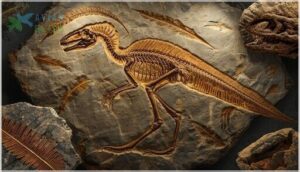
You’ll find the fossil record packed with stunning evidence linking birds to their dinosaur ancestors. Feathered fossils from China’s Liaoning deposits, dating back 120 million years, preserve microraptor’s flight feathers alongside skeletal remains.
Paleontology reveals Archaeopteryx and other ancient species with dinosaur tracks, teeth, and wings—transitional forms that bridge the gap between reptiles and modern birds, making bird evolution’s reptilian ancestry undeniable.
Comparative Anatomy: Scales, Feathers, and Bones
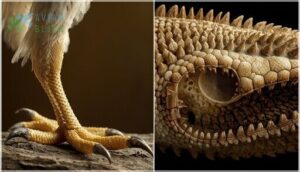
When you look closely at birds and reptiles, you’ll notice notable anatomical parallels. Both groups share keratin formation in their protective coverings—bird scales still grace avian legs and toes, while feathers evolved from similar keratinous tissues.
The avian skeleton reveals archosaur features, including specialized bone structure with air-filled cavities that echo their dinosaurian heritage, cementing why birds are reptiles in evolutionary terms.
Distinctive Traits: Birds Vs. Traditional Reptiles
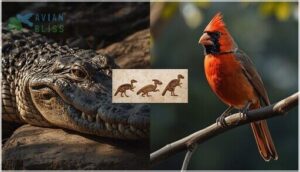
When you picture a reptile, you’re probably imagining something cold-blooded with scales, slithering through the underbrush or basking on a rock.
Birds seem like the complete opposite—warm, feathered, and soaring through the sky. But looking closer at their bodies reveals surprising connections to their reptilian heritage, along with some notable adaptations that set them apart.
Warm-Blooded Adaptations in Birds
You might wonder how birds maintain their energy for flight while reptiles bask in the sun—thermoregulation sets them apart. Warmblooded birds evolved remarkable metabolic rates, with hearts pumping over 500 beats per minute during peak activity, while their respiratory systems deliver oxygen through air sacs that work like bellows. This avian evolution transformed bird characteristics entirely.
| Adaptation System | Function | Impact on Thermoregulation |
|---|---|---|
| Metabolic rates | Fuel rapid muscle activity through glucose and fat metabolism | Sustain stable internal temperatures continuously |
| Circulatory efficiency | Four-chambered heart separates oxygen-rich blood completely | Delivers high oxygen volume to flight muscles |
| Respiratory systems | Unidirectional airflow maximizes oxygen uptake during both breathing phases | Enables rapid heat exchange without oxygen debt |
| Feather insulation | Traps air layers against skin through down feathers | Minimizes heat loss in cold environments |
| Heat management | Peripheral blood flow adjustments during activity | Keeps core temperature stable across conditions |
These interconnected systems reveal bird evolution and reptilian ancestry diverging dramatically, as birds developed internal heat production while traditional reptiles remained ectothermic, depending on external warmth sources.
Feathers and Their Evolutionary Origins
You’ve just learned how birds generate internal heat—now consider how feather evolution revolutionized bird evolution and reptilian ancestry through thermal insulation and aerodynamic features. Fossil impressions from early theropods show feather development progressing from simple filaments to complex vanes, revealing evolutionary adaptations that preceded powered flight by millions of years.
| Feather Stage | Structure | Primary Function |
|---|---|---|
| Early filaments | Simple unbranched keratin threads | Thermal insulation and display |
| Branched barbs | Central shaft with radiating projections | Enhanced coverage and signaling |
| Pennaceous forms | Interlocking barbules create cohesive surfaces | Aerodynamic features for gliding and flight |
| Modern diversity | Specialized down, contour, and flight feathers | Complete thermoregulation and aerial control |
These evolutionary adaptations transformed avian evolution, as feather development enabled birds to occupy ecological niches impossible for their ectothermic relatives, demonstrating how reptile and bird characteristics diverged through gradual innovation.
Scaly Legs, Egg-Laying, and Other Shared Features
Beyond feathers, you’ll notice birds retain unmistakable reptile traits—especially those scaly legs that reveal limb homology stretching back millions of years. Those scales share the same keratin composition as their reptilian cousins, while egg laying patterns and amniotic eggs demonstrate shared reproductive traits connecting birds directly to their archosaur ancestors, reminding you that birds are reptiles with remarkable adaptations.
| Feature | Birds | Traditional Reptiles |
|---|---|---|
| Leg covering | Reptile scales on feet and shanks | Scales across entire body |
| Egg type | Hard-shelled amniotic eggs | Hard or leathery amniotic eggs |
| Scale development | Keratin from epidermal cells | Keratin from epidermal cells |
Why Accurate Classification Matters in Biology
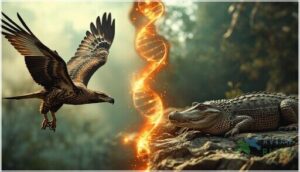
You might wonder why it matters so much whether we call birds reptiles or keep them in a separate category. The truth is, getting classification right affects everything from how we protect endangered species to how scientists communicate across disciplines.
Let’s look at three key areas where accurate evolutionary classification makes a real difference in biology.
Understanding Evolutionary Relationships
Phylogenetic trees map out evolutionary history by showing how species divergence unfolded across millions of years, revealing ancestral traits that connect seemingly different animals.
When you trace bird evolution and classification through molecular phylogeny, you’ll see that reptile traits persist in modern species, helping scientists predict characteristics in poorly studied organisms and clarifying the deep connections within evolution’s grand design!
Impacts on Conservation and Wildlife Management
Understanding reptile traits in birds shapes how you approach conservation and wildlife management today.
Habitat restoration projects targeting bird populations now account for shared reptilian characteristics, like egg-laying patterns and thermoregulation needs.
When you recognize birds within the archosaur lineage, ecosystem management strategies better protect biodiversity through species migration corridors that support both groups, enhancing wildlife preservation efforts across interconnected habitats.
Advancing Scientific Research and Communication
Reclassifying birds within reptile phylogeny revolutionizes how you share evolutionary biology findings with diverse audiences. When researchers embrace this phylogenetic analysis, they discover powerful pathways for science outreach and collaboration.
- Open access publications on bird evolution and classification reach twice as many readers, accelerating species classification understanding
- Data sharing protocols enable independent validation of reptile phylogeny studies
- Collaborative tools connect interdisciplinary teams studying archosaur relationships
- Research transparency builds public trust in evolutionary conclusions
Clear communication transforms how scientists, educators, and policymakers grasp these interconnected lineages.
Frequently Asked Questions (FAQs)
When did birds become classified as reptiles?
You can trace the shift to the mid-1900s, when Willi Hennig’s phylogenetic classification system gained traction, reframing bird evolution and classification through ancestry rather than Linnaean traits.
Are birds technically flying reptiles?
Yes, birds are flying reptiles in phylogenetic classification—descendants of feathered dinosaurs within the archosaur lineage.
Their avian ancestry debate centers on reptile feather origin and bird scale evolution, not traditional characteristics.
What is the connection between reptiles and birds?
You might think birds and reptiles are worlds apart, but birds evolved directly from feathered theropod dinosaurs within the archosaur lineage, making them a specialized branch of reptiles through shared ancestry and phylogenetic analysis.
Why are dinosaurs reptiles but not birds?
Dinosaurs are reptiles because they evolved from archosaur ancestors within the reptile lineage.
Birds are also reptiles—they’re living dinosaurs that survived the mass extinction, making them a specialized branch of the reptile family tree.
Why are birds considered flying reptiles?
As the old saying goes, You can take the bird out of the reptile group, but you can’t take the reptile out of the bird. Birds earned their flying reptiles designation through phylogeny—their evolutionary descent from feathered dinosaurs within the archosaur lineage, which also includes crocodilians and extinct reptiles.
Despite developing specialized flight mechanisms like hollow bones, air sacs, and remarkably efficient feathers that evolved from reptile scales, birds retain unmistakable reptile traits: those scaly legs you see on every sparrow, their egg-laying reproductive strategy, and shared genetic blueprints with other reptiles.
Avian origins trace back to theropod dinosaurs, meaning modern birds represent a living branch of the dinosaur family tree rather than a separate category. The transformation involved feather evolution—initially for insulation or display, later co-opted for powered flight—alongside skeletal adaptations that refined their ancestors’ body plans. Understanding this connection reveals how evolution repurposes existing structures, turning ground-dwelling dinosaurs into aerial masters while maintaining their fundamental reptilian identity beneath those extraordinary flight adaptations.
Why is a not a reptile?
Frogs belong to the class Amphibia, not Reptilia, because their evolutionary history diverged early from reptiles.
Their permeable skin, aquatic larval stage with metamorphosis, and shell-less eggs define distinct amphibian traits that separate them phylogenetically from reptiles.
How are birds dinosaurs if they aren’t reptiles?
Here’s the twist: birds are reptiles. Through phylogenetic classification systems, birds nest within the reptile family tree via theropod ancestry links, making them both dinosaurs and reptiles simultaneously—evolution of birds proves it.
Why are birds like reptiles?
Birds resemble reptiles through shared evolutionary links like scaly legs, amniotic eggs, and bone structures traced to archosaur roots, where feather origins connect to reptilian scales through common ancestry and phylogeny.
Why are birds classified as reptiles and not in their own class?
Modern phylogenetic classification groups organisms by shared ancestry rather than superficial traits.
Because birds descended from ancient reptilian ancestors within the archosaur lineage, they’re nested inside Reptilia, making a separate class scientifically inaccurate.
What sets birds apart from reptiles?
You’ll notice birds stand apart through their warm-blooded metabolism, complex feather maintenance, specialized beak structure for diverse diets, refined nesting behavior, and exceptional flight mechanics—adaptations that distinguish them within reptiles’ evolutionary phylogeny.
Conclusion
Feathers, fossils, and phylogenetic frameworks forever changed how you classify the cardinal at your window—why are birds reptiles? Because their DNA, bones, and evolutionary ancestry prove they never left the reptile family tree.
They simply adapted, survived, and thrived where their dinosaur cousins couldn’t. Next time you spot a sparrow, remember: you’re watching a living reptile that conquered the skies, carrying millions of years of survival in every wingbeat.