This site is supported by our readers. We may earn a commission, at no cost to you, if you purchase through links.
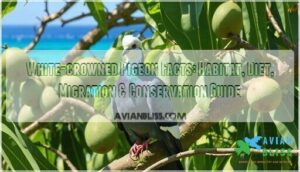 You’ll recognize the white-crowned pigeon by its distinctive white cap contrasting sharply against dark slate-blue plumage.
This Caribbean native measures about 13-15 inches long and inhabits tropical coastal forests from Florida Keys through the West Indies.
They’re fruit specialists, feeding primarily on figs, palm fruits, and berries while serving as essential seed dispersers across island ecosystems.
These strong fliers migrate seasonally between breeding and feeding grounds, often traveling in impressive flocks.
Unfortunately, habitat destruction and hunting pressure have caused population declines, making them a species of conservation concern.
Their unique ecological role and striking appearance make them fascinating subjects for both researchers and birdwatchers who know where to look.
Table Of Contents
- Key Takeaways
- Physical Characteristics of The White-crowned Pigeon
- Habitat and Range
- Diet and Feeding Habits
- Reproduction and Nesting
- Behavior and Social Structure
- Migration Patterns
- Conservation Status and Threats
- Ecological Importance
- Identification Tips for Birdwatchers
- Cultural Significance and Human Interactions
- Frequently Asked Questions (FAQs)
- Are white-crowned pigeons rare?
- Can you keep a crowned pigeon as a pet?
- Is the White-crowned Pigeon extinct?
- Do white-crowned pigeons mate for life?
- Where do white crowned pigeons live?
- What is a white crowned pigeon?
- What conservation measures benefit the white crowned pigeon?
- What happened to the white crowned pigeon?
- Is the white crowned pigeon endangered?
- Can I keep a White-crowned Pigeon as a pet?
- Conclusion
Key Takeaways
- You’ll identify this striking bird by its brilliant white cap contrasting against slate-gray plumage – they’re crow-sized with bright white eyes and measure about 14 inches long with a 23-inch wingspan.
- You’ll find them exclusively in tropical coastal areas from southern Florida through the Caribbean, where they specialize in eating fruits from over 50 native tree species and serve as critical seed dispersers for island ecosystems.
- You’ll witness impressive daily commutes as these birds fly over 30 miles between their mangrove roosting sites and mainland feeding areas, often traveling in flocks during dawn and dusk.
- You’re looking at a conservation concern species – they’re Near Threatened globally with only 7,500 breeding pairs left in Florida due to habitat destruction, overhunting, and coastal development pressures.
Physical Characteristics of The White-crowned Pigeon
You’ll instantly recognize the White-crowned Pigeon by its striking white cap contrasting against slate-gray plumage and bright white eyes.
This crow-sized bird measures 14 inches long with a 23-inch wingspan, featuring a plump body, broad wings, and streamlined proportions perfect for fast flights across tropical waters.
Size and Shape

Looking at a white crowned pigeon, you’ll notice its crow-sized build measuring 13-14 inches long with a 23-inch wingspan.
Body proportions feature a plump frame supported by broad wings and full tail length.
The short, slim beak structure perfectly suits fruit foraging, while wing morphology enables powerful flight.
Plumage density creates streamlined bird physical features optimized for tropical travel.
Coloration and Markings
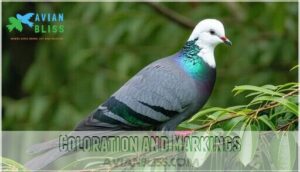
You’ll spot the white crowned pigeon by its brilliant white cap contrasting against slate-gray plumage.
This stunning bird displays green plumage iridescence across its neck and shoulders.
Males show more vivid crown variation during breeding season, while juvenile markings appear duller with grayish-white caps.
The white eyes and color development create striking bird physical features that make identification straightforward once you know what regional differences to expect, with a focus on regional differences and striking bird characteristics.
Habitat and Range
You’ll find White-crowned Pigeons thriving in the warm coastal regions of southern Florida and throughout the Caribbean islands.
These tropical beauties make their home where warm waters meet lush coastal forests.
These birds prefer low-lying tropical forests, especially mangrove systems and hardwood hammocks where fruiting trees provide their primary food source.
Preferred Ecosystems
White-crowned pigeons call specific ecosystems home, showing remarkable Habitat Specificity in their choices.
These coastal birds thrive in four primary environments:
- Mangrove forests – Dense, salt-tolerant trees providing shelter and nesting sites
- Tropical hardwood groves – Inland forests rich with native fruiting trees
- Island Habitats – Small offshore keys offering protection from predators
- Coastal Forests – Mainland areas connecting feeding and roosting locations
Their Mangrove Dependence shapes daily routines, as these island birds commute between roosting mangroves and fruiting areas for meals.
Geographic Distribution
Spanning tropical waters from southern Florida to Central America, the Whitecrowned Pigeon calls diverse Caribbean Islands home.
This bird’s geographical range reflects its adaptability to coastal ecosystems despite ongoing habitat fragmentation challenges.
Their habitat choices depend on resource and shelter.
Primary Distribution Areas:
- Florida Habitats – Keys, Everglades, and Biscayne Bay regions where mangrove forests provide essential nesting sites
- Caribbean Islands – Throughout Bahamas, Greater Antilles, and Lesser Antilles with established breeding colonies
- Central America – Coastal regions of Mexico, Belize, and Guatemala offering tropical fruit resources
- Range Expansion – Limited northward movement due to climate preferences and specific habitat requirements
Diet and Feeding Habits
You’ll find these tropical birds have quite sophisticated tastes, feeding almost exclusively on fruits and berries from over 50 native tree species including figs, poisonwood, and pigeon plum.
They’re surprisingly agile foragers that can hang upside down to reach the ripest fruit, often flying over 30 miles each morning to find the best feeding spots in tree canopies.
Favorite Foods
Abundance defines the White-crowned Pigeon’s relationship with tropical fruits. You’ll find these birds targeting over fifty native species, with fruiting figs serving as their dietary cornerstone.
Their pigeon diet includes poisonwood berries and other toxic plants, showcasing remarkable dietary adaptations that would sicken most creatures. They’ll consume tropical fruits from gumbo-limbo, blolly, and ironwood trees during peak seasons.
Small snails occasionally supplement their fruit-heavy menu. These fruiting trees support extensive foraging range activities, with birds traveling thirty-plus miles daily.
Their selective feeding on fruits and berries drives critical seed dispersal across Caribbean ecosystems, maintaining forest connectivity. To diversify their diet, consider offering high-quality birdseed blends.
Foraging Behavior
During early morning foraging flights, you’ll witness these pigeons display remarkable acrobatic skills while pursuing ripe fruit.
Their dietary adaptations allow them to consume toxic fruits like poisonwood that would harm other species.
Watch as they stretch, lean, and hang upside-down to reach prime selections.
This bird foraging behavior makes them exceptional seed dispersers, with fruiteating birds traveling over 30 miles between roosting and feeding areas daily, showcasing their role as efficient fruiteating birds.
Reproduction and Nesting

You’ll find that White-crowned Pigeons follow a fascinating reproductive strategy that’s perfectly adapted to their island-hopping lifestyle.
These remarkable birds time their breeding activities around Florida’s abundant fruit seasons, creating colonies that can house hundreds of pairs while maintaining surprisingly organized social structures.
Breeding Season
During May through September in Florida, you’ll witness White-crowned Pigeons engaging in intricate breeding behaviors.
Males perform elaborate courtship displays while fiercely defending small territories around potential nesting sites.
This pigeon breeding season involves careful parental care and specific nesting behavior patterns. Birds often choose nest sites based on environmental factors.
- Courtship displays captivate females through dramatic aerial maneuvers
- Territorial defense guarantees safe incubation zones for their precious clutch size
- Breeding threats from predators make successful fledgling success incredibly rewarding
Nest Construction
White-crowned Pigeons construct loose twig platforms in mangrove shrubs, typically 6-15 feet above ground or water.
Nest materials include small twigs and occasional leaves, creating flimsy structures about 6-8 inches across.
Colony size varies, with some areas hosting hundreds of pairs, and Nest location selection prioritizes predator-safe islands.
Males contribute to nest construction while females finalize arrangements, and Nest defense remains minimal beyond immediate territory.
These nests are similar to products sold online.
Egg Laying and Incubation
Once your nest is ready, you’ll find females laying a typical clutch size of two white eggs.
Both parents share parental roles during the 16-18 day incubation period, with males often taking day shifts while females handle nights.
This bird incubation strategy improves hatching success rates.
The smooth egg composition lacks distinctive markings, making proper nest site selection essential for protecting these vulnerable treasures from predators and weather, which is crucial for the overall incubation period and ensures the parents can safeguard their eggs.
Behavior and Social Structure

You’ll notice White-crowned Pigeons aren’t the chattiest birds in the forest, but they do communicate through soft cooing sounds and gentle wing-flapping displays.
These birds prefer hanging out in loose flocks when feeding, though they’re not as social as their city pigeon cousins and tend to keep more to themselves during nesting season.
Vocalizations
Listen closely, and you’ll pick up the White-crowned Pigeon’s distinctive owl-like "coo-coo-co-wooo" call echoing through coastal forests.
These acoustic communication patterns vary between call types, from soft courtship coos to louder contact calls that help flocks stay connected.
Bird vocalizations serve multiple purposes in bird behavior, including territory defense and mate attraction.
Song structure remains consistent, though subtle regional dialects exist across their Caribbean range, making these bird sounds fascinating for researchers studying vocal development.
Flock Dynamics
You’ll observe White-crowned Pigeons forming flocks with distinct social hierarchies where dominant birds control prime feeding spots.
Group size varies seasonally, with larger gatherings during migration enhancing predator avoidance.
Their flock behavior shows remarkable foraging efficiency as birds communicate through subtle body language, coordinating movements between roosting mangroves and fruiting trees.
This flock dynamics system maximizes survival success.
Migration Patterns
You’ll witness one of nature’s most impressive daily commutes when observing White-crowned Pigeons, as these birds regularly fly over 30 miles between their mangrove roosting sites and mainland feeding areas.
Their strong, fast flight patterns create distinctive morning and evening spectacles as flocks navigate high over open water between islands and coastal forests, showcasing their remarkable ability to travel long distances with ease.
Seasonal Movements
You’ll notice these birds don’t follow typical bird migration patterns.
Instead, Migration Triggers center on fruit availability rather than seasons.
When figs ripen in mangrove forests, flocks shift from Caribbean islands to Florida‘s coastal areas.
Breeding Movements occur when birds seek ideal nesting sites.
Foraging Shifts happen as different trees bear fruit throughout the year.
Climate Impact affects these Roosting Changes, forcing adaptations to new feeding schedules and locations.
Flight Characteristics
White-crowned Pigeons demonstrate remarkable Flight Speed and endurance during their impressive Migration Distance journeys.
These birds excel at Water Crossings, flying over 30 miles between feeding and roosting sites with their strong Soaring Ability. Their Flight Patterns include high-altitude longdistance flights over open water, showcasing efficient bird flight characteristics.
They navigate using visual cues such as landmarks.
Flight characteristics that’ll amaze you:
- Dawn and dusk commutes – They time their flights perfectly with natural light changes
- Group formations – Flocks navigate together for safety and efficiency over vast distances
- High-altitude precision – They maintain steady flight paths above challenging ocean waters
- Effortless endurance – Their streamlined bodies power through lengthy bird flight patterns without fatigue
Conservation Status and Threats
You’ll find that the White-crowned Pigeon faces significant conservation challenges despite its widespread Caribbean range.
The species currently holds a Near Threatened status globally, with Florida’s population of approximately 7,500 pairs particularly vulnerable to ongoing habitat destruction and hunting pressures.
Population Trends
Following their impressive long-distance flights, you’ll find Patagioenas leucocephala populations facing serious challenges. Current numbers show a global population of 150,000-300,000 mature individuals, but historical data reveals a troubling 30% decline over three generations.
This bird conservation crisis stems from multiple threat factors:
- Overhunting in Caribbean regions for traditional food sources
- Habitat fragmentation disrupting nesting and foraging areas
- Climate change impacts on coastal breeding environments
- Invasive predators increasing nest failure rates
Conservation impact efforts are underway, though future projections remain concerning without immediate intervention to address this population decline and improve conservation status.
Habitat Loss
Beyond declining population numbers, habitat loss represents the most pressing threat facing White-crowned Pigeons today.
Coastal Development has eliminated over 45% of Florida Keys nesting sites since the 1980s, while Mangrove Destruction removes critical breeding colonies.
Forest Fragmentation creates isolated patches averaging under 10 hectares, exposing nests to increased predation.
Climate Impacts and rising seas threaten Island Degradation, with models projecting 15-35% habitat loss by 2050.
This endangered species depends entirely on intact mangrove forests for survival.
Hunting Pressure
Across the Caribbean and southern Florida, hunting pressure poses a serious conservation threat to White-crowned Pigeons.
You’ll discover that illegal hunting during migration creates devastating population impacts, with some breeding islands experiencing 65% mortality from shooting alone.
Despite hunting regulations, enforcement challenges persist throughout their range.
Key hunting pressure factors include:
- Open hunting seasons coinciding with peak breeding periods
- High market prices driving commercial demand in informal markets
- Inconsistent law enforcement across Caribbean jurisdictions
- Cultural traditions supporting subsistence hunting practices
- Limited protected area coverage of critical roosting sites
Overhunting has caused local population extinctions on several offshore islets, while sustainable hunting initiatives show promise when properly implemented and monitored.
Ecological Importance

You’ll discover that white-crowned pigeons serve as nature’s gardeners, spreading seeds from over 50 native tree species across tropical coastal ecosystems.
Their daily flights between mangrove roosts and mainland forests create essential connections that help maintain biodiversity in fragmented habitats, which is a crucial role in these ecosystems, making them nature’s gardeners.
Seed Dispersal
These birds function as nature’s gardeners, carrying seeds across dispersal distances of 500 meters to over 2 kilometers.
Their fruit preference includes poisonwood, blolly, and gumbo-limbo berries from native trees and shrubs.
After consuming tropical fruits, they excrete viable seeds that boost seed germination rates.
This seed dispersal mechanism maintains habitat connectivity between fragmented forests, supporting ecosystem balance through their specialized bird diet focused on fruiting trees.
Role in Ecosystem
You’ll find White-crowned Pigeons functioning as ecosystem engineers in mangrove forests and coastal habitats.
These birds maintain habitat health by dispersing seeds from over 50 native tropical hardwood tree fruits, including poisonwood and strongbark.
Their seed dispersal services support forest regeneration and food web stability.
Birds also contribute to pest population control, which is essential for maintaining ecological balance.
Through avian ecology interactions, they’re practically keystone species that sustain biodiversity across Caribbean ecosystems.
Identification Tips for Birdwatchers
Identifying White-crowned Pigeons in the field requires attention to their distinctive white cap contrasting against slate-gray plumage and bright white eyes.
You’ll need to distinguish them from similar species like Rock Pigeons by noting their larger size, streamlined build, and preference for treetop perches in coastal mangrove habitats.
Field Marks
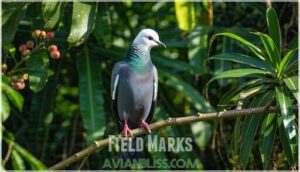
The White-crowned Pigeon’s distinctive white cap serves as your primary identification beacon among Caribbean coastal birds.
This striking crown variations from bright white in males to grayish-white in females makes whitecrowned pigeon field marks unmistakable. Their slate-gray plumage details and piercing white eye color create an elegant contrast you’ll easily spot in flight pattern observations.
For further assistance, consider a detailed pigeon guide.
- White cap: Brilliant crown stands out against dark foliage like a beacon
- Slate-gray body: Uniform coloration with subtle green neck iridescence
- White eyes: Piercing gaze that’s visible even at distance
- Size comparison: Crow-sized build distinguishing it from smaller doves
Similar Species
Distinguishing the White-crowned Pigeon from Related Pigeons requires attention to key field marks.
Rock Pigeons lack the distinctive white crown and show more varied plumage patterns.
Scaly-naped Pigeons display dark, scaly neck patches instead of the clean white cap.
| Feature | White-crowned Pigeon | Rock Pigeon | Scaly-naped Pigeon |
|---|---|---|---|
| Crown | Bright white cap | Variable, no white | Dark with scaling |
| Size | 14 inches | 11-13 inches | 14-16 inches |
| Habitat | Mangroves, tropical | Urban areas | Mountain forests |
| Neck | Green iridescence | Purple/green sheen | Scaly pattern |
| Flight | Swift, direct | Erratic, fluttering | Strong, steady |
These Distinguishing Features prevent Mimicry Cases during bird identification surveys, which is crucial for accurate identification and understanding the unique characteristics of each species.
Cultural Significance and Human Interactions

You’ll discover that White-crowned Pigeons hold deep cultural importance throughout the Caribbean, where they’ve been hunted as a traditional food source for generations.
These birds substantially impact local communities both economically and ecologically, serving as game species while facing mounting pressure from overharvesting that threatens their survival.
Traditional Uses
Throughout Caribbean history, you’ll discover white-crowned pigeons served multiple cultural symbolism roles beyond culinary uses.
These Caribbean birds held economic value through subsistence hunting and appeared in folk songs symbolizing resourcefulness.
Hunting practices traditionally provided up to 20% of household protein in rural communities, while feathers adorned ceremonial headdresses.
Some communities used pigeon fat for medicinal purposes, though bird conservation efforts now balance human interactions with sustainable hunting regulations.
Impact on Local Communities
Throughout the Caribbean, these pigeons generate significant economic impact through tourism benefits, drawing over 5,000 festival participants annually.
Community engagement flourishes as local groups provide conservation support, creating jobs for 250+ residents.
Educational opportunities reach 8,000 students yearly, while Caribbean birds face ongoing habitat loss and hunting pressures.
Effective bird conservation requires balancing traditional uses with sustainable tourism development.
Frequently Asked Questions (FAQs)
Are white-crowned pigeons rare?
Yes, you’ll find white-crowned pigeons are quite rare. They’re classified as Near Threatened globally and State-designated Threatened in Florida, with only about 7,500 breeding pairs remaining there.
Can you keep a crowned pigeon as a pet?
You can’t legally keep white-crowned pigeons as pets.
They’re protected under Florida state law as threatened species, making ownership illegal.
These wild birds need specialized tropical diets and aren’t suited for captivity anyway.
Is the White-crowned Pigeon extinct?
No, you’ll find the White-crowned Pigeon isn’t extinct. It’s classified as Near Threatened by IUCN, with Florida’s population around 7,500 pairs, though numbers are declining due to habitat loss and hunting.
Do white-crowned pigeons mate for life?
White-crowned pigeons don’t mate for life like some birds do.
They’re monogamous during each breeding season but often choose different partners each year, making them seasonally faithful rather than lifelong companions.
Where do white crowned pigeons live?
Coastal Caribbean creatures cleverly colonize countless islands and keys.
You’ll discover these slate-gray birds throughout southern Florida’s mangroves, the Bahamas, and Greater Antilles, where they commute between fruit-rich forests and roosting sites.
What is a white crowned pigeon?
You’ll encounter this crow-sized bird with its stunning white crown and slate-gray body in southern Florida’s mangroves and Caribbean islands, where it feeds on tropical fruits.
What conservation measures benefit the white crowned pigeon?
Ironically, saving these elusive fliers requires you to protect their island sanctuaries, reduce hunting pressure, preserve fruiting trees, and maintain mangrove forests they desperately need for survival.
What happened to the white crowned pigeon?
Population declines hit this species hard due to habitat destruction, overhunting across Caribbean islands, climate change impacts, and collisions with human-made structures threatening their survival.
Is the white crowned pigeon endangered?
No, it’s not endangered, but you’re looking at a species walking the conservation tightrope.
It’s classified as Near Threatened by IUCN and State-designated Threatened in Florida, where you’ll find about 7,500 pairs remaining.
Can I keep a White-crowned Pigeon as a pet?
No, you can’t legally keep one as a pet.
White-crowned Pigeons are protected under state law in Florida, where they’re listed as threatened.
Additionally, these wild birds require specialized tropical diets and habitats that can’t be replicated domestically.
Conclusion
When researchers tracked a white-crowned pigeon colony in the Bahamas, they discovered birds flying over 50 miles daily between roosting and feeding sites.
You’ll find these remarkable Caribbean natives face mounting challenges from development and hunting pressure. Their role as seed dispersers makes them essential for tropical forest regeneration.
If you’re planning to spot a white-crowned pigeon, focus on coastal mangroves during early morning hours. Conservation efforts depend on protecting both their breeding colonies and feeding habitats across their range.