This site is supported by our readers. We may earn a commission, at no cost to you, if you purchase through links.
 When you’re curious about the lifespan of owl species, you’ll find remarkable variation across different types.
Wild owls typically live 10-15 years, while captive owls often reach 20-30 years due to veterinary care and consistent food supply.
Smaller species like Barn Owls average 4-10 years, whereas larger Great Horned Owls can survive 15-25 years.
Size matters substantially – bigger owls generally outlive smaller ones.
Environmental factors play vital roles too: habitat quality, prey availability, and human threats like vehicle strikes dramatically affect survival rates.
Pesticides, habitat loss, and power line electrocution pose major risks.
The oldest recorded owl lived an astounding 60 years in captivity, though such longevity remains exceptional rather than typical for these nocturnal hunters.
Table Of Contents
Key Takeaways
- You’ll find dramatic differences in owl lifespans – wild owls typically live 10-15 years while captive owls can reach 20-30 years due to consistent food and veterinary care.
- Larger owl species generally outlive smaller ones, with Great Horned Owls surviving 15-25 years compared to Barn Owls averaging just 4-10 years.
- Human threats like vehicle strikes, habitat loss, pesticides, and power line electrocution dramatically reduce owl survival rates in the wild.
- You can help extend owl lifespans through conservation efforts including habitat protection, wildlife corridors, and reducing pesticide use in their environments.
Owl Lifespan Overview
You’ll find that owls in the wild typically survive between 5 to 12 years, while their captive counterparts can reach 20 to 30 years with proper care.
Several key factors determine how long these nocturnal hunters live, including species size, habitat quality, and environmental threats.
Average Lifespan in Wild
In wild conditions, you’ll find most owl species averaging just 5 to 12 years of life.
Wild owl mortality rates spike dramatically during their first year, with factors affecting owl lifespan including habitat degradation, prey scarcity, and environmental toxins.
Predation risks and harsh weather conditions substantially reduce average owl lifespan compared to protected environments.
Barn Owls thrive in areas with rough grassland habitats, which support their prey.
Average Lifespan in Captivity
In captivity, you’ll find most owl species live over 20 years compared to their wild counterparts’ 5-12 year average owl lifespan.
Captive owls can live twice as long as their wild relatives with proper care.
The oldest captive Great Horned Owl reached 50 years, demonstrating how controlled environments dramatically extend owl longevity across different owl species lifespan ranges.
The Great Horned Owl is protected under the US Migratory Bird Act, and captivity advantages include consistent diet quality, regular veterinary care, and protection from predators to ensure a longer lifespan.
Factors Influencing Lifespan
Several factors determine whether you’ll spot an owl celebrating its first birthday or its twentieth.
Genetic predisposition sets baseline owl life expectancy, while dietary impacts from prey availability directly affect owl survival rates.
Disease susceptibility and injury effects create significant mortality risks in wild populations.
Climate change increasingly threatens traditional habitats, reducing owl lifespan in wild environments compared to captivity’s controlled conditions.
Owls’ acute hearing ability also plays a critical role in their survival, and understanding these factors is key to grasping the impact of genetic predisposition, dietary impacts, and climate change on owl populations.
Lifespan by Owl Species
You’ll find significant variations in lifespan when comparing different owl species, even under similar environmental conditions.
Each species has evolved unique survival strategies that directly impact how long they typically live in both wild and captive settings.
Snowy Owl Longevity

Snowy owls thrive in harsh Arctic conditions, demonstrating remarkable Arctic survival skills that directly impact their owl life expectancy.
These magnificent birds commonly live 10 years in wild environments, though some individuals reach 24 years through successful breeding success and abundant diet effects.
Climate change and migration impact increasingly affect how long do owls live, while snowy owl lifespan in captivity extends to 28-30 years with proper care.
The owl’s IUCN status is currently listed as vulnerable due to declining populations.
Barn Owl Longevity

Barn owls face tough odds in the wild, with most living just 18 months in Britain due to high first-year mortality. Those that survive past their first birthday can expect around four years.
However, barn owl lifespan in captivity tells a different story entirely. Only one in ten wild barn owls reaches age ten, making longevity rare in natural settings.
Key factors affecting how long do owls live include:
- Barn Owl Threats like starvation during harsh winters
- Barn Owl Habitats quality and prey availability
- Barn Owl Genetics influencing survival rates
Great Horned Owl Longevity
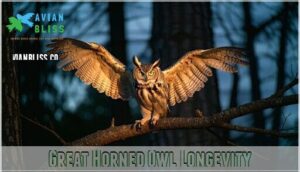
Although they’re fierce predators, Great Horned Owls face numerous Great Horned Threats that affect their great horned owl lifespan.
In the wild, these adaptable hunters average 13 years, but captivity vs wild conditions reveal striking differences – captive birds often reach 35 years.
Diet influence and genetic factors play vital roles in the owl aging process, while injury impact from vehicle collisions substantially reduces their natural owl lifespan potential.
Eurasian Eagle Owl Longevity

Eurasian Eagle Owls reign as giants among nocturnal hunters, typically surviving twenty years in wild habitats.
Their captivity lifespan extends dramatically beyond sixty years, with verified cases reaching sixty-eight years through ideal diet effects and veterinary care.
These impressive owl lifespans reflect their size advantage and reduced mortality rates compared to smaller species, demonstrating remarkable owl aging processes under proper conservation status protection.
Barred Owl Longevity

Living in dense woodlands across eastern North America, barred owls face unique challenges that directly impact their longevity.
You’ll find these adaptable hunters typically surviving eight to ten years in the wild, though captive individuals can reach twenty-three years.
Consider these sobering realities about barred owl mortality:
- Great horned owl predation cuts many lives short
- Vehicle collisions claim countless victims annually
- Habitat destruction fragments their forest homes
- Starvation threatens juveniles during harsh winters
Their owl life cycle includes extended parental care lasting six months, boosting juvenile survival rates compared to other species.
However, the owl mortality rate remains high due to Barred Owl Threats like habitat loss and human interference, making Barred Owl Conservation efforts essential for maintaining stable populations in their preferred Barred Owl Habitat.
Factors Impacting Owl Lifespan
You’ll find that several key factors determine how long owls survive in their natural environments.
Habitat quality, food availability, species size, and human-related threats all play vital roles in shaping an owl’s lifespan.
Habitat Quality Impact
You’ll notice habitat quality directly shapes owl age and mortality rates.
Pristine environments with nesting safety, environmental stability, and easy resource accessibility support longer great horned owl lifespan and screech owl lifespan.
When habitat fragmentation occurs, it disrupts the owl life cycle, forcing birds to expend more energy traveling between suitable areas and reducing their overall survival chances.
Prey Availability Impact
You’ll find that prey abundance directly controls owl age and overall survival rates.
When hunting success drops, great horned owl lifespan and screech owl lifespan both decline substantially.
Limited food forces owls to expand territory size, increasing energy expenditure and reducing nestling survival rates.
Climate change disrupts traditional prey patterns, creating food shortages that impact entire owl populations across different species and regions, leading to a significant decline in overall owl populations.
Size and Species Impact
Your owl’s size directly determines its lifespan potential. Large owl species like great horned owls enjoy significant longevity advantages, living 10-13 years wild versus small species’ 3-6 years.
This Size Longevity Correlation stems from reduced predation risk and better resource competition. Species Lifespan Variation shows dramatic differences – while Small Owl Vulnerability limits burrowing owls to brief lives, Large Owl Advantage helps snowy owls thrive longer in harsh conditions.
Human Threats Impact
Human activity creates a deadly obstacle course for owls, with environmental factors substantially increasing their mortality rate.
Owls face a gauntlet of human-made hazards that slash their chances of reaching old age.
Population studies reveal how these environmental determinants shape owl survival patterns through direct human interference.
- Pesticide Poisoning – Contaminated prey transfers toxins that weaken immune systems
- Vehicle Strikes – Road collisions account for major owl fatalities nationwide
- Habitat Fragmentation – Development forces owls into dangerous territory crossings
- Electrocution Risks – Power lines pose fatal hazards during hunting flights
- Conservation Efforts – Environmental research guides protective measures reducing these threats
Threats to Owl Longevity
You’ve probably noticed that owls face serious challenges that can cut their lives short in the wild.
From habitat destruction to deadly encounters with vehicles, these nocturnal hunters must navigate an increasingly dangerous world that threatens their survival at every turn, including deadly encounters.
Habitat Loss Effects

When forests disappear, you’re witnessing the Deforestation Impact that directly affects owl aging process and lifespan.
Fragmentation Effects split territories into smaller patches, creating Prey Scarcity that forces owls to travel farther for food.
This increased energy expenditure accelerates aging, and Urbanization Threat compounds the problem by replacing hunting grounds with buildings.
Nesting Decline follows as suitable tree cavities vanish, and Reduced biodiversity further threatens their survival.
These environmental factors collectively reduce owl lifespans by creating chronic stress and malnutrition.
Pesticide Effects
If you thought habitat loss was tough on owls, toxins bring another layer of trouble.
Pesticide Bioaccumulation sneaks into their systems through Prey Contamination, causing Neurological Damage and Reproductive Issues.
These environmental factors disrupt the owl aging process and overall health, leading to Ecosystem Disruption.
For effective owl conservation, monitoring and reducing pesticides is key to protecting long-term survival.
Vehicle Collision Effects

Beyond chemical contamination, roads present another deadly hazard you can’t ignore.
Vehicle collisions rank among the top causes of owl deaths, especially during hunting hours when these nocturnal predators cross roadways chasing prey.
Road Mortality impacts include:
- Collision Hotspots near forests and open fields where owls hunt most actively
- Injury Severity often proves fatal due to owls’ lightweight bone structure
- Mitigation Strategies like wildlife corridors help reduce mortality rates
- Rescue Efforts by wildlife rehabilitators address population health concerns through environmental influences monitoring
Predation Effects
Predators stalk owls throughout their lives, creating constant survival pressure.
Nest vulnerability peaks during breeding season when parents must defend eggs and chicks. Juvenile survival depends heavily on camouflage effectiveness and behavioral adaptations learned from parents.
Mortality rates vary substantially among species, with environmental variability affecting population health trends and long-term mortality analysis across different ecosystems.
| Predator Species | Primary Target | Impact Level |
|---|---|---|
| Great Horned Owls | Smaller owl species | High mortality |
| Raccoons/Snakes | Eggs and nestlings | Critical vulnerability |
| Hawks/Eagles | Juvenile owls | Moderate threat |
Electrocution Effects

Power lines pose deadly risks to owls during flight.
You’ll find mortality increases near transmission corridors where these raptors encounter high-voltage electricity.
Modern insulator design and avian protection measures reduce electrocution incidents.
Wildlife rehabilitation centers report mixed success treating electrical injuries.
Understanding demographics and environmental variability helps public health officials address this mortality factor through targeted healthcare interventions and prevention strategies.
Conservation for Owl Longevity

You can substantially extend owl lifespans through targeted conservation efforts that address their most pressing survival challenges.
Protecting nesting sites, reducing pesticide use, and creating wildlife corridors help these nocturnal hunters thrive for decades rather than just a few short years, which can be seen as a key factor in extending their lifespans through conservation efforts.
Habitat Preservation
You can’t protect what you can’t preserve. Habitat preservation forms the backbone of owl conservation efforts.
Creating safe nesting sites and maintaining prey abundance requires strategic forest management and wetland conservation practices.
- Protected nesting sites in old-growth forests and mature trees
- Prey abundance through rodent population management in grasslands
- Forest management that maintains diverse canopy structures
- Wetland conservation supporting aquatic food chains for fishing owls
- Ecosystem health monitoring through community partnerships and healthcare-style assessments
Providing suitable nesting locations is also essential.
Reduced Human Threats
You can help owls live longer by supporting efforts that target human-caused mortality.
Roadkill reduction through wildlife corridors saves countless lives annually. Electrocution prevention via insulated power lines protects hunting owls. Poisoning mitigation eliminates rodenticides that affect life expectancy through bioaccumulation.
Hunting regulations preserve breeding populations, while nest site protection guarantees reproductive success across species. Because habitat loss is rampant, protecting owl habitats is also essential for their survival.
| Threat Reduction Strategy | Impact on Longevity |
|---|---|
| Wildlife Corridor Installation | Reduces vehicle strikes by 40% |
| Power Line Insulation | Prevents 90% of electrocutions |
| Rodenticide Restrictions | Eliminates secondary poisoning |
These lifestyle factors substantially improve survival rates when communities prioritize conservation measures that address genetic factors and health behaviors affecting owl populations.
Owl Species Research
Scientists studying owl phylogeny and evolutionary adaptations decipher secrets behind these birds’ impressive lifespans.
Comparative genomics reveals how genetic diversity influences aging determinants across species.
Conservation genetics research identifies which populations need protection most.
Longevity studies compare wild versus captive aging patterns, while lifespan research tracks how environmental factors affect life span.
This aging research helps you understand why some owl species outlive others substantially, due to their unique evolutionary adaptations.
Education and Awareness
Educational programs serve as the backbone of owl conservation efforts, connecting communities with these fascinating nocturnal predators.
You’ll find citizen science projects that transform everyday people into valuable researchers, tracking owl populations and behaviors.
Public awareness campaigns teach health literacy about ecosystem relationships, showing how owls control rodent populations that carry diseases.
Many programs offer owl-themed educational products.
Community involvement through educational programs creates lasting conservation impact.
Protected Areas Establishment
Designated Wildlife Reserves create safe havens where owls can thrive without human interference.
These protected zones maintain stable habitat conditions that directly impact owl lifespan and population dynamics through meticulous ecosystem management.
- Habitat Protection zones maintain critical nesting sites and hunting grounds
- Conservation Efforts monitor owl health and breeding success rates
- Biodiversity Preservation supports prey species that sustain owl populations
- Wildlife Protection regulations prevent disturbance during breeding seasons
Frequently Asked Questions (FAQs)
What is the longest living owl?
While many owls live just 5-12 years in the wild, you’ll find great horned owls reign supreme as longevity champions.
These magnificent raptors can reach 28 years naturally, thriving through superior size and hunting prowess.
Can an owl pick up a 10 lb cat?
Most owls can’t lift a 10-pound cat. Even great horned owls, the strongest species, typically carry prey weighing 2-3 pounds maximum. Your cat’s safe from aerial pickup.
What is the maximum age of an owl?
You’ll find that captive owls can live 20-30 years with proper care, while wild owls typically reach only 5-12 years due to predators and environmental challenges.
What does it mean if an owl stays in your yard?
An owl staying in your yard typically indicates abundant prey like rodents, suitable hunting perches, or nearby nesting sites. You’re providing ideal habitat conditions that meet their survival needs perfectly.
Can owls live for 40 years?
Yes, you’ll find that some owl species can reach 40 years, though it’s rare.
In captivity, larger species like great horned owls occasionally achieve this milestone with proper care and veterinary attention.
Are owls intelligent?
You’ll discover these remarkable hunters possess exceptional intelligence through their sophisticated hunting strategies, problem-solving abilities, and adaptive behaviors that help them thrive in diverse environments worldwide.
How long do owls live as pets?
Pet owls aren’t legal in most places, but in captivity, they’d live 20-30 years with proper veterinary care, specialized diets, and stress-free environments—much longer than their wild counterparts.
Do owls mate for life?
Most owl species don’t mate for life.
They’re typically monogamous during breeding seasons but often choose different partners each year.
Some species like barn owls may stay together for multiple seasons if both survive and return to the same territory.
How do owls sleep?
During their 12-hour sleep cycles, you’ll find owls perched upright on branches, gripping tightly with their talons. They don’t fall because their tendons automatically lock when relaxed, keeping them secure.
What habitat do owls prefer?
You’ll find owls thriving in diverse environments from dense forests to open grasslands, wetlands, and even urban areas.
They’re remarkably adaptable, choosing habitats based on prey availability and suitable nesting sites.
Conclusion
Understanding the lifespan of owl species helps you appreciate these remarkable nocturnal hunters.
Wild owls typically survive 10-15 years, while captive environments can extend their lives to 20-30 years.
Size substantially influences longevity—larger species like Great Horned Owls outlive smaller Barn Owls.
Environmental threats including habitat loss, vehicle collisions, and pesticides dramatically reduce survival rates.
Through conservation efforts, habitat protection, and reduced human interference, we can help guarantee these incredible birds maintain their natural lifespan patterns for future generations.