This site is supported by our readers. We may earn a commission, at no cost to you, if you purchase through links.
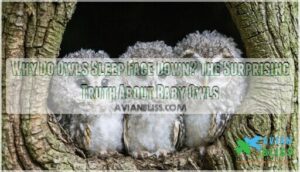 You’re looking at one of nature’s most adorable sights when you see why do owls sleep face down.
Baby owls, or owlets, can’t support their oversized heads while sleeping upright, so they literally face-plant into their nests or branches.
It’s not just about heavy heads though – this position helps them stay hidden from predators and conserve body heat during vulnerable sleeping hours.
Adult owls typically sleep upright using their powerful talons to grip branches, but youngsters need this flat sleeping strategy until their neck muscles develop.
Think of it like a human toddler who can’t hold up their head properly yet, except these fluffy bundles are perched high in trees.
Table Of Contents
- Key Takeaways
- Owl Sleeping Habits
- Why Owls Sleep Face Down
- Owl Sleep Positions
- Benefits of Face Down Sleep
- Owl Conservation Efforts
- Frequently Asked Questions (FAQs)
- What do owls do when they sleep?
- Do any owls sleep upside down?
- Why do owls turn their heads upside down?
- Why do owls lay face down?
- Why do owls bob their heads up and down?
- Why do owls turn their heads to look sideways?
- How do owls sleep upside down?
- Do owls sleep with their eyes open or closed?
- How long do owls typically sleep during the day?
- Can owls sleep while flying or in mid-air?
- Conclusion
Key Takeaways
- You’ll discover that baby owls sleep face down because their oversized heads are too heavy for their underdeveloped neck muscles to support while upright.
- You can observe this behavior as a clever survival strategy that helps owlets stay hidden from predators and conserve body heat during vulnerable sleeping hours.
- You should know that healthy adult owls don’t actually sleep face down – they sleep upright using their powerful talons to grip branches securely.
- You’ll find that this face-down sleeping position is temporary, lasting only until the owlets’ neck muscles develop enough strength to hold their heads upright like adult owls, which is a vulnerable sleeping period.
Owl Sleeping Habits
If you’ve ever wondered about baby owls, you’ll be amazed to learn they actually sleep face down because their heads are too heavy for their developing neck muscles to support while upright.
Baby owls sleep face down because their oversized heads are too heavy for tiny neck muscles to hold upright.
This adorable sleeping position isn’t just cute—it’s a clever survival strategy that helps young owls stay safe from predators and conserve essential energy as they grow, which is a vital part of their development.
Heavy Head Adaptation
Baby owls face a unique challenge: their heads can weigh three times more than similar-sized birds due to massive skulls housing oversized eyes and ears.
Baby owls’ oversized heads are nature’s trade-off: incredible sensory power packed into skulls too heavy for tiny necks to support.
This creates significant head weight issues that underdeveloped neck muscle strength can’t handle during sleep.
Key adaptations include:
- Skull size reaches 3% of body mass versus 1% in other birds
- Neck muscle strength develops gradually as owlets mature
- Skeletal adaptations support eventual upright sleeping positions
- Evolutionary pressures favor large heads for superior sensory abilities
- Blood circulation improves when sleeping face-down versus upright
This remarkable owl adaptation explains why sleeping owls exhibit such unusual face down sleep behavior.
Young owl behavior demonstrates how evolutionary pressures shape even basic functions like rest, making owl sleeping habits truly fascinating examples of nature’s problem-solving abilities.
Predator Avoidance Strategy
When young owls face danger, they’ve mastered the art of disappearing in plain sight.
Their face-down sleeping position works like nature’s invisibility cloak, using camouflage techniques to blend seamlessly with tree bark and forest debris.
This nocturnal behavior helps them avoid aerial predators during vulnerable daylight hours, when their silent flight abilities can’t protect them.
Owls also use plumage camouflage methods to further conceal themselves, utilizing camouflage techniques and nocturnal behavior to stay safe.
Heat Conservation Method
Beyond predator evasion, owlets face another challenge: staying warm. These fluffy youngsters lack the feather insulation of adults, making heat conservation critical for survival.
Their face-down sleeping position reduces surface area exposed to cold air, maintaining ideal metabolic rate and blood flow. This avian sleep adaptation helps prevent dangerous heat loss during nighttime torpor state.
Key heat conservation benefits include:
- Minimized exposed body surfaces shield essential organs
- Reduced energy expenditure maintains growth patterns
- Enhanced survival rates during temperature drops
This ingenious owl adaptation demonstrates how bird sleep patterns evolved for thermal efficiency in vulnerable young.
Why Owls Sleep Face Down
Owls don’t actually sleep face down – that’s a common misconception.
You’ve likely seen viral photos of baby owls appearing to sleep with their heads hanging down, but this isn’t their natural sleeping position.
These images often show owls that are sick, injured, or extremely exhausted.
Healthy owls sleep upright with their heads tucked back or resting against their bodies.
Their neck muscle strength supports proper head positioning during avian sleep.
Gravitys pull would create asphyxiation risk if owls regularly slept face down, restricting airflow and affecting blood flow regulation.
Owls often choose spots with camouflage for protection from predators.
The viral "face down" images actually highlight why proper owl sleep positions matter for survival.
Evolutionary advantages have shaped raptor sleep and bird sleep patterns to maintain alertness while resting.
| Sleep Factor | Normal Owls | Distressed Owls |
|---|---|---|
| Head Position | Upright/tucked | Hanging down |
| Breathing | Unrestricted | Potentially compromised |
| Alertness Level | High | Severely reduced |
| Survival Rate | Ideal | At risk |
| Animal sleep Quality | Restorative | Poor/inadequate |
Understanding real owl behavior helps distinguish between healthy rest and concerning symptoms requiring wildlife intervention.
Owl Sleep Positions
You’ll discover that owl sleep positions vary dramatically between adults and babies, with young owlets displaying some truly remarkable sleeping behaviors.
Unlike their parents who sleep upright on branches, baby owls often sleep face-down because their heads are so heavy they can’t hold them up while resting, which is a very dramatic difference.
Talons Gripping Branches

You’ll discover that owl talons work like nature’s ultimate safety harness when these nocturnal birds settle in for sleep.
Their remarkable foot anatomy features specialized tendons that automatically lock around branches, creating perch security that doesn’t require conscious effort.
Here’s how their grip system works:
- Talons Strength – Powerful muscles generate crushing force up to 300 pounds per square inch
- Branch Diameter – Feet automatically adjust to grip branches from pencil-thin twigs to thick limbs
- Grip Endurance – Locking mechanism maintains hold for hours without muscle fatigue
This owl adaptation guarantees they won’t tumble during deep sleep phases, making their perching ability one of the most efficient designs in bird behavior.
Owlets Falling Out of Trees
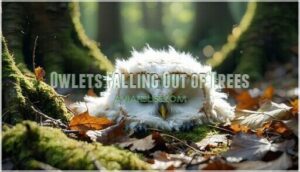
Unfortunately, even baby owls face steep learning curves in the process of staying put.
Up to 60% of young owlets tumble from their homes within three weeks, making nest construction and parental care essential for survival.
| Challenge | Impact | Outcome |
|---|---|---|
| Motor skills underdeveloped | 25% mortality rate | Rescue strategies needed |
| Weather exposure risk | Hypothermia threat | Injury prevention necessary |
| Sibling competition | Space shortage | Parental neglect possible |
| Peak fall season | Late spring danger | Owl adaptations tested |
These owl facts reveal how vulnerable these fascinating creatures are during their earliest weeks, despite remarkable owl characteristics that serve them well as adults.
Factors Threatening Baby Owls
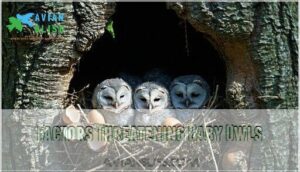
Why do baby owls face such perilous beginnings? Food scarcity during rodent crashes causes up to 45% nest failures, while nest predation from raccoons and snakes accounts for 40% of premature deaths.
Climate change intensifies extreme weather, reducing survival by 8%. Habitat destruction eliminates nesting sites, and inadequate parental care during daylight increases vulnerability by 22%.
These owl facts reveal why adaptations and conservation matter. Owls also face threats from habitat loss and human activities.
Benefits of Face Down Sleep
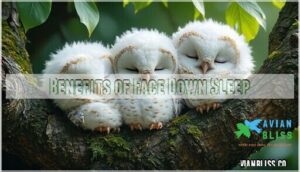
You’ll discover that face-down sleeping isn’t just a quirky habit—it’s actually a smart survival strategy that young owls use to stay safe and comfortable.
This unusual position helps baby owls protect themselves from harsh sunlight, conserve precious body heat, and avoid being spotted by hungry predators looking for an easy meal, which is a key part of their survival strategy.
Protection From The Sun
You’ll discover that owlets face down like tiny feathered sunbathers seeking shade.
This owl posture creates natural UV exposure protection, shielding delicate facial skin and eyes from harmful rays.
- Down feathers act as feather sunscreen – back plumage reflects sunlight away from sensitive areas
- Eye protection occurs naturally – facial discs stay hidden from direct solar radiation
- Heat regulation improves through reduced surface area exposed to warming sunlight
- Behavioral adaptations vary by owl species – lighter-colored owlets show greater sun resilience than darker varieties
This sleep position works alongside nest placement in shaded environments, creating double protection from intense daylight hours.
Creating a safe habitat can also protect birds from other dangers.
Benefit of Conservation of Heat
When you observe owl anatomy closely, their face-down sleep posture serves as nature’s perfect thermal regulation system.
This unique owl posture maximizes feather insulation effectiveness while conserving energy through reduced metabolism.
Different owl species maintain ideal body temperature using this strategic sleep position.
| Thermal Benefit | Mechanism | Energy Impact |
|---|---|---|
| Feather Insulation | Down traps warm air layers | 15-20% less heat loss |
| Reduced Metabolism | Lower heart rate during sleep | 25-30% energy savings |
| Body Temperature | Core warmth retention | Stable 104°F range |
| Heat Conservation | Minimal exposed surface area | Prevents overnight cooling |
| Thermal Regulation | Automatic temperature control | Consistent energy levels |
Avoidance of Predators
Beyond heat retention, why owls sleep face down relates directly to Nocturnal Safety and Predator Camouflage strategies.
This Vulnerable Sleep position actually enhances owl anatomy’s natural Defensive Postures through millions of years of Owl Evolution.
When you observe why owls sleep this way, consider these owl research findings:
- Predator Camouflage: Face-down positioning mimics broken branches, making sleeping owls nearly invisible to daytime hunters
- Reduced silhouette: This posture minimizes their outline against tree bark, essential for owl information about survival tactics
- Quick escape readiness: Owls can rapidly lift their heads and assess threats while maintaining grip with powerful talons
Owl Conservation Efforts
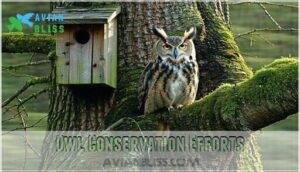
You’ve likely seen adorable photos of baby owls sleeping face-down on branches, but these viral images reveal a serious conservation challenge.
When owlets face increased vulnerability due to habitat loss and predator threats, their unusual sleeping position becomes both a survival adaptation and a symbol of the urgent need to protect owl populations worldwide.
Habitat Loss Impact
You’ll witness habitat loss’s devastating impact on owl populations through deforestation effects, urban sprawl, and climate change.
These forces destroy nesting sites, reduce prey populations, and fragment territories where owls sleep and hunt.
| Threat Type | Impact on Owls | Population Effect |
|---|---|---|
| Deforestation | Nesting disruption, territory loss | 60% habitat reduction |
| Urban sprawl | Prey decline, increased mortality | 25% rise in roadkill |
| Climate change | Range shifts, food mismatches | 40% habitat loss by 2080 |
Predator Vulnerability Concerns
Predator Awareness becomes critical when you consider that juvenile owls face their greatest threats during vulnerable sleeping periods.
Their face-down position serves as Camouflage Effectiveness against aerial hunters, while Nocturnal Risks from ground predators like foxes remain constant.
This sleeping strategy explains why only 30-50% survive to adulthood.
- Ground predators pose the highest threat during sleep
- Exposed nest sites increase vulnerability substantially
- Evolutionary Pressures shaped this defensive sleeping behavior
The reason behind this adaptation demonstrates nature’s ingenious survival mechanisms.
Human Activity Effects
Human activities pose serious threats to owl populations through multiple pathways.
Habitat Destruction from urbanization eliminates nesting sites, while Pollution Effects from rodenticides cause secondary poisoning. Vehicle strikes and Hunting Impact reduce survival rates substantially.
| Human Activity | Impact on Owls |
|---|---|
| Wildlife trafficking | 13+ species affected globally |
| Vehicle collisions | 25% of urban owl deaths |
| Rodenticide poisoning | 30% mortality in barn owls |
| Noise pollution | Disrupts prey detection |
| Recreational disturbance |
40% reduced breeding success.
These unusual animal behaviors emerge as owls adapt to human pressures, demonstrating why conservation efforts must address the root cause of declining populations.
Use of Owl Pictures for Education
You can use owl pictures as powerful Educational Resources to boost Visual Learning and Cognitive Development.
These images serve a clear purpose in Curriculum Integration, helping explain why owls sleep face down.
The reason visual content works so well is simple – students remember what they see.
Many educators find owl-themed educational products useful in their lessons.
Smart Engagement Strategies combine photos with explanations, making education memorable and effective for understanding owl behavior.
Frequently Asked Questions (FAQs)
What do owls do when they sleep?
Consider that baby barn owl researchers found falling asleep at their desks, mimicking their study subjects.
You’ll find adult owls sleep standing upright while babies lie on their stomachs because their oversized heads are too heavy to support.
Baby owls also use their hallux, which allows them to latch onto branches, preventing falls, and this unique adaptation is a key aspect of their developmental stage.
Do any owls sleep upside down?
No, owls don’t sleep upside down like bats.
They’re built differently – their talons lock automatically when perched, but they sleep sitting upright on branches or in tree hollows, keeping their balance naturally, with their talons being a key factor.
Why do owls turn their heads upside down?
Like nature’s periscope scanning the horizon, you’ll notice owls turn their heads upside down for enhanced visual scanning.
This dramatic movement compensates for their fixed eye sockets, letting them thoroughly examine surroundings from multiple angles.
Why do owls lay face down?
Young owls can’t support their heavy heads when sleeping, so they lie face-down on branches.
Their neck muscles aren’t strong enough yet to keep their heads upright during rest periods like adult owls can.
Why do owls bob their heads up and down?
You’ll notice these feathered night shift workers perform their rhythmic dance to triangulate sounds perfectly.
Owls bob their heads because their ears aren’t symmetrically placed—this head movement helps them pinpoint exactly where prey’s located in three-dimensional space.
Why do owls turn their heads to look sideways?
You’ll notice their heads swivel dramatically because owls can’t move their eyes like you can.
Their massive eyes are locked in their sockets, so they rotate their flexible necks up to 270 degrees for better vision.
How do owls sleep upside down?
You might think owls sleep upside down, but they don’t actually hang like bats.
Adult owls sleep upright on branches, gripping with their strong talons.
Only baby owlets sometimes sleep face-down due to their heavy heads and underdeveloped neck muscles, which makes them sleep differently than adult owls, highlighting the unique aspect of owlets.
Do owls sleep with their eyes open or closed?
Owls sleep with their eyes closed, just like you’d expect. They don’t need to keep watch while resting since they’re well-hidden in secure roosts during daylight hours.
How long do owls typically sleep during the day?
Like clockwork, you’ll find these nocturnal hunters catching their Z’s for about 12-14 hours daily.
They’re basically the teenagers of the bird world, sleeping away most daylight hours to recharge for their nighttime hunting adventures.
Can owls sleep while flying or in mid-air?
No, you can’t catch owls napping mid-flight because they need stable perches for proper sleep. Flying requires constant alertness, so owls land and find secure spots to rest safely.
Conclusion
Peculiar postures protect precious owlets during their most vulnerable moments.
You’ve discovered why do owls sleep face down through this fascinating adaptation that combines necessity with survival strategy.
Baby owls can’t support their disproportionately large heads, making face-down sleeping essential for comfort and safety.
This behavior helps them avoid predators, conserve essential body heat, and prevent dangerous falls from high perches.
Understanding these natural behaviors deepens our appreciation for owl conservation efforts and reminds us that even the most unusual animal behaviors serve important biological purposes, highlighting the importance of precious owlets, face-down sleeping, and survival strategy.
- https://enviroliteracy.org/why-do-owls-sleep-face-down/
- https://www.drool.pet/blogs/the-weird/why-baby-owls-actually-sleep-like-this
- https://www.snopes.com/fact-check/baby-owls-heads-sleep/
- https://www.mpg.de/7487401/baby-owls-sleep
- https://docs.google.com/forms/d/1GAQr3Kn1cURCVHUA82hAga1Wv8DCH0IuqDLRUrOpN7M/viewform?ts=63f4f653&entry.1515682415=https://www.merriam-webster.com/dictionary%2Fwhy