This site is supported by our readers. We may earn a commission, at no cost to you, if you purchase through links.
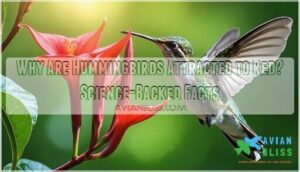 You’re not wrong to wonder why are hummingbirds attracted to red – it’s actually a fascinating case of evolutionary teamwork.
Hummingbirds aren’t specifically obsessed with red, but their incredible vision makes red flowers pop against green foliage like neon signs.
These tiny birds can see ultraviolet light and process colors faster than you can blink.
Red tubular flowers evolved to be hummingbird magnets because they offer the perfect combo: easy access to high-energy nectar and bright visibility.
It’s less about color preference and more about efficiency – red flowers typically signal "premium fuel station ahead."
The real story involves some surprising tricks nature uses to keep this partnership thriving.
Table Of Contents
- Key Takeaways
- Why Are Hummingbirds Attracted to Red?
- The Visual Perception of Hummingbirds
- Enhanced Color Sensitivity in Hummingbirds
- Red as a Nectar Indicator for Hummingbirds
- Adding Red to Your Yard to Attract Hummingbirds
- Avoiding Red Dye in Hummingbird Nectar
- Hummingbirds’ Visitation of Flowers of All Colors
- Frequently Asked Questions (FAQs)
- What’s a hummingbird’s favorite color?
- What colors do hummingbirds avoid?
- Do birds like the color red?
- Does red dye attract hummingbirds?
- Do hummingbirds like the color red?
- What Colour are hummingbirds most attracted to?
- Why are hummingbird feeders always red?
- What is the color preference of hummingbirds?
- Can hummingbirds see colors humans cant?
- Do different hummingbird species prefer different colors?
- Conclusion
Key Takeaways
- You’re seeing evolutionary teamwork in action – hummingbirds’ four-cone vision makes red flowers pop against green foliage like neon signs, while red blooms typically offer the richest nectar rewards.
- You can transform your yard into a hummingbird magnet by planting red tubular flowers like cardinal flower and bee balm, or adding red feeders and garden decorations that mimic nature’s signals.
- You don’t need red dye in your nectar – it’s actually harmful and unnecessary since hummingbirds come for the sugar content, not artificial coloring.
- You’ll discover these tiny birds aren’t picky about color when nectar quality is high – they’ll visit flowers of any hue that offer the right combination of sugar content, tubular shape, and easy access.
Why Are Hummingbirds Attracted to Red?
Hummingbirds are drawn to red through millions of years of evolutionary advantage. Their visual acuity surpasses ours with four color cones versus our three, creating enhanced red attraction that helps them spot food sources.
This color preference isn’t random—it’s survival strategy. Red flowers typically offer the richest nectar, creating strong color association between red and high-quality fuel.
When you see a hummingbird beeline for your red feeder, they’re following ancient programming that says "red equals reward." Their specialized vision makes red pop against green foliage like a neon sign.
This nectar quality connection runs so deep that red flowers have co-evolved with hummingbirds, creating nature’s perfect partnership. Color attraction to red gives these tiny birds a competitive edge in finding the sweetest energy sources.
To further enhance your garden, consider planting tubular flowers to provide a sustainable nectar source.
The Visual Perception of Hummingbirds
Looking through a hummingbird’s eyes reveals a world you can’t imagine.
Their tetrachromatic vision operates with four color cones in their retinas, while humans make do with three. This extra cone enables UV perception, letting them see ultraviolet light and colors that don’t exist in your visual vocabulary.
Their enhanced acuity transforms flower-spotting into an art form. What appears as a simple red bloom to you becomes a complex visual signal packed with information about nectar quality.
These tiny birds excel at color discrimination, distinguishing between subtle shades and UV combinations invisible to human eyes. Their plumage patterns aid species identification.
Their visual memory stores detailed maps of promising food sources, helping them revisit the best flowers season after season.
This superior color vision isn’t just impressive—it’s survival equipment. Every flower becomes a potential restaurant, and their four-cone system helps them read the menu with precision that puts our three-cone vision to shame.
Enhanced Color Sensitivity in Hummingbirds
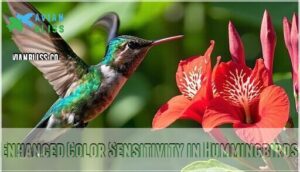
Beyond the basics of four color cones, hummingbirds possess what scientists call tetrachromatic vision—a superpower that puts human eyesight to shame.
While you see three primary colors, these flying gems detect an entire spectral range that includes ultraviolet light. Think of it as having built-in special effects filters that reveal hidden patterns on flowers.
Their UV perception works like a secret code. Many flowers reflect ultraviolet patterns invisible to you but crystal clear to hummingbirds.
This creates a treasure map leading straight to nectar-rich blooms. Their enhanced color discrimination means they can distinguish between subtle shades that look identical to human eyes.
The real magic happens with red amplification. Their visual system cranks up warm colors—reds, oranges, and yellows—making them pop against green backgrounds like neon signs.
This explains why red feeders work so effectively. Cool colors like blue appear muted, while warm hues practically glow.
This superior color vision isn’t just impressive—it’s essential for survival, helping them locate the highest-quality nectar sources with remarkable precision.
They can even see in the near UV range, which is invisible to humans.
Red as a Nectar Indicator for Hummingbirds
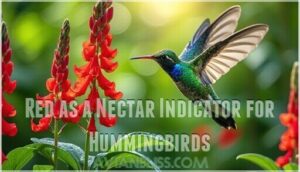
You’ll discover that hummingbirds have learned to connect red with high-energy food sources through millions of years of evolution.
Red flowers typically produce nectar with higher sugar content, making them worth the extra energy these tiny birds spend hovering and feeding, which is a result of their evolution to find high-energy food sources.
Evolution of Visual Acuity
Evolution crafted hummingbirds’ remarkable sight over millions of years.
Their visual adaptation allowed these tiny birds to spot the best food sources while competitors missed out.
Cone evolution in their retinas enhanced red detection, while UV perception expanded their color range beyond human capability.
This sophisticated color vision in birds developed through three key changes:
- Specialized cone cells – Four types instead of three like humans
- Enhanced oil droplets – Filter light for sharper color differentiation
- Increased cone density – Packs more visual receptors into small eyes
This foraging efficiency gives them a serious advantage when hunting for nectar-rich flowers among green foliage.
Association of Red With Nectar
After understanding how their evolved visual acuity works, you’ll discover that hummingbirds forge strong connections between red and reliable nectar sources.
This learned color association develops through positive reinforcement—when red consistently delivers high-energy nectar, these tiny birds remember.
Red flower abundance in nature reinforces this pattern, creating powerful visual cues that guide their foraging decisions.
| Red Food Source | Nectar Quality | Hummingbird Response |
|---|---|---|
| Cardinal flower | Rich, high-sugar | Frequent visits |
| Bee balm | Premium energy | Territorial defense |
| Trumpet vine | Abundant flow | Return trips |
This food association explains why red attracts hummingbirds so effectively—it’s nature’s promise of a worthwhile meal.
Adding Red to Your Yard to Attract Hummingbirds
Understanding your hummingbirds’ attraction to red can help you transform your yard into their favorite destination.
By strategically incorporating red elements into your garden design, you’ll create visual signals that these tiny birds naturally associate with high-quality nectar sources.
Red Flowers and Foliage
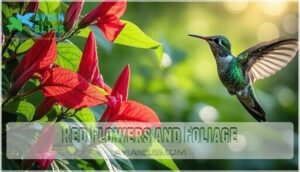
Creating a hummingbird haven starts with choosing the right red flowers and foliage. These tiny birds can’t resist the vibrant hues that signal rich nectar sources.
Smart gardeners know that red flower shapes matter most. Tubular blooms like cardinal flower and bee balm perfectly match hummingbird beaks. The foliage contrast between deep green leaves and bright red petals creates an irresistible visual beacon that catches their attention from great distances.
Many gardeners find red flower products useful.
Consider these proven red additions:
- Trumpet vine – Produces high nectar volume with excellent UV reflection
- Salvia – Offers regional variations in red shades that attract local species
- Cardinal flower – Native option with perfect tubular shape for attracting hummingbirds
- Red coleus – Provides striking foliage contrast as colorful backdrop
Red Garden Decorations
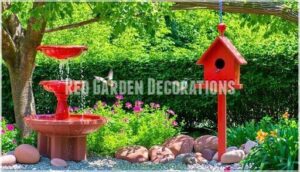
Transform your garden into a hummingbird magnet with strategic red garden art and decorative hummingbird houses.
Position red-themed bird baths near colorful flowers for drinking and bathing spots.
Scatter painted rocks in vibrant reds throughout flowerbeds, or add red garden furniture like benches and planters.
You can find inspiration for unique garden pieces online.
These eye-catching elements work alongside your flowers, creating multiple visual cues that enhance hummingbird attraction across your entire landscape.
Red Accents on Hummingbird Feeders
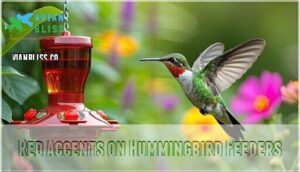
Red plastic or glass hummingbird feeders naturally attract these tiny birds through strategic feeder material and accent placement.
Different red shades on various feeder size options create significant design impact. Bright scarlet components work better than dark burgundy accents.
Position red elements near feeding ports where hummingbirds focus their attention. You can easily find various feeder options online.
These vibrant feeders outperform other flower colors in scientific studies, triggering learned associations with nectar-rich blooms.
Avoiding Red Dye in Hummingbird Nectar
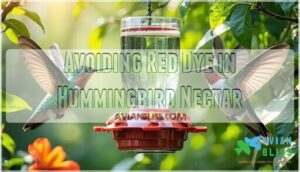
While you might think red dye makes nectar more appealing to hummingbirds, it’s actually unnecessary and potentially harmful to these tiny birds.
You’ll provide better nutrition and safer feeding by offering clear, homemade nectar made from just sugar and water, which is a safer and more natural approach.
Harmful Effects of Red Dye
Why add harmful chemicals when nature works perfectly?
Red dye toxicity poses serious risks including organ damage and behavioral changes in hummingbirds.
Studies reveal dye toxicity causes kidney problems and nectar contamination that accumulates in tissues.
Skip artificial nectar entirely – these tiny birds don’t need colored sugar water in hummingbird feeders.
Natural alternatives work better without the harmful side effects.
Preference for Natural Clear Nectar
You’ll discover that natural, clear nectar matches what hummingbirds find in wild flowers.
Making homemade sugar water eliminates unnecessary additives while supporting their natural diet:
- Nectar purity: Clear solutions mirror natural food sources without artificial colors
- Homemade benefits: Simple sugar concentration (1:4 ratio) provides ideal energy
- Natural alternatives: Avoiding additives keeps hummingbird behavior and health intact.
Some commercial nectars contain artificial additives that can be harmful.
Hummingbirds’ Visitation of Flowers of All Colors
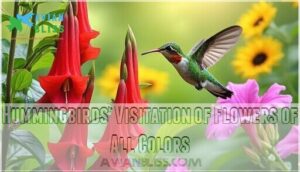
You might think hummingbirds only visit red flowers, but that’s not quite accurate.
While red remains their top choice, these tiny birds actually visit flowers of many colors when they contain the right combination of nectar quality, flower shape, and accessibility.
Misconceptions About Hummingbirds and Flower Colors
Imagine this: your backyard buzzes with hummingbird diet myths! These tiny acrobats don’t suffer from color blindness—they’ll visit flowers of every hue imaginable.
While feeder color matters and red creates excellent color contrast against green foliage, bird behavior shows they’re opportunistic feeders.
Flower shape trumps color when nectar quality’s high. Through learned associations and UV reflection detection, hummingbirds develop attraction strategies beyond just red preferences.
As overall color patterns help narrow down bird species quickly, it’s interesting to note how hummingbirds use color. Don’t let folklore fool you into thinking they’re picky about rainbow blooms!
Factors Attracting Hummingbirds to Flowers
While red attracts hummingbirds, several factors influence their flower preferences.
Nectar sugar content matters more than color – they’ll choose high-energy sources regardless of hue. Flower shape determines accessibility; tubular blooms match their bills perfectly.
Flower UV reflection creates invisible landing strips only they can see. Pollen availability provides essential protein.
Regional associations vary – some populations prefer purple or brown. Smart bird feeding considers color contrast against foliage, understanding complex bird behavior beyond simple color attraction.
Frequently Asked Questions (FAQs)
What’s a hummingbird’s favorite color?
While hummingbirds don’t have one favorite color, they’re most attracted to red because it stands out brilliantly against green foliage and signals high-energy nectar sources in nature.
What colors do hummingbirds avoid?
Birds of a feather flock together," but hummingbirds definitely avoid dull colors.
You’ll notice they steer clear of brown, black, and muted greens since these colors don’t stand out against foliage and rarely signal nectar-rich flowers in their natural world.
Do birds like the color red?
Most songbirds you’ll spot actually prefer other colors over bright red.
They’re drawn to blues, greens, and yellows that match their natural food sources and environments better than flashy crimson shades.
Does red dye attract hummingbirds?
Ironically, while red dye doesn’t attract hummingbirds, it’s actually unnecessary and potentially harmful.
You’ll find that hummingbirds come for the sugar content, not artificial coloring—they’re smarter than we give them credit for, and this understanding can help in creating a more effective and harmless way to attract them.
Do hummingbirds like the color red?
Yes, hummingbirds absolutely love red! You’ll notice they flock to red feeders and flowers because their enhanced vision makes warm colors pop dramatically against green foliage, creating an irresistible beacon.
What Colour are hummingbirds most attracted to?
Hummingbirds are most attracted to red, though they’ll visit orange, yellow, and pink feeders too.
Red flowers typically offer the highest sugar content, making them prime energy sources.
Their enhanced vision makes warm colors pop against green foliage.
Why are hummingbird feeders always red?
Like a red flag waving in a green meadow, red feeders act as visual beacons that hummingbirds can’t ignore.
You’ll find them red because they mimic nature’s nectar-rich flowers and stand out brilliantly against foliage backgrounds.
What is the color preference of hummingbirds?
Color preferences in hummingbirds aren’t set in stone.
You’ll find they’re most drawn to red, orange, and yellow because their enhanced vision makes these warm colors pop against green foliage, signaling high-energy nectar sources.
Can hummingbirds see colors humans cant?
Unlike your smartphone camera, you can’t Instagram that ultraviolet spectrum hummingbirds see effortlessly.
They’ve got tetrachromatic vision with four cone types, including ultraviolet detection that reveals hidden flower patterns and colors completely invisible to your three-cone human eyes.
Do different hummingbird species prefer different colors?
Different species don’t show distinct color preferences—they’re more flexible than you’d think.
While most associate red with nectar-rich flowers, they adapt to local environments.
Brazilian hummingbirds favor dull brown, Mexican species prefer purple or blue, showing regional flexibility over species-specific choices.
Conclusion
Remarkably, hummingbirds visit over 2,000 flowers daily while maintaining flight speeds up to 30 mph.
Now you understand why hummingbirds are attracted to red – it’s evolutionary efficiency at work. Their exceptional vision spots red tubular flowers easily against green backgrounds, signaling high-quality nectar rewards.
You can attract these aerial acrobats by planting red blooms like cardinal flower or bee balm, but remember they’ll visit any nectar-rich flower regardless of color.
Skip red dye in feeders – clear sugar water works perfectly while keeping them healthy and happy.
- https://science.ubc.ca/news/hummingbirds-see-colours-humans-can-only-imagine
- https://pmc.ncbi.nlm.nih.gov/articles/PMC7334476/
- https://www.ecowatch.com/hummingbirds-color-perception-2646191874.html
- https://www.nature.com/articles/s42003-022-03518-2
- https://www.smithsonianmag.com/smart-news/compared-hummingbirds-were-all-colorblind-180975111/