This site is supported by our readers. We may earn a commission, at no cost to you, if you purchase through links.
 If you’ve ever wondered why do hummingbirds attack each other, it’s because these tiny birds are surprisingly territorial fighters.
They’ll chase, dive-bomb, and even physically clash with rivals to protect their food sources and nesting areas.
Their high metabolism demands constant feeding – they need to consume half their body weight in nectar daily, making every flower and feeder worth defending.
During breeding season, males become especially aggressive as they compete for the best territories and mates.
The seemingly delicate creatures transform into aerial warriors, using their sharp bills and incredible speed to intimidate competitors and maintain control over prime real estate.
Table Of Contents
- Key Takeaways
- Why Do Hummingbirds Attack Each Other?
- Understanding Hummingbird Aggression
- Causes of Hummingbird Aggression
- Signs of Hummingbird Aggression
- Do Hummingbirds Inflict Harm?
- Behavioral Reasons for Hummingbird Aggression
- Managing Hummingbird Aggression
- Techniques to Deter Fighting
- Minimizing Hummingbird Aggression During Migration
- Female Hummingbirds and Territorial Behavior
- Frequently Asked Questions (FAQs)
- What does it mean when hummingbirds are fighting?
- Why do hummingbirds crash into each other?
- How do you keep hummingbirds from fighting?
- What does it mean when you see two hummingbirds fighting?
- Do hummingbirds hurt each other when fighting?
- Why do hummingbirds swoop back and forth?
- How can I attract more hummingbirds to my yard?
- What types of flowers do hummingbirds prefer?
- Can hummingbirds recognize individual humans?
- How do hummingbirds find feeders?
- Conclusion
Key Takeaways
- You’ll witness hummingbirds attacking each other because they’re defending critical resources like nectar sources, feeders, and nesting territories that they need for survival.
- You’re seeing nature’s energy conservation strategy in action – these tiny birds burn through half their body weight in nectar daily, making every flower worth fighting for.
- You can reduce feeder wars by spacing multiple feeders 20+ feet apart and removing perches that allow dominant birds to survey and control prime territories.
- You’ll notice aggression peaks during breeding season when males compete fiercely for mates and prime territories, while females defend nesting areas just as aggressively, in a battle for survival and nectar sources.
Why Do Hummingbirds Attack Each Other?
When hummingbirds clash in aerial battles, it’s all about survival and securing prime real estate.
Tiny aerial gladiators battling for liquid gold and prime real estate.
These tiny warriors engage in hummingbird fights primarily to defend critical resources like nectar-rich flower patches, feeders, and potential mates.
Their territorial behavior kicks into overdrive during breeding season, transforming your peaceful backyard into a feeder wars battleground.
Aggressive hummingbirds use intimidation tactics first—puffing out their chests, flaring colorful gorget feathers, and producing threatening chatters.
When that doesn’t work, they escalate to high-speed chases and dive-bombing attacks.
This bird dominance hierarchy determines who gets first dibs at the sugar water buffet.
Males are particularly fierce about territorial marking around food sources and potential partners.
Meanwhile, females focus their aggression on nest defense, protecting their babies from any perceived threats.
These hummingbird dominance displays might look dramatic, but they’re evolutionary strategies that guarantee the strongest birds survive and reproduce successfully.
Understanding Hummingbird Aggression
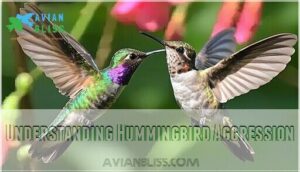
Feeder-focused warfare might seem surprising, but you’re witnessing nature’s most intense survival drama when hummingbirds clash. These territorial battles aren’t random acts of aggression—they’re calculated strategies driven by evolutionary pressures that determine who lives and who struggles to survive.
Hummingbird stress reaches peak levels during these confrontations, creating complex feeder dynamics that reveal fascinating behavioral patterns. Territorial marking behaviors emerge as birds establish invisible boundaries around prime feeding locations, while specific aggression triggers activate their fighting instincts.
Understanding bird conflict helps explain why these tiny warriors engage in such fierce battles:
- Dominance hierarchies develop through repeated confrontations, establishing which birds control the best resources
- Energy conservation drives aggressive behavior since defending one territory requires less energy than constantly searching for new food sources
- Genetic programming guarantees that only the strongest, most aggressive individuals pass on their survival traits
Aggressive hummingbirds exhibit distinct hummingbird dominance patterns that create predictable social structures. Their territorial behavior isn’t mindless violence—it’s sophisticated resource management that guarantees species survival through strategic hummingbird fights. This behavior is also influenced by bird aggression causes that can lead to increased conflict during nesting seasons.
Causes of Hummingbird Aggression
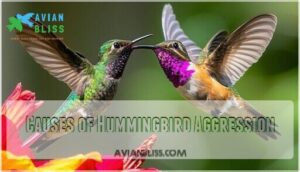
You’ll find that hummingbird aggression stems from two primary survival instincts that kick in when resources become scarce.
When
These tiny powerhouses attack each other to secure flower patches and protect valuable food sources, especially during mating season when they’re also defending potential mates and nesting territories.
Defense of Flower Patches
Imagine this: you’re watching what looks like an aerial dogfight in your backyard, but the combatants are no bigger than your thumb. When hummingbirds spot a prime flower patch, they’ll transform from delicate pollinators into fierce warriors defending their liquid gold.
These territorial battles aren’t random acts of aggression—they’re calculated survival strategies. Research shows that up to 85 distinct hummingbird territories can exist in a single season, with owners aggressively protecting their nectar sources. The larger and more nectar-rich the flower patch, the more intense the defending territory behavior becomes.
Hummingbird territoriality kicks into overdrive when resources are scarce, making every bloom worth fighting for. You’ll witness these dramatic displays of hummingbird aggression through:
- Dive-bombing maneuvers with needle-sharp beaks extended
- High-pitched warning calls that pierce the air
- Spectacular aerial chases reaching speeds of 30 mph
- Territorial marking through repeated patrol flights around patches
Even females join this nectar defense frenzy, especially during breeding season when energy demands soar. It’s nature’s way of ensuring survival when every drop counts. Understanding their energy needs dynamics is vital to grasping the intensity of these territorial battles.
Protection of Food and Mates
Beyond mere survival needs, hummingbirds wage fierce battles over food sources and potential mates with surgical precision. Males become particularly aggressive during mating season, transforming into tiny aerial gladiators defending their chosen territories.
Food Defense intensifies when multiple birds compete for the same nectar-rich feeders, triggering Mate Guarding behaviors that can last hours. Resource Competition drives Territorial Marking through aggressive displays—dive-bombing, chattering, and gorget flashing.
These Breeding Strategies aren’t just about showing off; they’re life-or-death decisions. Dominant males who successfully defend prime feeding spots attract more females, while subordinate birds often resort to sneaky "trapline" feeding tactics to avoid direct confrontation with territorial bullies.
Hummingbirds exhibit strong metabolic energy needs that fuel their aggressive behavior in defending feeders, driven by the need for survival and reproduction.
Signs of Hummingbird Aggression
You’ll spot several clear warning signs when hummingbirds are about to get aggressive, from high-pitched chattering to dramatic wing displays.
These tiny warriors use a predictable escalation pattern that starts with vocal warnings and can occasionally escalate to actual aerial combat.
Chasing Behavior
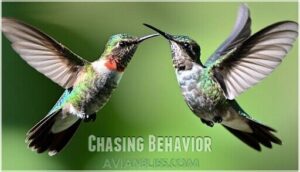
You’ll witness aerial dogfights as these tiny warriors engage in territorial chases that reveal their true nature.
When chasing intruders, males perform dramatic dive-bombing maneuvers, reaching speeds of 30 mph.
These aggressive signals serve as courtship displays for potential mates while establishing territorial dominance.
Feeder fights often trigger intense pursuit sequences, with dominant birds using specific chase tactics to expel competitors from prime feeding locations through persistent harassment.
Understanding the role of hummingbird predators is vital in maintaining a safe environment for these birds.
Threatening Postures and Sounds

When hummingbirds square off against intruders, they’ll deploy impressive threat displays before resorting to combat.
These miniature warriors use sophisticated warning systems to defend their turf:
- Tail feathers flare wide like tiny fans to appear larger and more intimidating
- Aggressive calls include sharp chittering sounds and high-pitched warning sounds that signal territorial boundaries
- Gorget feathers puff out dramatically while beaks point directly at perceived threats
These aggression indicators help establish dominance without physical contact, though courtship songs differ from territorial sounds used in conflicts.
Rare Physical Fights

When threatening displays fail to deter intruders, hummingbird disputes escalate into actual combat.
These aerial battles showcase remarkable intensity despite their diminutive size.
Injury severity can be surprisingly serious – their needle-sharp beaks become weapons capable of inflicting beak damage and wing trauma.
Fight frequency increases dramatically during peak feeding times when competition intensifies.
Mortality rates from hummingbird conflicts remain low, but fighting can cause:
- Punctured eyes or damaged flight muscles from direct strikes
- Broken wing bones during high-speed aerial collisions
- Internal injuries when aggressive birds slam opponents into feeders
You’ll notice hummingbird aggression peaks when resources become scarce, transforming these tiny jewels into fierce warriors defending their survival.
Do Hummingbirds Inflict Harm?

While hummingbird fights look dramatic, you’ll be relieved to know that serious injuries are surprisingly rare in these tiny aerial battles.
Most encounters result in nothing more than ruffled feathers and wounded pride, though in extremely rare cases, persistent aggression can lead to exhaustion or minor injuries that require attention, which can be considered a form of minor injuries.
Severity of Physical Injuries
Most hummingbird attacks don’t cause serious harm – these tiny warriors are tough but not invincible.
When territorial aggression escalates to physical contact, injury severity remains surprisingly low.
Beak damage typically involves minor puncture wounds or scratches, while feather loss occurs more commonly during aerial clashes.
The pointed bills can inflict small wounds, but collision impact rarely causes lasting harm.
Research shows less than 5% of aggressive encounters result in visible injuries.
Most wounds heal quickly thanks to hummingbirds’ robust wound healing abilities.
You’ll rarely see blood or serious damage from these skirmishes – they’re more theatrical than truly dangerous.
If you spot an injured bird, contact a bird injury treatment center immediately.
These professionals handle hummingbird care properly, since it’s illegal to rehabilitate them yourself.
Remember, while hummingbird attacks look fierce, actual damage stays minimal in nature’s carefully balanced system.
Rare Occurrence of Fatal Fights
Despite their fierce reputation, deadly encounters in hummingbird wars rarely result in fatalities.
You’ll observe that territorial aggression typically involves dramatic displays rather than lethal combat.
These aerial acrobats prefer intimidation over actual violence, making fatal fights extremely uncommon.
When deadly encounters do occur, several factors contribute:
- Beak strikes during intense territorial disputes can cause serious trauma
- Mid-air collisions at high speeds may result in fatal injuries
- Exhaustion from prolonged hummingbird attacks weakens birds substantially
- Breeding season intensity escalates normal territorial behavior into dangerous confrontations
Hummingbird mortality from bird combat represents less than 1% of all aggressive encounters, proving nature designed these tiny warriors for show rather than destruction.
Behavioral Reasons for Hummingbird Aggression
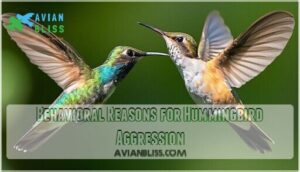
You’ll notice hummingbirds become fierce little warriors when their survival instincts kick in, driven by two main behavioral triggers that turn these tiny birds into aggressive defenders.
Understanding why they fight reveals fascinating insights into food protection strategies and the intense territorial battles that unfold during mating season, which is a key aspect of their survival.
Food Protection
In the context of resource competition, you’re witnessing nature’s ultimate survival strategy in action.
These tiny warriors don’t mess around when food source competition intensifies – they’ll transform from delicate nectar-sippers into fierce defenders faster than you can blink.
Nectar guarding becomes their full-time job, especially during peak feeding periods.
You’ll notice hummingbird dominance displays escalate dramatically when prime flower patches are at stake.
Their territoriality kicks into overdrive because energy conservation literally means life or death.
Feeder aggression follows predictable patterns that reveal their strategic thinking:
| Aggressive Behavior | Energy Impact |
|---|---|
| Chasing intruders daily | 300+ calories burned |
| Defending prime spots | 3x more energy intake |
| Territorial marking flights | Exhausting but essential |
| Resource hoarding displays | Survival advantage gained |
Smart foraging strategies drive this behavior – they’re not being mean, they’re being strategic.
Understanding feeder dynamics helps you appreciate why your backyard becomes their battleground when resources seem abundant to us but scarce to them.
Mating Season Behavior
When spring arrives, male hummingbirds transform into fierce competitors, launching aerial battles and elaborate courtship displays to win over potential mates.
You’ll witness intense male hummingbird aggression as they dive-bomb rivals at breakneck speeds, their gorgets flashing like tiny shields in combat.
Mating competition drives this territoriality to extreme levels.
Males establish prime territories around nectar-rich flowers, knowing females prefer partners who control the best resources.
Their hummingbird dominance displays include dramatic U-shaped dives from 50 feet high, rapid wing beats, and threatening postures that signal genetic fitness.
Breeding rituals involve territorial marking through persistent chasing and vocal warnings.
Meanwhile, females become equally protective around nesting sites, defending their chosen spots from intruders.
These mating rituals create temporary alliances between males and females, but only until breeding concludes.
The intensity of spring aggression directly impacts reproductive success.
Managing Hummingbird Aggression
You can substantially reduce hummingbird battles at your feeders with three strategic approaches. These simple techniques work by disrupting territorial control and spreading resources across your yard.
Removing Outside Threats
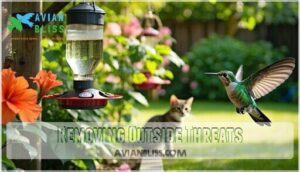
You can’t control every outside threat, but you can tackle the big ones.
Cats lurking near feeders stress hummingbirds and spark territorial disputes. Move feeders away from predator threats like prowling pets or bird nests.
Garden safety improves when you eliminate prime perching spots that bully hummingbirds use for surveillance, promoting better bird conservation through aggression minimization.
Effective garden safety measures are essential for creating a harmonious environment.
Spreading Out Feeders

Feeder placement becomes your secret weapon against hummingbird aggression.
Space multiple feeders throughout your yard, positioning them out of sight from each other.
This resource distribution strategy prevents territorial reduction by forcing dominant birds to expend energy patrolling larger areas.
Strategic feeder spacing—at least 10-15 feet apart—ensures food source management success, creating peaceful feeding zones where multiple feeders can coexist without constant skirmishes.
By implementing a hummingbird feeder setup, you can minimize aggression and attract more birds to your yard.
Removing Bully Hummingbird Perches

Dominant males love claiming prime perches to survey their territory and intimidate newcomers.
You can disrupt this hummingbird hierarchy by identifying and removing these strategic territorial markers. Look for elevated spots near feeders where bullies repeatedly land—branches, wires, or garden stakes. Remove or relocate these vantage points to force aggressive birds into less commanding positions.
This simple garden layout change reduces their ability to monitor and defend multiple feeders simultaneously.
- Perch removal forces bullies to work harder defending territory
- Strategic feeder placement without nearby perches levels the playing field
- Hummingbird behavior shifts when dominant viewing spots disappear
Techniques to Deter Fighting

You can substantially reduce hummingbird fights by making smart adjustments to your feeding setup.
The key lies in using single-port feeders, spacing them strategically, and eliminating environmental factors that trigger territorial disputes.
Utilizing Single-Port Feeders
While single-port feeders might seem counterintuitive for reducing conflicts, they’re actually your secret weapon against hummingbird aggression.
These feeders prevent one dominant bird from monopolizing multiple feeding ports simultaneously. When you strategically place several single-port feeders around your yard, territorial birds can’t defend them all effectively.
Feeder placement becomes vital—space them where aggressive hummingbirds lose visual contact. The smaller port size and controlled nectar flow make each feeder less attractive to bullies, while ideal feeder height and tube length guarantee comfortable access for all visitors.
Using the right single port feeders can substantially enhance the overall effectiveness of your hummingbird-friendly yard design.
Strategic Feeder Placement
Smart positioning transforms hummingbird aggression into peaceful coexistence.
Here’s your strategic feeder placement blueprint:
- Feeder Spacing: Position feeders 20+ feet apart to prevent territorial overlap
- Resource Allocation: Use multiple small feeders rather than one large unit
- Territorial Marking: Place feeders out of sight from each other
- Food Distribution: Stagger feeder heights to create separate dining zones
- Perch Removal: Eliminate nearby branches that enable surveillance behavior
This approach forces aggressive birds to expend more energy defending multiple areas, naturally reducing their dominance.
Effective hummingbird feeders are essential for maintaining a balanced ecosystem.
Minimizing Outside Disturbances
Create a peaceful environment by removing outside threats like cats or dogs that trigger hummingbird aggression.
Eliminate perches aggressive hummingbirds use for surveillance, forcing them to expend more energy defending territory.
Strategic feeder placement away from predator control zones and noise reduction areas helps minimize bird territoriality while enhancing overall garden design and bird safety.
Minimizing Hummingbird Aggression During Migration

During migration, thousands of hummingbirds converge on familiar routes, creating intense competition.
You’ll reduce hummingbird aggression by understanding migration patterns and implementing smart resource management.
Feeder placement becomes critical—space multiple feeders throughout your yard to prevent territorial mapping conflicts.
Hummingbird safety improves when you provide abundant nectar sources during peak migration periods.
Strategic aggression reduction through proper bird territoriality management helps exhausted travelers coexist peacefully while refueling for their journeys.
Understanding bird migration patterns is essential for minimizing conflicts and creating a harmonious environment for these birds.
Female Hummingbirds and Territorial Behavior

Despite common misconceptions about gender roles, female hummingbird aggression rivals male territorial behavior in intensity and frequency.
They’ll defend nesting areas within a 15-meter radius, spending up to 50% of daylight hours on resource defense during scarcity.
Female dominance emerges through strategic territorial marking and sophisticated nesting tactics.
- Feeder wars intensify during breeding season as females secure energy for chicks
- Territorial behavior extends beyond food to include prime nesting locations
- Dominance hierarchies form with aggressive females gaining higher reproductive success
- Bird aggression management requires understanding female-specific territorial patterns
- Hummingbird social behavior shows females can become primary aggressors when males are absent
Frequently Asked Questions (FAQs)
What does it mean when hummingbirds are fighting?
Like tiny knights defending their castle, hummingbirds fight to protect precious resources.
You’re witnessing territorial behavior where they’re defending food sources, nesting areas, or mates from competitors using aggressive displays and chasing, which is a key aspect of their defending strategy.
Why do hummingbirds crash into each other?
You’ll see hummingbirds crash during high-speed territorial disputes and courtship chases.
Their incredible agility can’t always prevent mid-air collisions when they’re focused on defending feeders or impressing mates through aggressive aerial maneuvers.
How do you keep hummingbirds from fighting?
Taming these tiny aerial warriors requires strategic diplomacy. Space multiple feeders far apart, out of sight from each other, and remove dominant perches where bullies survey their territory.
What does it mean when you see two hummingbirds fighting?
When you witness two hummingbirds fighting, you’re observing territorial behavior where they’re defending food sources, nesting areas, or mates through aggressive displays, chasing, and physical confrontations.
Do hummingbirds hurt each other when fighting?
Hummingbirds rarely seriously injure each other during fights, though minor scrapes can occur. Their aggressive displays involve mostly chasing, dive-bombing, and threatening postures rather than actual contact that causes harm.
Why do hummingbirds swoop back and forth?
Like watching a pendulum swing, you’ll observe hummingbirds swooping back and forth for territorial defense, courtship displays, or chasing competitors away from feeders and prime foraging spots they’ve claimed.
How can I attract more hummingbirds to my yard?
Plant native nectar flowers like bee balm and cardinal flower, hang multiple feeders spaced far apart, and add water features for drinking and bathing to create an irresistible hummingbird paradise.
What types of flowers do hummingbirds prefer?
Nectar-rich flowers are like a buffet spread for hummingbirds – they can’t resist the feast.
You’ll want bright red, orange, or pink tubular blooms like bee balm, cardinal flower, and trumpet vine that match their long beaks perfectly.
Can hummingbirds recognize individual humans?
Yes, you can count on hummingbirds recognizing your face! These remarkable birds remember both human faces and food source locations, often approaching closely when they associate you with their feeders.
How do hummingbirds find feeders?
Something remarkable happens when you hang your first feeder—hummingbirds discover it through their incredible vision and memory.
You’ll attract them with bright red colors, and they’ll remember your location forever, returning daily to a place they associate with food.
Conclusion
Did you know a single hummingbird can visit up to 2,000 flowers a day?
That’s why hummingbirds attack each other—there’s fierce competition for every nectar source.
When you spot these tiny aerial warriors chasing and dive-bombing, it’s all about survival and territory.
If you want to keep the peace in your backyard, try spreading out feeders and removing bully perches to create a more harmonious hummingbird haven.
- https://pmc.ncbi.nlm.nih.gov/articles/PMC6595422/
- https://digitalcollections.sit.edu/cgi/viewcontent.cgi?article=3494&context=isp_collection
- https://digitalcommons.usf.edu/cgi/viewcontent.cgi?article=19077&context=auk
- https://www.audubon.org/magazine/why-do-hummingbirds-fight-so-much
- https://slate.com/technology/2015/08/hummingbird-aggression-fierce-deadly-fights-for-territory-nectar-feeders-flowers.html