This site is supported by our readers. We may earn a commission, at no cost to you, if you purchase through links.
At 557 birds, the Aransas-Wood Buffalo flock of whooping cranes represents one of conservation’s most hard-won victories—and one of its most precarious. These five-foot-tall birds, crowned with distinctive crimson caps and sporting wingspans that stretch nearly eight feet, once teetered at just 15 individuals in 1941. Overhunting and relentless habitat destruction had pushed North America’s tallest bird to the brink of extinction.
Today, though their numbers have climbed to roughly 600 worldwide, whooping cranes still navigate a gauntlet of threats during their 2,500-mile migration between Canadian boreal wetlands and the Texas Gulf Coast. Power lines slice through their flight paths, diseases spread through staging areas, and climate change reshapes the shallow marshes they depend on for survival.
Table Of Contents
- Key Takeaways
- Whooping Crane Physical Characteristics
- Habitat and Geographic Range
- Diet and Foraging Habits
- Conservation Status and Recovery
- Threats and Ongoing Challenges
- Frequently Asked Questions (FAQs)
- How rare is the whooping crane?
- Where can I see whooping cranes in the US?
- Why did the whooping crane almost go extinct?
- What states have whooping cranes?
- Is it rare to see a whooping crane?
- Where can I see Whooping Cranes in the US?
- Why did the whooping crane go extinct?
- What states do Whooping Cranes live in?
- What unique courtship rituals do whooping cranes perform?
- How do whooping cranes communicate with each other?
- Conclusion
Key Takeaways
- The whooping crane‘s recovery from just 15 birds in 1941 to roughly 600 today represents one of conservation’s most dramatic success stories, though the species remains critically vulnerable with limited genetic diversity and continues to face threats from habitat loss, power line collisions, disease, and climate change.
- These, North America’s tallest birds—standing five feet tall with nearly eight-foot wingspans and distinctive crimson crowns—depend on a 2,500-mile migration corridor between Canadian boreal wetlands and Texas Gulf Coast marshes, making habitat connectivity and protected stopover sites essential to their survival.
- Conservation efforts combining captive breeding programs, protected refuges like Aransas National Wildlife Refuge and Wood Buffalo National Park, wetland restoration, and strategic reintroduction have driven population growth, but ongoing management requires addressing infrastructure risks, maintaining genetic diversity, and adapting to climate-driven habitat shifts.
- You can support whooping crane recovery through citizen science participation, visiting designated viewing sites that fund habitat protection through ecotourism, advocating for wetland preservation along migration flyways, and engaging with conservation partnerships that restore degraded habitats while monitoring wild populations.
Whooping Crane Physical Characteristics
When you spot a whooping crane in the wild, you’re looking at North America’s tallest bird, a creature that demands notice with every deliberate step across the wetlands. These impressive birds possess a combination of striking physical features, from their towering stature to their unmistakable crimson crowns, that set them apart from every other species on the continent.
Their pure white plumage makes them one of the most recognizable white birds in Florida, especially against the backdrop of Paynes Prairie’s golden grasses and dark waters.
Understanding what makes whooping cranes physically unique helps you appreciate why their recovery from near-extinction represents such an outstanding conservation achievement.
Size and Appearance
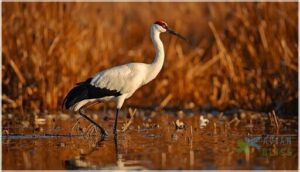
When you encounter a whooping crane—Grus americana—in the wild, you’ll witness North America’s tallest bird species standing about 5 feet tall with a wingspan reaching 7 to 8 feet across.
Adults weigh 10 to 14 pounds, with females slightly lighter, and their long, dark legs and slender neck create an upright, graceful silhouette that ornithology and wildlife conservation efforts work tirelessly to protect.
Distinctive Plumage and Markings
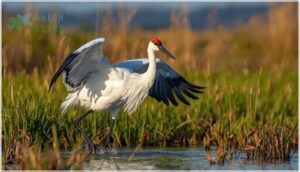
You can identify the whooping crane by its snowy-white plumage patterns that stand out against wetlands and prairies, making it a flagship for bird species conservation.
Here’s what you’ll see:
- Feather colors: Adults display mainly white bodies with striking black wing tips visible during flight.
- Crown marks: A crimson cap adorns the head, contrasting sharply with pale facial skin.
- Beak shapes: The dark, pointed beak aids foraging in shallow marshes. Recent research has shown that isn’t strictly linked to habitat type as previously thought.
Unique Calls and Behaviors
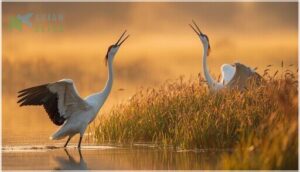
Beyond its striking appearance, you’ll recognize the whooping crane by its powerful, resonant bugle—a trumpet-like call that carries for miles across wetlands and plays a key role in bird species conservation efforts.
These vocalization patterns drive social bonding and courtship displays, with pairs synchronizing calls during graceful dances that strengthen lifetime partnerships, while migration signals help flocks maintain formation during their epic journeys between Canada and Texas.
Like many other species, the whooping crane demonstrates the fascinating diversity of animal sound communication.
Lifespan and Monomorphism
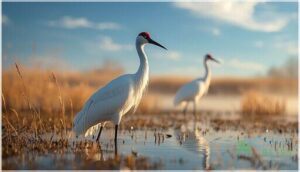
You’ll find that whooping cranes, or Grus americana, are monomorphic—males and females share identical snowy-white plumage and red crowns, though males stand slightly taller, a detail conservation biologists use during wildlife management and conservation efforts.
Longevity factors differ sharply between wild birds, which reach 22 to 30 years, and captive individuals living beyond 40 years, making each breeding adult critical for endangered species preservation.
Habitat and Geographic Range
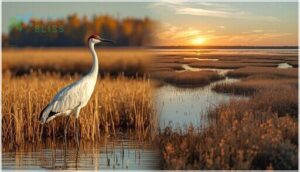
Understanding where whooping cranes live—and how that range has shifted over time—gives you vital insight into what these birds need to survive. Their habitat story stretches across thousands of miles, from remote Canadian breeding marshes to coastal Texas wintering grounds, with migration corridors that thread through the heart of North America.
While whooping cranes depend on specialized wetland habitats, other species like herring gulls demonstrate remarkable adaptability by thriving in both coastal and urban environments across diverse landscapes.
Let’s explore the specific locations and landscape features that define the whooping crane’s world today and compare them to the vast territories they once called home.
Breeding and Wintering Locations
You’ll find whooping cranes split their year between two critical strongholds: nesting in Wood Buffalo National Park’s remote boreal wetlands, then wintering at Aransas National Wildlife Refuge along the Texas coast. These contrasting landscapes—prairie marshes with standing water for breeding, and brackish coastal flats with abundant invertebrates—each offer the specific nesting habitat quality and wintering ground salinity these extraordinary birds require.
- Breeding territories concentrate in shallow, cattail-fringed wetlands where undisturbed shorelines protect nests from trampling
- Wintering grounds provide open water foraging zones rich in blue crabs and clams
- Both sites demand minimal human disturbance to sustain successful reproduction and survival
- Protected wildlife refuges and sanctuaries form the backbone of recovery
- Seasonal food resources dictate which habitats support flocks through each life stage
Migration Routes and Patterns
When you track whooping crane migration patterns across North America’s flyways, you’ll witness a breathtaking staged journey of 50 to 150 kilometers between stopovers, unfolding from March through May northbound and September to November southward.
Route navigation relies on river valleys and coastal landmarks, while stopover ecology—those critical 2-to-7-day refueling windows at wetlands—determines survival, underscoring why habitat connectivity and flyway conservation matter so profoundly.
Preferred Wetland Habitats
You’ll find whooping cranes thriving in wetland ecosystems where freshwater habitats meet marsh conservation priorities, from the coastal wetlands at Aransas National Wildlife Refuge to Wood Buffalo National Park’s northern marshes—each site featuring aquatic vegetation that fuels wetland ecology, underscoring how habitat restoration and management through wetland management safeguards their survival.
Essential whooping crane wetland features:
- Shallow water zones with emergent grasses like cattails providing cover and invertebrate feeding stations
- Seasonal floodplain flats that distribute nutrients and create temporary mudflat foraging grounds
- Freshwater pond complexes offering permanent water and dense vegetation for nesting rails
- Protected littoral zones in tidal systems where brackish conditions support diverse plant communities
- Remote areas with limited human disturbance ensuring safe breeding territories and predator detection
Historical Vs. Current Distribution
The whooping crane’s geographic range has shrunk dramatically—once spanning central North America from Texas to Hudson Bay with over 10,000 birds, the population crashed to fewer than 20 by the 1940s, forcing conservation efforts to concentrate survivors in protected refuges like Aransas National Wildlife Refuge and Wood Buffalo National Park, where habitat restoration and management now anchor bird migration and ecology strategies.
| Historical Distribution | Current Distribution |
|---|---|
| Broad central flyway across prairies, Texas to Hudson Bay | Concentrated at Aransas (300–500 birds) and eastern reintroduction sites |
| Extensive prairie pothole wetlands supporting high genetic diversity | Protected refuges mimicking natural wetlands with managed water levels |
| Unpredictable migration routes across vast wetland networks | Defined 2,000-mile corridors tracked by satellite transmitters |
| Large populations in remote boreal and Gulf Coast zones | Small core populations in Alberta, Saskatchewan, Montana, Texas coast |
| Cultural gatherings at traditional wetlands before land conversion | Managed complexes ensuring ice-free roosting and seasonal moisture |
Population trends reflect this habitat shift—migration patterns now follow restoration corridors rather than historic routes, with conservation efforts expanding geographic range through captive breeding programs that reintroduce birds into former breeding grounds, slowly rebuilding the whooping crane’s footprint across North America.
Diet and Foraging Habits
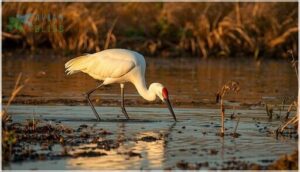
What whooping cranes eat changes with the seasons, and their foraging behavior is as adaptable as it’s impressive.
These towering birds use specific techniques to hunt and gather food in shallow waters, marshes, and coastal flats, playing a surprisingly important role in the health of wetland ecosystems.
Understanding their diet and foraging habits gives you insight into why protecting their feeding grounds is so critical to their survival.
Seasonal Dietary Preferences
Like most wildlife refuges and sanctuaries shaped by bird migration and ecology, whooping crane seasonal flexibility reflects habitat management and conservation biology principles.
You’ll notice coastal prey—blue crabs—dominate winter foraging at Aransas, while breeding nutrition shifts to protein-rich frogs and insects in Canada’s wetlands.
Migration diets rely heavily on waste corn, fueling your understanding of how these extraordinary birds adapt across habitats and seasons.
Foraging Techniques
You’ll witness awe-inspiring foraging strategies when these majestic birds wade deliberately through shallow wetlands, employing prey detection techniques honed over millennia. Their feeding behaviors reveal extraordinary adaptation to habitat selection and energy optimization.
Their feeding behaviors can be observed through the following methods:
- Methodical probing in mud flats to detect buried crustaceans and insect larvae
- Visual scanning along water lines to identify prey movement and surface ripples
- Seasonal patch selection based on prey density in reed beds and marsh channels
- Strategic coordination between walking, wading, and short flights to reach productive feeding grounds
Role in Wetland Ecosystems
Beyond their feeding strategies, you’re observing ecosystem engineering in action—these cranes actively shape wetland ecology through nutrient cycling as they stir sediments and deposit droppings that fuel plant growth.
Their foraging creates microhabitats supporting biodiversity conservation across marshes, while their presence signals habitat resilience and drives habitat preservation efforts that benefit entire wildlife refuges through ecological restoration.
Conservation Status and Recovery
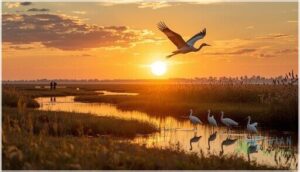
The whooping crane’s brush with extinction stands as one of the most dramatic conservation stories in North America, a demonstration to what determined efforts can achieve when a species teeters on the edge. From a catastrophic low of around 20 individuals in the 1940s, the population has climbed to roughly 600 birds today, though the journey toward full recovery remains far from complete.
You’ll find that this impressive turnaround relies on four interconnected strategies, each addressing a critical piece of the survival puzzle.
Population Decline and History
Survival hung by a thread when overhunting and habitat destruction nearly drove the whooping crane to extinction in the 1940s, with only 15 to 21 individuals clinging to existence.
By the 1940s, overhunting and habitat destruction had driven the whooping crane to the brink, leaving only 15 to 21 birds alive
This population bottleneck stripped genetic diversity from an endangered species that once numbered in the thousands, but conservation efforts launched in response became a demonstration of what you can achieve when protecting imperiled wildlife matters most.
Current Population Numbers
Today you’ll find roughly 600 whooping cranes worldwide—about 440 in the wild and 160 in captivity—a demonstration of conservation biology‘s power to reverse catastrophic population decline.
The Aransas-Wood Buffalo flock reached a record 557 birds in 2024–2025, demonstrating positive population trends and improved survival rates despite limited genetic diversity inherited from that near-extinction bottleneck, while smaller reintroduced groups add critical flock dynamics to species survival.
Captive Breeding and Reintroduction
You’ll see captive breeding programs acting as a genetic reservoir, pairing whooping cranes carefully to maintain diversity while avoiding inbreeding that threatens species preservation.
These recovery efforts include predator avoidance training, enrichment simulating wild foraging, and staged release strategies that ease birds into their natural habitat.
Genetic management tracks relatedness across generations, and reintroduction methods use radiotelemetry to monitor survival, ensuring whooping crane biology informs every conservation status improvement.
Protected Refuges and Wetland Management
You’ll find that refuge designation anchors habitat preservation across National Wildlife Refuges and Conservation Areas, where water level management through seasonal flooding creates foraging cues while wetland restoration reestablishes native sedge communities.
Habitat connectivity between breeding and wintering grounds, including Aransas National Wildlife Refuge, relies on conservation partnerships with landowners and NGOs, ensuring wildlife refuges and sanctuaries maintain flyway integrity through ecological restoration and adaptive wildlife management.
Threats and Ongoing Challenges
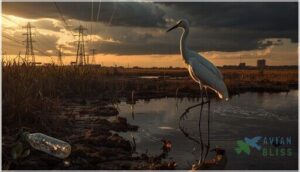
Despite the whooping crane’s impressive climb from near extinction, your support for these iconic birds must reckon with a gauntlet of modern threats that still jeopardize their hard-won recovery.
From vanishing wetlands to invisible disease vectors, the challenges facing today’s 600 whooping cranes demand constant vigilance and creative solutions. Understanding these ongoing dangers—and how you can help address them—is essential to ensuring these splendid birds don’t slip back toward the brink.
Habitat Loss and Degradation
You can’t protect what no longer exists. Habitat destruction and wetland fragmentation slice whooping crane territory into isolated patches, severing wildlife corridors and triggering ecosystem disruption.
Agricultural conversion, drainage projects, and urban sprawl eliminate breeding and foraging sites, while altered hydrology and invasive species degrade remaining wetlands.
Effective conservation strategies demand habitat preservation, ecological restoration, and habitat protection across the entire migratory flyway to reverse decades of relentless habitat loss.
Power Line and Infrastructure Risks
As you soar over wetland corridors, you’re threading a deadly gauntlet—transmission lines crisscross crane migration routes, turning invisible barriers into collision zones that claim lives annually.
Power line collisions pose a critical threat to whooping crane conservation, while infrastructure aging, grid security risks, and transmission line fires compound the danger. Mitigating these hazards through line marking, enhanced monitoring, and strategic siting protects recovering populations from preventable mortality across fragmented habitats.
Disease and Climate Change
Climate change and avian influenza threaten whooping crane species survival on multiple fronts, as shifting climate patterns alter disease vectors and expand transmission pathways across their migration corridors. Health impacts compound existing pressures, demanding urgent adaptation strategies.
The impacts are multifaceted:
- Warmer winters extend mosquito breeding seasons, raising vector-borne disease risks
- Avian flu outbreaks spread rapidly in densely populated staging areas
- Sea-level rise inundates critical coastal wintering habitats, forcing habitat shifts
Vector control and climate-smart habitat management offer paths forward.
Community and Conservation Efforts
You can join the fight to save whooping cranes through hands-on conservation efforts that blend community engagement with advanced wildlife monitoring. Local groups partner with the International Crane Foundation to restore wetlands, track migrations through citizen science, and build ecotourism benefits that fund habitat protection.
Conservation funding facilitates training programs where you’ll learn restoration techniques, transforming degraded shorelines into thriving crane sanctuaries while securing conservation biology’s future.
Frequently Asked Questions (FAQs)
How rare is the whooping crane?
You’re witnessing one of North America’s rarest success stories—fewer than 25 wild whooping cranes survived the 1940s, but dedicated conservation efforts have slowly brought today’s population into the low hundreds.
Where can I see whooping cranes in the US?
You’ll find the most reliable crane viewing along the Texas Gulf Coast at Aransas National Wildlife Refuge, where wintering populations gather from November through March, offering breathtaking sightings from designated boardwalks and observation towers.
Why did the whooping crane almost go extinct?
Once numbering over 10,000 birds, whooping cranes plummeted to just 15 individuals by 1941—habitat destruction from wetland drainage, relentless hunting, and agricultural conversion erased their nesting grounds across North America’s prairies.
What states have whooping cranes?
You’ll spot whooping cranes wintering along Texas’s Gulf Coast at Aransas National Wildlife Refuge, migrating through the Great Plains, and breeding in Canada’s Wood Buffalo National Park, with smaller populations in Wisconsin and Florida.
Is it rare to see a whooping crane?
Yes, wild sightings are extremely rare given the endangered species‘ tiny population of roughly 600 birds.
You’ll have your best chances at public viewing sites during migration timing peaks or at protected stopover sites supported by birding efforts.
Where can I see Whooping Cranes in the US?
You’ll witness the greatest concentrations at Aransas National Wildlife Refuge in Texas during winter months, where Whooping Cranes gather along coastal marshes.
While Nebraska’s Platte River hosts migrating flocks each spring.
Why did the whooping crane go extinct?
The whooping crane never went fully extinct—though hunting pressure and habitat destruction pushed the population to just sixteen birds by 1942, creating a genetic bottleneck that conservation efforts are still working to overcome.
What states do Whooping Cranes live in?
Catching a glimpse of freedom on the wing, you’ll find these endangered species breeding in Canada, Minnesota, and Wisconsin, wintering along the Texas Gulf Coast, and following migration corridors through Nebraska—with reintroduced populations in Florida and Louisiana.
What unique courtship rituals do whooping cranes perform?
You’ll witness dramatic leaps, synchronized calls, and graceful bowing as pairs perform their courtship dance—tossing grass mid-air while reinforcing lifelong pair bonding through unison calling and territorial nesting displays that strengthen mate attraction.
How do whooping cranes communicate with each other?
Silent wetlands erupt with sound when cranes speak—unison calls, alarm signals, and visual displays like courtship rituals form the social vocalizations that bind Gruidae families, a marvel in ornithology and bird research advancing wildlife conservation.
Conclusion
The whooping crane’s story mirrors a tightrope walker’s journey—each step forward balanced against the constant pull of gravity threatening to undo decades of progress.
You’ve seen how these impressive birds, once fifteen strong, now number over 600 through tireless human intervention. Yet their survival remains suspended between refuge wetlands and power lines, between protected breeding grounds and encroaching development.
Your awareness, your advocacy, becomes another safety net stretched beneath their precarious passage toward true recovery.
- https://savingcranes.org/species/whooping-crane/
- https://www.fws.gov/refuge/aransas
- https://whoopermap.savingcranes.org/?_gl=1*1l4jmu2*_gcl_au*MTUwODUwODgxOS4xNzI2MDAwNDgy*_ga*MTcyMjg2OTI1LjE3MjYwMDA0ODI.*_ga_50YYYG9GP8*MTcyOTI2MjA4MC4xMC4xLjE3MjkyODgwMjAuMC4wLjA.
- https://storymaps.arcgis.com/stories/1597d8ad42894fa19036044933815351
- https://nationalzoo.si.edu/animals/whooping-crane