This site is supported by our readers. We may earn a commission, at no cost to you, if you purchase through links.
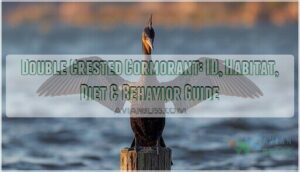
You’ll spot the double crested cormorant perched on a dock piling with wings spread wide in a heraldic pose that looks almost defiant. This dark-bodied waterbird demands notice across North American coastlines and inland waterways, though most people mistake its drying ritual for simple sunbathing.
The reality reveals complex adaptation—unlike ducks, cormorants lack waterproof plumage, trading buoyancy for the density needed to dive deeper and chase fish through underwater columns. That spread-wing stance isn’t vanity. It’s survival mechanics at work, drying feathers between hunting dives that can plunge 25 feet below the surface.
Understanding this species means recognizing how form follows function in one of the continent’s most efficient fish hunters.
Table Of Contents
- Key Takeaways
- What is The Double-crested Cormorant?
- Physical Characteristics and Identification
- Range and Habitat Preferences
- Diet and Foraging Behaviors
- Breeding and Nesting Habits
- Life Cycle and Development
- Social and Behavioral Patterns
- Population Trends and Conservation Status
- Ecological Role and Environmental Impact
- Human Interactions and Management
- Frequently Asked Questions (FAQs)
- How rare is the Double-crested Cormorant?
- Are cormorants an invasive species in the US?
- What is the difference between a cormorant and a Double-crested Cormorant?
- How rare is a double-crested cormorant?
- Is a double-crested cormorant a duck?
- What is the difference between a cormorant and a double-crested cormorant?
- Are Double-crested Cormorants rare?
- Can you eat Double-crested Cormorants?
- What are the main predators of the double-crested cormorant?
- How long do Double-crested Cormorants live?
- Conclusion
Key Takeaways
- Double-crested cormorants trade waterproof plumage for diving density, allowing them to plunge 25 feet deep to hunt fish—their spread-wing drying pose isn’t vanity but survival mechanics between dives.
- This species rebounded from near-extinction after DDT bans, growing from endangered status to over two million birds across North America, though they now face conflicts with fisheries over shared fish resources.
- You’ll identify them by aquamarine eyes against black plumage, yellow-orange facial skin, paired head crests during breeding, and their habit of perching with wings spread to dry non-waterproof feathers.
- Their ecological role extends beyond predation—cormorant guano enriches waters with nitrogen and phosphorus, boosting primary production and supporting complex food webs across coastal and inland aquatic ecosystems.
What is The Double-crested Cormorant?
The double-crested cormorant stands as one of North America’s most recognizable waterbirds, though many people mistake it for a goose or loon at first glance.
Despite its striking appearance, it rarely shows up on the comprehensive waterbird species lists that casual birdwatchers study.
Understanding what this bird actually is starts with knowing where it fits in the natural world and what sets it apart from its relatives. Here’s what you need to know about its classification and place among cormorants.
Scientific Classification
You’ll find the double-crested cormorant classified as Phalacrocorax auritus in ornithology, a binomial nomenclature system that gives every bird species a universal identifier.
This classification systems approach grounds avian biology in taxonomic ranks from Domain Eukarya down to species level. Understanding these evolutionary history markers helps with species identification when you’re trying to distinguish this cormorant from its five North American relatives.
For more details on the hierarchical model of taxonomy, you can explore how scientists organize all living organisms.
Species Overview
Beyond its taxonomic label, the double-crested cormorant stands as one of 38 cormorant species worldwide, shaped by aquatic adaptation over millennia of cormorant evolution. This waterbird thrives in bird migration corridors spanning Canada to Cuba, showcasing notable species diversity across coastal and inland waters.
- You’ll recognize its place in avian ecology as North America’s most abundant cormorant
- Conservation status shifted from concern to recovery following DDT bans
- Ornithology research reveals its role balancing aquatic food webs
Physical Characteristics and Identification
Spotting a double-crested cormorant isn’t difficult once you know what to look for. These birds have a distinctive profile that sets them apart from other waterbirds you’ll encounter.
Here’s what you need to recognize them in the field.
Size and Body Shape

You’ll recognize this waterbird by its hefty build and distinctive proportions. Adult double-crested cormorants stretch 32 to 45 inches from bill to tail, with wingspans reaching 52 to 63 inches. Their long, kinked necks give them a goose-like profile on the water.
Bodies weigh between 0.9 and 2.5 kilograms, varying by season and age.
| Feature | Measurement |
|---|---|
| Body Length | 32-45 inches |
| Wing Span | 52-63 inches |
| Neck Length | Elongated, kinked |
| Body Mass | 0.9-2.5 kg |
Plumage and Coloration

You’ll notice the breeding adult carries a uniform dark plumage powered by melanin production, creating an iridescent sheen that flashes blue-green under sunlight. Feather structure creates waterproof layers critical for diving. Watch for these color patterns:
- Matte black body with glossy mantle highlights
- White throat patches during breeding season
- Yellow-orange facial skin intensifying at courtship
- Juveniles show duller brown-gray tones with pale necks
Plumage maintenance through molting restores this striking armor annually. Birds across many species depend on environmental and genetic factors to produce the diverse feather colors seen in nature.
Unique Identification Features

You can nail bird identification on this waterbird by watching for signature field marks no other species combines. The double-crested cormorant flashes aquamarine eyes against dark plumage—a jewel-like contrast birders rely on.
Check facial skin for intense yellow-orange tones extending into the rounded gular pouch. During breeding, paired head crests curl above each eye, and the hooked bill shows blue mouth lining when open—features that separate this species instantly.
Differences Between Adults and Juveniles

You’ll spot the difference when a juvenile double-crested cormorant swims past an adult. Young birds show paler necks and breasts compared to the adult’s uniform black—a key marker during development stages.
Watching these growing birds from the shoreline reminds us how proper nutrition timing and variety supports healthy plumage development in all species.
Behavioral traits shift too, as juveniles hone foraging skills while adults demonstrate peak hunting efficiency. Watch for these physiological changes in growth patterns to strengthen your bird identification abilities and support wildlife conservation efforts.
Range and Habitat Preferences

Double-crested cormorants aren’t picky about where they set up shop. You’ll find these adaptable waterbirds across an impressive stretch of North America, from rocky coastlines to quiet inland ponds.
Let’s break down where they roam and what types of water they call home.
Geographic Distribution
You’ll find the double-crested cormorant across North America from Alaska to Mexico, with the Great Lakes hosting massive breeding concentrations.
Coastal habitats line both Atlantic and Pacific shores, while river systems connect inland colonies to estuaries. Migration patterns shift populations southward in winter, though some Atlantic birds stay year-round.
Habitat connectivity through watersheds facilitates their continent-wide geographic range.
Aquatic Habitat Types
You’ll encounter these birds wherever waterbird biology intersects with aquatic biodiversity. Freshwater lakes and river ecosystems provide prime foraging zones for waterfowl, while estuary management areas support high waterfowl densities due to nutrient-rich conditions.
Coastal wetlands offer nesting platforms and aquatic life concentrations. The habitat ecology ranges from rocky northern coasts to mangrove swamps, with shallow waters under 30 feet being preferred hunting grounds.
Seasonal Movements
You’ll see these waterbirds shift between coastal wintering grounds and inland breeding territories each year. Migration patterns follow river systems and shorelines, with flocks stopping at shallow bays to refuel.
Day length and prey availability trigger movement. Spring range shifts carry birds north to nesting lakes, while autumn brings them back to protected estuaries where fish remain accessible through winter.
Diet and Foraging Behaviors

Double-crested cormorants are opportunistic fish hunters that adapt their feeding strategies to whatever aquatic environments they encounter.
Their diet shifts with the seasons and available prey, but fish make up the vast majority of what they consume. Understanding their foraging methods reveals how these birds have become such successful predators across diverse North American waterways.
Primary Food Sources
Fish make up the backbone of your double-crested cormorant’s diet, with these opportunistic hunters consuming over 250 aquatic prey species. You’ll find them targeting small to medium-sized fish in shallow waters, but they won’t turn down crabs, crayfish, shrimp, or even the occasional frog.
Their dietary needs demand high protein for feather growth and fats for sustained energy during cold-water dives.
Hunting Techniques
You won’t believe how these master fishers operate beneath the surface. Their hunting techniques rely on underwater pursuit and ambush tactics in shallow zones less than 30 feet deep:
- Webbed-foot propulsion powers rapid chases through kelp beds and rocky structure
- Visual targeting locks onto prey from above before the dive
- Quick-strike bills snap shut on fish in milliseconds
Precision shooting happens fast.
Seasonal Diet Variations
Those ambush tactics target different prey as seasons shift.
Fish availability drives dietary adaptations across the year—spring brings trout and perch from thawing streams, while summer increases aquatic foraging with 1–2 additional weekly servings per adult.
Nutrient shifts occur naturally.
Ornithological research shows double-crested cormorant feeding behavior tracks seasonal cravings in avian ecology, optimizing protein intake through environmental cycles.
Breeding and Nesting Habits

Double-crested cormorants follow distinct reproductive patterns tied to their colonial lifestyle. Their breeding rituals involve elaborate displays and strategic nest placement across varied environments.
You’ll find these waterbirds begin nesting around age three, with specific timing and behaviors that guarantee colony success.
Breeding Season Timing
You’ll find double-crested cormorants begin their breeding cycles each spring after ice melts and waters warm. Colony establishment kicks off nesting schedules within the first two to four weeks of the breeding season.
Bird breeding habits include rapid nest site selection followed by egg laying within five to ten days. Incubation spans twenty-two to twenty-eight days, while fledging periods align with peak fish availability in early summer.
Courtship and Mating Displays
You’ll witness striking bird breeding habits once pairs form at the colony. Males use visual displays—lifting necks, spreading wings, and performing territorial dives—to catch female attention. Courtship calls feature sharp rattling from males and softer clucks from receptive females. Gift giving of captured prey signals foraging skill.
These double-crested cormorant breeding habits reveal mate selection through:
- Coordinated head bobs and tail flicks at roost sites
- Food exchanges during perched displays near nesting areas
- Synchronized arrivals at chosen nest platforms
- Low gliding flights with sudden vertical ascents
- Duet-like calls at dawn reinforcing pair bonds
Nest Construction and Locations
You’ll see pairs build platforms from sticks gathered by males and woven by females into sturdy bases. Nest architecture varies by location—cliff ledges in coastal colonies, canopy tops of tall conifers near inland lakes, or man-made pilings. Site selection prioritizes elevation (6-20 meters), proximity to shallow foraging waters, and protection from wind.
Double-crested cormorant nesting colonies favor mixed-species sites supporting habitat preservation.
| Nest Location | Materials Used | Height Range |
|---|---|---|
| Coastal cliffs & rocks | Sticks, seaweed, debris | 6-15 meters |
| Lake conifers & snags | Branches, vegetation | 10-20 meters |
| Man-made structures | Gathered sticks, plant matter | Variable elevation |
Life Cycle and Development
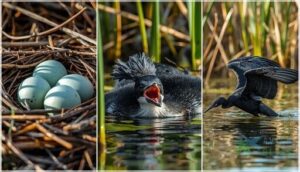
The Double-crested Cormorant‘s reproductive journey begins at around three years of age. From the moment eggs hit the nest to the day young birds strike out on their own, each developmental stage follows a precise biological timeline.
You’ll find three distinct phases that shape how these waterbirds grow from helpless hatchlings into skilled fish hunters.
Egg Laying and Incubation
The Double-crested Cormorant lays three to four chalky blue-green eggs during breeding season within nesting colonies. You’ll observe the female deposit one egg every two to three days in platform nests constructed from sticks and debris.
Both parents share incubation duties for 25 to 28 days, rotating eggs with their webbed feet to guarantee proper embryo development and successful hatching process.
Chick Growth Stages
Hatchlings emerge blind and featherless, weighing just 40 to 50 grams after eggs complete incubation. You’ll observe rapid transformation through these growth patterns:
- Week 1: Active leg movement begins, downy filaments appear, chick nutrition starts with water and starter feed
- Week 2-3: Feather development accelerates along wings and tail
- Week 4-6: Weight triples, brooder management shifts toward cooler temperatures
- Week 6-8: Fledgling success depends on complete molting and independent foraging skills
- Throughout: Avian behavior develops from simple pecking to coordinated flight preparation
Conservation of bird species requires understanding these critical Double-crested Cormorant milestones.
Age of Maturity
You’ll recognize reproductive readiness when Double-crested Cormorants reach three years old, though some populations breed earlier. Growth rates vary by colony density and prey abundance.
Maturity signs include full black plumage, elaborate courtship displays, and successful nest defense. The maturation process links directly to breeding success—older pairs show better coordination during incubation.
Bird watching reveals these avian behavior patterns support conservation efforts through ornithology research tracking age structure shifts.
Social and Behavioral Patterns

You’ll rarely spot a double-crested cormorant flying solo. These waterbirds are wired for group living, from their synchronized fishing trips to their dense breeding colonies.
Understanding their social rhythms and behaviors reveals how they communicate, coordinate, and structure their daily lives.
Flocking Behavior
You’ll witness Double-crested Cormorants moving as one fluid unit, their flock dynamics driven by simple local rules rather than a leader. Each bird aligns its flight path with nearby neighbors, creating synchronized collective movement that adapts instantly to threats or feeding opportunities.
This group coordination isn’t just spectacle for bird watching—it’s a survival strategy refined through social learning across countless bird migration cycles.
Communication Methods
You’ll catch cormorants speaking in multiple dialects when bird watching. Verbal Signals like sharp alarm calls and low territorial rumbles define colony life, while Visual Displays—wing spreading, head bobbing, puffed chests—mark dominance and intent.
Subsurface Cues including water ripples and splash patterns reveal feeding hotspots. Acoustic Communication travels far across water, and Contextual Signals shift with breeding seasons, helping you master wildlife identification beyond any Audubon Field Guide.
Daily Activity Cycle
You’ll see Circadian Rhythms drive the Double-crested Cormorant’s day from dawn foraging flights to evening roosts. Activity Peaks cluster at sunrise and late afternoon when Feeding habits align with fish movement, while midday brings Rest Behavior on open perches.
Social Synchronization pulls flocks to shared sites, creating Foraging Patterns that reveal Avian behavior and sharpen your bird watching tips near productive waters.
Population Trends and Conservation Status

The double-crested cormorant’s population has bounced back from near collapse, but the story isn’t over.
These birds once teetered on the edge due to pesticide poisoning, yet they’ve clawed their way to recovery in most regions. You’ll find their current status reflects both impressive resilience and ongoing pressures that demand your attention.
Current Population Estimates
You’ll find the Double-crested Cormorant population has rebounded dramatically since DDT was banned. Today’s numbers exceed two million birds across North America.
Growth rates have stabilized around 2-3 percent annually in most regions. Wildlife population dynamics show cormorant abundance varies by location. Some colonies have declined while others thrive.
Conservation efforts continue monitoring these population trends to balance ecological needs with fisheries management.
Conservation Designations
You’ll find the Double-crested Cormorant protected under the Migratory Bird Treaty Act, a regulatory framework that prohibits unauthorized harm. California lists it as a species of special concern, triggering habitat protection measures at critical rookeries.
These conservation designations shape environmental policies that govern wetland restoration and nesting site management. State wildlife agencies coordinate species listings with federal conservation efforts to maintain biodiversity conservation across aquatic ecosystems.
Major Threats and Challenges
You’ll face challenges that strike from multiple angles. Habitat loss fragments nesting islands and foraging wetlands.
Legacy pesticides like DDT thinned eggshells by up to 95 percent in some colonies, and modern pollution still accumulates through bioaccumulation.
DDT once thinned cormorant eggshells by up to 95 percent, and modern pollutants continue accumulating through the food chain
Human persecution continues through legal depredation orders authorizing large-scale culling near fisheries. Climate change alters prey distribution.
Conservation efforts now balance biodiversity protection against economic conflicts that threaten this species’ hard-won recovery.
Ecological Role and Environmental Impact

Double-crested cormorants occupy a complex position in North American aquatic ecosystems.
Their feeding habits and colonial nesting behaviors create ripple effects that influence fish populations, vegetation, and other waterbird species.
Understanding these ecological connections reveals both their natural role and the concerns that arise when their numbers fluctuate.
Importance in Aquatic Ecosystems
You’ll find double-crested cormorants playing a vital role as ecosystem engineers through nutrient cycling and trophic dynamics. Their guano deposits enrich waters with nitrogen and phosphorus, boosting primary production and ecological resilience.
These birds maintain aquatic connectivity across wetlands and coastal zones, supporting biodiversity through habitat linkages. Their foraging strengthens ecological balance, sustaining complex food webs essential for wildlife ecology and overall aquatic life vitality.
Impact on Fish Populations
Through intense foraging strategies, you’ll notice cormorants reshaping fish population dynamics in aquatic ecosystems. They can devour up to 1 kilogram daily, concentrating predation effects on juvenile fish and altering recruitment patterns.
Their wildlife feeding behavior influences fishery management decisions, as repeated pressure near spawning grounds shifts aquatic life communities. This creates significant conservation implications for both birds and fish populations alike.
Interactions With Other Species
Within complex ecological networks, you’ll find cormorants engaging in predator prey dynamics while supporting symbiotic relationships through shared colonies. Their ecosystem engineering activities create microhabitats that benefit invertebrates and fish.
- Dense rookeries promote disease transmission among waterfowl sharing shorelines
- Competition with herons intensifies human conflicts over fishery resources
- Guano deposits stimulate algal blooms, demonstrating ecological importance across trophic levels
Wildlife conservation requires balancing avian species conservation with wildlife-human conflict mitigation strategies.
Human Interactions and Management

You can’t talk about cormorants without addressing the friction between these birds and people.
Double-crested cormorants operate under federal protection through the Migratory Bird Treaty Act, yet they routinely clash with commercial and recreational fishing interests.
Understanding the legal framework, the conflicts, and current management strategies reveals how we’re trying to balance wildlife conservation with human economic needs.
Legal Protections and Regulations
You can’t just shoo away a double-crested cormorant without consequences. The Migratory Bird Treaty Act shields these birds through strict conservation laws enforced by the US Fish and Wildlife Service.
Environmental regulations require depredation permits before you take action against colonies. This regulatory framework demands you try nonlethal methods first. Wildlife policies set fines for violations. Wildlife conservation isn’t optional here.
Conflicts With Fisheries
When cormorant abundance surges, fishery and aquaculture management turns into a high-stakes balancing act. You’ll see wildlife-human conflict mitigation play out through:
- Economic strain on small-scale fishers who absorb gear damage costs without compensation
- Fishery regulations creating compliance burdens while cormorants face no quotas
- Depredation permits arriving too late to prevent aquaculture facilities losses
- Predator-prey dynamics shifting fishing grounds, forcing costly route changes
Management strategies struggle to satisfy both conservation and livelihoods.
Conservation and Management Efforts
You’ll find wildlife management strategies working to strike ecosystem balance through five coordinated approaches. Conservation plans incorporate habitat preservation and restoration alongside species monitoring protocols that track colony dynamics across breeding sites.
Wildlife conservation strategies now prioritize nonlethal deterrence and adaptive harvest schedules based on continuous fishery data, transforming wildlife-human conflict mitigation into evidence-driven ecological conservation efforts.
| Conservation Focus | Implementation Approach |
|---|---|
| Habitat Restoration | Wetland protection and roost site maintenance |
| Population Monitoring | Annual colony counts and mark-recapture studies |
| Fisheries Coordination | Adaptive depredation permits with time restrictions |
| Legal Framework | Federal and state permit systems with enforcement |
| Research Support | University partnerships providing updated science |
Frequently Asked Questions (FAQs)
How rare is the Double-crested Cormorant?
You won’t struggle to spot this bird species. Double-crested Cormorants hold a Least Concern conservation status with rebounding populations following DDT bans, though habitat loss and human conflicts continue threatening local colonies.
Are cormorants an invasive species in the US?
No, you won’t find double-crested cormorants classified as invasive species since they’re native to North America.
Wildlife management tackles localized overabundance and ecological impact assessment, not invasive status requiring habitat preservation concerns.
What is the difference between a cormorant and a Double-crested Cormorant?
Cormorant” refers to the entire family of waterbirds in ornithology.
The double-crested cormorant is one specific species within that family, distinguished by its breeding head crests, orange facial skin, and widespread North American range.
How rare is a double-crested cormorant?
You won’t struggle to spot this bird.
The double-crested cormorant is abundant across North America, with no rarity factors limiting its distribution.
Conservation status reflects stable numbers despite localized habitat loss.
Is a double-crested cormorant a duck?
You might spot this sleek diver and think “duck,” but the double-crested cormorant belongs to family Phalacrocoracidae.
Bird misidentification happens often—cormorant characteristics like hooked bills and drying wings distinguish them from true waterfowl in Anatidae.
What is the difference between a cormorant and a double-crested cormorant?
Thirty-eight Cormorant Species roam the globe, but only six claim North America as home.
The double-crested cormorant stands apart with paired head plumes during breeding season, orange facial skin, and stockier build than its relatives.
Are Double-crested Cormorants rare?
No, they aren’t rare. Double-crested Cormorant populations have rebounded strongly since DDT bans, earning a Least Concern conservation status despite habitat loss pressures and localized conflicts with fisheries across North America.
Can you eat Double-crested Cormorants?
You’d face jail time faster than you can say “Thanksgiving turkey“. The Double-crested Cormorant is federally protected under strict permit requirements.
Meat quality and health concerns aside, ethical debates and wildlife conservation efforts make eating them illegal and inadvisable.
What are the main predators of the double-crested cormorant?
You’ll spot bald eagles, raccoons, and foxes as the primary nest raiders and water predators targeting cormorants.
Human impacts through habitat disturbance and illegal shooting remain significant coastal dangers affecting these colonial waterbirds throughout their range.
How long do Double-crested Cormorants live?
You’ll find these avian species surviving roughly six years on average in wild conditions.
Survival rates drop sharply during the first year, though some individuals defy mortality causes and reach their mid-twenties under favorable longevity trends.
Conclusion
Watch for shifting attitudes toward the double crested cormorant as fishery conflicts intensify and ecosystem roles become clearer. You’ve learned to distinguish this species by morphology, behavior, and ecological function—knowledge that separates informed observation from casual assumption.
The bird’s evolutionary trade-offs reveal nature’s precision: sacrificed waterproofing for diving efficiency, colonial breeding for protection, adaptability for survival. Your understanding now extends beyond identification to the complex dynamics shaping this waterbird’s future across North American waters.