This site is supported by our readers. We may earn a commission, at no cost to you, if you purchase through links.
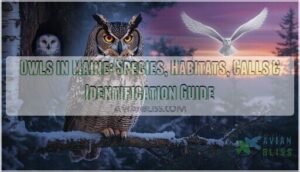
Last February, a Great Horned Owl crashed through a barn window in Aroostook County, talons locked around a rabbit twice its size. The collision barely fazed the five-pound predator—it just dragged its meal back outside and flew off. That’s Maine’s largest owl in action: silent, powerful, and utterly unbothered by winter.
But Great Horned Owls are just one of several species calling Maine home. From the tiny Northern Saw-whet hiding in spruce thickets to ghostly Snowy Owls patrolling coastal dunes each winter, these raptors occupy every corner of the state. Knowing what to look for—those bright yellow eyes, distinctive calls, and telltale hunting behaviors—transforms a quiet evening walk into a front-row seat to one of nature’s most skilled predators.
Table Of Contents
- Key Takeaways
- Common Owl Species in Maine
- Owl Habitats and Distribution Across Maine
- Identifying Maine Owls by Sight and Sound
- Owl Behavior, Hunting, and Diet in Maine
- Top Owl Guides and Posters for Maine Birders
- Frequently Asked Questions (FAQs)
- What is the most common owl in Maine?
- What owl hoots three times at night?
- What owl goes hoo hoo hoo sound?
- What are the most common owls in Maine?
- Is it good to have an owl in your yard?
- What kind of owl hoots during the day?
- Do owls come out during the day?
- How do Maines owls adapt to urban environments?
- What traditional folklore exists about owls in Maine?
- How does light pollution affect owl behavior in Maine?
- Conclusion
Key Takeaways
- Maine hosts five primary owl species year-round or seasonally: Great Horned Owls (the largest, most dominant predator), Barred Owls (identified by their “who cooks for you” call), Eastern Screech-Owls (tiny, camouflaged cavity nesters), Northern Saw-whet Owls (7-8 inch conifer specialists), and Snowy Owls (Arctic visitors appearing in coastal areas during winter irruptions).
- You can identify Maine’s owls through distinct physical markers—Great Horned and Eastern Screech-Owls display prominent ear tufts while Barred and Snowy Owls lack them, eye color ranges from bright yellow-orange to deep brown depending on species, and each owl produces unique vocalizations from deep territorial hoots to high-pitched whistling toots.
- These raptors occupy specialized habitats across the state: forest owls like Barred and Saw-whet species dominate mature woodlands and conifer stands, Short-eared Owls hunt open grasslands and marshes during daylight hours, while Great Horned Owls adapt successfully to both wild forests and urban parks by using man-made structures for nesting.
- Most Maine owls hunt nocturnally between 8 pm and midnight with prey preferences varying by species—Great Horned Owls tackle rabbits and squirrels up to 2 kg, Barred Owls switch between small birds and fish depending on rodent availability, and all species adjust their behavior seasonally with breeding cycles intensifying in early spring and winter driving changes in roosting and foraging strategies.
Common Owl Species in Maine
Maine’s forests and fields are home to a surprising number of owl species, each with its own unique features and behaviors. Some live here year-round, while others only visit during specific seasons.
These nocturnal hunters share certain traits with other types of birds of prey, including sharp talons and exceptional eyesight adapted for hunting.
Let’s look at the five most common owls you’re likely to encounter across the state.
Great Horned Owl
Meet the undisputed champion of owls in Maine—the Great Horned Owl. You’ll recognize this powerhouse by its prominent ear tufts, bright yellow eyes, and mottled brown plumage that blends perfectly into forest bark.
Weighing up to five pounds with a wingspan stretching nearly five feet, these dominant hunters don’t migrate and nest year-round across the entire state, reusing old nests in sturdy tree forks.
They maintain their status as top predators thanks to their crushing talon strength.
Barred Owl
While Great Horned Owls rule the canopy, Barred Owls thrive throughout Maine’s forests with a gentler presence. You’ll spot their round heads lacking ear tufts, dark eyes, and signature chest barring that transitions to vertical belly streaks.
These year-round residents defend large territories in mature woodlands, nesting in tree cavities. Listen for their unmistakable “who cooks for you” call echoing through dawn and dusk—your best identification tool.
With a healthy breeding population and adaptability to diverse environments, you can learn more about their status in this concise overview of barred owl conservation facts.
Eastern Screech-Owl
Unlike the Barred Owl’s deep call, you’ll hear the Eastern Screech-Owl’s descending trill in southern Maine’s forests. These masters of feather camouflage blend seamlessly with tree bark using gray or rufous plumage.
You’ll find them in both wild woodlands and urban parks, using nest boxes when natural cavities are scarce. Their conservation status remains stable thanks to outstanding urban adaptation and flexible nesting habits throughout their Maine range.
Northern Saw-whet Owl
When you hear a rapid, whistling to-to-to echoing through Maine’s conifer forests at dusk, you’ve likely found a Northern Saw-whet Owl. These tiny hunters measure just 7-8 inches tall with bright yellow eyes and catlike facial markings.
- Silent flight enabled by specialized feather structure makes them deadly efficient mouse hunters
- Nesting habits rely on small tree cavities in dense forests statewide
- Owl migration patterns bring increased winter sightings December through March
Snowy Owl (Winter Visitor)
When winter blankets Maine’s coastal fields in snow, you might spot North America’s heaviest owl—the Snowy Owl—scanning for prey from fence posts and dunes. These Arctic adaptation masters arrive during owl irruptions, when food shortages push them south from their tundra homes.
| Feature | Details |
|---|---|
| Size | 3-6 pounds, wingspan 4.5-5.5 feet |
| Winter Habitat | Coastal towns, open fields, marshes |
| Plumage | Nearly pure white with dark flecks |
| Cold Climate Survival | Dense feathering on body and legs |
Their bright yellow eyes and white plumage make Snowy Owl identification straightforward in your Maine owl species guide. Look for them hunting voles, lemmings, and shorebirds during daylight hours—a rare diurnal behavior among owls in Maine.
Unlike Snowy Owls, Great Horned Owls nest earlier in the season, often repurposing old hawk nests in urban parks where tall trees provide ideal shelter.
Owl Habitats and Distribution Across Maine
Maine’s owls don’t stick to one type of landscape—they’ve carved out territories across forests, fields, marshes, and even your neighborhood.
Each species has found its sweet spot, whether that’s deep in the pines or hunting over open grassland at dusk. Here’s where you’ll find them across the state.
Forest and Woodland Owls
Maine’s thick forests aren’t just scenery—they’re hunting grounds for some of the state’s most notable night predators. If you’re tracking owls in Maine, woodlands hold the richest diversity. Here’s where forest edge ecology meets owl magic:
- Great Horned Owls dominate mixed forests and riparian zones, using tree nesting sites to raise young year-round
- Barred Owl populations thrive in mature deciduous stands near swamps where their calls bounce between trunks
- Eastern Screech-Owl roosts in tree cavities from suburban woodlots to dense forest interiors
- Northern Sawwhet Owl hunts coniferous forests with thick understory during twilight hours
- Longeared Owl prefers woodland edges where open fields meet shelter, supporting woodland predator prey dynamics
Owl migration patterns shift some species seasonally, but these owl habitats in Maine remain critical throughout the year.
Grassland and Marshland Owls
Open grasslands and marshes offer a different stage for owl species in Maine. The Short-eared Owl claims these wetland conservation zones, using silent flight to hunt voles across unmowed fields. You’ll spot them during daylight, gliding low over knee-high sedges.
Grassland habitats near shallow wetlands support this ground-nester’s survival, making bird watching here a rewarding challenge. Owl migration patterns shift some populations seasonally through Maine’s marshland ecology.
Coastal and Island Owl Populations
Along the shore, coastal owl populations claim island roosting sites in old spruce-fir stands. Great Horned Owls hunt rabbits near estuary margins, while Barred Owls occupy wetland edges for owl prey.
Snowy Owls arrive December through March on beaches and marshes during coastal migration. Northern Saw-whet Owls use island woodlands for nesting sites, and seabird colonies attract marine habitats specialists during breeding season.
Urban and Suburban Habitat Adaptations
City lights don’t deter Maine’s adaptable owls from claiming urban conservation territory. You’ll spot Great Horned Owls perched in park trees near downtown, while smaller species use city nesting sites in mature suburban yards.
Human owl conflict stays minimal when residents protect owl habitats through thoughtful landscaping:
- Dense hedgerows provide suburban foraging cover for hunting prey
- Southwest-facing tree cavities offer warm urban roosting spots
- Native plantings boost local prey that support owl behavior and ecology
Identifying Maine Owls by Sight and Sound
You don’t need to be a seasoned birder to identify Maine’s owls—you just need to know what to look for and listen for. Each species has telltale physical features that make them stand out, from ear tufts to eye color to body size.
Pair those visual cues with their distinctive calls, and you’ll be able to recognize these birds with confidence.
Key Physical Characteristics
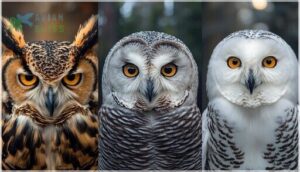
You can identify owl species in Maine by focusing on a few standout features. Eye colors range from the Great Horned Owl’s blazing yellow-orange to the Barred Owl’s deep, soulful brown. Ear tufts signal identity—prominent in Great Horned and Eastern Screech-Owls, absent in Barred Owls.
Plumage patterns, beak shapes, and feather textures complete the picture.
| Feature | What to Look For |
|---|---|
| Eye Colors | Yellow-orange (Great Horned), dark brown (Barred), bright yellow (Snowy) |
| Ear Tufts | Prominent tufts (Great Horned, Eastern Screech), none (Barred, Snowy) |
| Plumage Patterns | Vertical streaks (Great Horned), horizontal bars (Barred), white with dark marks (Snowy) |
| Beak Shapes | Heavy, hooked bills for tearing prey; pale beaks on Snowy Owls |
| Feather Textures | Soft, silent flight feathers; bulky insulating plumage on Snowy Owls |
Distinctive Calls and Vocalizations
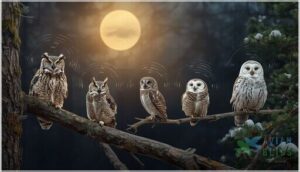
You can identify Maine’s owls by ear just as easily as by sight. Great Horned Owls deliver deep, five-second territorial hoots at dusk, while Barred Owls sing their famous “who cooks for you” sequence.
Eastern Screech-Owls use a downslurred whinny trill, and Northern Saw-whets emit high-pitched squeaky toots. Snowy Owls produce brief, motorcycle-like screeches during disputes.
These distinctive owl vocalizations and calls reveal identity, territory, and behavior.
Visual and Audio Identification Tools

You’ll need solid field guides and audio recordings to confirm what you’re seeing and hearing.
Modern birding apps offer species filters, spectrogram analysis, and offline owl identification tools that display hoots and calls on your phone.
High-quality guidebooks pair color plates with sound libraries, making identification of owls straightforward. These resources decode owl vocalizations quickly, whether you’re matching a hoot or analyzing a recorded call.
Owl Behavior, Hunting, and Diet in Maine
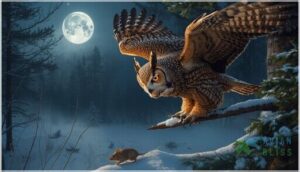
Owls in Maine don’t follow a single hunting playbook in terms of hunting and feeding. Some species prowl exclusively under moonlight, while others break the nocturnal rule entirely, and what they eat depends heavily on what’s moving through their territory.
Understanding these patterns helps you predict where and when you’ll spot different owls across the state.
Nocturnal and Diurnal Activity
Most Maine owls are classic nocturnal hunters, peaking between 8 pm and midnight when prey movement surges. You’ll notice crepuscular activity at twilight—those magical in-between hours when light fades.
Snowy Owls break the mold with diurnal behavior during winter coastal visits. Activity cycles shift seasonally: spring extends twilight hunting, while autumn migration intensifies dawn and dusk forays. Dense forests push owls deeper into night.
Prey Preferences and Feeding Habits
After dark hunting wraps up, these birds of prey must refuel. Great Horned Owls tackle rabbits and squirrels up to 2 kg—powerful talons ambush from perches.
Barred Owls prefer small birds and mice but shift to fish when rodents drop. Saw-whets specialize in forest mice.
Diet variation mirrors habitat: wetland edges offer amphibians, while grasslands serve up voles for Short-eared Owls.
Seasonal Changes in Behavior
Winter flips the script on owl behavior and ecology. You’ll notice nocturnal activity peaks when snow buries prey and shorter days compress foraging strategies.
Breeding cycles kick off in early spring—courtship calls echo through forests as males compete. Migration patterns shift some species south, while winter roosting habits drive others into sheltered cavities during cold snaps.
Nesting habits intensify by late spring when fledglings emerge.
Top Owl Guides and Posters for Maine Birders
Whether you’re just starting out or you’ve been tracking owls for years, the right field guide makes all the difference. A solid reference puts accurate identification details right in your hands when you need them most.
Here are four excellent guides and posters that’ll help you confidently identify Maine’s owls in the field and at home.
1. Owls of North America Guidebook
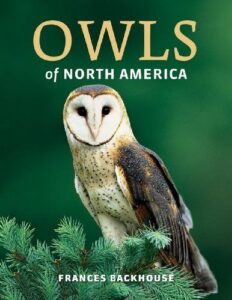
If you’re serious about understanding owl biology beyond basic identification, Frances Backhouse’s Owls of North America delivers outstanding depth. This 216-page guidebook profiles 23 species with 70 color photographs, detailed range maps, and thorough coverage of anatomy, mating behaviors, and feeding habits.
You’ll find it equally useful as a field reference or coffee table resource. Park rangers and educators value its solid foundation in owl ecology, though some readers note the textual format leans toward lists rather than flowing narrative.
| Best For | Birders, naturalists, educators, and park rangers who want a comprehensive guide to North American owl species with strong visual reference and detailed ecological information. |
|---|---|
| Focus Region | North America |
| Format Type | Hardcover Book |
| Species Count | 23 species |
| Visual Content | 70 color photographs |
| Primary Use | Reference/Education |
| Portability | Not portable (1.95 lbs) |
| Additional Features |
|
- Features 70 color photographs and range maps across 23 species, making identification straightforward
- Covers essential topics like anatomy, feeding habits, and mating behaviors with solid scientific grounding
- Works well both as a practical field guide and an attractive coffee table book
- Text is formatted more like lists than flowing narrative, which some readers find less engaging
- Focuses only on North American species, not a global owl guide
- Contains some redundancy between species accounts and introductory chapters
2. Peterson Guide To North American Owls
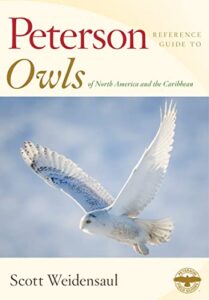
Peterson’s guide covers 39 owl species across North America and the Caribbean with 352 pages of field marks, range maps, and vocal descriptions. You’ll find color plates comparing similar species side-by-side, plus hundreds of photos showing plumage variations.
The October 2015 edition includes online recordings to match calls you hear in Maine’s forests. At 2.36 pounds, it’s too heavy for trail use, but works perfectly as a home reference for serious identification challenges.
| Best For | Serious birders and owl enthusiasts who want a comprehensive home reference with detailed species accounts, vocal recordings, and visual comparisons for identifying North American owls. |
|---|---|
| Focus Region | North America/Mexico/Caribbean |
| Format Type | Hardcover Book |
| Species Count | All North American species |
| Visual Content | Hundreds of color photos |
| Primary Use | Identification/Reference |
| Portability | Not portable (2.36 lbs) |
| Additional Features |
|
- Includes access to online vocal recordings that help match calls heard in the field with specific species
- Features hundreds of color photos and side-by-side comparisons showing plumage variations and field marks
- Covers all 39 owl species across North America, Mexico, and the Caribbean with detailed range maps and natural history information
- Too heavy at 2.36 pounds to carry comfortably on hikes or field trips
- Large dimensions (7 x 10 inches) make it impractical as a portable field guide
- Better suited as a desk reference than for quick identifications while outdoors
3. Sibley Eastern North America Owls Poster
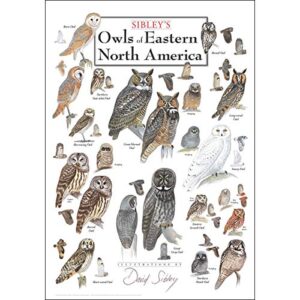
David Sibley’s 19″ x 27″ poster gives you all 13 eastern owls at a glance—perfect for quick reference when you’re sorting out species.
You’ll see multiple illustrations for each owl, showing perched and flight postures with labeled features that highlight ear tufts, facial discs, and plumage patterns. Printed on fade-resistant 80-pound stock, it’s museum-quality and frames beautifully.
The poster ships rolled in a protective tube and works brilliantly alongside your field guide during Maine outings.
| Best For | Birdwatchers and nature lovers in eastern North America who want a detailed reference guide for identifying all 13 owl species in the region. |
|---|---|
| Focus Region | Eastern North America |
| Format Type | Poster |
| Species Count | 13 species |
| Visual Content | Multiple illustrations |
| Primary Use | Identification/Display |
| Portability | Portable (5.6 oz) |
| Additional Features |
|
- Multiple illustrations per species show perched and flight views with clearly labeled features like ear tufts and facial discs
- Museum-quality printing on fade-resistant 80-pound stock that’s perfect for framing
- Large 19″ x 27″ size makes details easy to see and works great as both a learning tool and wall art
- Needs to be framed or mounted separately, which adds to the total cost
- Paper material isn’t weather-resistant, so it’s not practical for field use in wet conditions
- Ships in a bulky 2″ mailing tube that might be awkward to store if you’re not framing it right away
4. Sibley Owls of North America Poster
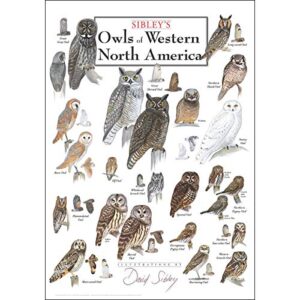
If you want the full continental picture, Sibley’s 19″ x 27″ North America poster expands your view to 19 owl species from coast to coast. You’ll get the same detailed illustrations—perched poses, flight views, and labeled features—printed on fade-resistant 80-pound stock that won’t wash out over time.
It’s especially useful if you travel beyond Maine or want to compare regional variations. The poster ships rolled in a protective tube and pairs perfectly with field guides for both home study and outdoor identification sessions.
| Best For | Bird enthusiasts and educators who want a comprehensive reference guide covering owl species across the entire continent, not just one region. |
|---|---|
| Focus Region | Western North America |
| Format Type | Poster |
| Species Count | 17 species |
| Visual Content | Multiple illustrations |
| Primary Use | Identification/Display |
| Portability | Portable (5.6 oz) |
| Additional Features |
|
- Features 19 owl species with detailed illustrations showing perched poses, flight views, and labeled features by renowned illustrator David Allen Sibley
- Printed on fade-resistant 80-pound coated stock that maintains quality over time
- Perfect companion to field guides for both home study and outdoor identification across different regions
- At 19″ x 27″, the poster may be smaller than expected and not ideal for larger spaces
- Shipping tube may not always provide adequate protection during transit
- Product descriptions sometimes lack detail about dimensions, which can lead to surprises upon arrival
Frequently Asked Questions (FAQs)
What is the most common owl in Maine?
Great Horned Owls rule Maine’s forests like feathered monarchs wearing ridiculous ear tufts.
You’ll find these year-round residents everywhere—from dense woodlands to urban parks—making them the state’s most common owl species by far.
What owl hoots three times at night?
Several species deliver three-hoot patterns at night. Barred Owls commonly produce three evenly spaced hoots during dusk.
Great Horned Owls often hoot twice, then add a softer third note. Eastern Screech-Owls emit rapid three-note sequences.
What owl goes hoo hoo hoo sound?
The Great Horned Owl produces a deep, booming “hoo-h’HOO-hoo-hoo” pattern that carries for miles.
You’ll also hear the Barred Owl‘s eight-note “Who cooks for you? Who cooks for you all?” echoing through Maine’s forests.
What are the most common owls in Maine?
You won’t believe the variety, but five species practically run the show: Great Horned Owls, Barred Owls, and Eastern Screech-Owls dominate year-round, while Northern Saw-whet Owls and Snowy Owls appear seasonally.
Is it good to have an owl in your yard?
Yes, owls bring natural pest control to your yard, hunting mice and voles that damage gardens.
They’re quieter than chemical solutions and offer you glimpses of wildlife without disrupting neighboring ecosystems.
What kind of owl hoots during the day?
Barred Owls are the daytime champions in Maine, belting out their famous “who cooks for you” hoots during morning and afternoon hours, especially when defending territory or coordinating with mates.
Do owls come out during the day?
While owls are famous night owls, some break the twilight rule. You’ll spot daytime hunters like snowy owls and barred owls, especially during winter when prey becomes scarce at night.
How do Maines owls adapt to urban environments?
Maine’s urban owls nest in attics, rooftops, and man-made boxes while hunting rodents near street lamps and bird feeders.
They’ve learned to tolerate traffic noise by shifting hunting to quieter dawn hours.
What traditional folklore exists about owls in Maine?
In rural communities, you’ll hear that Great Horned Owls are forest guardians, and their hoots warn travelers of change.
In these communities, Snowy Owls signal winter storms, while Barred Owls are cunning woodland tricksters.
How does light pollution affect owl behavior in Maine?
Artificial lighting disrupts nocturnal hunting by creating glare that reduces prey detection and shifts activity to darker patches.
Bright zones discourage roosting and nesting, while skyglow can mask territorial calls and breeding vocalizations.
Conclusion
Owls in Maine operate like shadows with heartbeats—silent, precise, and utterly adapted to every habitat from coastal dunes to deep forest.
You’ve now got the field marks, calls, and behaviors to separate a Barred Owl‘s hoot from a Screech-Owl’s trill. Grab binoculars, step outside after dusk, and listen. That rustle in the pines or flash of yellow eyes isn’t just wildlife—it’s proof that Maine’s wildest hunters are closer than you think.
- https://www.allaboutbirds.org/guide/Northern_Saw-whet_Owl/overview
- https://www.fs.usda.gov/nrs/pubs/ru/ru_fs366.pdf
- https://www.maine.gov/ifw/fish-wildlife/wildlife/living-with-wildlife/avoid-resolve-conflict/owls.html
- https://profile.google.com/cp/Cg0vZy8xMXRqcnoydzMx
- https://www.biodiversitya-z.org/content/least-concern-lc