
This site is supported by our readers. We may earn a commission, at no cost to you, if you purchase through links.

Most birds wait for spring. The great horned owl doesn’t get the memo.
While other species are still huddled against January cold, great horned owls are already deep into incubating eggs—sometimes in temperatures that drop below -35°F. A female will sit motionless on her clutch through snowstorms, her bare brood patch pressed against pale white eggs, while her mate hunts through the dark to keep her fed.
Great horned owl nesting starts as early as late December in some regions, making this one of the earliest-breeding birds in North America. What happens from that first egg to a fledgling capable of flight at ten weeks is a tightly orchestrated process—worth understanding if you’ve spotted a nest nearby or simply want to know what these birds are actually doing up there.
Table Of Contents
- Key Takeaways
- Great Horned Owl Nesting Season and Breeding Timeline
- Where Great Horned Owls Build Their Nests
- Great Horned Owl Nest Structure and Materials
- Great Horned Owl Eggs and Incubation
- Raising Owlets From Hatching to Independence
- Frequently Asked Questions (FAQs)
- How to get a Great Horned Owl to nest in your yard?
- What time of year do Great Horned Owls nest?
- Where does a Great Horned Owl nest?
- Where do Great Horned Owls prefer to nest?
- Do owls nest in the same place every night?
- When do great horned owls lay eggs?
- How long is the fledgling period?
- What materials line the nest?
- How many eggs are typically in a clutch?
- What is the incubation period for eggs?
- Conclusion
Key Takeaways
- Great horned owls nest in the dead of winter, beginning as early as December, making them one of North America’s earliest-breeding birds — driven by cold-weather timing rather than spring warmth.
- Rather than building their own nests, these owls claim abandoned stick platforms from hawks, herons, and other raptors, returning to the same site for up to a decade to conserve energy.
- The female incubates eggs alone through temperatures below -35°F, relying entirely on the male to hunt and deliver food across the full 30–37 day incubation period.
- Owlets move from blind, downy hatchlings to branching juveniles in just 5–7 weeks, then take another 2–3 months of parental support before they can hunt independently.
Great Horned Owl Nesting Season and Breeding Timeline

Great horned owls don’t follow the same seasonal rules most birds do — they actually nest in the dead of winter, long before spring arrives.
In fact, they often commandeer abandoned hawk nests and begin incubating eggs in January — a habit explored further in this guide to owl nesting and winter behavior in Arizona.
Timing can shift quite a bit depending on where a pair lives, and several other factors shape how their breeding season unfolds. Here’s what you need to know about when and how that process begins.
Winter Nesting Months
Unlike most birds that nest in spring, great horned owls begin their breeding cycle in the depths of winter — often late December through February. Cold temperatures actually drive this timing.
Females stay on the nest nearly constantly, while males handle most daytime hunting. Clutch sizes tend to be smaller in winter, reflecting the real energy costs of cold-weather nesting. To survive these seasons, many species rely on various survival adaptations to manage the harsh environment.
Regional Timing Differences
Timing shifts quite a bit depending on where you are. Coastal southern populations may begin nesting up to six weeks before inland birds, while montane owls nest two to four weeks later than valley pairs at similar latitudes.
Urban pairs usually start one to two weeks earlier than rural neighbors, partly because city prey is more reliable through winter.
Early Nest Site Searching
Pairs don’t wait for spring to start looking. Great horned owls begin scouting potential nest sites as early as September, checking tree crotches, abandoned raptor nests, and cliff ledges while foliage is still thin enough to reveal old stick platforms.
Watch for repeated visits to the same tree — that’s your clearest behavioral cue that a site is under serious consideration.
One Brood Per Year
Great horned owls commit to one brood per year. Raising owlets demands so much energy that most pairs simply can’t sustain a second attempt in the same season.
- Prey availability shapes the entire breeding season window
- Egg incubation and raising owlets drain significant parental energy
- Seasonal resource peaks align closely with a single clutch
- Second broods occur but remain rare, even in favorable years
- Reproductive energy allocation favors chick survival over quantity
Renesting After Failed Clutches
Occasionally, nest failure doesn’t end the breeding season entirely. Female body condition strongly predicts whether a replacement clutch follows. Early failures allow renesting within just 3 to 7 days; late incubation losses leave little time. Renesting energy costs are very real — replacement clutches often run smaller.
| Nest Loss Timing | Renesting Outcome |
|---|---|
| Early laying stage | High likelihood |
| Late incubation | Rarely attempted |
Where Great Horned Owls Build Their Nests
Great horned owls don’t build nests from scratch — they’re opportunists, and finding the right spot matters more to them than construction. Their choices are surprisingly varied, ranging from towering trees to urban structures you’d never expect. Here’s a look at the main places these owls call home during nesting season.
Their habit of taking over abandoned hawk or crow nests is just one of many fascinating behaviors you’ll discover when exploring great horned owl calls and habitat across Pennsylvania.
Abandoned Raptor Nests

To find a place to nest, great horned owls don’t build from scratch — they move in. These nest usurpers claim abandoned stick platforms left by red-tailed hawks, corvids, herons, ospreys, and bald eagles.
Old nests often contain:
- Weathered feathers and bark
- Bones and fur from prior prey
- Accumulated moss and lichen
Historical occupancy tracking reveals these natural nest locations remain structurally usable for years.
Tree Crotches and Cavities
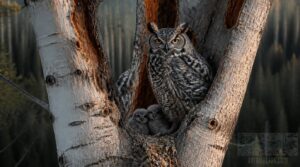
When old raptor nests aren’t available, great horned owls turn to the trees themselves. They favor crotches of deciduous trees — aspens and poplars especially — usually nesting 40 to 70 feet up.
Tree cavities form naturally as decay fungi break down wood over time, hollowing out trunks and limbs. These recesses shelter diverse invertebrates year-round, making them rich microhabitats that owls readily exploit for nesting.
Cliff Ledges and Caves

Not every great horned owl nest sits in a tree. When cliffs are nearby, owls readily claim narrow ledge shelves and rocky cavities carved by centuries of erosion. These niches — often 0.3 to 2.5 meters wide — offer surprising stability and natural shelter from rain and wind.
Cave interiors buffer temperature extremes, staying cooler in summer and slightly warmer in winter, which makes them reliable year-round refuges.
Bridges and Old Buildings

Bridges and old buildings turn out to be surprisingly practical substitutes for cliff ledges. The masonry nooks and girder shelves of aging structures mimic rocky outcrops closely enough that owls don’t hesitate.
Abandoned buildings offer sheltered corners, while bridge ledges provide elevation and stability. These man-made refuges give owls reliable urban nesting sites without requiring a single stick of nest building.
Urban Nesting Adaptations

Great horned owls have adapted remarkably well to urban nesting.
- City heat islands trigger earlier nesting than rural areas
- Bridges and buildings substitute for natural cliff ledges
- Urban predators like corvids shape nest height choices
- Structural complexity shelters nests within city habitats
- Territories merge natural and artificial sites seamlessly
Their habitat adaptability keeps them thriving across urban and suburban development.
Great Horned Owl Nest Structure and Materials

Great horned owls aren’t much for home improvement — they work with what’s already there. The structure and materials of their nests say a lot about how practical these birds really are. Here’s what their nesting setup usually looks like.
Repurposed Stick Platforms
Taking over someone else’s real estate without asking — that’s pretty much what great horned owls do. Rather than building from scratch, they claim large platform nests left behind by red-tailed hawks, herons, or ospreys.
These stick platform nests, usually two to four feet across, give owls a ready-made foundation of interwoven sticks, often reinforced with moss, bark, and natural fibers for grip and stability.
Shallow Messy Nest Bowls
Once inside a claimed stick platform, the owl works the center into a shallow, uneven bowl. The nesting architecture stays rough — no precise shaping, no deliberate crafting.
What matters is that the depression holds eggs without letting them shift. These nesting sites favor function over form, and the great horned owl’s nesting habits reflect exactly that.
Feathers Fur and Plants
The shallow bowl doesn’t stay bare for long. Owls soften it using three common lining types:
- Feathers — shed from prey or the female herself, providing thermal insulation layers
- Fur — stripped from hunted mammals, its dense underhair trapping warm air close to the eggs
- Soft plant material — dry grasses or bark that add camouflage textures blending with the nest’s rough sticks and twigs
Reused Nest Sites
Once the lining is in place, the nest itself may stick around for years. Great horned owls often return to the same great horned owl nest for three to four consecutive seasons — sometimes a decade — saving the energy that new construction would cost.
The tradeoff? Parasite buildup risks increase over time, and well-known sites can draw more predator attention.
Minimal Nest Building
Great horned owls are, at heart, minimalist builders. Rather than weaving an elaborate structure, they settle for a shallow bowl — often less than 6 inches deep — made from whatever materials the site already offers.
This approach keeps energy costs low during harsh winter months. Function wins every time over form, and the nest doesn’t need to be pretty to work.
Great Horned Owl Eggs and Incubation
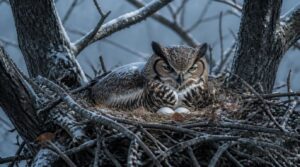
Once the nest is claimed, the real work begins — and eggs are the most important part. Great horned owls have some surprisingly specific habits around laying, incubation, and keeping those eggs alive through brutal winter cold. Here’s what’s actually happening inside that nest from the first egg onward.
Typical Clutch Size
Most great horned owl pairs lay 2 to 3 eggs per clutch — rarely more. Clutch size isn’t fixed; it shifts with prey availability, parent condition, and habitat quality. When food is scarce heading into breeding season, expect smaller clutches.
Four-egg clutches do occur, but they’re the exception. The owl’s strategy favors raising fewer chicks well over gambling on a larger brood.
Egg Appearance and Size
Each egg is pale white, oval-shaped, and compact — measuring roughly 58–70mm long and 40–50mm wide. You won’t find markings or color patterns on the shell.
- Egg mass: 60–80 grams per egg
- Shell texture: smooth to lightly glossy
- Shell thickness: 0.2–0.4mm — thin but mineralized
- Color: uniformly off-white, no markings
That mineralized shell helps protect developing chicks through cold, exposed nesting conditions.
Female Incubation Duties
Once the first egg arrives, the female takes over almost completely. She develops a bare brood patch on her abdomen that transfers heat directly to the eggs, keeping them within a narrow temperature range for roughly 30 to 37 days.
She can’t forage much during this stretch, so the male hunts for her — her body condition depends on how reliably he delivers prey.
Male Food Delivery
Every night during incubation, the male hunts alone, filling a role that directly shapes the female’s condition across 30 to 37 days of sitting still.
- Hunts at dusk
- Navigates varied terrain
- Carries prey back to the nest
- Delivers food directly to the female
- Repeats until dawn
Parental care like this is quiet, unglamorous work — but it’s essential.
Cold Weather Survival
Sitting through a winter night in sub-zero air isn’t a minor challenge — it’s a biological feat. Females can maintain incubation below -35°F, while the eggs themselves can survive brief exposure to -25°F for up to 20 minutes.
Female great horned owls endure sub-zero winters below -35°F, their bodies a living shelter for eggs that survive on borrowed warmth
Think of her body as a living shelter, layered warmth held steady against the cold until every egg hatches.
Raising Owlets From Hatching to Independence

Once the eggs hatch, the real work begins for both parents and owlets alike. The journey from blind, downy hatchling to independent hunter covers several distinct stages, each with its own milestones. Here’s what that process looks like, step by step.
Newly Hatched Owlets
When great horned owlets crack free of the shell, they arrive blind and barely covered, wrapped in sparse white down that offers little warmth.
Their eyes open gradually around days 7 to 10, revealing dark irises that look oversized for such a small head. Beaks start pale and soft. Even their claws lack the sharp curve you’d expect from a predator’s offspring.
Early Brooding Care
Those first days after hatching are fragile ones. The owlets can’t regulate their own body temperature yet, so the female stays pressed close, using hatchling heat conservation through direct body contact that covers most of the chick’s surface area.
Cold nights trigger longer brooding sessions. Nest microclimate management keeps temperatures well above the surrounding air — small wing shifts make a real difference.
Feeding Growing Chicks
Once the female’s brooding sessions shorten, both parents shift their energy almost entirely toward feeding. The male hunts through the night, delivering prey — often skunks — while the female tears pieces small enough for the chicks to swallow.
Protein intake drives rapid growth, with owlets reaching 800 to 1,000 grams within just 25 days of hatching.
Branching and Fledging
Around 5 to 7 weeks old, owlets leave the nest bowl for nearby branches — not yet flying, just practicing. They grip through wind gusts, hop between limbs, and test their wings repeatedly.
This branching stage builds the flight muscles needed for real flight at 9 to 10 weeks. Fledglings then roam within about a kilometer of the nest, still dependent on their parents.
Territory Defense and Safety
Both parents become noticeably bolder once owlets start branching. They use deep, far-carrying hoots to warn rival owls away, and mated pairs often duet at dawn and dusk to strengthen their claim. If a threat gets too close, expect a swift, silent swoop.
Near urban nests, human disturbance is a real concern — staying 50 feet back keeps everyone safer.
Frequently Asked Questions (FAQs)
How to get a Great Horned Owl to nest in your yard?
Getting a great horned owl to nest in your yard takes patience and the right setup. Offer a 22-by-22-inch nest platform 15–45 feet high, reduce disturbance, and support healthy rodent prey populations.
What time of year do Great Horned Owls nest?
While most birds hold off until spring, Great Horned Owls start courting in December and usually lay eggs between February and March — making them one of the earliest nesting birds across all of North America.
Where does a Great Horned Owl nest?
These owls don’t build — they take. Abandoned raptor nests in tall deciduous trees are the top choice, but cliff ledges, tree cavities, and even urban bridges work just as well when natural sites run short.
Where do Great Horned Owls prefer to nest?
These powerful raptors favor elevated, concealed sites — stolen hawk platforms in deciduous tree crotches 40 to 70 feet up, rocky cliff ledges, and even city bridges or buildings, wherever height and hunting access align.
Do owls nest in the same place every night?
Not exactly. During nesting season, they return reliably to the same cavity or platform to incubate eggs. Nightly, though, adults shift between roost sites and hunting perches as they patrol their territory.
When do great horned owls lay eggs?
Egg laying peaks in February across most of North America. Southern pairs start as early as December, while northern populations wait until March or April — their timing tracks local prey cycles and climate rather than the calendar.
How long is the fledgling period?
Like ancient apprentices learning a trade, young owlets take 6 to 10 weeks to develop true flight. Post-fledging dependence extends another 2 to 3 months, with parents gradually reducing food as hunting skills improve.
What materials line the nest?
Bark fibers, feathers, animal fur, and soft plant material line the nest bowl, cushioning eggs and trapping warmth. Moss and lichens help regulate moisture, while local materials like dry grass fill gaps for thermal insulation.
How many eggs are typically in a clutch?
Most clutches hold two to three eggs, though a lone egg or a rare four can appear when prey is abundant. The female’s condition and local food supply quietly shape that number.
What is the incubation period for eggs?
The female begins incubating her eggs right after the first one is laid, which means chicks hatch at different times. The full egg development period runs 30 to 37 days, with the male hunting each night to keep her fed throughout.
Conclusion
A female great horned owl once incubated her eggs through a three-day blizzard — temperatures never climbing above -20°F — and every owlet survived. That’s not luck.
Great horned owl nesting succeeds because of precision: the right site chosen months early, the right division of labor between mates, the right instinct at every stage. You now understand what that process actually looks like. Watch a nest this winter, and you’ll see that precision firsthand.
- https://georgiawildlife.com/out-my-backdoor-great-horned-owls-may-be-nesting-your-yard
- https://www.almanac.com/nesting-season-owls
- https://becausetees.com/blogs/articles/where-do-owls-nest
- https://www.allaboutbirds.org/guide/Great_Horned_Owl/lifehistory
- http://wildlife.foothillsclusters.com/seasonal-great-horned-owls