This site is supported by our readers. We may earn a commission, at no cost to you, if you purchase through links.
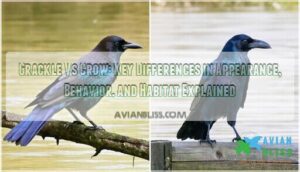 When you’re sizing up a grackle vs crow, you’ll notice the grackle’s smaller frame, long tail, and shimmering blue-purple feathers.
Crows are heftier, with matte black plumage, fan-shaped tails, and thick, curved beaks.
Grackles flash pale eyes and stick to big flocks, while crows keep tight family bonds and show off clever tool use.
You’ll find grackles near water and southern parks, crows almost everywhere from city streets to forests.
Both make a mess at feeders and play key roles in pest control, but their personalities and habitats set them apart, with real secrets behind their survival.
Table Of Contents
- Key Takeaways
- Grackle Vs Crow: Key Identification Differences
- Behavior and Intelligence Compared
- Habitat, Range, and Adaptation
- Ecological Roles and Interactions
- Conservation, Culture, and Significance
- Frequently Asked Questions (FAQs)
- Is a grackle the same as a crow?
- Are grackles good birds to have around?
- Are grackles smart birds?
- What is a flock of grackles called?
- Are grackles and crows the same species?
- Do grackles and crows have the same predators?
- Do grackles and crows migrate?
- What is the lifespan of a grackle vs. a crow?
- Are grackles and crows considered pests?
- Can grackles and crows interbreed naturally?
- Conclusion
Key Takeaways
- You’ll spot grackles by their smaller size, shimmering blue-purple feathers, and pale eyes, while crows are larger, matte black, and have thick curved beaks.
- Crows form tight family groups and use clever tools, while grackles gather in massive, noisy flocks and stick near water.
- Grackles migrate with changing seasons, but most crows stay put year-round, adapting to almost any environment.
- Both birds play major roles in pest control and urban ecosystems, but their habits, intelligence, and appearance set them apart.
Grackle Vs Crow: Key Identification Differences
You can tell grackles and crows apart by paying attention to their size, feather color, and beak shape.
Spot the difference by watching their size, color shimmer, and the shape of their beaks
These birds may look similar at first, but key physical features make identification much easier.
Size and Weight Comparison

When you compare Grackle size range to Crow weight averages, the differences stand out.
Grackles measure 11–13 inches long and weigh about 4 ounces, while crows are larger at 16–21 inches and 16–21 ounces.
Sexual dimorphism is slight in both.
Here’s a quick bird species comparison for relative proportions and measurement variations:
| Bird Species | Length (in) | Weight (oz) | Relative Size | Size Shape |
|---|---|---|---|---|
| Common Grackle | 11–13 | 2.6–5 | Robin-sized | Lanky, long tail |
| American Crow | 16–21 | 16–21 | Larger, stout | Fan tail, robust |
The table provides a clear comparison of the two bird species, highlighting their relative proportions and size shape differences.
This comparison is useful for understanding the distinct characteristics of Grackles and Crows, including their length and weight.
Plumage Color and Iridescence
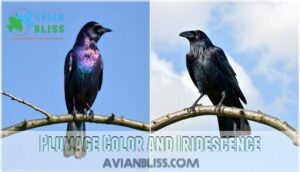
After looking at size, let’s talk color. Grackles stand out with Iridescent Grackle Plumage—shimmering purple or blue, especially in breeding plumage.
Crows, on the other hand, show even matte black Crow Feather Pigments. These differences come from Plumage Color Genetics, helping with Coloration and Camouflage.
Seasonal Color Changes also affect each bird’s Color Pattern.
| Feature | Grackle | Crow |
|---|---|---|
| Color | Iridescent blue/purple | Matte black |
| Genetics | Strong iridescence genes | Matte pigment genes |
| Seasonal Change | Yes | Minimal |
| Camouflage | Moderate | High |
| Breeding Plumage | Glossy | No change |
Beak and Eye Features

Every birdwatcher knows the beak and eye features set Grackles and Crows apart.
Grackle beak shape is thin and straight, while Crow beak strength comes from its thick, curved design.
Eye color variations add to Grackle characteristics, with pale eyes in Common Grackle and GreatTailed Grackle.
Crow binocular vision and Grackle eye placement also differ.
| Feature | Grackles | Crows |
|---|---|---|
| Beak Shape | Thin, straight | Thick, curved |
| Eye Color | Pale yellow, white | Dark brown, black |
| Eye Placement | Side, wider field | Front, binocular |
| Notable Species | Common, GreatTailed, BoatTailed | American Crow |
The differences between Grackles and Crows are notable, with distinct characteristics such as beak shape and eye color.
The table summarizes the main differences between Grackles and Crows, highlighting their unique eye placement and notable species.
Wing and Tail Shape

You’ll notice distinct differences in flight identification when observing wing and tail features.
Grackles display wings that appear short relative to their long tails, creating a distinctive silhouette during flight mechanics.
Their tails form a characteristic keel shape that sets them apart from other birds.
| Feature | Common Grackle | Crow |
|---|---|---|
| Wing Length | Short-appearing relative to tail | Proportionate to body |
| Tail Shape | Long, keel-shaped | Fan-shaped, shorter |
This shape variation affects their flight patterns substantially.
Grackle characteristics include that lanky appearance with extended tail feathers, while crows maintain more balanced proportions.
These bird size and shape differences make field identification easier when you understand the wing-to-tail ratio each species displays.
Behavior and Intelligence Compared
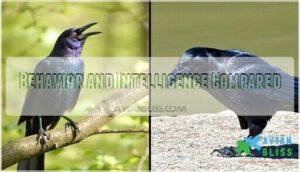
You’ll notice clear differences when comparing how grackles and crows behave in their daily activities and social interactions.
Watch grackles and crows for a few minutes and their unique personalities quickly stand out
These two black birds show distinct patterns in their intelligence, communication methods, and group dynamics that help you tell them apart in the field, which is related to their communication methods.
Social Structure and Flocking
Crows form tight-knit family groups with complex flock hierarchy, while grackles gather in massive flocks during roosting habits.
Grackles from the blackbird family display more basic social learning compared to crows’ advanced cooperative defense strategies.
During breeding season, common grackle colonies show organized group foraging behavior, and blackbirds like grackles demonstrate simpler bird behavior patterns than highly intelligent crow communities.
These crow communities maintain year-round social bonds and are known for their complex behaviors.
Foraging and Feeding Habits
You’ll notice distinct foraging techniques between these species that reveal their adaptability.
Grackles wade through shallow water hunting fish and amphibians, while crows demonstrate impressive tool use to crack nuts and extract insects.
Both species show dietary overlap in urban areas, frequently engaging in food stealing from other birds.
Their winter diet shifts dramatically – grackles focus on grains and seeds, while crows increase scavenging behavior around human settlements.
Grackles, with their iridescent feathers, differ substantially in physical appearance compared to crows.
Nesting and Breeding Behavior
Grackles build their nests in colonies, with 10-30 pairs clustering together for breeding success.
You’ll find their bulky cup nests hidden in dense trees near water, crafted from grass and twigs.
Female grackles handle nest building and egg incubation for 12-14 days, while both parents provide parental care once young hatch, feeding nestlings insects for 16-20 days until fledging.
Urban grackles may even incorporate human-made materials into their nests.
Vocalizations and Communication
The sounds these Blackbirds make tell completely different stories about their lives and social structures.
While both species use vocalizations for territory defense and mate attraction, their communication styles reveal distinct Bird Behavior patterns that help with Bird Identification.
- Grackle sounds: High-pitched, metallic squeaks and harsh calls that lack the complex variation found in Crow dialects
- Crow vocalizations: Rich repertoire of caws, clicks, and rattles with regional dialects and Seasonal variations in tone
- Mimicry abilities: Crows can imitate other bird species and human voices, while Common Grackle vocalizations remain fairly consistent
- Call meanings: Crow calls convey specific messages about food sources and threats, whereas Grackles focus mainly on basic territorial communication
Problem-Solving Abilities
When comparing Cognitive Skills between these Bird Species, New Caledonian crows outperform Common Grackle populations in complex problem-solving.
Crows demonstrate superior Tool Use and Innovation, creating multi-part tools and planning sequential actions. The crows’ ability to perform compound tool creation highlights their advanced problem-solving abilities.
Grackles excel in Learning Behavior and Memory Capacity for simpler tasks but lack advanced planning abilities seen in corvids versus New World blackbird species.
| Cognitive Ability | Crows | Grackles |
|---|---|---|
| Tool Creation | Advanced multi-part assembly | Limited innovation |
| Planning Skills | Multi-step foresight | Trial-and-error approach |
| Task Success Rate | 37-66% complex problems | 87-100% simple tasks |
| Learning Speed | 10-50 trials average | 12-17 trials average |
| Behavioral Flexibility | Context-dependent adaptation | Rapid preference switching |
Habitat, Range, and Adaptation
You’ll find these birds in completely different regions across North America, with grackles preferring the eastern and southern states.
While crows spread throughout nearly the entire continent, both species have mastered urban living.
Grackles stick closer to wetlands and water sources, whereas crows thrive in diverse environments from forests to city centers.
Geographic Distribution in North America

You’ll find North American birds like grackles and crows occupy vastly different territories across the continent.
Understanding their geographic distribution helps with accurate bird identification in your local area.
Regional Variations in North America:
- Great-tailed Grackle species span from coastal Mexico through Texas, reaching Colorado and Iowa
- American crows inhabit nearly all continental United States and southern Canada
- Range Expansion shows grackles increased their territory 5,500% northward since 1880
- Climate Influence limits crow distribution, while Urban Sprawl accelerates grackle colonization
Habitat Overlap occurs primarily in the southwestern United States, where both species adapt to human-modified landscapes.
Preferred Habitats

Both grackles and crows show distinct habitat preferences across urban vs. rural environments.
Grackles favor wetland edges, open woodlands, and suburban parks where they find ideal nesting locations in dense trees near water.
Great-tailed Grackle species particularly seek man-made structures for roosting.
Meanwhile, crows adapt to diverse bird habitats from forests to farmlands, demonstrating greater flexibility than most grackle species in habitat selection.
Some people even attract them using specialized bird baths, which can be an effective way to observe these birds in their preferred urban environments.
Urban Adaptation

Both grackles and crows excel at urban living, but they adapt differently. You’ll spot grackles thriving in city environments through their flexible nesting habits and opportunistic feeding.
Their survival rates improve thanks to abundant human interaction and diverse food sources. Native plants provide natural food and shelter.
City nesting strategies include:
- Building sites – Grackles nest in parking lot trees and building eaves
- Food access – They exploit garbage, pet food, and restaurant scraps
- Noise tolerance – These Grackle Birds handle noise pollution better than forest species.
Common Grackle Identification becomes easier in cities where their bird behavior shows remarkable adaptation to urban bird habitats.
Migration Patterns
Unlike urban-dwelling crows that typically stick around year-round, grackles follow distinct migration triggers tied to temperature and food availability.
These blackbirds use major flyway routes across North America, gathering in massive winter roosts that can hold thousands of birds.
Climate impacts are shifting traditional grackle migration timing, with some populations staying north longer as winters become milder.
Ecological Roles and Interactions

You’ll find that both grackles and crows play important roles in their ecosystems, but they affect the environment in different ways.
Understanding how these birds interact with other species and impact their surroundings helps explain why they’re such successful and widespread species.
Impact on Local Ecosystems
If you’ve watched blackbirds in North America, you’ve seen how Grackles and crows shape ecosystems.
Their Species Predation affects local bird populations, while their Grackle Diet and Waste Management help control insects and clean up carrion.
These Grackle Birds Information points show their role in Habitat Modification and Insect Control, making them key players in ecosystem balance.
Pest Control and Seed Dispersal
Every season, you’ll spot crows and grackles working as nature’s cleanup crew.
Their diets help with insect control, keeping Crop Damage down. Grackles often raid feeders for seeds, including black oil sunflower seeds, while crows scatter and bury seeds—helping with seed predation and ecosystem balance.
Both birds impact agricultural areas, shaping how fields and gardens thrive. For those seeking solutions, pest control options are available.
Interactions With Other Birds
When you look at bird feeding behavior, you’ll notice food stealing and nest predation are common, especially among types of Grackles.
Mixed flocks show interspecies aggression and sometimes cooperative foraging.
Grackles often raid nests, while crows join in, too, creating a lively, competitive atmosphere wherever they’re found, and both species’ nesting habits impact other birds.
Human-Bird Conflicts
After seeing how grackles and crows interact with other birds, you’ll notice their presence can spark human-bird conflicts. Both can cause crop damage, mess up feeders, and even pose public health risks.
Understanding their behavior is key, as nesting season aggression can lead to unwanted encounters. If you’re dealing with these birds, consider the importance of coexistence strategies.
To address the issues caused by grackles, you may want to explore:
- Bird deterrents for property damage
- Coexistence strategies in urban spaces
- Knowing types of grackles like Greattailed and Boattailed Grackle, which can help in developing effective deterrents for your specific situation.
Conservation, Culture, and Significance

When you compare grackles and crows, you’ll notice each species has a unique role in conservation, culture, and daily life.
Understanding their population trends, cultural symbolism, and impact on agriculture helps you appreciate their significance in ecosystems and society.
Population Trends and Status
While grackles shape ecosystems, their numbers are shrinking.
Grackle decline is sharp—over 50% since the 1960s—while Crow stability is the norm.
IUCN status for Common Grackle is Near Threatened, with agricultural impact and regional variations driving loss.
Crow populations thrive, especially in cities.
Grackle Migration, Greattailed Grackle, and Boattailed Grackle trends highlight North American Birds’ changing fortunes.
| Species | Population Trend | IUCN Status |
|---|---|---|
| Common Grackle | Declining | Near Threatened |
| American Crow | Stable/Rising | Least Concern |
Conservation Efforts
Just as population decline raises concern among North American birds, conservation efforts step up.
Habitat preservation is a major focus, helping protect grackles’ nesting spots and food sources like seeds.
Farmers adopt mitigation strategies to reduce agricultural impact.
Public awareness helps folks understand the grackles’ diet and needs, supporting birds through community projects while balancing wildlife protection and human interests.
Folklore and Symbolism
From Crow mythology to Grackle symbolism, you’ll find these birds steeped in bird superstitions and omen association.
Their color pattern variation and breeding plumage spark cultural depictions across North America.
The BoatTailed Grackle’s iridescence stands out as much as the crow’s intelligence.
- Grackle symbolism
- Crow mythology
- Omen association
- Cultural depictions
- Bird superstitions
Importance in Agriculture and Society
When you think about Agriculture in North America, both grackles and crows leave their mark.
Their bird diet covers pests, helping with disease control and ecosystem services.
Public perception’s mixed: grackles, through their nesting, sometimes damage crops.
Meanwhile, crows boost bird breeding by dispersing seeds.
Habitat loss substantially impacts these bird populations.
These roles shape the economic effects farmers experience each year.
| Factor | Grackles |
|---|---|
| Agricultural impact | Crop raiding, pest control |
| Economic effects | Local crop loss, seed dispersal |
| Public perception | Mixed, sometimes negative |
| Ecosystem services | Supports pest control, bird breeding |
Frequently Asked Questions (FAQs)
Is a grackle the same as a crow?
Imagine you spot a glossy bird soaking bread in water while a matte black one scavenges nearby.
You’re seeing two species: grackles and crows.
They differ in size, plumage, calls, and behavior—so they’re not the same.
Are grackles good birds to have around?
You’ll notice grackles gobbling up insects, seeds, and even pesky pests, helping balance your yard’s ecosystem.
But they can get rowdy, raid feeders, and sometimes bother smaller birds, so it’s a mixed bag.
Are grackles smart birds?
Brains over brawn—grackles surprise you with clever tricks.
You’ll see them soaking bread in water, stealing food, and even hunting.
They adapt fast, solve problems, and thrive in changing environments, showing remarkable intelligence for their size.
What is a flock of grackles called?
You’ll hear birders call a flock of grackles a “plague.”
It’s a fitting term, since these birds gather in huge, noisy groups, sometimes thousands strong, sweeping across fields or roosting together in trees and urban spaces, which can be considered a plague.
Are grackles and crows the same species?
If you’re hoping grackles and crows are just birds in disguise, you’ll be disappointed.
They’re not the same species.
Grackles flaunt glossy feathers and keel-shaped tails, while crows sport matte black plumage and fan-shaped tails.
Do grackles and crows have the same predators?
You’ll find grackles and crows share many predators, including hawks, owls, and raccoons.
Snakes and cats also target their eggs and young.
Both rely on flocking and vigilance to dodge danger and protect their nests.
Do grackles and crows migrate?
You’ll notice grackles migrate in large flocks, heading south for winter, while most crows stick around all year.
Some northern crows do migrate short distances, but grackles show more dramatic seasonal movements than crows.
What is the lifespan of a grackle vs. a crow?
Think of bird lifespans like chapters in a book—grackles usually live 6-8 years in the wild.
While crows can turn the page for 7-8 years, sometimes reaching 15-20 years with luck and smarts.
Are grackles and crows considered pests?
You might call grackles and crows pests if they raid crops, flock around garbage, or crowd bird feeders.
Their bold behavior and appetite for seeds, grains, and scraps often put them at odds with farmers and homeowners.
Can grackles and crows interbreed naturally?
Grackles and crows can’t interbreed naturally, since they’re different species with distinct genetics and behaviors.
Even though they sometimes flock together or share habitats, their DNA is too different for any mixing to happen, which highlights their inability to interbreed due to being different species with distinct genetics.
Conclusion
Like two puzzle pieces in nature’s bird mosaic, grackle vs crow show you how details matter.
You’ll spot grackles by their shimmering feathers and big flocks near water, while crows stand out with their clever tool use and matte plumage almost everywhere.
Knowing these differences helps you identify each species, understand their roles in pest control, and appreciate their unique survival strategies.
Next time you see a black bird, you’ll know if it’s a grackle or a crow.