This site is supported by our readers. We may earn a commission, at no cost to you, if you purchase through links.
Walk through any Texas parking lot at dusk and you’ll probably see a crowd of glossy black birds staring you down like they own the place — because, honestly, they kind of do. The Great-tailed Grackle alone has turned strip malls and suburban lawns into its personal kingdom, while somewhere out in the marsh, a Red-winged Blackbird is defending a cattail patch with the intensity of a seasoned bouncer.
Texas hosts more blackbird species than most people realize, and telling them apart takes more than just noticing they’re black. Size, eye color, tail shape, habitat — the details matter. This guide walks you through every species you’re likely to encounter, where to find them, and exactly what to look for.
Table Of Contents
- Key Takeaways
- Common Black Birds in Texas
- Less Common Texas Blackbirds
- How to Identify Them
- Where to Find Them
- Behavior, Calls, and Seasons
- Frequently Asked Questions (FAQs)
- Are there Blackbirds in Texas?
- What birds are black in Texas?
- What does a blackbird look like in Texas?
- Are red-winged blackbirds common in Texas?
- Is there a more beautiful black bird in Texas?
- Why doesn’t Texas have any endemic birds?
- Are grackles good or bad birds?
- What’s the difference between a crow and a grackle?
- Are blackbirds good to be in your yard?
- How do you identify a blackbird in Texas?
- Conclusion
Key Takeaways
- Texas is home to over ten blackbird species, and telling them apart comes down to a handful of field markers — size, eye color, tail shape, and shoulder patches.
- The Great-tailed Grackle and Common Grackle dominate urban spaces, while Red-winged Blackbirds and Yellow-headed Blackbirds stick to marshes and wetlands where cattails and bulrushes give them cover.
- Those glossy "black" feathers aren’t truly black — nanostructured barbs bend light into iridescent purples, blues, and greens, so the color you see shifts depending on the angle.
- Brown-headed and Bronzed Cowbirds skip parenting entirely by laying their eggs in other birds’ nests, a survival strategy called brood parasitism that makes them unlike any other blackbird in the state.
Common Black Birds in Texas
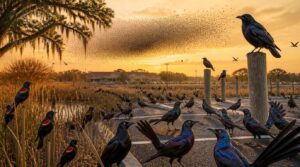
Texas is home to a handful of black birds you’ll run into almost anywhere you go — parking lots, marshes, backyards, you name it. A few species show up so regularly that once you know them, you’ll start spotting them without even trying. Here are the ones you’re most likely to see.
Coastal marshes and wetlands are especially rewarding, and a solid rundown of herons found across Texas can help you tell them apart when you’re out in the field.
Red-winged Blackbird
The Red-winged Blackbird is probably the bird you’ve walked past a hundred times without knowing its name.
Males are easy to spot — glossy black body, about 17–23 cm long, with those unmistakable bright red-and-yellow epaulets flashing from their shoulders.
Think of the epaulets as tiny stop signs: "this territory is taken." Recent studies note a significant population decline of over 35% since the 1960s.
Great-tailed Grackle
If the Red-winged Blackbird is subtle, the Great-tailed Grackle (Quiscalus mexicanus) is anything but.
Males stretch 15–18 inches long, with a dramatic keeled tail and glossy black plumage that shifts blue-purple in sunlight. Bright yellow eyes stare back like headlights.
You’ll find them everywhere in Texas — parking lots, parks, wetlands — loud, bold, and completely unbothered.
Common Grackle
Think the Great-tailed Grackle is flashy? The Common Grackle (Quiscalus quiscula) runs a close second.
At 11–13 inches, it’s smaller, but that blue-green iridescent sheen on its head and body stops you mid-step.
Juveniles look dull and brownish — easy to overlook.
You’ll spot adults scavenging parking lots, lawns, and dumpsters with zero shame.
Brown-headed Cowbird
If the Common Grackle owns the parking lot, the Brown-headed Cowbird (Molothrus ater) quietly rules by a different strategy — brood parasitism.
Males are glossy black with a rich brown head, females duller overall. At 6–8 inches, they’re compact.
Their real trick? Laying eggs in other birds’ nests, letting warblers and sparrows do all the parenting work.
European Starling
Meet the bird that crashed the party — and never left. The European Starling (Sturnus vulgaris) arrived in New York in 1890 and spread across the entire continent within decades. At 7–9 inches with glossy black, iridescent plumage, it can look purple or green in sunlight. Winter brings white speckles across its chest.
Bonus skill: it mimics other birds almost perfectly.
Less Common Texas Blackbirds
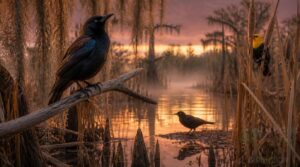
Not every blackbird in Texas shows up at your feeder every day — some take a little more effort to find. These species aren’t rare exactly, but you won’t spot them without knowing where and when to look. Here are the less common blackbirds worth keeping on your radar.
Yellow-headed Blackbird
If you’ve ever spotted a blackbird that looks like it dunked its head in golden paint, you’ve found the Yellow-headed Blackbird (Xanthocephalus xanthocephalus).
Males wear a vivid yellow head and chest on a black body, with white wing patches that flash in flight.
Females are subtler — brownish-gray with a pale yellow throat.
Brewer’s Blackbird
Brewer’s Blackbird (Euphagus cyanocephalus) is easy to overlook — until the sunlight hits just right. That’s when the male’s purple-blue iridescence lights up his head and neck like a tiny oil slick.
About nine inches long, he walks fields and parking lots with quick, confident head‑jerks, picking off grasshoppers and beetles wherever he goes.
Boat-tailed Grackle
The Boat-tailed Grackle (Quiscalus mexicanus) is built for the Texas coast. That long, keel-shaped tail — sometimes exceeding body length — gives males an unmistakable silhouette against marsh skies. In bright sun, their black feathers shift from purple to green.
You’ll find them nesting colonially in Gulf Coast bulrushes, foraging with that long, curved bill through tidal flats and saltwater edges.
Rusty Blackbird
The Rusty Blackbird (Euphagus carolinus) is genuinely easy to overlook — until fall, when those rusty-brown feather edges appear across its wings and back, giving the bird its name. It’s about 8–10 inches long with pale yellow eyes that pop against dark plumage.
Unlike its grackle cousins, this bird needs forested wetlands to thrive.
Bronzed Cowbird
Meet the Bronzed Cowbird (Molothrus aeneus) — a glossy black bird with a secret weapon: red eyes that practically glow against its dark feathers. Here’s what makes it stand out:
- Bronze iridescence on the head and neck
- A stout, slightly curved bill
- Brood parasitism — it never raises its own chicks
- Common in southern Texas open woodlands
- Larger than a Brown-headed Cowbird
How to Identify Them
Once you know what to look for, telling these birds apart gets a lot easier. The trick is breaking it down into a few key features — size, color, eyes, tail, and markings. Here’s what to pay attention to when you’re out in the field.
Size and Body Shape
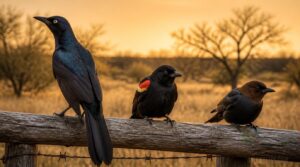
Size alone can save you a lot of squinting. Great-tailed Grackles stretch 23–28 cm with wingspans near 50 cm — noticeably longer and leaner than a Red‑winged Blackbird, which tops out around 25 cm.
Grackles carry an elongated neck and flat‑backed perching posture.
Cowbirds look chunky by comparison, short‑tailed and thick‑bodied — like a small bird that skipped leg day.
Plumage and Iridescence
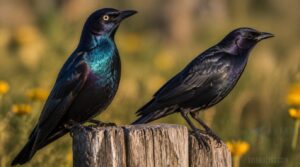
Here’s where "black" gets complicated. Those glossy feathers aren’t really black — nanostructured feather barbs bend light like a prism, creating iridescent blues, purples, and greens through interference rather than pigment.
Those glossy black feathers aren’t truly black — nanostructured barbs bend light into iridescent blues, purples, and greens
Angle the bird differently and the color shifts.
Common Grackles flash blue-green to purple, while Brewer’s Blackbirds shimmer with blue-purple highlights — same lighting, totally different bird.
Eye and Bill Color
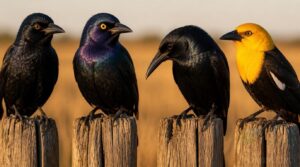
Once you’ve clocked the iridescence, shift your focus to the face. Eye and bill color can seal the deal fast.
- Bright yellow eyes: Brewer’s Blackbird and Common Grackle males
- Dark brown irises: Great-tailed Grackle blends eye into plumage
- Amber-toned irises: Yellow-headed Blackbirds, especially adults
- Bill length and curve: Grackles probe; cowbirds pick
Tail Length Differences
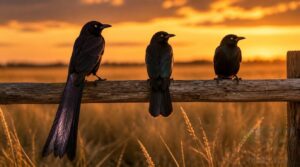
After zeroing in on the eyes, look lower — the tail tells a different story fast. Tail length is one of the easiest field markers you’ve got.
The Great-tailed Grackle’s long, keel-shaped tail is unmistakable at 15–18 inches total. Common Grackles are noticeably shorter. Cowbirds? Stubby by comparison.
Male Versus Female Markings
Once you move past size and shape, male versus female markings become your sharpest tool.
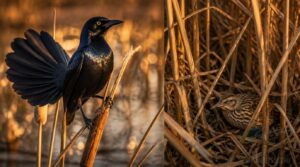
Males wear the flashy stuff — glossy black with iridescent blue-purple highlights, bold epaulets, bright yellow eyes. Females stay deliberately dull: streaked browns, matte tones, cryptic colors built for hiding on a nest.
That contrast isn’t accidental. It’s evolution doing its job.
Where to Find Them
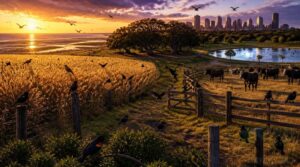
Texas blackbirds aren’t picky — they’ve carved out a home in just about every corner of the state. But each species does have its favorite haunts, and knowing where to look cuts your search time in half. Here are the five spots most likely to put one in your binoculars.
Marshes and Wetlands
If you want to find Red-winged Blackbirds and Yellow-headed Blackbirds, head straight to Texas marshes. These wetlands — packed with cattails, bulrushes, and reeds — are basically blackbird hotels.
The dense vegetation filters water, recharges groundwater, and even sequesters carbon.
Good for the planet, great for birding.
Farms and Pastures
Farms and pastures across Texas draw in some of the blackbird species you’re most likely to see.
Brown-headed Cowbirds love open fields, foraging along fence lines and rotational grazing paddocks where fresh-turned soil exposes seeds and insects.
Red-winged Blackbirds winter here too, trading cattails for grain fields and pastures.
Parks and Neighborhoods
Your neighborhood park might be better birding than you think.
Common Grackles and Great-tailed Grackles are practically locals — strutting across lawns, raiding picnic tables, and perching loudly in shade trees.
Brown-headed Cowbirds show up too, foraging quietly along paved paths and grassy edges.
Coastal Salt Marshes
The Texas Gulf Coast hides some of the best blackbird habitat in the state — and most people drive right past it.
Boat-tailed Grackles rule here. They’re built for this environment:
- Foraging along tidal creeks and mudflats
- Reading salinity gradients where brackish meets salt
- Nesting near dense cordgrass that buffers storm surge
Parking Lots and Lawns
You don’t need binoculars and a trail map to find blackbirds in Texas — sometimes a strip mall will do just fine.
Great-tailed Grackles own the parking lot. Their flexible diet includes insects, seeds, and whatever fell out of someone’s fast-food bag, making asphalt their second home.
Common Grackles and Brown-headed Cowbirds work the grassy edges nearby.
Behavior, Calls, and Seasons
Knowing what a bird looks like is only half the story — how it acts, what it sounds like, and when it shows up tells you just as much. Texas blackbirds have some genuinely interesting quirks once you start paying attention. Here’s what to watch and listen for across the seasons.
Songs and Alarm Calls
Once you slow down and really listen, the blackbirds around are basically having full conversations.
The Red-winged Blackbird’s "conk-la-ree" is unmistakable — a rich, metallic phrase that announces territory loud and clear.
Alarm calls flip the script entirely: short, sharp bursts fired fast to warn the flock.
In noisy Texas cities, some species actually crank up the volume to cut through traffic.
Flocking and Feeding Habits
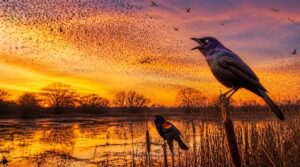
Once you’ve tuned your ear to their calls, the next thing worth watching is how blackbirds move together. Safety in numbers is real — a predator targeting a flock of thousands has terrible odds of picking out one bird.
Alarm calls trigger instant, coordinated flushes, turning the whole group into one fast-moving escape.
Feeding together works the same way: one bird finds a grain spill, and suddenly everyone knows.
Breeding Season Behavior
When the days get longer in spring, something clicks in male blackbirds almost overnight. Photoperiod — day length — is the real trigger, not temperature. Testosterone surges, and suddenly every male Red-winged Blackbird is belting "conk-la-ree" from the cattails, epaulets blazing, ready to fight any rival who gets close.
Territory defense gets physical fast. Wing flicks, feather puffing, tail fanning — it’s a full-body argument.
Winter Range Changes
Once spring’s territorial chaos settles, the birds shift gears entirely. As temperatures rise, winter range shifts push many species south or toward urban edges.
Urban heat islands — city blocks that stay warmer than surrounding land — let grackles and cowbirds linger where they’d otherwise leave.
Red-winged Blackbirds flock to agricultural fields, trading cattails for leftover grain.
Nesting and Brood Parasitism
Nesting season is where things get sneaky.
Brown-headed Cowbirds skip building a nest entirely — they drop their eggs into other birds’ nests and disappear. Egg mimicry tactics help the eggs fit in, so many hosts never notice. Cowbird chicks often hatch first, grabbing more food.
Some hosts abandon ship, but that’s a gamble too.
Frequently Asked Questions (FAQs)
Are there Blackbirds in Texas?
Think Texas has just a few blackbirds? Think again. The state hosts over ten species year-round, from coastal marshes to city parking lots — some residents, some seasonal visitors passing through.
What birds are black in Texas?
Texas hosts ten-plus black bird species, from the glossy Great-tailed Grackle to the streaky-winged Red-winged Blackbird — each with distinct sizes, eye colors, and habitats scattered across the state.
What does a blackbird look like in Texas?
Glossy black feathers are the starting point, but Texas blackbirds range from 7 to 18 inches, with yellow eyes, streaked browns, and shifting iridescent sheens of purple, blue, and green.
Are red-winged blackbirds common in Texas?
Yes, red-winged blackbirds are very common in Texas — especially near wetlands and coastal marshes year-round. East Texas and the Gulf Coast hold the densest populations, though you’ll spot them statewide with ease.
Is there a more beautiful black bird in Texas?
Hard to beat the Great-tailed Grackle — that long, keel-shaped tail, bright yellow eyes, and oil-slick black feathers shifting between purple and green make it genuinely stunning in the right light.
Why doesn’t Texas have any endemic birds?
Birds don’t read maps. Texas borders four U.S. states and multiple Mexican states, so species simply spill across lines. North American endemism is rare — most birds range too far for any one state to claim them.
Are grackles good or bad birds?
Both, honestly. Grackles help control insects and clean up waste, keeping ecosystems balanced. But their nest predation and reliance on human food scraps can frustrate backyard birders and disrupt smaller species.
What’s the difference between a crow and a grackle?
Two similar-looking birds, one far bigger. Crows are 17–21 inches, grackles just 11– Crows have dark eyes and fan-shaped tails; grackles flash yellow eyes and iridescent plumage.
Are blackbirds good to be in your yard?
Yes — with some caveats. Blackbirds like Red-winged Blackbirds eat crop-damaging insects, making them natural pest controllers. Just know that grackles dominate feeders, so manage your setup if you want variety.
How do you identify a blackbird in Texas?
Look at size, eye color, tail shape, and shoulder markings. Yellow eyes signal grackles; red patches mean Red-winged Blackbirds. Listening helps too — each species has a distinct, unmistakable call.
Conclusion
Funny how the birds most people wave off as "just black birds in Texas" turn out to be some of the most fascinating, complex creatures in the state.
The Great-tailed Grackle running your parking lot? That’s a highly intelligent survivor. The Red-winged Blackbird screaming from a cattail? A territorial maestro with a PhD in intimidation.
Once you start looking closely, you stop seeing a flock and start seeing individuals — each one worth knowing by name.
- https://www.allaboutbirds.org/guide/Common_Grackle/id
- https://www.massaudubon.org/nature-wildlife/birds/crows-vs-ravens-vs-grackles
- https://www.audubon.org/news/how-tell-raven-crow
- https://en.wikipedia.org/wiki/Eugene_Schieffelin
- https://www.bbc.com/future/article/20191211-crows-could-be-the-smartest-animal-other-than-primates