This site is supported by our readers. We may earn a commission, at no cost to you, if you purchase through links.
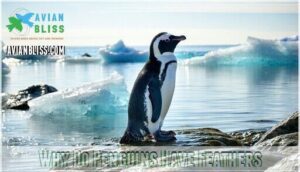 You have feathers because you’re looking at birds that evolved from feathered dinosaurs.
Penguins developed a specialized three-layer feather system that’s nothing like typical flight feathers. Their outer contour feathers create waterproof barriers, middle plumules trap warm air pockets, and inner down feathers provide core insulation.
This setup lets emperor penguins survive -40°F Antarctic conditions while descending 1,800 feet underwater.
The black-and-white pattern isn’t just for looks—it’s camouflage that confuses predators from above and below. These feathers also control buoyancy during prolonged dives and help penguins recognize their mates in crowded colonies.
The engineering behind their feather maintenance reveals survival strategies you’d never expect.
Table Of Contents
- Key Takeaways
- Penguin Feathers Overview
- Why Do Penguins Have Feathers
- Feather Types and Functions
- Feathers and Penguin Survival
- Feather Maintenance and Molting
- Frequently Asked Questions (FAQs)
- Why do penguins need feathers?
- Why do penguins have flippers instead of wings?
- What does it mean when a penguin flaps its wings?
- Why is a penguin a bird and not a fish?
- What are penguin feathers special?
- Why do penguins have flippers and not wings?
- Are penguins born without feathers?
- Why do penguins need to be waterproof?
- Do penguins have different types of feathers?
- How do penguins use their feathers to attract a mate?
- Conclusion
Key Takeaways
- You’ll get three specialized feather layers that work together as a thermal regulation system – contour feathers create waterproof barriers, plumules trap warm air, and down provides core insulation that keeps you alive in -40°F conditions.
- You’re looking at nature’s engineering solution for aquatic survival – these feathers aren’t just leftover flight equipment but specialized adaptations that let penguins dive 1,800 feet deep while maintaining body temperature through dense feather packing (up to 100 feathers per square centimeter).
- You’ll see camouflage that works both ways – the black-and-white counter-shading pattern confuses predators from above and below while swimming, plus unique feather variations help penguins recognize their mates in crowded colonies.
- You’re witnessing advanced maintenance systems – penguins spend hours daily preening and distributing waterproof oils, then undergo complete annual molting where they shed all feathers simultaneously to regenerate their survival gear.
Penguin Feathers Overview
Penguins possess sophisticated feathers that function as their ultimate survival tool in Earth’s harshest environments.
These remarkable plumage systems create multi-layered insulation while providing waterproofing, streamlined swimming efficiency, and thermal regulation capabilities essential for Antarctic survival.
Structure and Function
Penguin feathers pack incredible feather density—up to 100 feathers per square centimeter—creating unmatched thermal insulation.
You’ll find their unique feather structure includes overlapping contour feathers and downy plumules with specialized microstructure analysis revealing branched barbules.
Nature’s ultimate insulation: 100 feathers per square centimeter creating unmatched thermal protection in Antarctica’s harshest conditions.
This bird plumage design offers feather flexibility for temperature control while maintaining an aerodynamic shape that’s perfectly engineered for survival.
The unique feather insulation mechanisms of penguins allow them to thrive in extreme environments.
Adaptation to Environment
Over millions of years, harsh Antarctic conditions shaped penguin feathers into remarkable survival tools.
You’ll find these evolutionary traits perfectly match their ecological niche – thermal insulation beats freezing temperatures while waterproof coatings handle icy waters.
Environmental pressures drove climate adaptation, transforming flight feathers into dense insulation layers.
Their flightlessness isn’t a limitation but specialized animal characteristics for aquatic mastery.
Penguins have developed unique physical traits, including streamlined bodies, that enable them to thrive in their environment, showcasing their ability to achieve aquatic mastery with dense insulation layers.
Importance of Feathers
Understanding feather benefits becomes essential when you’re studying penguin survival strategies.
These remarkable structures serve multiple critical functions that enable penguins to thrive in harsh Antarctic conditions.
- Thermal insulation through dense feather layers that trap warm air against the body
- Feather density reaching 100 feathers per square centimeter for maximum heat retention
- Aerodynamic boost from smooth, overlapping feathers that reduce underwater drag
- Penguin adaptation showcasing millions of years of feather evolution perfecting avian survival
Why Do Penguins Have Feathers
You’ve likely wondered why these aquatic acrobats sport feathers instead of fur or blubber like other Antarctic residents.
The answer lies in millions of years of penguin adaptation that transformed these Flightless Birds into underwater champions.
Feather Evolution equipped penguins with the perfect solution for their dual-lifestyle challenges.
Your typical Penguin Habitat demands survival tools that work both in frigid air and icy water.
Avian Feathers provide unmatched versatility – they’re lightweight yet incredibly effective for Thermal Regulation.
Unlike heavy fur that’d drag underwater, feathers create streamlined efficiency while maintaining warmth.
These unique characteristics are a result of penguins being classified as bird species with distinct adaptations.
| Challenge | Feather Solution | Survival Benefit |
|---|---|---|
| Freezing temperatures | Dense insulation layer | Maintains core body heat |
| Underwater hunting | Waterproof coating | Prevents heat loss while diving |
| Predator detection | Strategic Feather Coloration | Camouflage protection |
These Penguin Characteristics represent nature’s engineering at its finest.
Feather Function extends beyond simple warmth – they’re multi-purpose survival equipment that’s kept these remarkable birds thriving for millennia.
Feather Types and Functions
You’ll discover that penguins possess three distinct feather types, each engineered for specific survival functions in harsh Antarctic conditions.
These specialized feathers work together as an integrated system, providing thermal regulation, waterproofing, and hydrodynamic efficiency that keeps penguins alive in one of Earth’s most challenging environments, with harsh Antarctic conditions.
Contour Feathers

Contour feathers create your penguin’s outer armor against harsh Antarctic conditions.
These short, stiff structures pack densely across the body, forming overlapping layers that boost waterproofing and aerodynamic shape.
Here’s how contour feathers work their magic:
- Feather density reaches 9-13.5 feathers per square centimeter, creating multiple insulation layers
- Feather structure includes 47 barbs with 1,250 barbules each for maximum thermal regulation
- Muscle control lets penguins compress or fluff feathers based on temperature needs
Penguins’ unique feather adaptations enable them to thrive in extreme cold.
Downy Plumules
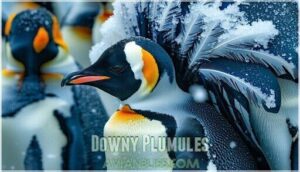
Beneath the sleek contour feathers lies penguin biology’s secret weapon: downy plumules.
These fluffy Plumule Structures pack together like nature’s insulation layers, creating incredible Feather Density.
With four plumules for every contour feather, they form a vital Thermal Barrier.
This Microstructure Analysis reveals how penguin species evolved perfect feather maintenance systems, making their bird anatomy supremely adapted for survival in harsh environments.
The unique structure of feathers is due to their feather microstructure variations that determine their function.
Feather Barbules
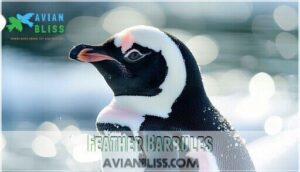
Every barbule contains thousands of microscopic branches that create penguin species’ most efficient thermal insulation system.
These intricate structures work like nature’s finest engineering, trapping air molecules between their branched networks while maintaining waterproof barriers essential for penguin biology.
Here’s how barbule structure enhances penguin survival:
- Microscopic Features – Tiny hooks and branches interlock to create seamless feather surfaces
- Feather Branching – Complex networks multiply insulation capacity by creating air pockets
- Thermal Insulation – Branched barbules trap warm air close to skin, preventing heat loss
- Barbule Function – Interlocking mechanisms maintain feather integrity during diving and swimming
- Feather Maintenance – Self-repairing structures allow penguins to restore damaged barbules through preening
Feathers and Penguin Survival
You’ll discover how penguin feathers serve as nature’s ultimate survival toolkit, protecting these remarkable birds from Antarctica’s harshest conditions.
Their specialized feather system combines thermal insulation, waterproofing, and hydrodynamic efficiency to guarantee survival in one of Earth’s most challenging environments.
Insulation and Waterproofing
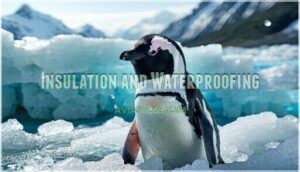
Penguin feathers create nature’s ultimate survival system through remarkable thermal insulation and waterproof coating.
Nature’s engineering marvel: penguin feathers transform Antarctic survival into underwater mastery through dense, waterproof thermal armor.
Dense feather density—up to 100 feathers per square centimeter—traps air layers for exceptional heat retention. This cold adaptation lets penguins maintain 38°C body temperature in freezing penguin habitat conditions.
Their specialized bird physiology includes oil-coated feathers that repel water, keeping these aquatic animals dry and warm underwater. The unique structure of penguins’ feathers provides a natural example of waterproof jacket technology that inspires human innovations in outdoor gear, utilizing remarkable thermal insulation and waterproof coating to create an effective system.
Camouflage and Communication

Beyond insulation, feather patterns serve as nature’s communication system for penguins.
These visual signals help them navigate social interactions and survive in harsh environments.
Here’s how penguin feathers facilitate camouflage and communication:
- Counter-shading patterns – Dark backs and white bellies provide camouflage from predators above and below when swimming
- Species recognition markers – Unique feather coloration helps penguins identify their own kind during breeding season
- Courtship displays – Specialized feather arrangements and colors attract mates through visual courtship rituals
- Individual identification – Subtle feather variations allow penguin partners to recognize each other in crowded colonies
- Predator avoidance signals – Coordinated feather positioning helps communicate danger alerts throughout penguin groups
Buoyancy and Swimming
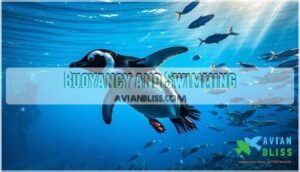
When you watch penguins torpedo through water, their feathers work like a high-tech wetsuit.
Feather streamlining creates smooth underwater propulsion while feather density provides precise buoyancy control.
This swimming efficiency comes from specialized feather types that trap air bubbles, reducing drag by 80%, which is a key factor in their remarkable penguin behavior adaptations, showcasing their evolved traits.
Understanding bird morphology reveals reasons why these birds evolved such adaptations.
Feather Maintenance and Molting
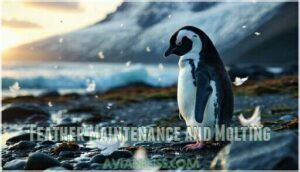
You’ll need to understand how penguins maintain their feather systems to appreciate their remarkable survival adaptations.
This essential process involves both daily preening behaviors and dramatic annual molting cycles that guarantee superior feather performance.
Preening and Oiling
You’ve got to admire how penguins keep their feathers shipshape – it’s like watching nature’s own dry cleaning service.
These birds spend considerable time preening, using their beaks to distribute oil from the uropygial gland located near their tail base. This oil composition creates waterproofing effectiveness that’s simply remarkable.
Here’s what makes penguin preening so fascinating:
- Oil gland location – positioned strategically at the base of the tail for easy access
- Preening frequency – occurs multiple times daily, especially after swimming
- Social preening – partners help reach difficult spots on head and neck areas
- Oil composition – contains waxy esters that repel water effectively
- Waterproofing effectiveness – creates a barrier preventing water from reaching skin
This penguin behavior isn’t just vanity – it’s survival. The oil coating transforms ordinary feather types into high-performance gear.
Bird morphology shows us that without proper maintenance, even the best-designed feathers fail. There are good reasons why penguins invest so much energy in this daily ritual.
The unique properties of penguin feather oil play a vital role in their ability to thrive in aquatic environments.
Molting Process
You’ll witness something truly remarkable during penguin molting – these flightless birds undergo catastrophic feather loss annually.
Unlike other birds in ornithology, penguins shed all feathers simultaneously over 2-4 weeks.
This dramatic shedding cycle creates distinct molting stages, from explosive feather loss to complete regeneration patterns.
The biology behind this process guarantees waterproof plumage renewal essential for survival.
Penguins require proper feather care tips to maintain their unique feathers and overall health during this critical period.
New Feather Growth
After molting, your penguin’s new feathers don’t just pop up overnight like magic.
The regeneration process follows distinct growth stages spanning several weeks, with each follicle producing fresh plumage with renewed feather density, restoring the bird’s insulation powers.
This molting cycle helps these flightless birds maintain their survival edge in harsh environments through continuous feather renewal, which is crucial for their well-being.
Understanding feather growth factors, such as feather growth serum, is vital for healthy feather health.
Frequently Asked Questions (FAQs)
Why do penguins need feathers?
You’ll find that penguin feathers serve as nature’s ultimate survival gear.
They create dense insulation trapping air to maintain body temperature, provide waterproofing through oil coating, and offer streamlined swimming efficiency underwater.
Why do penguins have flippers instead of wings?
When emperor penguins dive 500 meters deep hunting fish, you’d see why flippers beat wings.
Evolution transformed their wings into powerful underwater propulsion systems.
Flippers provide efficient thrust for swimming speeds up to 22 mph, sacrificing flight for superior aquatic maneuverability.
What does it mean when a penguin flaps its wings?
When you see a penguin flapping its wings, it’s engaging in thermoregulation, communication, or exercise behavior.
These flipper movements help circulate air through their feathers, signal to other penguins, or maintain muscle strength for swimming.
Why is a penguin a bird and not a fish?
Penguins are classified as birds because they’ve got feathers, lay eggs, and possess hollow bones—classic avian traits. Unlike fish, they’re warm-blooded vertebrates that breathe air through lungs, not gills.
What are penguin feathers special?
You’ll discover these remarkable feathers aren’t just for show—they’re engineering marvels with specialized structures that trap air, repel water, and regulate temperature through oil-coated barbules and adjustable positioning.
Why do penguins have flippers and not wings?
You’ll find flippers instead of wings because penguins evolved for underwater propulsion rather than flight.
Their streamlined, paddle-like flippers generate thrust through water, making them incredibly efficient swimmers capable of reaching speeds up to 22 mph underwater.
Are penguins born without feathers?
Baby penguins aren’t born naked – they hatch with a fluffy, downy coat called natal down.
This initial plumage keeps chicks warm but isn’t waterproof.
They’ll gradually molt and develop their adult feathers for swimming later.
Why do penguins need to be waterproof?
Imagine Emperor penguins diving 500 meters deep—they’d freeze instantly without waterproofing.
You need feathers coated with oil from their preen gland to create a watertight seal, preventing hypothermia and maintaining buoyancy for efficient underwater hunting.
Do penguins have different types of feathers?
Yes, penguins have two main feather types.
You’ll find downy plumules underneath that provide insulation, and contour feathers on top that create waterproofing.
The plumules actually outnumber contour feathers four-to-one for maximum warmth.
How do penguins use their feathers to attract a mate?
Penguins don’t primarily use feathers for mate attraction.
Instead, they rely on elaborate courtship behaviors, vocalizations, nest-building displays, and body posturing.
Their feathers mainly serve thermoregulation and waterproofing rather than visual signaling for reproductive purposes.
Conclusion
Nature’s armor tells a story of survival written in layers.
Penguin feathers aren’t just remnants from their dinosaur ancestry—they’re sophisticated engineering solutions.
You’ve discovered why do penguins have feathers: these specialized structures create waterproof barriers, trap insulating air, and provide camouflage in hostile environments.
Their three-layer system enables survival in temperatures reaching -40°F while diving 1,800 feet deep.
Through constant preening and strategic molting, penguins maintain this remarkable adaptation that transforms flightless birds into aquatic masters of the Antarctic.
- https://schoolpartnership.washu.edu/app/uploads/2019/02/penguin-feathers.pdf
- https://seaworld.org/animals/all-about/penguin/physical-characteristics
- https://ocean.si.edu/ocean-life/seabirds/penguins
- https://www.sciencedirect.com/science/article/abs/pii/S1742706119302740
- https://www.coolantarctica.com/Antarctica%20fact%20file/science/cold_penguins.php