This site is supported by our readers. We may earn a commission, at no cost to you, if you purchase through links.

Stand at the edge of a marsh at dawn and you might spot it before you hear anything — a great egret, motionless as carved ivory, its S-curved neck coiled like a spring waiting to release. No movement. No sound. Just that sharp yellow bill fixed on whatever swims beneath the surface.
For a bird that once faced extinction from plume hunters, the great egret’s comeback is one of conservation’s quieter success stories. It’s also the reason you’ll now find this striking white wader from Gulf Coast tidal flats to Pacific estuaries, thriving in habitats most birds ignore.
What makes this species worth understanding goes deeper than its elegance — from its lightning-fast hunting strikes to its colonial nesting behavior, the great egret reveals how form and function align in the natural world.
Table Of Contents
- Key Takeaways
- Great Egret Appearance and Identification
- Great Egret Size and Measurements
- Great Egret Habitat and Range
- Great Egret Diet and Behavior
- Great Egret Nesting and Conservation
- Frequently Asked Questions (FAQs)
- Are Great Egrets rare?
- What is the difference between a great white heron and an egret?
- What states do Great Egrets live in?
- Is the Great Egret a heron?
- What is special about Great Egrets?
- How long do great egrets typically live?
- Can great egrets be kept as pets?
- Do great egrets migrate? If so, how far?
- Are there any predators that hunt great egrets?
- How do great egrets communicate with each other?
- Conclusion
Key Takeaways
- The great egret’s all-white plumage, black legs, and yellow dagger-like bill aren’t just good looks — they’re field-tested tools for hunting, signaling health, and standing out to a mate across a crowded marsh.
- What looks like stillness is actually a precision weapon: the egret’s coiled S-neck can unload a strike in under a tenth of a second, beating any fish’s reaction time.
- This bird doesn’t belong to one ecosystem — it follows water and prey from freshwater wetlands to coastal tidal flats, adapting wherever shallow hunting ground exists.
- Once hunted to the brink for hat feathers, the great egret’s recovery to 9.5 million birds worldwide is proof that the right protections, applied in time, can pull a species back from the edge.
Great Egret Appearance and Identification
Spotting a great egret in the wild isn’t hard once you know what to look for. A few key physical traits set it apart from other white birds you might see near water. Here’s what to pay attention to when you’re out in the field.
Its brilliant white feathers and distinctive yellow bill make the great egret unmistakable — a closer look at egret plumage patterns and field markings can sharpen your eye before heading out.
White Plumage

The great egret’s entirely white plumage isn’t accidental — it results from feather structures that lack melanin, reflecting light uniformly across all wavelengths.
Key facts about their white feathers:
- Densely packed barbules diffuse light, creating that luminous glow
- Keratin microstructures scatter broad-spectrum light
- Genetic pathways suppress pigment during feather growth
- Dirt dulls brightness — clean feathers signal health
- White plumage aids mate recognition at distance
These birds are often seen alongside other various white birds in their natural habitats.
Long S-Curved Neck

That white glow draws your eye first — but it’s the S-curved neck that tells the whole story. Watch a great egret stand motionless at the water’s edge: the neck coils into a compact S, cervical vertebrae stacked between C4 and C6, ready to uncoil in milliseconds when prey passes below.
Yellow Dagger-Like Bill
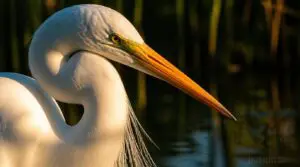
That coiled neck uncoils in a flash — and what it launches is a yellowish-orange dagger-like bill built for one thing: precision. The upper mandible tapers to a rigid, sharp tip that concentrates impact perfectly, letting the egret spear fish and amphibians with minimal force.
During breeding season, that yellow deepens noticeably — a visual signal rivals and mates can’t miss.
Black Legs

Below the bill, the legs make just as strong a statement. Solid black from the lower legs down through the feet, they stand in sharp contrast to all that white above — a field mark reliable enough to spot across a marsh in decent light.
Those long, slender legs aren’t just distinctive — they’re purpose-built for wading in shallow water, keeping the body elevated while partly webbed feet grip soft mud without sinking.
Similar White Birds

Spotting a great egret sounds simple — pure white, tall, unmistakable. But the marsh has a way of humbling you.
The Snow Goose flashes black wingtips in flight. The Mute Swan carries an orange bill with a dark knob. A Great White Heron shares black legs but towers noticeably taller.
Learn those differences, and you won’t second-guess yourself again.
Great Egret Size and Measurements

The great egret isn’t just elegant — it’s impressively built, and the numbers back that up. Knowing its size helps you spot it with confidence, whether you’re scanning a marsh or watching one glide overhead. Here’s a look at the key measurements that define this bird.
Adult Body Length
Great egrets stretch 80 to 100 centimeters from beak tip to tail — roughly the length of a standard guitar.
Their striking plumage shifts subtly with the seasons, and understanding how molt stages shape field identification helps birders distinguish great egrets across their full annual cycle.
Three things shape how you read that length accurately:
- Alert, upright posture gives the truest measurement
- A stretched neck can make the bird appear noticeably longer
- Adult length stays consistent across breeding and nonbreeding seasons
Posture effects are real — slouch changes everything, even in birds.
Wingspan Range
Those wings stretch 104 to 128 centimeters tip to tip — wider than most people are tall. Wing loading stays moderate, enabling efficient gliding with fewer wingbeats across wetlands. Feather development during juvenile stages determines where an individual lands within that range. Nutritional stress early on can shave centimeters off the upper limit — bird morphology shaped by circumstance.
| Measurement Category | Range (cm) | Key Influence |
|---|---|---|
| Minimum adult span | ~104 | Smaller individuals |
| Typical adult span | 110–125 | Most populations |
| Maximum adult span | ~128 | Well-nourished birds |
| Juvenile (post-molt) | 100–130 | Growth rate, diet |
| Sexual dimorphism | Minimal difference | Males ≈ females |
Maneuverability patterns shift at wingtip extension — sharp turns briefly push feathers to maximum spread, while seasonal molt can slightly alter perceived span as fresh plumage fills in.
Average Body Weight
Body weight averages 35.3 ounces — roughly 912 to 1,140 grams depending on nutrition and season. Lean times show clearly in the numbers. Bird morphology responds fast to what’s available.
- Diet quality directly shapes individual mass
- Heavier birds survive cold snaps better
- Juvenile weight predicts adult size
- Males and females weigh nearly equally
- Nutritional stress permanently stunts growth
Flight Posture
Watch a great egret cross the sky and you’ll notice something instantly — the neck pulls back into a tight S-shaped retraction, unlike storks or cranes that fly neck-forward. This reduces air resistance a lot.
Wings beat at roughly 1–2 strokes per second, staying slightly angled at the tips. Legs tuck clean along the body. The tail fans just enough to hold course in crosswinds — passive, efficient, easy.
Breeding Plumage Features
Once a year, breeding adults pull off a quiet transformation. White plumage shifts into something sharper — fresher feathers catch light more evenly, giving the neck and chest a cleaner, almost luminous glow.
This isn’t random. Molt timing aligns precisely with courtship season, when brighter birds tend to display earlier and attract more attention. Nutritional health before molt directly shapes how vivid that signal becomes.
Great Egret Habitat and Range

The great egret doesn’t belong to just one kind of place — it shows up wherever water and opportunity meet. From inland wetlands to open coastlines, this bird has figured out how to make itself at home across a surprisingly wide stretch of North America.
Here are the key habitat types and range details that define where you’re most likely to find one.
Freshwater Wetlands
Freshwater wetlands are where you’ll most reliably find great egrets. These waterlogged ecosystems do more than shelter wading birds — they filter pollutants, store carbon in their soils, and slow floodwaters naturally.
What makes them ideal for egrets:
- Shallow water exposes fish and amphibians
- Dense vegetation provides nesting cover
- Anoxic soil conditions sustain rich aquatic food webs
That daggerlike bill needs the right stage.
Coastal Shorelines
Saltwater habitats pull great egrets far beyond inland wetlands. Along coastal shorelines — tidal flats, estuaries, barrier island edges — that daggerlike bill works just as precisely as it does inland.
Barrier islands shift with storms, but egrets adapt, hunting whatever shallow water remains. Their white plumage against grey surf makes them unmistakable, still as driftwood, waiting.
Marshes and Swamps
Tidal flats aren’t the only story. Marshes and swamps offer something different — shallow, nutrient-rich water loaded with fish, frogs, and crustaceans hiding beneath emergent reeds and cattails.
- Wetland vegetation provides hunting cover
- Flood buffering keeps water levels unpredictable but productive
- Salinity fluctuations shift prey availability seasonally
That white plumage stands out — motionless, patient, perfectly positioned against dense marsh growth.
North American Range
From Gulf Coast marshes to Pacific coast estuaries, great egrets claim a vast North American footprint. You’ll find them along the Mississippi River valley, coastal wetlands from the Carolinas to California, and even inland reservoirs across the Great Plains.
Their white plumage makes identification straightforward — a bright contrast against open water, cutting a clean silhouette wherever shallow prey-rich habitat exists.
Seasonal Movements
Great egrets don’t stay put. As temperatures drop and prey disappears, nonbreeding birds push south — following food, not instinct alone. Wetlands and coastal estuaries serve as critical stopover habitats along the way.
Their breeding range expands northward each spring when daylight lengthens and shallow waters warm. Resource availability drives every decision — where to go, when to leave, how far to travel.
Great Egret Diet and Behavior

The great egret is a patient, precise hunter — and watching it work is like seeing nature’s version of a perfectly timed ambush. Whether it’s wading through a tidal flat or standing frozen at the edge of a marsh, every move has a purpose. Here’s a closer look at what it eats and how it hunts.
Fish and Aquatic Prey
The egret’s menu reads like a wetland roster. In freshwaters, it targets minnows and small fry; along coasts, euryhaline fish and crustaceans fill the gap.
- Seasonal flooding unlocks tadpoles and amphibians
- Aquatic insects round out leaner periods
- Agricultural rice fields offer opportunistic pickings
It flips prey headfirst before swallowing — reducing drag, maximizing efficiency. Every catch is deliberate.
Shallow-Water Hunting
Wading into shallow water between 5 and 20 cm, the egret reads every shoreline like a map. Visual detection methods — binocular vision and head tilts — pinpoint prey against murky bottoms. Morning light sharpens contrast, giving environmental lighting a real hunting edge. Marsh edges and reed beds serve as prime foraging areas where microhabitat prey concentration tilts the odds.
| Hunting Factor | How It Helps | Best Condition |
|---|---|---|
| Water depth | Limits prey escape routes | 5–20 cm margins |
| Light angle | Sharpens prey contrast | Morning and late afternoon |
| Shoreline contour | Concentrates aquatic prey | Reed beds and mud flats |
Motionless Stalking
Think of it as nature’s version of freeze and wait — pure patience turned into a survival tool.
The great egret locks its body upright with almost zero movement, relying on visual fixation techniques to track prey without giving itself away. Those white feathers, oddly enough, don’t betray it — shallow water and broken light scatter contrast enough to keep it concealed.
What makes this stealth hunting tactic work:
- Body stillness cuts the bird’s detectability to near zero
- Slow, deliberate wading keeps water disturbance minimal
- White plumage blends surprisingly well against reflective shorelines
- Fixed eye position locks onto prey without telegraphing movement
- Energy conservation means the egret hunts longer without fatigue
That neck wobble you might spot mid-stalk isn’t restlessness — it’s a calculated prey detection method, thought to trigger movement in nearby fish without revealing the exact strike point.
Among wading birds, few match this camouflage efficiency in open aquatic hunting terrain.
Rapid Bill Strikes
When patience breaks, it breaks fast. The egret’s neck muscles explode forward in under a tenth of a second — extending reach by up to 30 percent — driving that dagger-like bill through water before prey can react.
Eyes lock target, compensating for water refraction with a precise head tilt. High impulse, low energy cost. That’s predatory efficiency you can’t argue with.
Rice Field Foraging
Rice paddies aren’t just farmland — they’re wetland ecosystems wearing a disguise.
During late May to early June, great egrets move into flooded agricultural fields across South Korea and beyond, hunting small fish, amphibians, and invertebrates concentrated in shallow water. They work field edges and levees, where prey stays exposed. Pesticide use can quietly hollow out that abundance, leaving elegant hunters stalking nearly empty water.
Great Egret Nesting and Conservation

Regarding raising young, great egrets don’t go it alone — they’re deeply social nesters with habits worth knowing. From where they build to how they protect their species, there’s a clear story behind every nest. Here’s what shapes their nesting life and conservation standing today.
Colonial Nesting Sites
Great egrets are colonial nesters by nature. They gather in groups — sometimes thousands of nests — where shared vigilance keeps predators at bay.
Their nesting habits include:
- Nesting colonies ranging from dozens to thousands of pairs
- Mixed species interactions with herons and ibises
- Synchronized hatching that briefly overwhelms predators
- Nest density competition for prime interior spots
- Island sites chosen to block land predators
Numbers bring safety.
Stick Platform Nests
Once the colony claims a site, building begins. Each pair constructs a stick platform nest — a flat lattice of interwoven sticks and twigs, lined inside with grasses or moss.
| Feature | Detail |
|---|---|
| Nest height | 10–90 feet above ground |
| Primary material | Dry sticks and twigs |
| Interior lining | Grasses, moss, rootlets |
| Nest reuse | Rebuilt seasonally by same pair |
Platform stability determines whether eggs survive wind and weather.
Eggs and Incubation
With the stick platform built, the female lays 3 to 4 pale blue-green eggs. Both parents share incubation duties for 23 to 26 days, keeping eggs near 37.5–38°C.
The semipermeable eggshell controls gas exchange naturally. Eggs are turned regularly to prevent membrane adhesion, while humidity stays balanced — too dry shrinks contents, too wet invites fungal growth.
Chick Development
Once those eggs hatch, the real work begins. Great egret chicks are altricial at birth — helpless, eyes barely open, relying entirely on both parents for warmth and food delivered by regurgitation.
By week three, they’re climbing the platform of sticks. By weeks six to seven, they take their first flight — instinct kicking in right on schedule.
Conservation Status
Survival, for the great egret, has never been guaranteed. Plume hunting in the late 1800s nearly wiped them out — feathers sold for hat fashion at a brutal cost.
Plume hunting in the late 1800s nearly drove the great egret to extinction — all for hat fashion
Today, the IUCN lists them as Least Concern globally, with roughly 9.5 million birds. Even so, Southern African populations are Near Threatened, and climate-driven wetland loss keeps pressure real. International treaties like RAMSAR help hold the line.
Frequently Asked Questions (FAQs)
Are Great Egrets rare?
No, they’re not rare. With a global population of 5 million, great egrets hold Least Concern status — an impressive recovery from near-extinction after 19th-century plume hunting devastated their numbers.
What is the difference between a great white heron and an egret?
Great white herons are larger and heavier, prefer saltwater mangroves, and show lighter leg coloring. Great egrets are slimmer, favor freshwater wetlands, and display long delicate aigrettes during breeding season.
What states do Great Egrets live in?
From Florida to Maine, Gulf Coast to Pacific shores — these birds push boundaries, claiming wetlands across North America. You’ll spot them in southeastern states, the Midwest, coastal California, and the Atlantic seaboard.
Is the Great Egret a heron?
Yes — the great egret is a true heron, belonging to the family Ardeidae. Its scientific name, Ardea alba, places it squarely in the same genus as other large herons. "Egret" is simply a common name.
What is special about Great Egrets?
Ironically, the most striking thing about pure white is how hard it is to ignore. Their dagger-like bill, S-curved neck in flight, and lightning-fast hunting reflexes set them apart from every other wading bird you’ll encounter.
How long do great egrets typically live?
Wild egrets live around 15 years, though some reach their low 20s. In captivity, with steady food and veterinary care, they often surpass 22 years.
Can great egrets be kept as pets?
No, great egrets can’t be kept as pets. They’re protected under wildlife laws, require vast wetland habitats, and need live aquatic prey. Captivity causes serious stress and abnormal behaviors in these wild birds.
Do great egrets migrate? If so, how far?
Many birds follow food, not seasons — and great egrets are no different. Northern populations migrate south each fall, traveling 300 to over 1,000 kilometers depending on region, prey availability, and wetland conditions along the route.
Are there any predators that hunt great egrets?
Yes — hawks, eagles, owls, raccoons, foxes, and snakes all hunt or raid nests. Alligators ambush wading birds near shorelines. Juveniles face the highest predation risk during early dispersal flights.
How do great egrets communicate with each other?
Birds signal each other through harsh croaks, visual postures, and movement. Alarm calls spike near threats, while courtship displays — neck arches, wing stretches — strengthen pair bonds and coordinate nesting duties throughout the breeding season.
Conclusion
The great egret is nature’s patience made visible — a hunter that wins not by speed alone, but by stillness. Like anyone who’s learned to read a room before acting, it waits, watches, then strikes with precision.
Every marsh it wades through tells the same story: survival belongs to those who understand their environment deeply. Study the great egret and you’ll find more than a bird — you’ll find a blueprint for watching the world clearly.