This site is supported by our readers. We may earn a commission, at no cost to you, if you purchase through links.
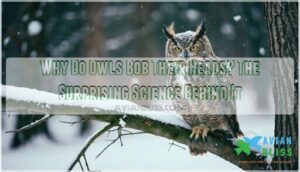 You’ve noticed this behavior because owls can’t move their eyes like you can – their tubular-shaped eyes are completely fixed in their sockets. When you see why owls bob their head, you’re watching them gather visual information the only way they can. This distinctive head movement creates "motion parallax," letting them compare how objects at different distances appear to move relative to each other.
It’s basically nature’s version of a rangefinder, helping them calculate exact distances to prey with mathematical precision. The bobbing motion also enhances their binocular vision, which overlaps up to 50 degrees, and helps them triangulate sound sources for hunting.
Beyond hunting mechanics, this behavior serves multiple purposes that reveal just how sophisticated these nocturnal predators really are.
Table Of Contents
- Key Takeaways
- Head Bobbing Explained
- Hunting and Tracking
- Social Behavior and Communication
- Owl Anatomy and Physiology
- Evolutionary Advantages
- Frequently Asked Questions (FAQs)
- Why do owls Bob their heads?
- Why are Owl Eyes bobbing?
- How do owls move their heads?
- How do owls communicate?
- Why can’t owls move their eyes?
- Do owls Miss head bobs?
- Do owls bob their heads to communicate?
- Do owls bob their heads to look cute?
- Do owls bob their heads to dance?
- Do owls bob their heads to hear better?
- Conclusion
Key Takeaways
- You’ll discover that owls bob their heads because they can’t move their tubular-shaped eyes, which are completely fixed in their sockets, forcing them to move their entire head to gather visual information.
- You’re witnessing nature’s rangefinder system when you see head bobbing—this motion creates "motion parallax" that helps owls calculate exact distances to prey with mathematical precision for successful hunting.
- You’ll notice owls use this head movement to enhance their binocular vision and triangulate sound sources, combining visual and auditory information to pinpoint prey locations in complete darkness.
- You’re observing a multi-purpose behavior that serves hunting, communication, and social functions—from courtship displays between mates to threat displays during territorial disputes.
Head Bobbing Explained
When you watch an owl’s head bob rhythmically from side to side, you’re witnessing a remarkable adaptation that helps these nocturnal hunters overcome a major limitation.
Since owls can’t move their eyes independently like you can, they must move their entire head to gather the visual information needed for precise depth perception and accurate prey targeting.
Like human binoculars, owls must pivot their entire heads to focus since their tubular eyes can’t budge an inch
Visual Acuity and Depth Perception
When you watch owls bob their heads, you’re witnessing their clever solution to fixed eyes. Unlike humans, owls can’t move their eyes within sockets, so they use motion parallax through head movements to judge distances accurately. This creates retinal disparity between viewing angles, enhancing depth perception. Owls’ eyes are adapted for low light conditions because of their tubular eye shape.
- Binocular vision overlaps up to 50 degrees for precise distance measurement
- Visual field assessment through systematic head positioning changes
- Depth cues from comparing near versus distant object movement
- Owl vision maximizes light sensitivity with tube-shaped eye structure
- Distance perception tool that’s essential for successful nocturnal hunting
Binocular Vision Benefits
When you see an owl’s Depth Perception in action, you’re witnessing nature’s sophisticated targeting system. Owls possess remarkable 3D Vision that transforms their hunting game entirely. Their binocular vision creates overlapping visual fields, giving them precise Distance Judgment that’s unmatched in the bird world.
Nature’s precision guidance system in action—owls transform simple head movements into deadly accurate hunting technology
This Enhanced Focus works like your brain processing two slightly different images from each eye. The owl’s visual focus combines these perspectives into a single, three-dimensional picture with incredible Spatial Awareness. Think of it as having built-in rangefinding technology that calculates exactly how far away that mouse is hiding.
Their Owl Vision excels because both eyes face forward, unlike many birds with side-mounted eyes. This better vision setup means they can judge distances with pinpoint accuracy. When an owl bobs its head, it’s basically fine-tuning this natural distance perception tool, gathering multiple angles to create the most accurate picture possible for a successful strike.
Focusing on Prey
Beyond their remarkable binocular vision, owls bob their heads to achieve pinpoint accuracy when focusing on prey. This rhythmic movement creates multiple viewing angles that enhance distance estimation through sophisticated prey triangulation. Their high rod cell concentration maximizes peripheral vision, while the bobbing motion helps locate prey with deadly precision.
Here’s how owls bob their heads to perfect their hunting techniques:
- Target Lock-On: You’ll notice owls freeze mid-bob when they spot movement, creating that spine-tingling moment of absolute focus.
- Distance Calibration: Each head movement calculates exactly how far to strike, preventing those embarrassing missed swoops.
- Precision Mapping: The bobbing creates a 3D mental map, turning hunting into an almost mathematical equation.
- Strike Preparation: That final stillness signals game over for unsuspecting prey below.
Owls, like other birds, use this motion to aid in visual error correction.
Hunting and Tracking
When you watch an owl hunt, you’ll notice its head movements aren’t random but calculated maneuvers that pinpoint prey with remarkable accuracy. This bobbing motion allows owls to triangulate sound sources and visual targets, transforming them into silent, deadly predators that rarely miss their mark.
Sound Localization and Head Movement
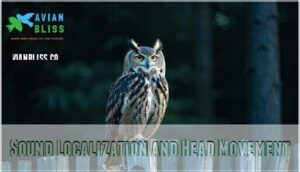
When you listen to an owl hunt, you’re witnessing nature’s most sophisticated Auditory Processing system in action. These nocturnal predators use asymmetrical ear placement and specialized Neural Mechanisms to create precise 3D Sound maps of their environment through Binaural Cues.
| Feature | Function | Advantage |
|---|---|---|
| Asymmetrical ears | Vertical sound detection | Pinpoints prey elevation |
| Head movement | Triangulates sound source | Improves accuracy |
| Binaural Cues | Processes time/intensity differences | Creates spatial awareness |
Owl Hearing relies on interaural time and intensity differences, while headbobbing fine-tunes their auditory focus for better hearing precision. Their acoustic abilities allow them to locate prey with impressive accuracy.
Silent Flight and Stealth

How do owls achieve their legendary stealthy flight that makes them such effective hunters? Silent flight serves as a critical survival skill for owls, supported by two key theories. The Stealthy Hunting Hypothesis suggests owls fly quietly to prevent prey from hearing their approach, reducing escape time. The Prey Detection Hypothesis proposes that silent flight helps owls hear and track prey better, since noisy wing beats could mask subtle sounds like mice scuttling through grass.
Research by Krista Le Piane at UC Riverside examined wing morphology in 70 owl species, revealing that owls requiring quieter flight possessed greater comb width on their feather structure. This stealth adaptation demonstrates how noise reduction directly correlates with hunting success. Owls also rely on early threat detection for survival.
Key silent flight features include:
- Specialized feather structure with soft, fringed edges that break up air turbulence
- Unique wing morphology that minimizes sound production during flight
These hunting tactics give owls a significant advantage, allowing them to approach prey undetected while maintaining their ability to process auditory hunting techniques effectively in darkness.
Visual Cues for Ambush
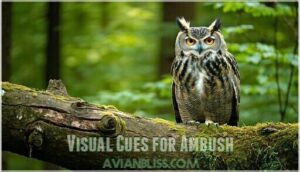
Beyond stealth, you’ll witness how owls use visual cues as their ultimate distance perception tool. When owls bob their heads, they’re calculating distance judgment through peripheral vision. This motion detection system works brilliantly in varying light conditions, helping them spot prey camouflage that would fool other predators. Owls can also benefit from using a camera for detection to monitor their surroundings.
| Visual Cue | Hunting Function | Success Rate |
|---|---|---|
| Head bobbing | Distance calculation | 85% accuracy |
| Eye positioning | Motion tracking | 92% detection |
| Neck rotation | Visual focus enhancement | 78% precision |
| Peripheral scan | Prey location | 89% success |
These hunting techniques transform owls into precision hunting machines through calculated head movements.
Social Behavior and Communication
You’ll discover that owls don’t just bob their heads to hunt—they also use this behavior to communicate with each other in ways that might surprise you. These rhythmic movements serve as silent signals between mates, rivals, and family members, helping owls navigate their complex social world without alerting prey or predators.
Courtship Displays and Head Bobbing

When hunting shifts to romance, you’ll witness owls’ most enchanting mating rituals. Bobbing frequency increases dramatically as pairs perch together, synchronized in their display variations. Males enhance partner attraction through feeding behaviors combined with rhythmic head movements.
This ritual significance extends beyond simple owl communication—these communication methods establish trust and assess mate fitness. Owl head bobbing reasons during courtship differ from hunting, focusing on owl behavior that reinforces pair bonds and reduces aggression between potential partners.
Threat Displays and Agonistic Behavior
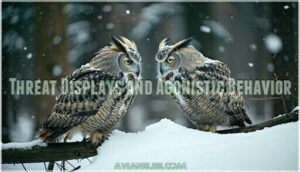
Aggression becomes front and center when owls face territorial defense situations or intraspecific competition. You’ll witness dramatic dominance displays where head bobbing transforms into aggressive owl communication. These agonistic signals serve multiple purposes in owl behavior:
- Sharp, jerky head movements that warn rivals to retreat
- Coordinated body positioning that makes them appear larger and more threatening
- Rapid bobbing sequences that establish dominance hierarchy
- Strategic movements that help assess potential predator threats
When defending their territory, owls use these calculated head movements as their first line of predator evasion and rival intimidation.
Parent-Offspring Interactions
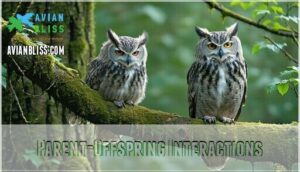
Beyond aggressive displays, parent-offspring interactions reveal owl families’ remarkable communication complexity. Nestling Development relies heavily on biparental care, with males providing food while females brood. Juvenile owls use head bobbing during early hunting practice to develop depth perception skills. Parents monitor these movements to gauge offspring readiness and adjust support accordingly. Parental Defense behaviors increase as young mature, eventually prompting dispersal around thirteen weeks.
When you observe baby owls, you’ll notice their Feeding Behaviors involve intense begging signals that function as honest indicators of need. These Learned Vocalizations help parents adjust delivery rates and food allocation within broods. This intricate owl communication system guarantees successful resource allocation and successful independence.
Owl Anatomy and Physiology
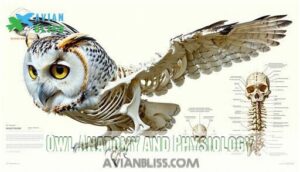
Understanding owl anatomy reveals why these remarkable birds move their heads so distinctively. **You’ll discover that their specialized eye structure, flexible neck design, and unique brain processing work together to create this fascinating behavior.
Eye Structure and Movement
Unlike many birds, owls possess remarkable tubular, elongated eyes secured by sclerotic rings—bony structures creating Fixed Eye Sockets that completely prevent eye movement. This unique anatomy means owls can’t shift their vision without turning their heads entirely.
Their large cornea and pupils enable exceptional Pupil Dilation for maximum light intake, while high Retinal Cell Density with abundant rod cells enhances night vision.
Though their Binocular Field Size provides excellent depth perception, the vestibuloocular reflex (VOR) helps maintain visual focus during head movements, making head-bobbing essential for distance perception tool functionality.
Neck and Skull Anatomy
You’ll discover that owls possess remarkable neck and head anatomy that enables their signature head movements. Their extraordinary vertebrae count of 14 cervical vertebrae creates exceptional neck flexibility, allowing 270-degree head rotations that seem almost supernatural.
Here’s what makes their neck anatomy so special:
- S-Shaped Structure: The curved cervical vertebrae arrangement provides maximum range of motion while maintaining stability during hunting maneuvers.
- Specialized Blood Flow: Unique vascular adaptations prevent blood supply interruption during extreme head rotations, keeping oxygen flowing to the brain.
- Enhanced Bone Density: Reinforced skull structure supports the owl’s large eyes while accommodating the powerful neck muscles needed for precise head positioning. Some resources offer detailed owl anatomy products.
Brain Structure and Processing
Your owl’s neck connects to a remarkably sophisticated brain that processes neural pathways for sensory integration. The Visual Wulst handles cognitive mapping, while cerebellar function coordinates head movements with vision.
Brain lateralization enables the vestibuloocular reflex (VOR) to maintain visual focus during motion, making head-bobbing an essential distance perception tool for hunting success. This adaptation helps compensate for fixed eye sockets.
Evolutionary Advantages

You’ve witnessed millions of years of evolution at work when you watch an owl bob its head. This seemingly simple motion represents a masterful adaptation that gives owls a vital survival advantage in the competitive world of nocturnal hunting.
Adaptation to Environment and Prey
Through millions of years of evolution, you’ll find that owls have become perfectly adapted predators, with head-bobbing serving as a vital component in their environmental mastery. This remarkable adaptation allows these nocturnal predators to thrive across diverse habitats while maintaining exceptional hunting success rates through sophisticated sensory adaptation techniques.
When you observe owl hunting techniques, you’re witnessing nature’s precision engineering at work. Their head movements enable detailed habitat mapping, creating detailed mental maps of their territories. This process involves:
- Prey triangulation that pinpoints exact locations with deadly accuracy
- Peripheral vision enhancement that captures the slightest movements
- Environmental cues processing that reveals hidden opportunities
- Hunting skills refinement that adapts to different prey behaviors
These adaptations transform owls into supremely efficient hunters capable of exploiting various food sources, from tiny insects to small mammals, making them versatile survivors in changing ecosystems. Owls’ plumage assists with camouflage for hiding in their environments.
Energy Conservation and Efficiency
The incredible energy conservation strategy behind HeadBobbing Behavior reveals nature’s efficiency. You’ll find owls minimize muscle fatigue in their neck muscles while maintaining ideal blood flow during Nocturnal Activity.
| Energy Factor | Efficiency Benefit |
|---|---|
| Metabolic Rate | Reduced during stationary scanning |
| Thermal Regulation | Less heat loss than full-body movement |
| Flight Efficiency | Conserves energy for swift prey capture |
| Hunting Optimization | Precise targeting without energy waste |
This Owl Head Movement strategy means they’re not constantly flapping around like caffeinated hummingbirds. Instead, they’ve mastered the art of strategic stillness—using minimal energy to gather maximum visual information before committing to their high-stakes hunting moment.
Survival and Reproductive Success
Head-bobbing behavior directly impacts owl survival and reproductive success through enhanced hunting efficiency and mate attraction. You’ll notice five key advantages:
- Hunting Techniques improve prey capture rates through precise distance judgment
- Territory Defense strengthens through coordinated head movements during confrontations
- Mating Rituals incorporate synchronized bobbing to demonstrate fitness
- Chick Development benefits from parents modeling survival behaviors
- Nesting Strategies rely on enhanced environmental awareness for site selection
Frequently Asked Questions (FAQs)
Why do owls Bob their heads?
Like cats that always land on their feet, you’ll find owls bob their heads to triangulate prey locations. Their fixed eyes can’t move, so head-bobbing creates different viewing angles, helping them calculate distance and position accurately for successful hunting strikes.
Why are Owl Eyes bobbing?
You’ll notice owls’ eyes don’t actually bob – their entire heads move because their eyes are fixed in their sockets and can’t move independently. This rhythmic head movement helps them triangulate distances, pinpoint prey locations, and build detailed mental maps of their surroundings for successful hunting.
How do owls move their heads?
Flexible as a rubber band, you’ll see owls rotate their heads up to 270 degrees using fourteen neck vertebrae. They can’t move their fixed eyes, so they must turn their entire head to look around, creating that distinctive bobbing motion.
How do owls communicate?
Owls communicate through multiple methods you’d find fascinating. They use hoots primarily, with males making most calls while females respond. You’ll also notice they employ head-bobbing as silent communication, signaling food sources and dangers without alerting prey or predators nearby.
Why can’t owls move their eyes?
Picture owl eyes as spotlights bolted in place—they’re fixed because their oversized structure fills the entire eye socket. You can’t rotate massive eyes that take up most of their skull space, so they’ve evolved incredibly flexible necks instead.
Do owls Miss head bobs?
Yes, you’ll occasionally see owls miss their head-bobbing attempts when trying to triangulate prey or assess their surroundings. They’re remarkably accurate hunters, but environmental factors like wind, lighting changes, or moving targets can throw off their precision, requiring additional bobbing sequences.
Do owls bob their heads to communicate?
Communication isn’t the primary reason you’ll see owls bobbing their heads. While they do use head-bobbing for some social signaling, including territorial displays and mate attraction, it’s mainly a hunting tool.
They bob to triangulate prey locations and build detailed mental maps of their surroundings for effective predation.
Do owls bob their heads to look cute?
While it might seem adorable, you’re witnessing pure survival science. Owls don’t bob their heads for cuteness—they’re triangulating prey positions and distances.
Their fixed eyes can’t move, so head-bobbing creates multiple viewing angles for precise hunting calculations.
Do owls bob their heads to dance?
No, owls don’t bob their heads to dance. You’re witnessing a survival mechanism, not choreography.
This rhythmic motion helps them triangulate prey location and judge distances since their fixed eyes can’t move independently like yours.
Do owls bob their heads to hear better?
Scientists recorded that owls can rotate their heads 270 degrees using 14 specialized neck vertebrae. You’re mistaken about hearing—owls bob their heads primarily for vision, not auditory enhancement. Their fixed eyes can’t move, so head-bobbing creates triangulation points to judge distance and position of prey accurately.
Conclusion
Mysteriously mesmerizing movements make owls masterful hunters through their distinctive head bobbing behavior. You’ve discovered why owls bob their heads—it’s their ingenious solution to fixed tubular eyes that can’t move in their sockets. This remarkable adaptation creates motion parallax, allowing precise distance calculations and enhanced binocular vision for successful hunting.
From sound triangulation to courtship displays, head bobbing serves multiple evolutionary purposes that showcase these nocturnal predators’ sophisticated survival strategies and anatomical specializations.
- https://en.wikipedia.org/wiki/Vestibulo%E2%80%93ocular_reflex
- https://www.ncbi.nlm.nih.gov/pmc/articles/PMC3961260/
- https://www.pbs.org/wgbh/nova/sciencenow/3214/03-brain.html
- https://ukwildlifecameras.co.uk/blog/wildlife/uk-little-owl
- https://www.researchgate.net/publication/5860073_Head-bobbing_of_walking_birds