
This site is supported by our readers. We may earn a commission, at no cost to you, if you purchase through links.
Two woodpeckers land on the same suet feeder, and suddenly you’re squinting at your phone, trying to figure out which one is which. They look almost identical—black and white, compact, methodical—yet field guides insist they’re easy to tell apart.
Here’s the thing: ornithologists use a single measurement to separate them instantly. The bill. A Downy’s bill runs about 9–12 mm, roughly one-third the length of its head. The Hairy’s bill matches its head nearly one-to-one.
Once that clicks, the whole downy vs hairy woodpecker puzzle unravels fast—and the differences go much deeper than beak length.
Table Of Contents
- Key Takeaways
- Identifying Woodpeckers
- Plumage Patterns
- Size and Beak Shape
- Vocalizations
- Habitat Preferences
- Identifying Fledglings
- Feeding Habits
- Attracting Woodpeckers
- Behavioral Differences
- Woodpecker Identification Tips
- Frequently Asked Questions (FAQs)
- What bird looks like a Downy Woodpecker but is bigger?
- What is a natural enemy of a woodpecker?
- What is the difference between a downy and a Hairy Woodpecker?
- How rare is it to see a Downy Woodpecker?
- How do you identify a Hairy Woodpecker?
- Do all Downy Woodpeckers have red on them?
- Do downy and hairy woodpeckers have different nesting habits?
- How long do downy and hairy woodpeckers typically live?
- Do these woodpecker species migrate?
- Are there other similar species that could be confused with these two?
- Conclusion
Key Takeaways
- The fastest way to tell these two birds apart is bill: a Downy’s is stubby and about one-third of its head length, while a Hairy’s is long and nearly matches its full head.
- Size backs up the bill clue — Downys are sparrow-sized at around 6.5 inches, while Hairys sit closer to 9 inches, more like a robin standing next to a sparrow.
- Your ears work just as well as your eyes: the Downy gives a soft, high pik with a fading whinny, while the Hairy delivers a sharp, flat peek that carries much farther through the trees.
- Where each bird forages tells you as much as how it looks — Downys work on thin twigs and bark surfaces up high, while Hairys stay low on thick trunks, digging deeper for bigger prey.
Identifying Woodpeckers
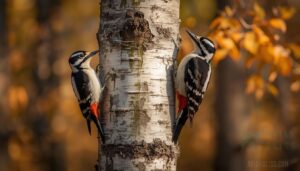
At first glance, Downy and Hairy Woodpeckers look like the same bird wearing the same outfit — and honestly, that’s a fair reaction. But key physical traits make telling them apart much easier than you’d think.
Once you know what to look for, identifying Downy vs Hairy Woodpecker differences becomes surprisingly satisfying in the field.
what to look for.
Bill Size Difference
The bill is honestly the quickest way to tell these two apart. With the Downy, the bill is shorter than the head — roughly a third of it — giving the bird that compact, almost button‑nosed look. The Hairy’s bill is about as long as the head, more dagger than a toothpick.
Here’s what that bill morphology actually means in practice:
- Bill-to-Head Ratio — Downy measures around 9–12 mm; Hairy runs 12–16 mm.
- Foraging Depth Preference — the longer bill digs deeper into trunk crevices; the shorter one works thin twigs and bark surfaces.
- Bill Mass Correlation — bigger bird, bigger bill, deeper excavation. It’s a tidy package.
That size and bill shape comparison isn’t random. Bill length variation between species keeps them foraging in different spots, so neither one crowds the other out. Studies show that bill heat loss can account for up to 10% of total heat loss in birds.
Overall Size Comparison
Once you move past bill morphology, overall size becomes your next reliable anchor. The Downy sits around 6.5 inches — sparrow territory — while the Hairy stretches closer to 9 inches, more like a robin. That’s a meaningful size difference in the field.
| Feature | Downy | Hairy |
|---|---|---|
| Body Mass Difference | 0.7–1 oz | 1.4–3.4 oz |
| Wing Span Gap | 13–18 cm | 16–22 cm |
| Flight Silhouette | Compact, quick | Broader, steadier |
The posture contrast is obvious when both visit your feeder simultaneously — Hairy simply looks chunkier and taller.
Tail Feather Patterns
Tail feather patterns offer one more solid clue.
The Hairy’s white outer tail feathers are clean — no markings at all. The Downy’s outer feathers carry black bars or spots on white, easy to catch when the bird fans its tail.
Barring density variation, seasonal moult effects, and sex-based markings can shift visibility slightly, but that spotted-versus-clean tail pattern remains a dependable separator.
Plumage Patterns
Once you get past size and bill shape, plumage is where things get really interesting. Both birds wear the same basic black-and-white outfit, but a few small details give them away.
Here’s what to look for.
Black and White Patterns
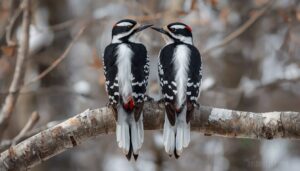
Both woodpeckers wear the same bold black-and-white outfit — think Checkerboard Contrast meets Zebra Stripes — yet the details differ enough to tell them apart.
Focus on these four plumage clues:
- White outer tail feathers on the Hairy are clean and unmarked, almost Pinstripe Elegance against the black central tail feathers.
- Black bars or spots on white outer tail feathers mark the Downy — a subtle Houndstooth Texture if you look closely.
- Both sport a black mask with a bold white eyestripe, like a Domino Grid splitting the face.
- Shoulder spur patterns differ: Hairy’s are separated, Downy’s often connect.
Tail feathers are your quickest shortcut.
Red Patch on Male Woodpeckers
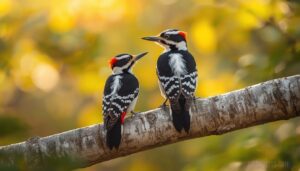
Here’s a detail worth remembering: male Downys sport a single solid red spot on the back of the head, while male Hairys carry a split red patch divided by black.
Both get their color from carotenoid pigmentation, brightest in early spring — peak molt timing for mate attraction and territorial signaling.
Females of both species lack it entirely, making this one of the cleaner visual cues for differentiating male and female woodpeckers.
White Outer Tail Feathers

Flip your binoculars to the tail end — it’s one of the most reliable spots for tail feather markings for woodpecker ID. During Tail Flicking Displays, both birds reveal their outer tail feathers clearly:
- Downy shows black bars or spots against white — subtle but consistent.
- Hairy flashes all-white outer tail feathers, clean and unmarked.
- Structural Coloration keeps these plumage differences crisp year‑round.
- Signal Function extends beyond ID — these patterns aid Predator Detection too.
Seasonal Plumage Changes can soften markings slightly, so fresh‑feathered birds in early spring offer the clearest look when identifying woodpecker species.
Size and Beak Shape
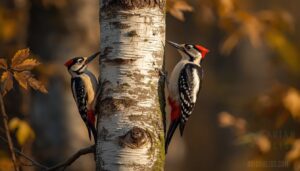
Size is where these two birds really give themselves away. Even from a distance, the difference is hard to miss once you know what to look for.
A Pileated, for instance, dwarfs a Downy the way a crow dwarfs a sparrow — and knowing that scale helps you choose the right suet feeder height for larger woodpeckers.
Here’s how they stack up.
Downy Woodpecker Size
The Downy Woodpecker is genuinely small — think somewhere between a House Sparrow and a robin regarding overall size. It measures 5.5 to 6.7 inches long, with a body mass range of just 20 to 33 grams. That’s lighter than a handful of quarters.
Here’s what makes its size comparison with common backyard birds so useful for identification:
- wing length ratio is noticeably shorter than a robin’s
- Tail length proportion stays compact, under 6 cm
- head-to-bill ratio reveals a stubby, short bill
- Seasonal weight variation is minimal year-round
- It easily fits on thin twigs where larger birds can’t perch
Hairy Woodpecker Size
The Hairy Woodpecker is built like it means business.
At 7 to 10 inches long with a body mass range of 40 to 95 grams, this bird is roughly one-third larger than its Downy cousin — a meaningful gap in any size comparison with common backyard birds.
Think American Robin territory.
Head proportion looks noticeably blockier, and wing length variation across geographic populations adds some nuance, though the overall size stays consistently bigger.
Geographic size variation is real but minor.
Seasonal size shift is minimal.
When distinguishing Downy and Hairy Woodpeckers, bird size and tail feather differences together make identification far less guesswork.
Beak Shape Difference
The beak tells the whole story, honestly. The Downy’s bill is dainty — a tiny stubby beak about one-third of its head length, built for precise probing in shallow crevices. The Hairy carries a longer and stronger bill nearly matching its full head length.
Here’s what separates them up close:
- Bill size: The short black bill of a Downy versus the dagger-like Hairy bill
- Robustness contrast: Hairy’s beak texture is thicker, supporting harder pecking
- Tip sharpness and gape width: Downy favors precision; Hairy pulls larger prey with a wider gape
Tip curvature stays minimal in both — but everything else signals a different game plan.
Vocalizations
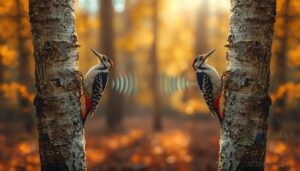
Can’t get a close look? Your ears might save the day. Each of these two woodpeckers has its own distinct sound — here’s what to listen for.
Downy Woodpecker Calls
Once you’ve spotted a small woodpecker in the yard, close your eyes for a moment — voice will confirm your ID.
The Downy woodpecker produces a sharp, high-pitched pik call, each note lasting roughly 0.04 to 0.08 seconds. Pik Call Timing usually quickens when the bird is alarmed or foraging intently.
The Whinny Structure is equally distinctive: a descending series of notes that trails off over about two seconds, like a tiny laugh fading into the trees.
Seasonal Call Variation is real — you’ll hear more calling during breeding season. Age Call Differences matter too; juveniles produce softer, less piercing versions.
| Call Type | Key Feature |
|---|---|
| Pik Call | Sharp, repeated; quickens when alarmed |
| Whinny Call | Descending series, ~2 seconds long |
| Juvenile Calls | Softer, less piercing than adults |
Hairy Woodpecker Calls
If the Downy’s call is a cheerful chirp, the Hairy’s is a statement. Its peek call hits around 4–5 kHz and rings out 3–5 decibels louder — sharp enough to cut through dense forest noise.
Unlike the Downy’s descending whinny pattern, the Hairy’s call pitch stays flat and steady, almost like a squeaky dog toy that means business.
Seasonal call usage peaks during spring breeding, when you’ll hear that emphatic peek repeating up to ten times per minute.
Vocal identification gets easier once you know what to expect.
Drumming Patterns
Once you’ve nailed the calls, drumming patterns seal the deal.
Roll duration is your first clue — Downy rolls last around 1.2 seconds, while Hairy’s extend to 2.5 seconds with a noticeably deeper tone.
Strike speed differs too: Downy hits 19–25 beats per second, Hairy a slower 15–20.
That rhythm modulation and amplitude profile — flat for Downy, peaking midway for Hairy — make drumming pattern analysis surprisingly reliable for territory signaling identification when you can’t get a clear visual.
Habitat Preferences

Where a woodpecker hangs out tells you almost as much as what it looks like. These two species have pretty different ideas about what counts as a good neighborhood.
Here’s how their habitat preferences break down.
Downy Woodpecker Habitat
Unlike its forest-loving cousin, the Downy Woodpecker is genuinely comfortable anywhere trees grow — including your backyard. You’ll find it working in open deciduous groves, riparian deciduous corridors along streams, and urban suburban parks with equal ease. It’s the woodpecker most likely to show up outside your kitchen window.
- Thrives in suburban areas around ornamental trees and feeders
- Patrols riparian environments and forest edges for bark insects
- Relies on dead tree snags as winter foraging areas and nest sites
Hairy Woodpecker Habitat
Hairy Woodpeckers are the forest specialists of the pair. They gravitate toward mature mixed forests — think conifers alongside hardwoods — often at mid elevations up to around 6,500 feet.
Their large tree preference isn’t pickiness; those thick trunks simply hold more wood-boring beetles. They also rely on snag cavity sites for nesting and feel right at home near water, where insect populations stay healthy.
Overlapping Habitats
Both species share more ground than you’d expect. Forest Edge Overlap zones, suburban parks with decent tree canopy, riparian habitat sharing along cottonwood-lined rivers — these are the places where you’ll see them working the same patch of woods. Conifer-Hardwood Mix stands are a sweet spot for both.
- Mature urban parks with 30% or more canopy cover
- Riverside woodlots thick with willow and cottonwood snags
- Mixed boreal transitional forests in the Northeast
- Apple and cherry orchards across the Midwest
- Floodplain edges where dead trees cluster near water
Suburban Park Coexistence happens more than most birders realize — suet feeders alone can boost co-occurrence noticeably. Orchard Habitat Convergence is another quiet overlap zone. The trick is watching where each bird forages: Downys work thin twigs up high, Hairys stay low on thick trunks. Same tree, different neighborhood.
Same tree, different neighborhood: Downys work thin twigs up high while Hairys stay low on thick trunks
Identifying Fledglings

Fledglings are their own puzzle — they don’t follow the same rules as adults, and that trips up even experienced birders. Both species swap out the typical nape patch for a crown patch, which muddies the usual ID markers you’d rely on.
Here’s watch for when you’re looking at young Downys, young Hairys, and how parent behavior can actually help you sort them out.
Young Downy Woodpeckers
Young Downy Woodpeckers are surprisingly recognizable— even before they’ve figured out how to properly exit a tree cavity. Fledglings weigh just 15–25 grams and measure around 12–13 cm, already showing a stubby, chisel‑in‑progress bill.
Watch for these fledgling identification and plumage changes:
- Fluffy, softer plumage with less contrast than adults
- Spotted outer tail feathers — consistent tail feather markings from day one
- Stubbier bill mid‑chisel formation, still developing its adult edge
- High‑pitched begging calls with a distinct begging call structure
- Tentative cavity exit learning — awkward but endearing
Growth milestones happen fast. Fledgling flight begins around 20–25 days post‑hatching.
Young Hairy Woodpeckers
Spotting juvenile Hairy Woodpeckers takes a little patience — they’re basically the awkward teenager version of an already tricky identification puzzle. A key curveball: fledglings often sport a yellow crown patch instead of the adult male’s red, which scrambles your usual plumage pattern analysis.
Their bill growth trajectory starts shorter than adults too, so the size and bill shape comparison you’d normally rely on becomes less reliable for a few months.
Feather brightness increase happens gradually with each molt, sharpening that bold black-and-white contrast over time.
Watch for foraging height shift as they grow — young birds move steadily up the trunk, practicing drumming skill development and building the sharp "peek" you’ll eventually come to recognize.
Parent-Offspring Identification
When adults are nearby, parent-offspring observation becomes one of your sharpest identification tools. Watch for these reliable visual cues during family feeding sessions:
- Bill size comparison — parent’s beak length instantly confirms species
- Tail feather markings for woodpecker ID — spotted (Downy) versus clean white (Hairy)
- Call pitch variation — fledglings echo their parent’s distinct vocalizations
- Feather length cue — juvenile primaries run shorter than adult feathers
- Tail flick signaling — parents direct fledglings toward food using this behavior
Size and bill shape comparison between parent and offspring clinches the ID every time.
Feeding Habits

Knowing where these birds eat is one thing, but what they eat — and how — tells you even more about them. Downy and Hairy woodpeckers actually have some real differences in their feeding habits, despite looking so similar.
Here’s a closer look at what ends up on the menu.
Insect Diet
Both woodpeckers are insect-hunting machines, but their foraging habits reflect their size differences almost perfectly.
Downy woodpeckers work on smaller branches and twigs — pulling ant larval prey from shallow galleries, harvesting termite nymphs from decaying logs, and handling woodborer egg removal from thin aspen bark.
Hairy woodpeckers dig deeper, targeting beetle grub preference in thick trunk crevices and excavating wood borer larvae up to 3 cm long.
Both species also consume spider egg sacs, rounding out a remarkably varied insect diet.
Fruit and Seed Consumption
Insects aren’t the whole story — both species have a serious taste for plant-based foods too, and understanding their seed and nut preferences can make your feeder setup far more effective.
- Seed size preference: Downy go for black oil sunflower seeds and smaller peanut pieces, while Hairy crack open large striped sunflower seeds and whole peanut hearts without breaking a sweat.
- Summer fruit focus: Both species forage on dogwood berries, serviceberries, and sumac fruits — especially during late summer and fall migration.
- Winter seed surge: When cold weather comes, high energy seeds and suet-embedded options become essential fuel for both birds.
Matching your feeder offerings to these feeding habits of woodpeckers is honestly the easiest way to keep them coming back.
Unique Feeding Behaviors
Beyond seeds and berries, these two birds part ways pretty sharply in how they actually hunt for food.
Downy are the nimble specialists — gleaning surface insects from twigs under 2 cm thick, hovering briefly to snatch spiders, even sipping nectar when pickings are slim. Their probe depth rarely exceeds 2 cm, but that’s plenty for thin-bark foraging.
Hairy woodpeckers go deeper, chiseling 3–4 cm into solid wood after bark beetle larvae.
Both species practice sap well drilling in spring and rely on winter food caching to survive cold snaps. Watch them at suet and suet cakes — their tree foraging styles tell the whole story immediately.
Attracting Woodpeckers
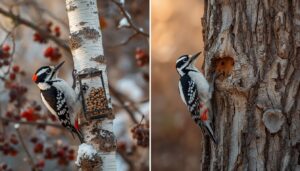
Want woodpeckers showing up regularly? The good news is both species are surprisingly easy to attract — you just need to know what each one is looking for.
Here’s what works for each of them, plus a few yard tweaks that help bring both in.
Downy Woodpecker Attraction
If you want Downy Woodpeckers showing up regularly, a few smart choices go a long way.
Suet feeder placement matters more than you’d think — hang a tail‑prop suet cage about 4 to 6 feet up, close to a trunk so they can brace naturally while feeding.
Shrub cover proximity helps too, giving them a quick escape route if something spooks them.
Here’s what rounds out a solid backyard bird feeding setup:
- A shallow bird bath, 1–3 inches deep, refreshed daily
- Black oil sunflower seeds or peanuts at platform feeders
- Beech tree nuts and native dogwood for natural foraging
- Snags or dead wood nearby for drilling insects
- No pesticides — their bug supply depends on it
Backyard birdwatching tips for woodpeckers always circle back to habitat.
Match habitat preferences and they’ll find you.
Hairy Woodpecker Attraction
Hairy Woodpeckers are pickier guests than their smaller cousins. They need mature forest — think towering oaks, rough bark, and standing dead snags at least 12 feet tall for foraging.
A tail-prop suet cage design mounted near trunk-sized trees mimics natural feeding posture.
For nest box placement, go 12–20 feet high near conifers. Heavy canopy cover and insect habitat seal the deal.
Tips for Woodpecker-Friendly Yards
Both species will visit if you set things up right. Start with native tree planting — oaks, maples, and beeches give woodpeckers foraging bark and resident insects year‑round. Keep any dead snag retention going; those standing trunks aren’t eyesores, they’re prime real estate.
Smart suet feeder placement near tree bases mirrors natural feeding posture. Add safe nest boxes at appropriate heights and a simple water source installation, like a drip bath, and your yard practically becomes a full‑service woodpecker stop.
- Plant native oaks or maples to feed bark-foraging insects naturally
- Leave dead snags standing — they’re nesting and drumming gold
- Mount suet feeders 5–10 meters from cover on baffled poles
- Install cedar nest boxes sized for your target species
- Add a shallow drip bath; moving water draws birds fast
Behavioral Differences
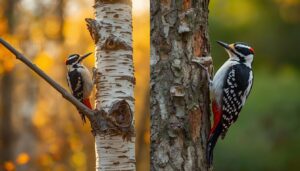
Size and markings will only take you so far — sometimes you have to watch what a bird actually does to know which one you’re looking at.
These two woodpeckers share a lot of the same world, but they move through it differently. Here’s a closer look at how their behaviors set them apart.
Downy Woodpecker Behavior
Downy woodpeckers are surprisingly bold little birds for their size — about 6.5 inches of pure hustle. Their foraging behavior keeps them constantly moving, hitching up trunks and creeping to the very tips of thin twigs where larger woodpeckers simply can’t follow.
Territory patrol stays low-key but consistent, with both partners sharing the work. Nest excavation happens in soft, decaying wood, often just a few meters up.
Come winter, winter roosting in small cavities keeps them snug. Their quick "pik" vocalizations and short drumming bursts tell the whole neighborhood they’re home.
Hairy Woodpecker Behavior
If you thought the Downy was busy, wait until you meet its larger cousin. Hairy Woodpeckers bring noticeably more intensity to everything they do — Territory Defense included.
They’ll dive-bomb intruders and drum on resonant snags up to 19 times per minute, carrying that sound nearly half a mile through mature forest.
Here’s what sets their behavior apart:
- Drumming Behavior: Powerful, steady rolls lasting 1.5–2 seconds — no slowdown at the end.
- Courtship Displays: Males chase females in looping flights and tap potential nest sites to test wood softness.
- Nest Excavation: Cavities go 4–10 inches deep in trees with heartrot — serious construction.
- Parental Feeding: Both parents feed fledglings for nearly a month after hatching.
Their habitat preferences of woodpeckers like these lean toward large, mature trees — the bigger, the better.
Social Interactions
Social dynamics between these two reveal a lot about their personalities.
Downy Woodpeckers are the social butterflies — joining mixed-species flocks in winter, tolerating neighbors, and using subtle bird body language and vocalizations as cooperative signaling during feeding. Hairy Woodpeckers? Strictly solo operators.
| Behavior | Downy | Hairy |
|---|---|---|
| Flock behavior | Joins mixed flocks | Stays solitary |
| Conflict resolution | Loose dominance hierarchy | Aggressive territory defense |
| Drumming behavior | Short, declining rolls | Long, steady powerful rolls |
Their feedback loops and turn-taking norms differ too — Downys yield; Hairys don’t negotiate.
Woodpecker Identification Tips
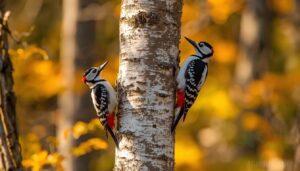
Getting good at telling these two apart takes a little practice, but it gets easier when you stack a few clues together instead of relying on just one.
The key is knowing where to look and what to listen for.
Here are a few tips that’ll sharpen your eye — and your ear — fast.
Combining Identification Methods
No single clue wins every time — that’s the honest truth about identifying these two birds. Smart birders use what’s called multi-modal cue fusion: pulling together size, bill shape, plumage, and sound before making a call. Think of it as building a case, not grabbing the first fingerprint you find.
Here’s a practical three-step framework for comparing hairy and downy woodpeckers in the field:
- Bill length as a diagnostic feature — A bill nearly as long as the head points to Hairy; a stubby, shorter bill means Downy.
- Tail feather markings for woodpecker ID — Spotted outer tail feathers signal Downy; clean white means Hairy.
- Vocalization and drumming differences — A sharp "peek" with a steady roll versus a softer "pik" with a fading burst.
Cue weighting and contextual prioritization matter too — In dim forest light, lean on sound. At a sunny feeder, trust your eyes first.
Observing Woodpecker Behavior
Watching how these birds actually move can seal the deal when looks alone aren’t enough. Both species use tail bristle bracing — pressing stiff tail feathers against bark to stay anchored while drilling — but their target zones differ noticeably.
Downy woodpeckers work on thin branches and weed stalks, using wing flick repositioning to hop between spots with quick, acrobatic ease. Hairy woodpeckers stick to main trunks, drilling deeper with steady, deliberate focus.
You’ll also notice a zigzag pecking pattern in both species as they sample crevices around a single section of bark.
At feeders, Hairy usually dominates — it’ll chase smaller birds off without much hesitation.
These foraging strategies and behavioral ecology cues are genuinely useful field identification strategies for birders, especially when bill size and drumming comparisons aren’t giving you a clean answer.
Consulting Field Guides and Experts
Even the sharpest eyes need a second opinion sometimes. A good bird identification guide — especially one with range maps and seasonal updates — can settle a tough call fast. Digital apps like Merlin and eBird put expert knowledge in your pocket.
Here’s how to sharpen your ID game:
- Cross-reference two or more field guides using visual cues for bird identification.
- Download digital apps with built-in reference cards and field identification tips for backyard birds.
- Attend expert workshops where instructors walk you through real field guide techniques for birders.
You’ll get there.
Frequently Asked Questions (FAQs)
What bird looks like a Downy Woodpecker but is bigger?
Think of the Hairy Woodpecker as the Downy’s bigger sibling — same outfit, bigger frame.
It’s the most common larger look-alike, with a size difference that’s hard to miss once you know what to look for.
What is a natural enemy of a woodpecker?
Woodpeckers face threats from owls, hawks, and snakes that raid nests. Foxes and domestic cats also pose real dangers.
Even cavity-nesting woodpeckers in dead trees aren’t fully safe from mammalian predators or raptor attacks.
What is the difference between a downy and a Hairy Woodpecker?
Nature’s great prank? Two birds, nearly identical outfits. The Hairy runs 50% larger with a bill matching its head length — the Downy’s is barely one-third that, stubby as a pencil eraser.
How rare is it to see a Downy Woodpecker?
Spotting a Downy Woodpecker is about as rare as finding coffee in a café.
They’re North America’s most common woodpecker, showing up year-round in suburbs, parks, and backyards across the continent.
How do you identify a Hairy Woodpecker?
Once you get the bill right, everything else falls into place. A Hairy Woodpecker’s bill-to-head ratio is nearly one-to-one — long, dagger-like, built for serious trunk work.
Do all Downy Woodpeckers have red on them?
Not all of them, no.
Only male Downy Woodpeckers carry that small red spot on the back of the head. Females are strictly black and white — not a trace of red anywhere.
Do downy and hairy woodpeckers have different nesting habits?
Yes and no.
Both are cavity-nesting woodpeckers that excavate dead trees, but Downys nest lower in smaller stubs while Hairys go higher into larger, decay-softened trunks — same blueprint, different real estate.
How long do downy and hairy woodpeckers typically live?
Downy woodpeckers average 2–5 years in the wild, while Hairy woodpeckers commonly reach 4–11 years. Banding records show rare individuals hitting 11–12 years, though urban mortality cuts many lifespans short.
Do these woodpecker species migrate?
Neither species migrates.
Both are year-round residents throughout most of North America, with only minor elevation movements during harsh winters to find better winter food availability near lower, more accessible forests.
Are there other similar species that could be confused with these two?
A few other species can throw you off. Pileated Woodpeckers look dramatic up close, but sapsuckers are sneakier look‑alikes.
Even nuthatches fool beginners at distance.
Knowing the beak shape usually settles it fast.
Conclusion
Picture yourself at the feeder, coffee in hand, watching two black-and-white birds work the suet side by side.
This time, your eye goes straight to the bill—and you know. That’s the moment the downy vs hairy woodpecker puzzle stops being frustrating and starts being fun.
Size, sound, behavior, habitat—every clue you’ve learned sharpens that moment. The birds haven’t changed. You have.