This site is supported by our readers. We may earn a commission, at no cost to you, if you purchase through links.
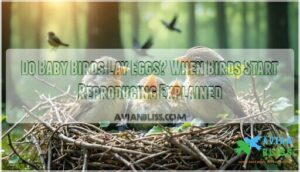 You can’t expect baby birds to lay eggs—they’re simply not ready for the responsibility! Baby birds don’t lay eggs because they haven’t reached sexual maturity yet. Think of it like asking a toddler to drive a car; their bodies just aren’t developed enough.
Small songbirds typically reach maturity in their first year, but larger raptors need three to five years to get there.
These juvenile birds spend their time learning the essentials—how to hunt for food, dodge predators, and nail their flying techniques. All that energy? It goes straight into building strength and survival skills, not making babies.
Only adult birds with fully developed reproductive systems and the right hormone triggers can create and lay eggs. Understanding when different species reach maturity reveals fascinating patterns in the avian world.
Table Of Contents
- Key Takeaways
- Do Baby Birds Lay Eggs?
- Bird Life Cycle Stages
- When Do Birds Start Laying Eggs?
- Why Can’t Baby Birds Lay Eggs?
- How Birds Build and Use Nests
- The Egg Laying Process in Birds
- Incubation and Hatching Explained
- How Baby Birds Grow and Learn
- Unique Egg Laying Behaviors by Species
- Protecting Birds and Their Nests
- Frequently Asked Questions (FAQs)
- At what age do birds start laying eggs?
- How long do baby birds stay in the nest?
- How long does it take for baby bird eggs to hatch?
- What happens to baby birds when they leave the nest?
- Can birds recognize their own eggs in a nest?
- How do birds know when to stop laying eggs?
- Can birds lay eggs if they are under stress?
- Do birds reuse nests where eggs didnt hatch?
- What sounds do baby birds make?
- How long do birds stay babies?
- Conclusion
Key Takeaways
- You won’t see baby birds laying eggs because they haven’t reached sexual maturity yet – just like human children can’t reproduce, young birds lack the necessary physical development and hormones for egg production.
- Small songbirds mature within their first year, while larger birds take 3-5 years – the timeline depends on species size, with robins ready around 10 months but eagles needing up to 5 years to develop reproductive capabilities.
- Baby birds focus their energy on survival skills instead of reproduction – during their juvenile phase, they’re learning to fly, find food, avoid predators, and build strength rather than developing breeding abilities.
- Only adult birds with fully developed reproductive systems can create eggs – the complex process of egg formation requires mature ovaries, proper hormone regulation, and specialized physical structures that baby birds simply don’t have yet.
Do Baby Birds Lay Eggs?
You might wonder if those adorable baby birds you spot in your backyard can lay eggs. The answer is a definitive no. Baby birds can’t lay eggs because they haven’t reached sexual maturity yet.
Think of it like human development – young birds go through distinct phases in their avian reproduction cycles. Whether they’re tiny hatchlings still in the nest, nestlings growing their first feathers, or fledglings taking their maiden flights, none have developed the physical machinery for egg formation. Their reproductive organs are basically still under construction.
Bird breeding capabilities and nesting instincts kick in only once they hit adulthood – typically within their first year for most songbirds.
Bird Life Cycle Stages
You’ll recognize each bird life cycle stage by observing specific physical and behavioral characteristics that ornithologists use to classify young birds.
Each species takes its own sweet time getting from egg to full-grown bird – a hummingbird might zip through the process in weeks while an eagle takes its time over months.
Egg, Hatchling, and Nestling Phases
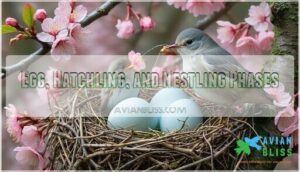
Understanding egg formation marks the beginning of every bird’s journey through life. You’ll witness three distinct phases before birds reach reproductive maturity. Baby birds progress through specific developmental stages that determine their survival capabilities.
The early bird life cycle includes these critical phases:
- Egg stage – Embryonic development occurs inside protective shells
- Hatchling development – Newly emerged chicks lack feathers and sight
- Nestling care – Parents provide constant feeding and protection
- Avian growth – Feathers develop while remaining nest-bound
- Bird maturation – Strength builds for eventual independence
During nesting periods, you’ll observe how bird eggs require precise incubation conditions. Hatchlings emerge completely dependent on parental care, unable to regulate body temperature or feed themselves.
Nestling care involves continuous feeding cycles as baby birds rapidly develop essential survival skills within their protective bird nesting habits environment.
Fledgling, Juvenile, and Adult Development
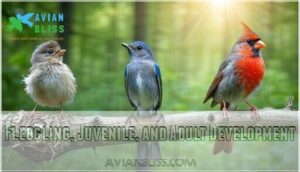
Once nestlings develop their first coat of feathers, they become fledglings. Fledgling growth involves learning essential survival skills while still receiving parental care. You’ll notice juvenile plumage differs from adult feathers – it’s often duller for camouflage.
During this stage, bird socialization occurs as youngsters interact with siblings and parents. Feather development continues as juveniles molt into adult maturity. This progression takes months to years depending on species.
Throughout fledgling and juvenile stages, birds can’t lay eggs due to incomplete reproductive development and hormonal immaturity.
When Do Birds Start Laying Eggs?

You’ll find that birds don’t start laying eggs until they reach sexual maturity, which varies dramatically across species. Small songbirds like robins can start reproducing within their first year, while larger raptors like eagles won’t lay their first eggs until they’re three to five years old.
Age of Sexual Maturity in Birds
For most songbirds, nature’s developmental timeline runs like clockwork—they’ll reach sexual maturity within their first year. However, bird growth rates vary dramatically across developmental stages. Small species, like house sparrows, mature within months, while larger birds, such as golden eagles, need four to five years to complete their reproductive cycles.
Why such dramatic differences? It all comes down to size and lifestyle. Smaller birds like robins can start families at just ten months old, but those impressive raptors soaring overhead? They’re still figuring out their reproductive systems years later.
Body size drives the timeline—bigger birds simply need more time to develop the complex systems required for successful breeding.
Differences Across Bird Species
You’ll find striking Species Diversity in when bird species reach maturity. Small songbirds usually start laying eggs within their first year, while larger raptors can take three to five years. Bird Migration Patterns also influence timing, as Arctic species compress reproductive cycles.
This variation reflects avian biology complexity – hummingbirds with rapid Feather Development mature quickly, whereas eagles need extended growth periods. Ornithology research shows Beak Variations correlate with maturity rates, and different Nesting Strategies require varying developmental stages across bird species characteristics.
Why Can’t Baby Birds Lay Eggs?

You won’t see baby birds laying eggs because their reproductive systems haven’t developed yet, just like human children can’t have babies.
Young birds lack the necessary hormones and physical structures needed for egg production, which only develop when they reach sexual maturity at different ages depending on their species.
Physical and Biological Limitations
Baby birds simply can’t lay eggs yet – their bodies aren’t ready for it. Their reproductive systems haven’t developed. Instead, all their energy goes toward staying alive: growing feathers, building muscle, and getting strong enough to survive.
Think of it like asking a kindergartener to drive a car – the physical machinery just isn’t there. Young birds from hatching through their first flights focus on rapid growth, not making babies. They’re learning to fly and find food, not creating eggs.
The nest phase is all about dependence, not reproduction.
Role of Hormones in Reproduction
Young birds simply aren’t ready to lay eggs because their hormone systems haven’t kicked in yet. Think of it like a biological timer that hasn’t gone off – their bodies are still figuring out the basics of growing up, not making babies.
The key hormones that tell adult birds "time to reproduce" just aren’t active in juveniles. Scientists have found that luteinizing hormone and follicle-stimulating hormone stay switched off until birds reach sexual maturity.
It’s nature’s way of making sure young birds put all their energy into getting bigger and stronger instead of trying to breed.
In bird ecology, these hormone cycles need to line up just right for breeding to work. That’s why wildlife conservationists pay attention to these natural timing patterns when they’re setting up protected nesting areas.
How Birds Build and Use Nests
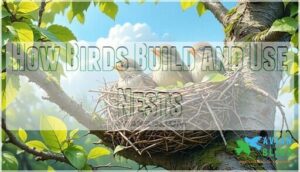
You’ll discover that birds construct nests as temporary nurseries, not permanent homes, using materials ranging from simple twigs to complex architectural designs with waterproof exteriors.
These structures serve specific purposes during breeding season, with construction techniques varying dramatically across species depending on their environmental needs and available resources.
Nest Construction Techniques
Birds master intricate nest construction through precise techniques. You’ll observe them selecting prime nesting sites like tree cavities or dense shrubs for nest camouflage.
Their nest architecture follows these methods:
- Foundation laying with sturdy twigs
- Wall building using interwoven materials
- Interior lining for comfort
- Waterproofing outer layers
- Camouflage integration with surroundings
Cavity-nesting birds excavate or modify existing holes, while others weave elaborate structures.
Materials Birds Use for Nests
Once you’ve mastered construction techniques, understanding what nesting birds actually use becomes fascinating. You’ll discover bird nests showcase remarkable resourcefulness—from spider silk to mud. Different bird behavior patterns reveal species-specific material preferences that create impressive nest architecture.
| Material Type | Common Examples | Primary Function |
|---|---|---|
| Plant Fibers | Grass, moss, bark strips | Structural foundation |
| Feather Insulation | Down, contour feathers | Temperature regulation |
| Binding Materials | Spider webs, animal hair | Securing components |
Nesting sites determine available materials, influencing each species’ architectural choices.
Purposes of Bird Nests
Unlike human homes, bird nests serve one vital purpose: creating a safe avian nursery for raising young. You’ll find these temporary structures aren’t permanent dwellings but specialized facilities designed for reproduction.
Nest architecture reflects ingenious nesting strategies across bird habitats.
- Incubating bird eggs – maintaining ideal temperature and humidity
- Protecting vulnerable hatchlings from predators and weather
- Providing secure feeding stations for growing nestlings
- Offering structural assistance during rapid development phases
- Serving as launching pads for fledgling birds’ first flights
The Egg Laying Process in Birds
You’ll discover that egg formation starts when hormones trigger a female bird’s ovaries to release a yolk into her reproductive system.
The entire process takes about 24-26 hours as the egg travels through her oviduct, collecting layers of albumen, membranes, and finally the protective shell before she’s ready to lay it.
Formation of Eggs

Every single egg represents nature’s extraordinary engineering feat. You’ll witness how yolk formation begins in the ovary, where nutrients concentrate to nourish developing embryos.
Mature birds have this egg-making process down to a science.
Young birds? They’re nowhere near ready—their reproductive systems won’t develop the machinery needed for this biological masterpiece until they hit sexual maturity.
Adult birds have mastered this complex process, while baby birds lack the biological machinery for such intricate reproduction until they reach sexual maturity.
Triggers for Egg Laying

When daylight hours stretch longer, you’ll notice something extraordinary happens in the avian world. Hormone regulation kicks into high gear as increased sunlight triggers breeding cycles in most bird species.
These environmental cues activate complex mating rituals and nesting instincts that prepare adult birds for egg formation. Temperature changes and food availability also play vital roles in this biological timing system.
Think of it like nature’s alarm clock—when conditions are right, mature birds can’t help but start preparing their nests for the future offspring, while baby birds remain focused on fledging.
Incubation and Hatching Explained

You’ll witness the striking transformation from egg to baby bird during the incubation period, when parent birds carefully regulate temperature and humidity for proper embryo development.
Once you understand the hatching process, you’ll appreciate how these tiny creatures break free from their shells using a specialized egg tooth and begin their journey toward independence.
Parental Roles in Incubation
Once eggs are laid, parental care becomes a full-time job. Both parents often share incubation duties, though roles vary by species. You’ll observe these key parental care behaviors:
- Egg turning – Parents rotate eggs regularly to prevent embryos from sticking
- Temperature regulation – Adults adjust body position to maintain ideal warmth
- Nest defense – Parents guard against predators and territorial threats
- Humidity control – Brooding techniques help maintain proper moisture levels
- Shift scheduling – Many species alternate incubation duties between mates
These nesting behaviors guarantee baby birds develop properly inside their protective shells.
Hatching Process and Early Development
When eggs crack open, you’ll witness nature’s most dramatic transformation. Hatchling Development begins as tiny chicks break free using their egg tooth, a temporary structure that disappears within days. This Egg Formation culmination marks the start of intense Nestling Care.
| Development Stage | Duration | Key Characteristics |
|---|---|---|
| Hatchling | 0-3 days | Eyes closed, no feathers, completely dependent |
| Nestling | 3-14 days | Eyes open, pin feathers emerge, rapid growth |
| Fledgling Stage | 14+ days | First flight attempts, learning independence |
Baby birds can’t regulate their body temperature initially, making parental warmth essential. Bird Maturation progresses rapidly as chicks develop from helpless creatures into capable flyers within weeks.
How Baby Birds Grow and Learn
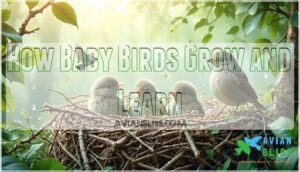
You’ll witness one of nature’s most extraordinary transformations as baby birds progress from helpless hatchlings to independent flyers through careful parental guidance and instinctive learning.
These young birds can’t reproduce yet, but they’re busy mastering essential survival skills like recognizing food, avoiding predators, and developing the flight muscles that’ll carry them through adulthood.
Feeding and Care by Parents
Once baby birds hatch, parents become full-time food delivery services. Parental feeding involves bringing insects, worms, and seeds directly to hungry chicks every few minutes. This intensive nestling care continues around the clock, with both parents usually sharing duties.
Some species practice brood reduction when food becomes scarce, focusing resources on stronger offspring. Chick nutrition varies by species—seed-eaters offer regurgitated food, while insect-eaters provide fresh catches.
This dedicated animal behavior ensures proper development before fledgling assistance begins.
Learning to Fly and Fledge
Young birds’ journey to independence begins when Wing Development reaches critical stages during the Fledgling Stage. You’ll notice Feather Growth accelerates as baby birds prepare for their maiden flights. These developing youngsters practice Aerodynamic Skills through wing-flapping exercises that strengthen flight muscles. Ornithology research shows fledglings master Flight Patterns gradually, hopping between branches before attempting longer distances. Bird Development during this phase is extraordinary – watching wildlife education unfold naturally.
- Fledgling wing muscles strengthen through daily flapping exercises
- Flight Patterns develop from short hops to sustained gliding
- Parent birds demonstrate landing techniques and wind navigation
- Feather Growth provides the lift needed for controlled flight
- Baby birds practice takeoffs from progressively higher perches
Unique Egg Laying Behaviors by Species
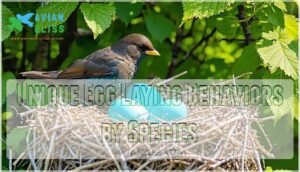
You’ll discover that not all birds follow the same egg-laying playbook, with some species developing truly extraordinary strategies that seem almost like cheating.
Cowbirds, for instance, skip nest-building entirely and instead sneak their eggs into other birds’ nests, leaving the unsuspecting foster parents to raise their young.
Brood Parasitism (e.g., Cowbirds)
Some birds break all the rules regarding parenting. Brownheaded cowbird behavior includes nest invasion, where females sneak into other birds’ nests to lay their eggs. This brood parasite relies on host manipulation rather than building its own nest.
Cowbirds have mastered egg mimicry, laying eggs that resemble their host’s eggs. You’ll find cowbirds parasitizing over 200 species across North America. This parasite ecology strategy means host birds unknowingly raise cowbird chicks, often at the expense of their own offspring.
Animal development takes an unexpected twist when avian behavior and ecology involve such deceptive reproduction strategies. The impact of brood parasite behavior is a significant factor in the decline of certain songbird populations.
Adaptations in Nesting and Reproduction
Beyond brood parasitism, you’ll find striking reproductive strategies across avian species that showcase nature’s ingenuity. Arctic terns demonstrate exceptional bird migration patterns, traveling pole-to-pole while timing egg formation with prime food availability.
Nest architecture varies dramatically—from hummingbirds’ tiny cups to eagles’ massive platforms weighing tons. Penguins huddle together, sharing avian parenting duties in harsh conditions. Some nesting birds like megapodes bury eggs in warm soil, abandoning traditional incubation methods.
These adaptations in animal development reflect millions of years of evolution, with each species perfecting unique approaches to guarantee baby birds survive in their specific environments.
Protecting Birds and Their Nests

You can protect birds and their nests by understanding federal laws like the Migratory Bird Treaty Act, which makes disturbing nests or eggs illegal in most cases.
Simple actions like keeping cats indoors and maintaining safe distances from nesting areas help guarantee these vulnerable families can raise their young successfully.
Conservation Laws and Regulations
When it comes to protecting birds and their nests, federal laws act as the backbone of wildlife conservation. Take the Migratory Bird Treaty Act of 1918 – this landmark legislation makes it a federal crime to mess with nests or snatch eggs from over 1,000 native bird species. It’s been quietly doing its job for more than a century.
But the feds aren’t working alone. State governments step up with their own rules, especially when it comes to endangered species and designated bird sanctuaries. These local conservation efforts fill in the gaps, creating a network that keeps habitat preservation and animal welfare front and center across the country.
The beauty of this system? Multiple layers of government working in sync to keep our feathered neighbors safe.
You’ll find that wildlife conservation efforts work together at multiple government levels to safeguard our feathered friends.
Tips for Safeguarding Bird Habitats
Creating bird-friendly gardens transforms your backyard into a conservation haven. You can aid wildlife conservation by planting native species that provide natural food sources and nesting materials.
Habitat preservation starts with selecting diverse plants that offer shelter throughout seasons. Implement eco-friendly practices like avoiding pesticides and maintaining water sources.
Strategic nesting site selection means leaving dead trees when safe and installing appropriate nest boxes. These wildlife management strategies create corridors that connect fragmented habitats.
Your conservation efforts directly impact bird species protection, giving our feathered friends the resources they need to thrive and reproduce successfully.
Frequently Asked Questions (FAQs)
At what age do birds start laying eggs?
You’ll see most songbirds reach sexual maturity within their first year, while larger species like hawks need 3-5 years. Small birds start laying eggs around springtime after their first winter.
How long do baby birds stay in the nest?
Good things come to those who wait – and you’ll wait about 10 days to 3 weeks for baby birds to fledge. Most songbirds stay 2-3 weeks, while larger raptors need 8-10 weeks before they’re ready to spread their wings.
The duration of baby birds’ stay in the nest is influenced by their nesting behavior patterns.
How long does it take for baby bird eggs to hatch?
Most bird eggs hatch in 10-14 days, though you’ll see variation by species. Smaller songbirds usually hatch faster, while larger birds take longer—some up to 35 days for bigger species.
What happens to baby birds when they leave the nest?
Once you spot fledglings leaving the nest, they’ll spend several days hopping around on the ground, learning to fly while their parents continue feeding and protecting them nearby.
Can birds recognize their own eggs in a nest?
Like nature’s own fingerprint system, you’ll discover birds absolutely can recognize their own eggs. Rejector species show striking abilities to distinguish their eggs from foreign ones, using visual identity signals to recognize their offspring.
This prevents costly misdirected parental care.
How do birds know when to stop laying eggs?
Hormones and daylight cues tell you when to stop. A clutch is the total eggs a bird lays per each nesting attempt. Once you’ve reached your species-specific number, your body naturally shuts down production until the next breeding cycle.
Can birds lay eggs if they are under stress?
Stress can actually interrupt your bird’s egg-laying cycle. Research shows excessive stress can suppress the reproductive process, though some mild stress might trigger breeding behavior in certain species.
Do birds reuse nests where eggs didnt hatch?
Nature’s recycling program isn’t foolproof—you’ll find birds often abandon nests with failed eggs rather than reusing them.
Most species prefer building fresh nests each breeding season for better success rates.
What sounds do baby birds make?
You’ll hear baby birds making enthusiastic chirps, raspy squeaks, and loud begging calls when they’re hungry.
These sounds help them communicate with parents, who respond with soft contact calls during feeding times.
How long do birds stay babies?
Ironically, "baby" birds grow up faster than you’d expect! You’ll observe hatchlings become nestlings in days, then fledglings within 2-4 weeks depending on species. Most reach independence by summer’s end.
Conclusion
Like Rome wasn’t built in a day, birds don’t develop reproductive abilities overnight. Baby birds can’t lay eggs because they haven’t reached sexual maturity yet. Their bodies need time to develop the complex reproductive systems required for egg production.
Baby birds can’t lay eggs because their reproductive systems haven’t developed yet—nature requires maturity before the miracle of egg creation begins
Small songbirds generally mature within their first year, while larger species like eagles need three to five years. During this juvenile period, young birds focus on survival skills rather than reproduction.
Understanding when baby birds lay eggs helps us appreciate the intricate timing of avian development and reproduction cycles.