This site is supported by our readers. We may earn a commission, at no cost to you, if you purchase through links.
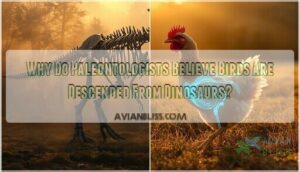
The chicken on your dinner plate shares more with Tyrannosaurus rex than most people realize—not metaphorically, but structurally, down to the protein sequences locked inside fossilized bone. Mary Schweitzer’s extraction of collagen from a T. rex femur in 2003 rattled paleontology precisely because the closest molecular match wasn’t a crocodile or a lizard. It was a chicken.
That single finding crystallized what decades of fossil evidence had been quietly building: birds aren’t just dinosaur relatives, they’re dinosaurs, nested firmly within theropod lineage. The case paleontologists make for this rests on converging lines of evidence—skeletal architecture, feathered transitional fossils, and developmental genetics that trace the same fingerprints across 150 million years of evolution.
Table Of Contents
- Key Takeaways
- Why Do Paleontologists Think Birds Descend From Dinosaurs?
- Fossil Discoveries Linking Birds and Dinosaurs
- Shared Anatomy Between Birds and Theropod Dinosaurs
- Genetic and Developmental Evidence for a Dinosaur Origin
- Evolutionary Adaptations Supporting The Dinosaur-Bird Link
- Frequently Asked Questions (FAQs)
- What is the closest bird descendant to dinosaurs?
- How are birds descendants of dinosaurs if they went extinct?
- Why do paleontologist think birds evolved from dinosaurs?
- Why did researchers think that dinosaurs were ancestors of birds?
- Are birds descended from dinosaurs?
- What evidence supports the theory that birds are descendants of dinosaurs?
- What dinosaur group did modern birds evolve from specifically?
- How long did it take for Archaeopteryx to acquire birdlike features?
- What was the purpose of feathers when they first evolved?
- What happened to the hands of theropod dinosaurs as they evolved into birds?
- Conclusion
Key Takeaways
- Birds aren’t just related to dinosaurs — they are dinosaurs, sitting squarely within the theropod lineage, a fact confirmed by fossils, anatomy, and molecular evidence converging on the same conclusion.
- Mary Schweitzer’s 2003 extraction of collagen from a T. rex bone was a turning point: the closest protein match wasn’t a crocodile or lizard, but a chicken, giving the dinosaur-bird link its first direct molecular proof.
- Feathers didn’t evolve for flight — they started as insulation in early theropods, then got repurposed over millions of years for display, brooding, and eventually the aerodynamic lift that made powered flight possible.
- The connection isn’t just buried in ancient rock; it’s still visible in living biology, from the hollow bones and wishbones of modern birds to the brief reptilian tail a chicken embryo grows — and then loses — during development.
Why Do Paleontologists Think Birds Descend From Dinosaurs?
If you’ve ever looked at a sparrow and thought “that’s somehow related to a T. rex,” you’re not wrong — and paleontologists have spent decades building the case for exactly that.
It’s a connection that goes deeper than most people realize, and understanding whether birds are reptiles or mammals helps explain why that family tree looks the way it does.
The evidence cuts across fossils, anatomy, and genetics, each piece reinforcing the others. Here’s what drives that scientific consensus.
The Search for Evolutionary Connections
Every major discovery in understanding bird evolution starts the same way — someone looks closer at a fossil and asks the right question.
The fossil record reveals that theropod dinosaurs didn’t just share a passing resemblance to birds; the evolutionary timeline shows a deep, systematic connection. Tracking theropod diversity across millions of years exposes gradual evolutionary transitions that make the dinosaur-to-bird link impossible to ignore.
Recent fossil discoveries have revealed the gradual transition from dinosaurs to birds, highlighting key evolutionary steps such as the emergence of feathers and changes in body size.
Early Theories and Modern Evidence
The debate over bird origins didn’t start with consensus — it started with conflict. When Thomas Henry Huxley compared theropod dinosaurs to modern birds in 1868, many scientists pushed back hard.
Evolution debates ran hot for nearly a century. But the fossil record eventually settled things.
Today, scientific consensus firmly places birds within theropod dinosaurs, backed by overwhelming fossil evidence and anatomical data. For more on Huxley’s influential ideas, explore his evolutionary framework for bird origins.
Fossil Discoveries Linking Birds and Dinosaurs
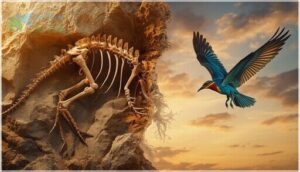
The fossil record is where the dinosaur-bird connection stops being theory and starts being something you can actually see.
Over the past century and a half, a handful of outstanding discoveries have made that case almost impossible to argue with. Here are the key fossil finds that changed how scientists think about where birds came from.
The Significance of Archaeopteryx
Few fossils in the entire fossil record stop scientists in their tracks quite like Archaeopteryx. Discovered in 1861, this creature from Late Jurassic Bavaria is the textbook case for transitional forms in bird origins — because it’s genuinely both things at once.
What makes Archaeopteryx so fascinating is how it blurs the line — a creature with feathers, wings, and surprisingly bird-like traits alongside the claws and teeth of its dinosaur ancestors.
Its dinosaur heritage shows clearly in three key features:
- Teeth and a long bony tail typical of theropod dinosaurs
- Clawed fingers alongside fully developed, asymmetrical flight feathers
- A furcula (wishbone) paired with a dinosaur-like hip structure
That combination is exactly what feather evolution and function studies predict you’d find bridging non-avian theropods and true birds — and Archaeopteryx delivers it almost perfectly.
Feathered Dinosaur Fossils From China
Archaeopteryx set the stage, but China’s Jehol Biota rewrote the whole script.
Preserved in lake sediments laid down roughly 120–133 million years ago, these Chinese discoveries gave us feathered theropod dinosaurs in stunning detail — from Sinosauropteryx’s filamentous coat to Microraptor’s four-winged anatomy.
Feather evolution, it turns out, started long before flight did, with insulation and display driving the earliest plumage.
Transitional Fossils and Their Traits
Think of transitional fossils as evolution caught mid-sentence. Each specimen documents a different chapter in theropod dinosaur evolution, and together they build an undeniable case.
- Anchiornis shows early wing development with feathered limbs but no breastbone keel
- Microraptor reveals four-winged flight experimentation in the fossil record
- Jeholornis captures beak formation alongside a still-reptilian tail
Skeletal adaptations and feather evolution didn’t happen overnight — they unfolded in stages.
Shared Anatomy Between Birds and Theropod Dinosaurs
The fossil record tells one story, but the bones themselves tell another — and it’s just as compelling.
When you look closely at theropod dinosaurs and modern birds side by side, the anatomical overlap is hard to ignore. Several key structural features make the connection almost impossible to dismiss.
Similarities in Skeletal Structure
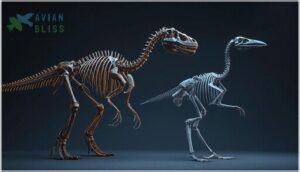
When you line up a theropod skeleton next to an early bird’s, the skeletal similarities are hard to ignore.
Joint alignment in the hip and ankle follows the same mechanical logic, and limb proportions across both groups reflect shared theropod dinosaur evolution.
Vertebral similarities, especially through the neck and sacrum, reinforce what phylogenetic analysis and systematics keeps confirming — these animals share a genuine evolutionary blueprint.
The Furcula (Wishbone) and Hollow Bones
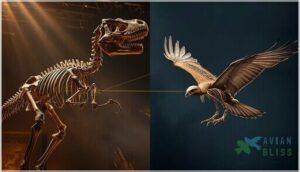
Two skeletal features — the furcula and hollow bones — do a lot of the heavy lifting in terms of linking theropods to modern birds.
Furcula formation traces back roughly 230 million years, appearing in basal theropods through midline fusion of the clavicles. Hollow bones followed a similar path, with air sacs invading bone interiors and slashing weight without sacrificing strength — critical skeletal adaptations that made wishbone evolution and avian anatomy possible.
Hand-to-Wing Evolution

The dinosaur hand didn’t disappear — it transformed. Early theropods carried five-fingered hands, but over millions of years, the outer digits vanished, leaving three elongated fingers. In Archaeopteryx, those fingers still bore claws.
Digit Transformation continued until bones fused into a carpometacarpus, enabling Wing Formation. Meanwhile, Wrist Mobility evolved through a specialized semilunate carpal, and Feather Evolution turned grasping limbs into true wings — Limb Modification at its most extraordinary.
Genetic and Developmental Evidence for a Dinosaur Origin
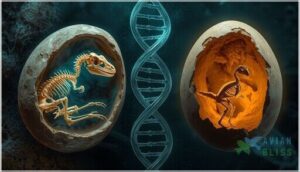
Fossils tell part of the story, but genes and developmental biology fill in the gaps that bones can’t.
Scientists have found striking molecular and embryological evidence that ties birds directly to their dinosaur ancestors.
Here’s what the research reveals.
Genetic Markers and Feather Development
The genetic links between dinosaurs and birds go deeper than bones.
Feather genomics reveals that keratin proteins in modern feathers are encoded by gene families that expanded in the shared ancestor of birds and turtles — a burst of gene expression that coincides with pennate feather origins.
Melanosome biology and developmental genetics confirm these molecular fingerprints connect avian characteristics to theropod lineages at a cellular level.
Paedomorphosis and Bird Skull Shape
Here’s something that might surprise you: adult bird skulls look more like baby dinosaurs than adult ones. That’s paedomorphosis at work — a developmental shortcut where juvenile traits carry into adulthood.
In bird evolution, this means Skull Development basically paused early, producing:
- Braincase Expansion beyond typical theropod adult proportions
- Facial Truncation, shrinking the snout and enabling Beak Formation
- Enlarged orbits supporting Cranial Kinesis
Paleontological discoveries confirm this juvenile dinosaur blueprint shaped avian characteristics we recognize today.
Comparative Genomics Studies
Skull shape offers one window into bird origins, but modern DNA sequencing opens another entirely.
Comparative genomics — sequencing whole genomes across dozens of bird and reptile species — confirms what fossils suggest. Phylogenetic analysis consistently places birds within theropod archosaurs, not alongside lizards or turtles.
Gene expression patterns and conserved regulatory sequences reveal deep molecular continuity, making the dinosaur-bird connection visible right down to your genome’s blueprint.
Evolutionary Adaptations Supporting The Dinosaur-Bird Link
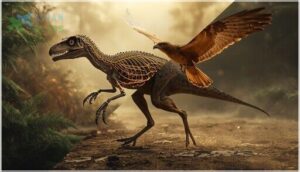
The fossil evidence is compelling, but the physical adaptations tell their own story.
Certain biological changes, shared across both groups, make the dinosaur-bird connection hard to dismiss. A few stand out as especially revealing.
The Role of Feathers in Flight and Insulation
Feathers didn’t start as flight tools — they likely began as insulation. In theropod dinosaurs, early feather structure trapped air near the skin, managing thermal regulation long before anything resembling flight mechanics existed.
Over time, those same structures became aerodynamically refined: asymmetrical vanes improved lift, interlocking barbules resisted air leakage, and the aerodynamic benefits stacked up. Understanding this reveals how evolutionary biology often repurposes one adaptation for something entirely new.
Evolution’s greatest trick was turning insulation into wings
Miniaturization and Lightweight Skeletons
Body size reduction didn’t happen overnight. Over roughly 50 million years, the theropods leading to birds kept shrinking — at least 12 consecutive lineages smaller than their ancestors.
That sustained miniaturization drove skeletal adaptations you can trace directly: hollow vertebrae, skeletal fusion into structures like the pygostyle, and forelimb evolution that shifted weight forward. Lighter, more agile — flight became mechanically possible.
Respiratory Systems and Endothermy
Shrinking bodies needed smarter breathing. Many theropods developed Air Sac Systems that pushed air through the lungs in Unidirectional Flow, keeping oxygen delivery high even during exhalation — just like modern birds do today.
Combined with Feather Insulation and elevated metabolism, this points toward full Avian Endothermy emerging gradually. Dinosaur Thermoregulation wasn’t a switch that flipped; it was a slow burn, perfected across millions of years of biological adaptation.
Frequently Asked Questions (FAQs)
What is the closest bird descendant to dinosaurs?
No single bird holds that title. All modern birds descend equally from maniraptoran theropods, making every species a living dinosaur.
Deep-branching paleognaths, like ostriches, simply preserve more primitive feathered ancestors’ traits.
How are birds descendants of dinosaurs if they went extinct?
They didn’t — not completely. The extinction myth misses one vital branch: avian dinosaurs survived.
The fossil record shows that small, feathered dinosaurs crossed the 66-million-year boundary, continuing the dinosaur legacy as modern birds.
Why do paleontologist think birds evolved from dinosaurs?
Paleontologists trace bird origins through the fossil record, where shared dinosaur traits — hollow bones, wishbones, feathers — reveal a clear evolutionary path from theropod dinosaurs, confirming a direct phylogenetic relationship.
Why did researchers think that dinosaurs were ancestors of birds?
The fossil record told the story first. Researchers noticed that ancient species like Archaeopteryx shared unmistakable dinosaur traits — clawed fingers, teeth, a bony tail — alongside clear bird features, making the evolutionary links impossible to ignore.
Are birds descended from dinosaurs?
Yes — birds are living theropod dinosaurs. The fossil record, avian anatomy, and feathered dinosaurs all confirm that bird evolution runs directly through the dinosaur traits of maniraptoran theropods.
What evidence supports the theory that birds are descendants of dinosaurs?
The evidence spans fossil records, skeletal similarities, feather evolution, and genetic links — all pointing to theropod dinosaurs as direct bird ancestors, with anatomical traits and evolutionary relationships between species confirming this across multiple scientific disciplines.
What dinosaur group did modern birds evolve from specifically?
Modern birds evolved from maniraptorans — a group of small, feathered theropods within the broader Theropod Clade.
More precisely, they sit inside Paraves, making them living descendants of the Avialae branch of the Dinosaur Lineage.
How long did it take for Archaeopteryx to acquire birdlike features?
Birdlike features in Archaeopteryx accumulated over roughly 30–40 million years within small coelurosaurs.
Feather development began long before flight, with the evolution timeline showing gradual skeletal and structural refinement across transitional forms.
What was the purpose of feathers when they first evolved?
Feathers didn’t start as flight tools. In early theropods, Feather Insulation came first — simple filaments trapping warmth.
Visual Display, Camouflage Tactics, and Brooding Behavior followed, each shaping feather evolution long before Aerodynamic Origins entered the picture.
What happened to the hands of theropod dinosaurs as they evolved into birds?
Theropod hands shrank and fused over millions of years. Digit reduction left only three fingers, wrist evolution added flexible folding, and forelimb transformation gradually shifted grasping claws into feather-supporting wings.
Conclusion
Watch a chicken embryo develop, and you’ll witness something astonishing: it briefly grows a long, reptilian tail before genetics pull it back. That developmental echo is exactly why paleontologists believe birds are descended from dinosaurs—the evidence isn’t just buried in ancient rock, it’s still running in living biology.
Fossils, proteins, and embryos all point the same direction. The dinosaurs didn’t vanish 66 million years ago. Some of them learned to fly.
- https://www.nhm.ac.uk/discover/how-dinosaurs-evolved-into-birds.html
- https://www.birdlife.org/news/2021/12/21/its-official-birds-are-literally-dinosaurs-heres-how-we-know/
- http://albertonykus.blogspot.com/2011/06/back-to-basics-maniraptor-feathers-part_13.html
- https://www.scientificamerican.com/article/how-dinosaurs-shrank-and-became-birds/
- https://www.sci.news/paleontology/science-evolution-theropod-dinosaurs-flying-birds-02085.html