This site is supported by our readers. We may earn a commission, at no cost to you, if you purchase through links.
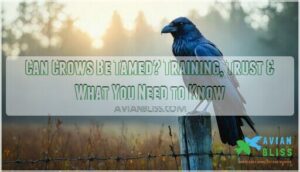 A crow watches you from a telephone wire, tilting its head as you walk by. Days later, that same bird dive-bombs your neighbor but leaves you alone—it remembered your face. These glossy-black corvids possess cognitive abilities that rival primates, crafting tools, solving multi-step puzzles, and holding grudges for years.
Their intelligence naturally raises the question: can crows be tamed? The answer isn’t a simple yes or no. While you can build trust with these wild birds through patience and consistent positive interactions, true domestication remains out of reach.
Understanding the difference between taming and domestication—and what crows actually need to thrive—will determine whether forming a bond with one of these exceptional creatures is something you should even attempt.
Table Of Contents
- Key Takeaways
- Crow Behavior and Intelligence
- Can Crows Be Domesticated?
- Taming a Crow: Essential Considerations
- Training a Crow: Techniques and Tips
- Long-Term Implications of Crow Domestication
- Frequently Asked Questions (FAQs)
- Can Crows be tamed?
- Can Crows Be Tamed as pet birds?
- Is it illegal to tame a crow?
- How do you tame a crow?
- Can You domesticate a crow illegally?
- How to tame a raven or crow?
- How long does it take to tame a wild crow?
- Can crows be kept with other domesticated birds together?
- What kind of diseases can crows transmit to humans easily?
- Are crows prone to escape if kept in aviaries outdoors?
- Conclusion
Key Takeaways
- Crows can be tamed through patient trust-building and consistent positive reinforcement, but true domestication remains impossible because they retain wild instincts, complex social needs, and biological traits that resist captivity.
- Their cognitive abilities rival primates—they craft tools, solve multi-step puzzles, remember human faces for years, and communicate through sophisticated vocal and body language systems that reflect tight-knit social networks.
- Legal barriers protect crows in most regions under wildlife laws like the Migratory Bird Treaty Act, making it illegal to keep them without permits, and ethical concerns arise from their need for massive flight space, mental stimulation, and flock dynamics that captivity can’t replicate.
- Successfully building a relationship with a wild crow demands months to years of offering food from a distance, respecting their boundaries, and accepting that some wildness will always remain—they’re partners, not pets.
Crow Behavior and Intelligence
Before you try to tame a crow, you need to understand what you’re dealing with. These birds aren’t your average backyard visitors—they’ve got the problem-solving skills of a primate, the social complexity of a wolf pack, and communication methods that rival some mammals.
So what is it about crows that makes them both incredible and tricky when it comes to earning their trust?
Problem-Solving Abilities in Crows
Watch a crow tackle a locked box, and you’ll see why scientists call them feathered geniuses. These birds don’t just react—they strategize, innovate, and outthink obstacles most animals can’t even recognize.
What sets crows apart cognitively:
- Metatool problems: New Caledonian crows link three separate actions to reach food, planning multiple steps ahead like a chess player.
- Tool innovation: They craft hooked sticks and value complex tools, keeping their best equipment safe for future challenges.
- Cognitive flexibility: Crows adjust strategies on the fly, transferring learned rules across brand-new situations.
- Numerical cognition: Some crows produce specific numbers of calls on command, matching abilities seen in human toddlers.
- Working memory: Their mental capacity rivals rhesus monkeys, letting them juggle multiple pieces of information simultaneously.
This avian intelligence means you can’t just entertain a crow with shiny objects—you’ll need puzzle feeders, rotating toys, and constant mental challenges to keep that sharp mind engaged. The ability to learn and adapt is evident in their animal intelligence capabilities, which are being further studied.
Complex Social Behaviors of Crows
If crows were just smart problem-solvers flying solo, they wouldn’t be half as fascinating—but the truth is, they’re living in intricate social networks that would make your family reunions look simple. Crow Flock Dynamics reveal dominance hierarchy structures where older birds mentor younger ones through social learning. Cooperative breeding means offspring stick around to help raise siblings—rare in avian intelligence and social structure studies. This crow behavior drives complex foraging strategies and territorial defense.
| Social Role | Behavior Pattern | Impact on Flock |
|---|---|---|
| Dominant Adults | Lead foraging, defend territory | Set crow social hierarchy rules |
| Helper Offspring | Assist with nest defense, food gathering | Enable cooperative breeding success |
| Juvenile Learners | Observe and mimic elders | Master survival through social learning |
| Mated Pairs | Maintain long-term bonds, coordinate hunting | Strengthen crow flock dynamics |
If you really want to grasp crow behavior, you need to look past the individual bird’s smarts—their real genius lies in the collective wisdom they share across generations.
Communication Methods of Crows
Once you understand how crows organize themselves socially, the next natural question is: how do they actually talk to each other—and what are they saying?
Studies show crows learn their calls, developing specific sounds for different moments—spotting danger, finding food, or identifying individuals. Sound is only part of the story, though.
Watch a crow long enough and you’ll notice they communicate through posture too: the angle of their wings, the tilt of their head, subtle movements that signal what they’re thinking.
Their communication toolkit breaks down into:
- Alarm calls with unique variations to identify specific predator types
- Mimicry behavior that confuses threats or imitates other species
- Postural displays conveying dominance, submission, or playful invitation
- Coordinated calling during mobbing events to recruit backup
It’s pretty wild when you think about it—corvids use communication strategies as sophisticated as what we see in primates.
Adaptability of Crows to Human Environment
While their communication skills are impressive, what really sets crows apart is how they’ve figured out that living alongside us—with all our chaos and contradictions—can actually work in their favor.
Urban crow habitats now thrive where most wildlife retreats. They’ve cracked the code on human-crow conflict by timing garbage raids perfectly and tolerating noise pollution that would drive other birds mad.
Their environmental adaptations include using traffic to crack nuts and memorizing delivery schedules—proof that crow urbanization isn’t just survival, it’s strategic brilliance in action.
Can Crows Be Domesticated?

The idea of turning a wild crow into a household companion sounds tempting, but the reality is far more complicated than most people expect.
Crows have been the subject of domestication attempts throughout history, yet they remain fundamentally wild creatures with needs that clash with captivity.
Let’s look at what actually happens when humans try to domesticate these intelligent birds.
History of Crow Domestication Attempts
For thousands of years, humans have tried their hand at crow taming, but true domestication never took root. Archaeological digs at Iron Age sites reveal crow bones scattered among settlements, while Vietnamese communities in the 1800s kept semi-domesticated crows for their smarts.
Yet these historical attempts at domesticating wild animals hit walls—Henry VIII even offered bounties for crow extermination in 1532, and domestication efforts faltered because crows refused to breed in captivity or conform to selective breeding like chickens did.
The challenges of crow domestication are further complicated by their complex crow behavior patterns.
Challenges of Domesticating Wild Crows
Trying to turn a wild crow into a pet is like asking a free spirit to trade the open road for a cubicle—their biology and psychology just aren’t wired for it. Here’s what makes crow domestication so tricky:
- Wild instincts trump training: Crows retain fierce independence that resists captivity challenges, no matter how patient you are.
- Crow stress management becomes impossible: Confined crows develop serious welfare concerns like feather plucking and depression.
- Legal barriers block taming efforts: Wildlife domestication laws protect these birds in most regions.
- Their social needs can’t be met: Crows require complex flock dynamics that captivity simply can’t replicate.
Comparison With Other Domesticated Bird Species
When you stack crows against truly domesticated species, the gap becomes striking. Only five bird species—chicken, duck, goose, pigeon, and turkey—have crossed the domestication history threshold, showing genetic changes and reduced aggression over generations.
Bird intelligence tells a different story: crows and parrots rival each other in problem-solving and avian socialization complexity, yet parrots adapt better to captivity while maintaining their smarts.
Urban adaptation? Crows excel at exploiting human environments without needing us, unlike chickens bred specifically for confinement. This species comparison reveals why crow domestication remains elusive—they’ve got the brains for bird training but lack the temperament that makes pet birds manageable.
Taming a Crow: Essential Considerations

If you’re serious about taming a crow, you can’t just wing it—these clever birds demand respect, preparation, and a clear understanding of what you’re getting into.
Before you get anywhere near a crow’s good side, four key factors will determine whether you build trust or blow it entirely.
Here’s what separates success from failure when befriending one of nature’s sharpest minds.
Building Trust With a Wild Crow
If you’ve ever watched a crow eye you from across a parking lot—sharp, calculating, maybe even judging your grocery choices—you already know these birds don’t hand out their trust like free samples. Building trust with a wild crow isn’t about breaking their spirit; it’s about earning a place in their world.
Earning a crow’s trust takes patience, consistency, and an understanding of their intricate social world. Want to start building that bond?
- Show up regularly with small food offerings—unsalted peanuts work wonders for trust building.
- Keep your distance initially, letting the crow approach on its terms during wild crow interaction.
- Move deliberately, avoiding sudden gestures that scream "threat" in crow language.
- Observe their signals—caws, head tilts, and body posture reveal everything about crow socialization readiness.
This is animal friendship on their schedule, not yours.
Creating a Suitable Environment for a Crow
You can’t just stick a crow in a cage and call it a day—these birds need space that honors their wild intelligence, not a prison that crushes it.
Your crow enclosures should span at least 10x10x8 feet, providing serious flight space for daily exercise. Load up on environmental enrichment—branches at varying heights, puzzle feeders, shiny objects to investigate.
Noise reduction matters too; crows despise chaos. Include socialization areas like windows for observing the world, because proper avian care means respecting their need to stay mentally connected to their wild roots.
Nutrition and Dietary Needs of Crows
Feeding a crow isn’t about tossing scraps—it’s about replicating the wild diversity their bodies actually need. Crow Diet Analysis shows their natural intake splits roughly 72% plant matter and 28% animal matter, which means your Nutrient Requirements must hit both categories hard.
Food Sources should include:
- Protein-rich insects like mealworms and crickets (nestlings need 1.81–16.32% crude protein)
- Unsalted nuts and seeds for healthy fats
- Fresh fruits and vegetables to round out their foraging strategies
Avoid processed foods—what really matters for keeping crows healthy is getting the right balance of protein and calcium through proper supplements.
This directly impacts their overall health and helps prevent disease.
Health Risks and Veterinary Care for Crows
A healthy crow is one thing, but keeping one healthy long-term is where most people hit a wall they didn’t see coming. Avian Diseases like West Nile Virus strike hard, and finding Veterinary Care from someone who actually knows Crow Care and Management isn’t easy.
Health Monitoring means catching parasites early, understanding Crow Nutrition inside-out, and having Disease Prevention protocols locked down. Wildlife Rehabilitation experts will tell you—without specialized Avian Health and Diseases knowledge, you’re flying blind with a bird smarter than your dog.
Training a Crow: Techniques and Tips
Training a crow isn’t about breaking their wild spirit—it’s about meeting them halfway with patience and respect.
If you want to actually connect with a crow, you need methods that work with their intelligence, not against it.
The techniques below tap into what these birds already do well—without trying to dominate them.
Positive Reinforcement Training Methods
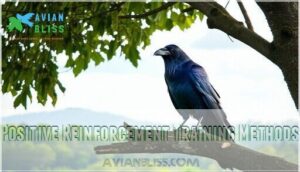
Training a crow isn’t about breaking its spirit—it’s about working with that fierce intelligence to build something that benefits both of you. Positive reinforcement through operant conditioning transforms taming a crow from a battle of wills into a partnership. You’re not forcing compliance—you’re building consistency and trust through reward systems that speak to their problem-solving nature.
The mechanics of behavioral modification break down into four essentials:
- Use high-value rewards: Nuts, insects, or shiny objects trigger genuine motivation during training sessions.
- Keep sessions short: Five to ten minutes prevents mental fatigue and maintains engagement.
- Time your rewards perfectly: Immediate reinforcement links behavior to consequence.
- Read their body language: A puffed crow or harsh caw means stop—respect their boundaries.
This approach honors their wild instincts while creating meaningful connection through animal training and education.
Clicker Training for Crows
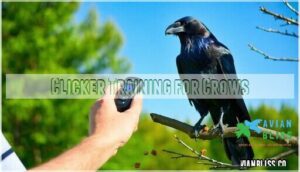
Clicker training takes positive reinforcement up a notch by giving you a precise way to mark the exact moment your crow nails the behavior you’re after. You’ll need clicker basics: pair the click with treats until your crow connects the sound to reward systems. That’s the foundation of behavioral modification.
Once they’ve got it, you can shape complex actions—crow psychology thrives on this clarity. These training tools make taming a crow feel less like guesswork and more like conversation, transforming animal training and education into real partnership through taming and training crows with precision timing.
Target Training for Crows
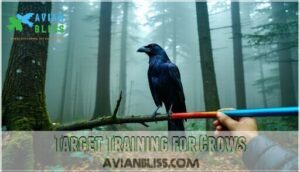
Once your crow has mastered the click-and-treat connection, it’s time to introduce a physical target—a simple tool that turns vague commands into crystal-clear communication. Start with a colored stick or ball, and each time your crow touches it, click and reward.
That’s crow targeting at work—precision behavioral conditioning that builds flight control and focus. Through consistent training sessions and smart reward systems, you’re not just taming a crow; you’re unlocking deeper bird behavior and psychology, proving that animal training and domestication thrives on clarity and trust in taming and training crows.
Addressing Behavioral Issues in Crows
Even the smartest crow can throw you a curveball—screaming fits, surprise dive-bombs, or swiping your lunch the second you look away—but here’s the truth: most bad behavior isn’t rebellion, it’s communication. Understanding crow psychology and avian cognition and social behavior means recognizing boredom, stress, or crow social hierarchy disputes.
Combat issues through environmental enrichment—puzzle feeders, varied perches—and behavioral therapy techniques like redirecting aggression toward toys. Stress management matters: quiet spaces and consistent routines support social rehabilitation, proving animal behavior thrives on patience, not punishment.
Long-Term Implications of Crow Domestication

Before you bring a crow into your life, you need to understand what you’re really signing up for. These birds don’t just need a cage and some seeds—they demand space, social interaction, and a lifetime commitment that most people underestimate.
Here’s what crow ownership actually involves, from daily housing needs to the wider conservation issues at play.
Space and Housing Requirements for Crows
If you’re serious about keeping a crow happy long-term, you can’t just wing it regarding space—these birds need room to actually be birds. We’re talking a minimum enclosure of 10x10x8 feet with solid flight space, sturdy perches at varying heights, and enrichment items like puzzles and foraging opportunities.
Proper enclosure design isn’t optional—it’s the foundation of ethical bird keeping and care.
Socialization and Interaction Needs of Crows
Here’s the thing about crows: they’re not wired to be loners, and if you ignore their social nature, you’re setting yourself up for a miserable bird and a world of trouble. Crow bonding isn’t just about befriending crows with treats—it’s about understanding their complex social learning patterns and crow behavior. In the wild, they thrive in tight-knit flocks where human-crow interaction naturally occurs through observation and adaptation.
Your crow needs:
- Daily human interaction that respects their animal intelligence and independence
- Environmental enrichment like puzzle feeders that challenge their problem-solving skills
- Opportunities for social learning through mirrors or visual contact with wild crows
- Mental stimulation that mimics natural flock dynamics and communication
- Consideration for wild release if socialization needs can’t be met long-term
Without proper attention to these needs, crow domestication becomes captivity—and that’s when behavioral problems spiral.
Potential Risks to Human Safety and Property
Let’s be real—inviting a crow into your life isn’t just about bonding and birdseed; it’s about accepting that these clever, independent birds can turn your world upside down in ways you never saw coming.
Crow attacks on perceived threats aren’t rare—these birds remember faces and can hold grudges. Property damage from their strong beaks and claws is practically guaranteed. Noise pollution? Try listening to territorial calls at dawn.
Disease transmission remains a legitimate concern, requiring strict safety precautions and compliance with wildlife laws and regulations that govern wildlife management practices.
Conservation Implications of Crow Domestication
Domestication doesn’t just affect individual birds—it sends ripples through entire ecosystems. When you remove crows from their crow habitat, you’re pulling threads from a delicate web. Research shows increased crow populations correlate with declining threatened species due to nest predation, yet removing birds for captivity disrupts ecological balance too.
Consider the paradox:
- Genetic diversity suffers when wild populations lose breeding individuals, potentially weakening biodiversity protection
- Wildlife preservation efforts clash with personal desires, raising thorny conservation ethics questions
- Wildlife laws and regulations exist precisely because animal domestication and taming can undermine wildlife conservation goals
Responsible conservation efforts mean appreciating crows where they belong—wild and free.
Frequently Asked Questions (FAQs)
Can Crows be tamed?
You’d think birds that can solve puzzles and remember human faces would resist taming, yet wild crow trust builds surprisingly well through patient, consistent interaction.
Though true crow domestication remains ethically complex and legally restricted in most regions.
Can Crows Be Tamed as pet birds?
Technically, you can’t keep crows as pet birds—most wildlife laws prohibit it, and these wild minds resist confinement. Bird domestication demands generations of selective breeding, something crow socialization with humans hasn’t achieved.
While animal friendship and bonding with crows happens, avian psychology shows they thrive free, making true crow domestication impractical and often illegal, raising serious bird welfare and wildlife conservation concerns.
Is it illegal to tame a crow?
In many places, yes—it’s illegal. The Migratory Bird Treaty Act protects crows across North America, making domestication without wildlife permits a federal offense.
Even with authorization, taming consequences include legal implications and violations of wildlife conservation laws that carry serious penalties.
How do you tame a crow?
Winning a wild crow’s trust isn’t about caging freedom—it’s about earning respect.
Start by offering consistent food in a safe spot, moving slowly, and letting the crow set the pace. Patience and predictability build trust over weeks or months.
Can You domesticate a crow illegally?
Yes, you can physically domesticate a crow, but it violates the Migratory Bird Treaty Act and state Wildlife Laws in most regions.
The Illegal Pet Trade undermines Crow Conservation efforts, threatens Avian Welfare, and carries serious legal consequences for Wildlife Interaction and Management.
How to tame a raven or crow?
Building trust with wild corvids—crow or raven—starts with patience, not possession.
Taming requires consistent food offerings from a distance, letting the bird approach you on its terms, respecting boundaries, and understanding that true avian bonding happens through mutual respect, not domestication or confinement.
How long does it take to tame a wild crow?
Patience is your best friend here—taming a wild crow takes anywhere from several months to over a year.
Trust building happens on their schedule, not yours, so consistency matters more than speed. Move slowly, respect their wariness, and let the crow dictate the pace.
Can crows be kept with other domesticated birds together?
Flock dynamics with crows? You’re entering risky territory. These intelligent birds are fiercely competitive and territorial—mixing them with pet birds like parakeets or canaries creates serious avian compatibility issues.
Crows may view smaller species as threats or prey, making safe coexistence strategies nearly impossible without constant wildlife expert supervision.
What kind of diseases can crows transmit to humans easily?
You risk exposure to several pathogens when interacting with crows. Histoplasmosis from crow droppings poses a real danger, especially in poorly ventilated areas.
West Nile Virus and Avian Influenza can spread through direct contact, while crow parasites like mites occasionally jump to humans during close Human-Crow Interaction and Bonding situations.
Are crows prone to escape if kept in aviaries outdoors?
Crows are notorious escape artists. Their intelligence and problem-solving abilities make outdoor enclosures risky unless you’ve designed an escape-proof aviary with reinforced welded wire, secure latches, and overhead netting.
Wildlife experts emphasize proper avian security measures.
Conclusion
Taming a crow is like earning a PhD in patience—it’s not impossible, but it demands respect for the bird’s wild nature. While you can build a striking bond through consistent trust-building and positive reinforcement, these intelligent corvids will never be house pets in the traditional sense.
The real question isn’t whether crows can be tamed, but whether you’re prepared to meet them on their terms, honoring their intelligence and autonomy while accepting that some wildness will—and should—always remain.
Taming a crow means meeting them on their terms—honoring their intelligence while accepting that some wildness will always remain
- https://www.technologyreview.com/2022/10/31/1062370/how-to-befriend-a-crow-crowtok-tiktok/
- https://pmc.ncbi.nlm.nih.gov/articles/PMC7996111/
- https://urban.uw.edu/news/crows-hold-grudges-against-individual-humans-for-up-to-17-years/
- https://www.animalbehaviorandcognition.org/article.php?id=1286
- https://www.junehunter.com/blogs/nature/how-to-make-friends-with-crows