
This site is supported by our readers. We may earn a commission, at no cost to you, if you purchase through links.
 Tucked into the scrub oak and pinyon-juniper slopes of the Interior West lives a warbler that most birders overlook—not because it’s rare, but because it masters the art of invisibility. Virginia’s Warbler flits through dense chaparral between 6,000 and 9,000 feet, its gray plumage blending seamlessly with sun-bleached branches and rocky terrain.
While warblers like the Yellow Warbler announce themselves with bright feathers and conspicuous behavior, this species reveals itself through subtlety: a flash of yellow undertail coverts, the faint russet crown of a breeding male, or a sharp chip note cutting through mountain silence.
Understanding how to identify this cryptic bird—and recognize the high-elevation habitats it depends on—unlocks access to one of western North America’s most understated yet ecologically significant passerines.
Table Of Contents
- Key Takeaways
- Identification and Physical Characteristics of Virginia’s Warbler
- Habitat and Range of Virginia’s Warbler
- Breeding Behavior and Nesting Habits
- Feeding Ecology and Diet of Virginia’s Warbler
- Conservation Status and Population Trends
- Frequently Asked Questions (FAQs)
- What is the difference between Nashville and Virginia’s warbler?
- Are there warblers in Virginia?
- What is the rarest warbler in the United States?
- How did the Virginias Warbler get its name?
- What are the main threats to Virginias Warbler populations?
- How long do Virginias Warblers typically live?
- Do Virginias Warblers form flocks during migration?
- What are the primary predators of Virginias Warblers?
- What predators hunt Virginias Warbler in the wild?
- How long does Virginias Warbler typically live?
- Conclusion
Key Takeaways
- Virginia’s Warbler thrives in dry, high-elevation scrublands (6,000–9,000 feet) across the Interior West, where its cryptic gray plumage and subtle yellow undertail coverts make it one of North America’s most overlooked warblers despite its ecological significance in pinyon-juniper and scrub oak habitats.
- The species undertakes remarkable nocturnal migrations exceeding 2,000 kilometers between western U.S. breeding grounds and Mexican wintering sites, yet faces a devastating 46% population decline since 1968 due to habitat loss, fragmentation, and climate-driven range contractions projected to eliminate 86% of suitable habitat by 2080.
- As specialized insect hunters, these warblers employ diverse foraging strategies—gleaning, aerial hawking, and ground-level hunting—while shifting their diet seasonally from 95% insects during breeding to 50% plant material in winter, demonstrating remarkable ecological adaptability that sustains their role in arthropod regulation and inadvertent pollination.
- Despite current "Least Concern" status, the species requires urgent conservation intervention as habitat degradation from livestock clearing, bark beetle infestations, and altered fire regimes compounds climate pressures, threatening breeding success across core New Mexico populations that represent nearly one-third of the global breeding range.
Identification and Physical Characteristics of Virginia’s Warbler
Spotting Virginia’s Warbler in the field means knowing what separates it from other warblers in the western scrublands. You’ll need to focus on specific markers—plumage patterns, body proportions, and vocal signatures that reveal its identity even when it’s moving through dense brush.
Here are the key identification features that confirm you’re watching this elusive mountainside specialist.
Plumage and Coloration
If you’re scanning the mountainsides of the Southwest for this elusive warbler, knowing what to look for can mean the difference between a fleeting glimpse and a rewarding observation.
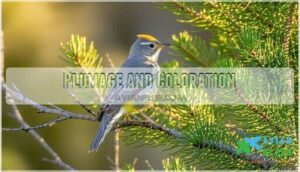
Virginia’s Warbler plumage exhibits understated elegance—watch for these diagnostic features during warbler identification:
- Gray dorsal surfaces contrasting with paler ventral regions and conspicuous white orbital rings
- Yellow undertail coverts visible in all plumages, with adult males displaying yellow pectoral wash
- Rufous crown patch in breeding plumage males, though often concealed
The tail feathers show subtle variation, while wing bars remain inconspicuous—critical distinctions from sympatric species.
Size and Shape
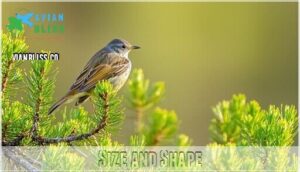
Beyond the subtle coloration patterns that characterize this species, Virginia’s Warbler’s diminutive stature and body proportions offer equally valuable identification criteria in the field. You’ll measure this warbler at roughly 4–4.25 inches—comparable to sparrow dimensions but with distinctly different morphometrics.
| Feature | Measurement/Description |
|---|---|
| Body Length | 4–4.25 inches (10–11 cm) |
| Wing Length | Relatively short, compact |
| Tail Structure | Notched to square-tipped |
Its slender, pointed beak works perfectly for plucking insects from leaves and branches.
Studies show these compact proportions let the bird move nimbly through thick chaparral, foraging efficiently among scrub oak and pinyon-juniper.
Distinctive Features

While size and shape provide the foundational metrics for identification, you’ll find that Virginia’s Warbler’s diagnostic field marks—those subtle yet unmistakable visual signatures—truly clinch a positive identification in the brushy terrain it inhabits. The most conspicuous facial markings include bold white eye rings that contrast sharply against gray plumage patterns. You’ll notice these distinctive features across warbler species:
- Vibrant yellow undertail coverts that flash during foraging
- Rufous crown patch on breeding males
- Yellow chest wash—prominent in adult males, faint in females
- Slender beak shape adapted for insect capture
- Greenish-yellow rump visible in flight
These color variations and avian habitat adaptations make bird species information critical for accurate virginias warbler identification and physical characteristics assessment.
Song and Call Notes
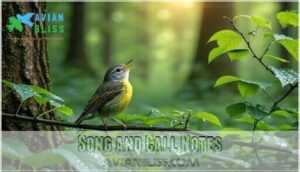
If you’ve spotted those white eye-rings and yellow undertail coverts, your ears might be the next tool to confirm what you’re seeing—Virginia’s Warbler delivers a surprisingly bold acoustic signature for such a secretive brush-dweller.
Listen for the distinctive patterns in its song: a quick, lively trill—"seedle-seedle-seedle"—that rings out through thick chaparral during the breeding season.
That spirited sound pulls double duty out in the wild, both declaring territory and catching a mate’s attention.
You’ll also detect call variations, including a distinctive sharp "tsick" or "plink" note. These acoustic features make bird species information accessible even when foliage obscures visual confirmation, supporting conservation efforts through reliable acoustic monitoring of this warbler’s populations.
Comparison With Similar Species
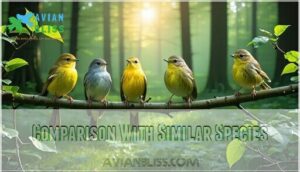
Morphological comparison reveals telling distinctions you’ll recognize in the field. Virginia’s Warbler (10–11 cm) displays a gray overall plumage, contrasting with Nashville Warbler’s olive-green back and brighter yellow underparts. Both Wood Warblers share white eye-rings, yet behavioral contrasts emerge: Virginia’s tail-pumping habit and mid-canopy foraging differ from Nashville’s shrubby undergrowth preference.
Habitat divergence further separates these New World warbler species. Virginia’s favors arid pinyon-juniper zones, while Nashville occupies moist deciduous forests, enabling species coexistence through ecological interactions that minimize direct competition. The Virginia’s Warbler is often found in its western United States habitats, which provide a unique environment for the species.
Habitat and Range of Virginia’s Warbler

If you want to track down Virginia’s Warbler, you’ll need to know where it calls home throughout the year. This species doesn’t stick to one place—it migrates between distinct breeding and wintering grounds, each with specific habitat requirements.
Here’s where you’re most likely to spot this elusive warbler and what kind of terrain it prefers.
Breeding Habitat Preferences
Virginia’s Warblers don’t just settle for any mountainside—they’ve carved out a niche in some of the West’s most rugged, sun-baked terrain. You’ll find their breeding grounds scattered across dry slopes where scrub oak, chaparral, and pinyon-juniper form dense, low tangles.
Habitat selection hinges on vegetation density and terrain features—these warblers need thick brush for nesting sites and foraging cover. They’re creatures of elevation, breeding between 6,000 and 9,000 feet where mountain mahogany and Gambel oak dominate, creating ideal breeding and feeding zones that support their insect-rich diet.
Migration Patterns
Every fall, Virginia’s Warblers begin remarkable nighttime journeys that carry them more than 2,000 kilometers from their western breeding grounds to wintering sites in Mexico.
Their migration unfolds in three key phases:
- August departures from breeding grounds, with peak southward movements from mid-August through early October
- Nighttime flight patterns launching 30–45 minutes after sunset, following geographic corridors through Arizona, New Mexico, and Texas
- Strategic stopover sites in streamside woodlands and mid-elevation forests for refueling along avian migration routes
These seasonal movements trace the Sierra Madre Occidental’s inland corridors, avoiding coastal regions entirely. Spring migration reverses the pattern, with arrivals back on breeding grounds occurring from late April to mid-May—a demonstration of their navigational precision across vast southwestern landscapes. The species’ breeding habits are closely tied to specific mountain habitats that support their unique life cycle.
Wintering Grounds
When Virginia’s Warblers touch down in their Mexican strongholds each winter, they’re not just escaping the cold—they’re claiming territories in a completely different ecological theater where survival depends on mastering mid-elevation scrublands stretching from Nayarit to Oaxaca.
These wintering grounds offer critical food sources—caterpillars, beetles, and spiders hidden in dense vegetation—that fuel their climate adaptation strategies. You’ll spot them foraging low, usually within 15 feet of the ground, exploiting the same avian migration corridors their ancestors have navigated for millennia.
Yet habitat loss and climate change now threaten these essential Mexican refuges, compressing their geographic range and jeopardizing future migration patterns.
Geographic Distribution
If you’re mapping the breeding strongholds of this elusive warbler, you’ll trace a distinctive arc through the American Southwest—a geographic fingerprint that reveals how topography and climate conspire to shape avian distribution patterns.
Your field surveys will concentrate in New Mexico, Colorado, Utah, Nevada, and Arizona—the core breeding grounds where these warblers establish territories.
During migration routes southward, they funnel through western United States corridors before reaching their wintering areas in southwestern Mexico, primarily Nayarit through Oaxaca. This distribution and range reflects their adaptation to specific elevation zones and regional variations in scrub-oak habitats.
Elevation and Vegetation Types
You’ll discover that elevation dictates everything for Virginia’s Warblers—these birds have carved out a vertical niche that’s as specific as a fingerprint, thriving in dry scrublands perched between 6,000 and 9,000 feet where the air thins and few other warblers dare to compete.
Your field observations across these elevation gradients will reveal distinct vegetation zones: scrub oak anchoring lower mountain slopes, chaparral forming dense tangles mid-elevation, and pinyon-juniper woodlands dominating higher terrain features—a mosaic where habitat fragmentation threatens these woodwarblers’ geographic distribution and demands urgent habitat preservation.
Breeding Behavior and Nesting Habits
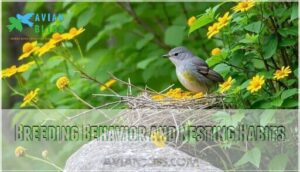
Virginia’s Warbler’s breeding life remains one of ornithology’s intriguing mysteries—its secretive nesting habits make observation a challenge even for seasoned field researchers.
Studying this species requires patience and sharp eyes, as the bird conceals its nest deep within dense scrub where few ever venture.
From courtship displays to fledgling flight, researchers have pieced together key stages of the bird’s reproductive cycle.
Courtship and Pair Formation
Male Virginia’s Warblers launch their spring courtship with persistent singing from exposed perches, advertising both territorial boundaries and genetic fitness to prospective mates through complex, cascading trills that echo across dry mountainsides.
Females evaluate these vocal performances carefully—mate selection hinges on song complexity and territorial quality.
Once pair bonding occurs, males perform courtship displays, including wing-fluttering and chase flights through dense chaparral. These breeding strategies optimize reproductive success in their challenging scrubland habitat.
Nest Construction and Placement
After courtship rituals seal the pair bond, the female assumes primary responsibility for nest architecture—a cryptic ground structure that ornithologists have historically struggled to locate despite the species’ abundance across western ranges.
On steep hillsides and talus slopes, she builds a cup-shaped nest, carefully layering materials into a secure home.
Through skillful construction, she turns breeding sites into safe havens where her eggs and chicks will be protected.
- Coarse grass forms the structural foundation
- Bark strips provide flexible reinforcement
- Plant roots add architectural stability
- Moss creates thermal insulation
- Fine animal hair lines the interior for egg camouflage
This ground-nesting strategy reflects habitat and distribution patterns across dry mountainsides.
Egg Laying and Incubation
Following construction of this concealed ground nest, the female deposits a clutch of 3-6 smooth eggs—each cream-colored with distinctive reddish-brown speckles that ornithologists recognize as diagnostic breeding evidence. Egg formation proceeds rapidly during the early breeding season, with egg laying occurring daily until clutch size reaches completion.
The female shoulders incubation duties for approximately 12-13 days, maintaining precise thermal regulation critical for embryonic development. These incubation periods directly influence nesting success and fledgling rates, linking breeding characteristics to population viability across the species’ western range.
Parental Care and Fledgling Period
Both parents sustain parental care through nestling growth and the fledgling development phase, delivering parental feeding at peak rates during early to mid-July. Nestlings fledge after 10–14 days, but post-fledging care extends for several weeks, as observed through adults provisioning insects to dependent juveniles.
This extended investment in breeding characteristics directly influences brood survival, though predation from jays and infrequent cowbird parasitism challenge nesting habits. Feeding and breeding behaviors converge during this critical window, shaping population recruitment across western mountainsides.
Breeding Season Timeline
Virginia’s Warbler orchestrates its breeding cycle across a compressed 10–12 week window, from mid-May arrival through late July fledging, synchronized precisely with peak insect abundance on western montane slopes. You’ll observe these breeding patterns unfold through distinct fledgling stages:
- Territory establishment and mating rituals commence immediately upon arrival
- Nest construction and egg-laying occur throughout late May and early June
- Incubation periods span approximately 12 days
- Nesting cycles conclude with fledging after 10–14 days in the nest
This breeding season demonstrates how breeding and feeding habits converge—nesting habits align with caterpillar emergence, ensuring maximum breeding behavior and nesting habits success.
Feeding Ecology and Diet of Virginia’s Warbler

Virginia’s Warbler doesn’t just survive in dry western scrublands—it thrives there as an insect-hunting specialist. Understanding what these warblers eat and how they capture their prey reveals why they’re so at home in seemingly harsh habitats.
Their feeding strategies, seasonal diet shifts, and ecological importance paint a complete picture of their survival toolkit.
Primary Food Sources
When you’re watching these birds dart through the scrub oak, you’ll notice they’re basically scanning every leaf and twig for their next meal—and that meal is almost always an insect.
Their dietary habits reveal a specialized feeding ecology focused on small invertebrates—caterpillars, beetles, flies, spiders, and aphids dominate their menu. This insect prey fuels their role in food chains and nutrient cycling throughout their mountain habitats.
Foraging Techniques and Behavior
These warblers are relentless hunters, always on the move with a varied arsenal of tactics that any predator would envy. Watch how they work their territory with strategic precision:
- Gleaning insects from foliage and twigs with precision during breeding season
- Ground-level foraging, scanning leaf litter for hidden prey
- Aerial hawking to capture flying insects mid-flight
- Probing buds and flowers for concealed invertebrates
- Low-elevation hunting within 15 feet of ground during winter months
These feeding habits demonstrate impressive behavioral plasticity in insect capture, essential for bird conservation efforts monitoring dietary habits and feeding ecology.
Seasonal Dietary Changes
You’d be surprised how dramatically this warbler’s menu shifts across the calendar. Over 95% of the spring diet consists of insects—caterpillars dominate the breeding season buffet—yet by fall migration, up to 80% of droppings contain fruit residues. During winter in Mexico, insect abundance drops and diet composition shifts to roughly 50-60% insects supplemented by nectar and plant material.
This seasonal dietary flexibility reflects intricate feeding ecology adaptations tied directly to migration patterns and energy reserves:
- Spring protein surge: 25+ insect prey items captured per hour during peak migration
- Autumn carbohydrate loading: fruit consumption quadruples body mass in fresh weight daily
- Pre-migratory fat storage: energy intake reaches 60 kJ/day, up from 50 kJ baseline
- Winter season foraging: nectar feeding peaks at 15% of observations during floral abundance
Adaptations for Insect Capture
If you’ve ever watched a warbler work a shrub for prey, you’ll recognize the intricate morphological toolkit evolution handed this species for capturing arthropods on the wing and among foliage. Bill shape features a slender, fine-tipped structure perfectly engineered for extracting caterpillars from tight crevices.
Visual acuity allows detection of cryptic insects at 15-meter distances, while rictal bristles flanking the beak structure function as sensory guides during rapid insect pursuit.
These insect-eating machines don’t just hunt—they’re weaving through branches with feather adaptations that reduce drag during mid-air sallies, optimizing foraging efficiency across Virginia’s Warbler’s feeding ecology and diet spectrum.
Role in Ecosystem
Virginia’s Warblers do more than catch your eye with their yellow-marked feathers—they’re actually vital players in dry-scrub ecosystems.
They bridge insect populations with predators higher up the food chain while unintentionally helping plants through pollination and seed dispersal as they forage.
Their ecosystem engineering impact manifests through three mechanisms:
- Arthropod regulation maintaining food web dynamics across breeding territories
- Pollination services during bud-probing foraging bouts
- Habitat modification supporting biodiversity conservation through species interactions
These avian taxonomy specialists demonstrate how wildlife conservation and habitat conservation efforts protect entire ecological networks.
Conservation Status and Population Trends
Virginia’s Warbler faces real challenges that need your attention if you care about keeping this species around. While it’s not in immediate danger, surveys show populations declining across its range.
Here’s what’s threatening these birds and what you can do to help protect them.
Current Conservation Classification
The IUCN Red List currently classifies Virginia’s Warbler as Least Concern, a designation that sounds reassuring but doesn’t tell the whole story. While this IUCN Status suggests the species isn’t immediately threatened, Partners in Flight has placed it on their Yellow List—a warning signal for declining populations across its range.
Recent surveys reveal a steady population decrease, prompting ornithologists to advocate for enhanced habitat protection and biodiversity preservation measures. This species’ vulnerability underscores how conservation efforts must address both immediate threats and long-term climate resilience challenges before intervention becomes critical.
Threats to Virginia’s Warbler Populations
Over 46% of Virginia’s Warblers vanished between 1968 and 2019—numbers that should stop you in your tracks. Habitat Loss drives this decline as clearing for livestock and firewood strips away pinyon-juniper woodlands, particularly across New Mexico where nearly a third of the global population breeds.
Habitat Fragmentation amplifies nest predation, while Invasive Species like Cheatgrass degrade native understory critical for foraging. Pesticide Use indirectly starves warblers by decimating arthropod prey, and neonicotinoids disrupt reproductive success.
Human Disturbance through controlled burns—ironically intended as management—reduces nest sites and triggers local population crashes. Habitat Degradation accelerates as persistent drought and bark beetle infestations compound these Conservation Status and Threats, jeopardizing both breeding grounds and migration corridors.
Climate Change Impacts
Projected range losses of 86% by 2080 illustrate how Climate Change upends survival for Virginia’s Warblers. Temperature Rise has already pushed southwestern habitats 1°F warmer since the 20th century, with days exceeding 100°F multiplying.
Weather Patterns now swing between prolonged drought and extreme storms—both devastating nest success. Ecosystem Disruption cascades as altered vegetation productivity starves fledglings, while shifting Sea Level and Climate Shift force mountain shrublands toward collapse.
These Climate Change Impacts compound existing Habitat Loss, threatening an Environmental Impact that could erase half the species’ range and worsen its Conservation Status.
Habitat Loss and Fragmentation
As humans clear mountainsides for crops and firewood, they’re slicing up the scrubby terrain Virginia’s Warblers depend on—leaving behind isolated fragments too small to support healthy breeding groups.
The result? A chain reaction of habitat problems.
- Edge Effects expose nests to higher predation rates and temperature extremes
- Corridor Fragmentation severs pathways between isolated breeding sites
- Habitat Degradation from bark beetle infestations weakens vegetation structure
- Wildlife Corridors vanish as development tightens its grip
Such fragmentation effects intensify ecosystem disruption, leaving these warblers stranded on habitat islands. Without intact landscapes, habitat destruction accelerates the species’ decline—a pattern demanding urgent conservation strategies.
Conservation Efforts and Management Strategies
Wildlife Preservation Efforts are gaining ground through targeted Habitat Restoration. Retention of oak and shrub understory sustains one breeding pair per 40 acres.
Conservation Planning under Partners in Flight coordinates Species Monitoring via Breeding Bird Survey data, tracking the 1.1% annual decline.
Wildlife Management integrates prescribed fire with adaptive thresholds, balancing short-term nest loss against long-term vegetation recovery.
Ecosystem Protection priorities maintain occupancy in designated habitat blocks, ensuring Warbler Conservation Status improvements through multi-agency collaboration and private landowner outreach across core breeding ranges.
Frequently Asked Questions (FAQs)
What is the difference between Nashville and Virginia’s warbler?
Both Nashville warblers and Virginia’s Warbler share gray plumage, but look closer—the rufous crown patch sets Virginia’s apart. Nashville warblers breed farther east and lack this chestnut feature, making Species Distinction straightforward for careful Bird Identification during Warbler Migration across their separate ranges.
Are there warblers in Virginia?
You’ll discover over forty warbler species during Warbler Migration in Virginia, particularly Yellow-rumped, Black-and-white, and Common Yellowthroat across diverse Eastern Warblers habitat.
Virginia’s Warbler from the Western United States, however, doesn’t occur here despite its misleading name—it was named for Virginia Anderson.
What is the rarest warbler in the United States?
Like a needle in an ornithological haystack, Kirtland’s Warbler (Setophaga kirtlandii) represents the rarest warbler species in the United States.
You’ll encounter this critically endangered species nesting almost exclusively in young jack pine forests of Michigan, with limited populations extending into Wisconsin and Ontario—a stark contrast to Virginia’s Warbler, which maintains Least Concern conservation status.
How did the Virginias Warbler get its name?
Named after Virginia Anderson, wife of the military surgeon who collected the type specimen in New Mexico during 1858, this species bears the taxonomic designation Leiothlypis virginiae.
Spencer Baird formally described the bird, establishing its place in ornithological nomenclature and taxonomy history.
What are the main threats to Virginias Warbler populations?
When you’re studying threatened bird species, habitat loss is probably the biggest problem you’ll face.
Climate change makes things worse—ongoing droughts, shifting fire patterns, and damaged ecosystems all interfere with where these birds breed.
Human activities like clearing for agriculture and fragmentation impacts further isolate populations, which surveys indicate decline approximately 2% annually despite current conservation efforts.
How long do Virginias Warblers typically live?
You’re wondering about longevity in these birds. While Longevity Studies remain limited, most small passerines show similar Mortality Rates—wild Virginia’s Warblers usually survive two to five years, though some individuals reach seven years through effective Survival Tactics.
Do Virginias Warblers form flocks during migration?
Flocking together isn’t exactly their migration "flock-te." You’ll find that Virginia’s Warblers primarily undertake their migratory routes as solitary travelers, moving through the night independently.
However, during daylight foraging periods, these warblers may join loose, temporary groups with other migrants, allowing efficient insect capture while maintaining relatively solitary traveling behavior throughout their journey.
What are the primary predators of Virginias Warblers?
Predator Avoidance strategies prove critical as hawks, owls, snakes, and weasels pose significant threats and migration risks. Nest Predators exploit dense chaparral cover, while Hawk Attacks and Snake Threats target vulnerable fledglings.
Understanding these Feline Encounters is essential for Virginia’s Warbler conservation.
What predators hunt Virginias Warbler in the wild?
Hawks swoop down from above, snakes slither through dense brush, and even feral cats stalk these insect-eating machines—making survival a constant challenge.
Habitat loss amplifies these threats, leaving warblers more exposed to avian competitors and invasive species.
How long does Virginias Warbler typically live?
You won’t find extensive Longevity Studies on this species, but banding data suggests most Virginia’s Warblers live 2-4 years in the wild.
Survival Tactics against predators and harsh conditions influence Mortality Rates markedly, while Population Trends reflect these Lifespan Factors across their breeding range.
Conclusion
Like a quiet thread woven through the West’s mountain tapestry, Virginia’s warbler reminds you that mastery lies not in spectacle but in adaptation.
You’ve learned to recognize its muted elegance, decode its habitat preferences, and understand the ecological pressures reshaping its future.
Whether you’re scanning chaparral slopes or tracking migration corridors, this warbler teaches a fundamental truth: sometimes the species that demand your closest attention are the ones that disappear most easily into the landscape they call home.