This site is supported by our readers. We may earn a commission, at no cost to you, if you purchase through links.
Most birders call it the ring-necked duck, then spend ten minutes at the water’s edge searching for a ring around its neck that’s barely visible in the field. That copper-tinged collar—nestled against glossy black feathers—inspired the name, yet the bold white ring encircling its gray bill is what actually catches your eye.
It’s a small irony that has followed this species since Wilson first described it in 1813.
A compact diving duck of boreal marshes and quiet winter ponds, the ring-neck rewards patient observation with sharp field marks and surprisingly intricate behaviors that go well beyond a misleading name.
Table Of Contents
- Key Takeaways
- What is a Ring-Necked Duck?
- How to Identify Ring-Necked Ducks
- Ring-Necked Duck Habitat and Range
- Ring-Necked Duck Diet and Feeding
- Ring-Necked Duck Behavior and Flight
- Ring-Necked Duck Breeding Cycle
- Ring-Necked Duck Conservation Status
- Frequently Asked Questions (FAQs)
- Are ring neck ducks rare?
- What is another name for Ring-necked Duck?
- What kind of duck has a ring around its neck?
- What is the difference between Ring-necked Duck and tufted duck?
- What is the average lifespan of a Ring-Necked Duck?
- How do Ring-Necked Ducks protect themselves from predators?
- Can Ring-Necked Ducks be found in urban environments?
- What is the purpose of the Ring-Necked Ducks distinctive call?
- Are Ring-Necked Ducks considered an endangered species?
- How do Ring-Necked Ducks communicate with each other?
- Conclusion
Key Takeaways
- The ring‑necked duck is actually named for a faint chestnut collar you’ll almost never see in the field—the real giveaway is the bold white ring on its bill.
- It dives in water between 0.3 and 1.5 meters deep, targeting pondweed beds, freshwater snails, and aquatic insects depending on the season and its age.
- Despite breeding in remote boreal marshes across Canada, it adapts well to wintering on shallow urban ponds and coastal estuaries throughout the southeastern U.S. and Caribbean.
- With a stable population near two million and an IUCN Least Concern status, its biggest ongoing threats are wetland drainage, agricultural runoff, and climate-driven shifts in boreal breeding habitat.
What is a Ring-Necked Duck?

The ring-necked duck is one of North America’s most commonly misidentified diving ducks — and once you know what to look for, you won’t mix it up again.
Its distinctive diving behavior — and a few subtle field marks — make the ring-necked duck much easier to identify once you explore Colorado’s diving duck species up close.
It’s a compact, sharply marked bird with a surprisingly interesting story behind its name.
Here’s what you need to know to get started.
Scientific Classification and Species Overview
The ring-necked duck (Aythya collaris) sits firmly within a well-mapped taxonomic hierarchy. The species follows the hierarchical taxonomic hierarchy used in biology. Here’s its phylogenetic placement at a glance:
- Order: Anseriformes
- Family: Anatidae
- Genus: Aythya — built for diving
- Species authority: Wilson, 1813
- Evolutionary lineage: closely related to redhead and scaup
This genus shares strong diving adaptations across its members — and the ring-necked duck wears that heritage well.
Name Origin and Common Misconceptions
The etymology of name here is a bit misleading. Despite the "neck ring" label, it’s the bill ring — a bright white band at the bill base — that actually defines Ringnecked Duck field identification.
The neck ring myth persists, but that faint chestnut collar nearly disappears outside breeding season.
Regional naming variants and subspecies naming confusion add to the mix, making bill ring misidentification surprisingly common among birders.
Key Facts at a Glance
Once you know what to look for, the facts lock in fast.
This compact diver weighs 490–910 g and stretches 39–46 cm — smaller than a Redhead, stockier than a scaup. Sexual dimorphism is sharp: bold male, subtle female.
Its IUCN population estimate sits near 2 million. Molting schedule, migration patterns, breeding behavior, and predation threats all shape how you’ll encounter it in the field.
How to Identify Ring-Necked Ducks
Spotting a ring-necked duck gets easier once you know what to look for. Males and females each have their own set of field marks that set them apart from similar species.
Here’s what to focus on when you’re out watching.
Male Vs. Female Plumage Differences
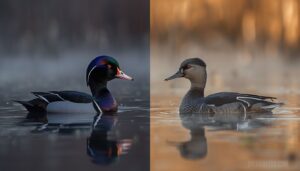
Spotting sexual dimorphism in Ringnecked Ducks is straightforward once you know what to look for.
Males wear a glossy black head and back with sharp wing stripe contrast and bold flank markings.
Females are mostly gray-brown, cryptic by design. Ringnecked Duck plumage variation deepens seasonally — male seasonal molt briefly intensifies UV reflectance, while facial marking intensity and tail shape variation stay subtler in females year-round.
Distinctive Bill Ring and Facial Marks
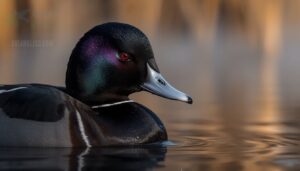
Look past the name — the real field mark isn’t on the neck at all.
It’s the Bill Ring Shape that catches your eye first: a crisp white ring on the bill, set against a gray bill with a black tip.
The Facial Mask Contrast and Eye Crown Contrast sharpen this look further.
Juveniles show duller Juvenile Bill Markings, while Seasonal Ring Visibility peaks during breeding.
Size, Shape, and Wing Pattern

Size and shape tell you a lot before color ever does. Ring‑necked ducks are compact birds with moderate wing loading — built for diving, not soaring.
- Length: 39–46 cm, shorter than most scaup
- Wingspan: roughly 62–63 cm with a gray wingstripe in flight
- Weight: 490–910 g — sturdy but agile
- Tail morphology: short, squared‑off, aiding underwater turns
That flight silhouette identification clicks fast once you’ve seen it — round‑headed, thick‑bodied, purposeful.
Comparison With Scaup and Redhead

When comparing ringnecked duck vs scaup differences, the bill morphology is your fastest clue. The ring-neck’s bold white bill band beats any scaup’s plain gray.
Redheads show rounder heads and rusty tones.
Differentiating scaup, redhead, and ringnecked ducks gets easier once you study bill shape — that clean white ring doesn’t lie, even at distance.
Ring-Necked Duck Habitat and Range

Ring-necked ducks aren’t picky about water — but they do have clear favorites depending on the season. From boreal breeding marshes to warm wintering estuaries, their range tells a fascinating story about how they live.
Here’s a closer look at the key habitats and movement patterns that define their year.
Breeding Wetlands and Boreal Marshes
Ring-necked ducks are surprisingly picky real estate shoppers. They nest deep in boreal forests, targeting wetlands where three conditions align:
- Beaver Pond Influence creates variable depths ideal for nesting and brood-rearing.
- Emergent Plant Structure, taller than 40 cm, hides nests from predators above.
- Peatland Edge Invertebrates fuel duckling growth through protein‑rich insects.
Seasonal Flooding Effects and Water Level Dynamics shift the habitat mosaic yearly, keeping nest site selection fresh and unpredictable.
Wintering Lakes, Ponds, and Estuaries
When winter arrives, ring‑necked ducks trade boreal marshes for shallow lakes, ponds, and coastal estuaries across the southeastern U.S. and Caribbean. They favor wintering habitat where submerged plant beds stay accessible beneath the surface.
Ice edge foraging concentrates birds around open water refugia, where under‑ice oxygen sustains invertebrate prey. Winter predator patrol by eagles and hawks keeps these wetland ecosystems supporting ring‑necked duck flocks constantly alert.
Migration Routes and Seasonal Movement
These birds don’t wander randomly — flyway fidelity runs deep.
Ring-necked ducks follow the Atlantic, Mississippi, and Pacific flyways with notable consistency, using navigational landmarks like river corridors and mountain ridges to stay on course.
Timing cues from daylight shifts trigger departure, while weather influences can stall or accelerate movement.
Stopover habitat along shallow marshes keeps them fueled between breeding grounds and ring‑necked duck wintering grounds.
Preferred Water Depth and Vegetation
Stopover wetlands aren’t chosen randomly — water depth and plant cover matter enormously.
Ideal Depth Range sits between 0.3 and 1.5 meters. That’s where Shallow Water Foraging peaks for this species.
Here’s what drives their Wetland Habitat Preferences:
- Emergent Vegetation Zones — shallow freshwater wetlands and cattail marshes at 0.3–0.8 m offer cover between dives.
- Submerged Macrophyte Richness — pondweed beds at 0.8–1.4 m concentrate invertebrates and seeds.
- Vegetation Density Impact — 30–60% cover maximizes foraging without restricting movement.
- Dense Emergent Vegetation — thick shoreline reeds shield ducklings from predators.
- Depth Flexibility — birds shift shallower during brood‑rearing for easier access to cover.
Ring-Necked Duck Diet and Feeding

The ring-necked duck is a surprisingly practical eater — it works with what the wetland offers, and it does so efficiently. What it eats shifts depending on age, season, and what’s available just beneath the surface.
Here’s a closer look at the key parts of its diet and how it gets the job done.
Main Plant Foods and Aquatic Seeds
When you watch a ring‑necked duck dive, it’s hunting a surprisingly rich plant menu. Pondweeds, sedges, smartweeds, and algae form the core of its diet.
It also targets water chestnut seeds, lotus seeds, wild rice, arrowhead tubers, and water lily seeds — all harvested from shallow bottoms. These aquatic plants pack serious nutritional value, fueling long migration flights with exceptional efficiency.
Invertebrates Eaten by Adults and Ducklings
Plants aren’t the whole story. Ring-necked ducks round out their diet with a surprising variety of aquatic invertebrates.
Adults target mollusks, snail consumption being especially common where soft-shelled freshwater snails shelter under submerged plants.
Ducklings rely heavily on midge larvae, dragonfly larvae, and aquatic insects during early growth.
Amphipod foraging and crustacean diet contributions boost protein intake, supporting the species’ demanding feeding ecology year-round.
Diving and Up-ending Feeding Methods
Ring-necked ducks feed two ways: full dives and upending posture.
During diving foraging, neck rotation tucks the bill forward, and wingbeat modulation slows at depth to conserve energy. Dive duration stretches longer in dense aquatic plants. Bill sifting strains submerged plant feeding sites for seeds and aquatic insects alike.
Upending keeps the tail skyward while feet paddle steadily below.
Role in Wetland Food Webs
Think of these ducks as quiet engineers of wetland ecosystems. Their diving and foraging habits drive energy transfer from aquatic plants up to predators like eagles and pike.
Ring-necked ducks are wetland engineers, quietly moving energy from aquatic plants to eagles with every dive
Through nutrient cycling, their waste fertilizes bottom sediments. Seed dispersal reshapes plant communities over time.
Meanwhile, their bottom-stirring creates oxygenation effects that benefit invertebrates — the same aquatic invertebrates’ diet that fuels food web dynamics from the mud up.
Ring-Necked Duck Behavior and Flight

Watching a ring-necked duck in action tells you a lot about what kind of bird it is. From how it moves through the air to the company it keeps on the water, every habit reveals something worth knowing.
Here’s a closer look at what to expect.
Social Habits and Mixed-species Flocks
You’ll often spot ring-necked ducks on the edges of larger flocks — they’re classic satellite species, picking up foraging information and predator vigilance cues from core diving duck groups.
Core satellite dynamics shift with the season, so wintering grounds bring looser mixed-species flocks of diving ducks, while migration patterns tighten these associations. Seasonal flock shifts reflect habitat quality and resource availability rather than fixed social bonds.
Flight Silhouette and Field Cues
Once airborne, the ring‑necked duck shows a compact silhouette with tight neck alignment and a tucked tail posture.
Watch for that underwing flash — a pale trailing edge briefly visible on the upstroke.
Its altitude profile stays low, usually 10–25 meters over water.
Steady wingbeat rhythm, the white wedge at the shoulder, white ring on the bill, and white strip behind the bill confirm a strong and fast flier.
Vocalizations and Communication
Quiet doesn’t mean silent. Ring-necked ducks rely on a compact but effective vocal toolkit. Territorial calls—short, sharp soft quacks—keep rivals at bay near breeding edges.
Males shift to low-pitched nasal whistles and mating whistles during courtship, while females answer with brief clucks. Alarm squeaks burst out in quick clusters when predators appear. Juvenile peep development starts soft, maturing fast. Social call coordination keeps mixed flocks moving together.
Daily Activity and Migration Timing
Dawn is when ring-necked ducks truly come alive. Dawn foraging peaks hit within two hours of sunrise, driving birds toward shallow, vegetated margins. Photoperiod-driven movements trigger southward shifts as days shorten.
Dusk pre-migration feeding extends foraging bouts, building fat reserves. Evening temperature influence shapes where flocks settle. Nocturnal rest patterns keep most flight activity in predawn hours.
- Foraging peaks two hours after sunrise
- Bimodal activity — morning and mid-afternoon
- Dusk feeding intensifies before migration
- Nocturnal flights occur in predawn windows
- Photoperiod cues trigger seasonal departure
Ring-Necked Duck Breeding Cycle

The ring-necked duck’s breeding cycle is a surprisingly efficient process — from nest to first flight in just a few months. If you’ve ever wondered how these ducks pull it off, the details are worth knowing.
what happens at each stage.
Nest Site Selection and Nest Structure
Where a female ring‑necked duck builds her nest isn’t random — it’s a calculated decision. She favors floating vegetation mats and emergent marsh edges, balancing vegetation cover, water depth, and predator proximity with quiet precision. Ringnecked duck nesting site selection directly shapes survival odds.
| Nest Factor | What She Prefers |
|---|---|
| Vegetation Cover | Dense emergent reeds or sedges |
| Water Depth | Shallow zones near open water |
| Predator Proximity | Low‑disturbance, concealed spots |
| Nest Material Choice | Down, grasses, fine aquatic plants |
| Site Fidelity | New location each season |
Understanding ringnecked duck breeding and nesting behavior means recognizing that ringnecked duck reproductive ecology begins with smart real estate choices.
Egg Laying and Clutch Size
Once the nest is ready, laying begins fast — usually within 24 hours.
Seasonal Egg Timing follows courtship closely, with most clutches starting on mild spring mornings.
Clutch Size Variability reflects real conditions:
- Typical range: eggs 8–10, up to 14
- Food Driven Laying: abundant vegetation increases clutch size
- Predation Impact: exposed sites mean smaller clutches
- Nest Temperature Regulation begins before the final egg drops
Incubation and Duckling Development
Once egg laying wraps up, incubation begins — and the clock starts ticking. The female holds eggs at roughly 37.5–38.5°C, with humidity levels around 55–65%. Egg turning prevents embryo sticking. The incubation period runs 25 to 29 days, hitting key embryo milestones weekly.
| Stage | Days | Development |
|---|---|---|
| Early | 7–9 | Movement visible |
| Mid | 18–22 | Wing joints form |
| Late | 28–30 | Pip begins |
Precocial ducklings leave within 12–24 hours after hatch — already swimming, already alive.
Fledging and Brood Care
Those precocial ducklings, ready to swim within 12–24 hours after hatching, don’t stay dependent long. Fledging happens around 49–55 days.
post-fledging survival hinges on feeding independence — ducklings shift from invertebrates to aquatic plants as they grow. Sibling competition shapes who feeds best.
Watch the parental role shift too: mom steps back gradually, guiding water depth preference toward safer, vegetated shallows.
Ring-Necked Duck Conservation Status

The ring-necked duck is holding its own out there — but that doesn’t mean it’s without challenges. A few key factors shape how this species is doing today, from wetland loss to shifting climates.
Here’s what you need to know about its conservation status.
Current Population Trend
The ring-necked duck’s global numbers tell a reassuring story. The IUCN status sits at Least Concern, with roughly 2 million individuals tracked through population monitoring efforts.
Here’s what the population trends show:
- Stable or increasing across most of its range
- Expanding regionally into eastern North America since the 1930s
- Well-documented through Christmas Bird Count data and species distribution modeling
Main Threats From Habitat Loss
Wetland Drainage and habitat fragmentation quietly chip away at what ring-necked ducks need most: shallow, vegetated water.
| Threat | Impact |
|---|---|
| Agricultural Runoff Pollution | Degrades foraging plants and invertebrates |
| Invasive Plant Encroachment | Displaces native aquatic vegetation |
| Fragmented Migration Corridors | Disrupts safe seasonal movement |
| Wetland loss from land conversion | Eliminates breeding and wintering sites |
These pressures compound each other, leaving fewer functional wetland ecosystems supporting ring-necked duck populations year‑round.
Climate Change and Breeding Habitat Impacts
Climate change is quietly reshaping the boreal wetlands ring‑necked ducks depend on. Ice melt timing shifts compress the pairing window before nests can be established.
Hydroperiod shifts dry ponds earlier, triggering emergent plant decline and forcing birds into exposed sites — driving predation risk increase and nest site fragmentation. These overlapping pressures are among the most serious climate change threats to ring‑necked duck breeding habitat today.
Monitoring and Protection Efforts
Tracking these birds takes a village. Biologists use banding tagging and acoustic surveys to map movement across wetland ecosystems supporting Ring-necked Duck populations year-round. Citizen science volunteers log weekly sightings through mobile apps, cross-validated against professional counts.
Key efforts include:
- Habitat restoration of degraded boreal marshes
- Poaching enforcement with rapid-response penalty protocols
- Water quality monitoring at stopover sites
- Cooperative landowner agreements protecting private wetlands
- Annual reporting on conservation status of Ring-necked Duck and population trends of Ring-necked Duck
Frequently Asked Questions (FAQs)
Are ring neck ducks rare?
Think of them as hidden gems — common in the right place, scarce in others.
The Ring-necked Duck holds Least Concern IUCN status, with a stable population near two million. Local rarity factors and observer detection rates shape your experience.
What is another name for Ring-necked Duck?
You’ll often hear it called the Ring-billed Duck — a nod to that crisp white bill ring. Some historic field aliases include Collar Duck.
The alternative English name Ringnecked Duck remains widely accepted across regional common names today.
What kind of duck has a ring around its neck?
A duck with a ring around its neck? That’s the ring-necked duck (Aythya collaris) — a compact North American diver wearing a subtle cinnamon collar on its glossy black neck.
What is the difference between Ring-necked Duck and tufted duck?
Eurasian tufted duck sports a drooping head tuft and lacks a bill ring.
The ring-necked shows a peaked crown, white basal band, and angular facial profile — clean separation at a glance.
What is the average lifespan of a Ring-Necked Duck?
Like a candle in the wind, Wild Longevity varies. Most live 2–5 years. Captive Lifespan reaches 15– Survival Influences include habitat, predation, and climate. Regional Longevity Differences exist across populations.
How do Ring-Necked Ducks protect themselves from predators?
They rely on group vigilance, camouflage plumage, and diving escape tactics. Alarm calls trigger synchronized flight.
Brood defense strategies shield ducklings from predators, reducing predation pressure through collective awareness and rapid submersion.
Can Ring-Necked Ducks be found in urban environments?
Yes, you can spot them in urban parks during migration. They favor shallow ponds with vegetation, though human disturbance limits their stay.
Citizen reporting via eBird helps track these brief but rewarding urban appearances.
What is the purpose of the Ring-Necked Ducks distinctive call?
Their low-pitched nasal whistles serve many roles — pair bond reinforcement, threat signaling, dawn chorus coordination, and navigation cues.
During courtship displays and breeding season, these vocalizations and communication signals strengthen pair bonds and support acoustic monitoring efforts.
Are Ring-Necked Ducks considered an endangered species?
Fortunately, flourishing flocks face few extinction fears. The IUCN 31 Least Concern classification reflects a population estimate surpassing two million.
Conservation status of Ringnecked Duck remains stable, with population trends of Ringnecked Duck are holding steady across North America.
How do Ring-Necked Ducks communicate with each other?
They use vocalizations, low-pitched nasal whistles, and alarm calls alongside visual signaling and body language. Courtship displays peak in spring, while seasonal communication shifts toward flock cohesion cues in winter.
Conclusion
Like a field guide hiding its best entry in plain sight, the ring‑necked duck rewards those who look past the misleading name. Once you’ve locked onto that bold bill ring, crisp plumage, and agile dive, you’ll spot this species with confidence from winter ponds to boreal marshes.
Understanding its habitat, diet, and seasonal movements turns a casual sighting into something richer—proof that the birds you overlook most are often the ones worth knowing best.