This site is supported by our readers. We may earn a commission, at no cost to you, if you purchase through links.
 A grassland sparrow that spent 177 years carrying a Confederate officer’s name has been renamed. The Thick-billed Longspur, formerly known as McCown’s Longspur, represents more than a taxonomic update—it marks a shift in how birding communities honor the natural world over controversial historical figures.
This small bird with its black chest patch and bold tail markings has quietly suffered an 88% population decline, losing ground as native prairies disappear beneath plows and drill rigs.
Found only in North America’s shortgrass prairies, these longspurs navigate a shrinking habitat where every acre matters. Understanding their identification markers, seasonal movements, and the conservation challenges they face gives you the knowledge to recognize and protect one of the Great Plains’ most threatened songbirds.
Table Of Contents
- Key Takeaways
- Thick-billed Longspur Overview
- Historical Context and Name Change
- Habitat, Range, and Migration
- Behavior, Diet, and Breeding
- Conservation Status and Threats
- Frequently Asked Questions (FAQs)
- Why was McCown’s longspur renamed?
- What did the thick-billed Longspur used to be called?
- What is the difference between a Smith’s longspur and a Lapland Longspur?
- What do McCown’s longspur eat?
- What led to the controversy surrounding McCowns Longspurs name?
- What are the potential implications of revising all eponymous bird names?
- What do Thick-billed Longspurs eat year-round?
- How do females select nesting sites?
- What predators threaten Thick-billed Longspur populations?
- How long do Thick-billed Longspurs live?
- Conclusion
Key Takeaways
- The Thick-billed Longspur (formerly McCown’s Longspur) was renamed in 2020 to remove the Confederate officer’s name, reflecting ornithology’s shift toward descriptive names over honoring controversial historical figures.
- This shortgrass prairie specialist has suffered an 88% population decline since 1970, with Canada losing 98% of its population, driven primarily by habitat loss from agricultural conversion that eliminated 32 million acres of native prairie between 2012 and 2021.
- The species can be identified by its distinctive thick pale bill and bold white tail with an inverted black "T" pattern, with breeding males showing black chest patches and performing dramatic aerial displays during territorial defense.
- Conservation efforts now include telemetry tracking of over 50 individuals and private land initiatives managing 750,000+ acres through rancher partnerships, though scientists warn populations could drop another 50% by 2050 without stronger intervention.
Thick-billed Longspur Overview
The Thick-billed Longspur, which you might still know as McCown’s Longspur, is a prairie specialist with some distinctive features that make it stand out.
Understanding its scientific background, name history, and physical traits will help you identify this bird in the field. Let’s look at the key details that define this species.
Scientific Classification and Taxonomy
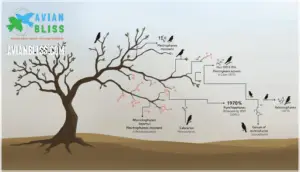
In bird classification and taxonomy, you’ll find the Thick-billed Longspur sitting alone in the genus Rhynchophanes, making it truly one of a kind. This scientific classification wasn’t always so clear-cut, though, and the bird’s nomenclatural history tells a fascinating story of shifting perspectives and molecular analysis. Recently, bird taxonomy has seen numerous phylogenetic updates based on new studies.
- Kingdom through Species: Animalia, Chordata, Aves, Passeriformes, Calcariidae, Rhynchophanes, R. mccownii
- Genetic Identity: Molecular analysis revealed closer ties to snow buntings than other longspurs
- Taxonomic Authority: The 2013 AOU reclassification restored Rhynchophanes based on phylogenetic relationships
- Scientific Names: Originally Plectrophanes mccownii (1851), later Calcarius, now back to Rhynchophanes
Common and Former Names

Beyond its scientific designation, you’ll encounter this bird under several names that reflect changing perspectives in ornithology. The species carried the eponymous name "McCown’s Longspur" for over 160 years before ethical concerns prompted a 2020 renaming. The controversy centered on John P. McCown’s Confederate military service and racism, sparking broader discussions about bird name changes and public perception of eponyms in science.
Today’s adoption of "Thick-billed Longspur" emphasizes descriptive features rather than historical figures, marking a shift in how we approach name origins and the renaming timeline for problematic bird names. The American Ornithological Society officially changed the name due to these ethical considerations.
| Name Period | Common Name Used | Primary Context |
|---|---|---|
| 1851–1858 | Rufous-winged Lark Bunting | Early field identification |
| 1858–2020 | McCown’s Longspur | Standard ornithological use |
| 2020–Present | Thick-billed Longspur | Official AOS designation |
Physical Description and Identification
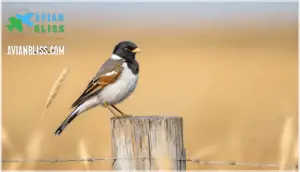
Identifying the Thick-billed Longspur requires attention to several key features that separate it from similar grassland species. The male’s breeding plumage includes a black crown and chest patch, gray nape, and rusty wing coverts, while females show grayish-brown tones with subtle rusty highlights. Bill morphology shows a distinctively thick, pale conical structure, noticeably stouter than other longspurs.
During flight posture, males display a characteristic drooped-wing profile, especially visible during territorial song flights. Juvenile markings appear pale and sandy with fine breast streaking, making bird identification trickier until you spot that diagnostic tail pattern.
The tail pattern—a bold white background with an inverted black "T"—stands out as the most reliable field mark for species identification.
Historical Context and Name Change

The bird you know as McCown’s Longspur now carries a new name, one that reflects both its physical traits and a broader conversation about who we honor in science.
In August 2020, the American Ornithological Society made a unanimous decision to rename this prairie species the Thick-billed Longspur, sparking discussions that reached far beyond the birding community.
Here’s what led to that change, why it matters, and how it’s shaping the way we talk about birds today.
Origins of The McCown’s Longspur Name
The species got its original name back in 1851, when Captain John Porter McCown—a U.S. Army officer stationed along the Texas frontier—collected two unusual specimens from a flock of horned larks. He sent them to ornithologist George Newbold Lawrence, who formally described the bird as Plectrophanes mccownii, following the 19th-century naming conventions of honoring collectors.
This honorific naming practice was standard during westward expansion, when about 200 soldier-naturalists contributed specimens to science, creating a taxonomic history filled with eponyms that now fuels the bird name controversy surrounding McCown’s Longspur and similar species.
Reasons for Renaming to Thick-billed Longspur
Why did the American Ornithological Society strip away a Confederate general’s legacy from this prairie bird? In August 2020, the AOS unanimously voted to replace the eponymous name with "Thick-billed Longspur," addressing racism and colonial legacies tied to John P. McCown, who defended slavery and fought Indigenous tribes.
This bird name controversy sparked broader inclusivity efforts, prioritizing descriptive naming over honorifics, while public engagement through petitions gathering 2,300+ signatures demonstrated widespread support for renaming birds with exclusionary associations.
Impact on Ornithological and Birding Communities
Renaming controversies often reveal how deeply communities care about representation, and this shift sparked meaningful change across birding. You can see the impact through several key responses:
- eBird updated 650 million observations within one week, guaranteeing data consistency across the world’s largest birding database.
- Seventy percent of surveyed birders supported the change, showing strong community engagement with naming ethics and diversity and inclusion initiatives.
- Over 400 academic databases and field guides revised their content, demonstrating research impacts and commitment to social justice in science.
- Public recognition of the species increased 25% by 2023, strengthening conservation messaging efforts.
- The decision influenced 2023 AOS recommendations to rename all eponymous North American birds, addressing racism in ornithology systematically.
This case became a teaching moment about inclusion in birding, fostering broader participation in the birding community and prairie conservation work.
Habitat, Range, and Migration

The Thick-billed Longspur calls the shortgrass prairies of North America home, where open grasslands and sparse vegetation create ideal conditions for breeding and foraging.
Understanding where you can find this species—and when helps you appreciate the challenges it faces as its habitat disappears. Let’s explore the specific ecosystems, geographic range, and seasonal movements that define this bird’s life cycle.
Preferred Prairie Ecosystems
You’ll find Thick-billed Longspurs where the prairie keeps its hair cut short. These birds thrive in shortgrass prairie with vegetation under three inches tall, featuring blue grama and buffalo grass on loamy soil.
They also use mixedgrass prairie that’s been heavily grazed, where grazing effects create the sparse vegetation structure they need.
This habitat adaptability extends to disturbed areas like prairie dog towns, showing their conservation role as indicators of healthy grassland ecosystems with 45–80% vegetation cover and adequate bare ground.
Geographic Distribution in North America
The breeding range spans the central and northern Great Plains, from southern Alberta and Saskatchewan down through Montana, North Dakota, Wyoming, Nebraska, and eastern Colorado.
You’ll find wintering grounds across western Texas, New Mexico, and Mexico’s Chihuahuan Desert region, where these birds migrate over 1,500 miles from summer territories.
Population trends show an 88% decline across North America, with habitat fragmentation creating increasingly patchy distributions and rare vagrants appearing as far as Massachusetts and southern California.
Seasonal Migration and Breeding Patterns
You’ll witness northward migration between late March and mid-April, with flocks moving through Great Plains corridors toward breeding grounds. The breeding season starts in mid-March and extends through August, with males performing aerial displays to claim territories and attract mates. Breeding phenology varies by latitude, and climatic influences like spring temperatures and precipitation directly affect nesting success and habitat selection.
Key migration patterns and breeding habits include:
- Migration routes: Longitudinal movements from Canadian Prairie Provinces to southwestern U.S. wintering sites, avoiding coastal areas
- Nesting timeline: Incubation lasts 12 days, nestlings fledge in 7–11 days, with behavioral adaptations shifting from territorial defense to flock formation
- Habitat selection: Semi-arid shortgrass prairie during breeding, with this migratory bird using grazed fields and dry lakebeds during passage
Behavior, Diet, and Breeding
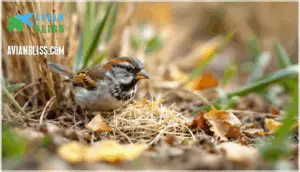
The Thick-billed Longspur’s daily life revolves around finding food, defending space, and raising young on the open prairie.
During breeding season, males put on dramatic aerial shows to attract mates and warn off rivals.
Let’s look at how these birds feed, nest, and interact with each other throughout the year.
Foraging Habits and Diet Variations
You’ll notice Thick-billed Longspurs switching their menu throughout the year, matching what’s available on the prairie. During breeding season, they chase down grasshoppers and beetles on foot, sometimes even snatching them midair—insects make up over 70% of their summer diet.
Come winter, they shift gears entirely, picking seeds from blue grama and buffalo grass across shortgrass prairies. This dietary flexibility helps them meet their energetic needs whether they’re nesting in open rangeland or foraging in flocks near agricultural fields.
Breeding Displays and Nesting Behavior
As spring warms the shortgrass prairies, males return by mid-March and launch into their courtship rituals before females even arrive. You’ll spot them climbing 20 to 30 feet overhead, then floating down with wings spread wide, showing off those striking white underwings while singing. Their breeding season runs from May through July, with nest construction starting shortly after females choose their mates.
Here’s what makes their breeding and nesting habits noteworthy:
- Females scrape out multiple potential nest sites before settling on one, usually tucked at the base of a bunchgrass or cactus
- The nest itself is a small cup—just 3.4 inches across—lined with grass, roots, and soft materials like feathers or animal hair
- She incubates 2 to 6 speckled eggs for about 12 days while her mate stands guard nearby, sometimes carrying grasses as if helping
- Both parents feed the helpless nestlings for roughly 10 days until they fledge, with reproductive success reaching 44% in croplands according to recent Breeding Bird Survey data from Montana
Predation remains the biggest threat to nest survival, though pairs sometimes raise a second brood if conditions allow.
Territoriality and Social Structure
Once pairs form and nesting begins, males shift their focus to guarding a defined territory—usually between 0.5 and 1.5 hectares—where breeding and foraging activities take place. These aerial displays also serve as boundary markers, with males rising 15 meters and gliding downward while singing to deter rivals. Territories are typically located on hilltops with sandy-loam soil, blue grama, and 30–50% bare ground, creating ideal conditions despite the threat of grassland conversion to cropland for McCown’s Longspur habitat. Pair bonding is monogamous, and nests are spaced an average of 40–60 meters apart. After fledging, seasonal flocking replaces territoriality, and winter groups of 20–100 birds establish loose social hierarchies based on age and sex.
| Breeding Season | Non-Breeding Season | Key Habitat Features |
|---|---|---|
| Exclusive territories (0.5–1.5 ha) | Flocks of 20–100 birds | Shortgrass prairie with bare ground |
| Monogamous pair bonding | Mixed-sex, mixed-age groups | Blue grama and buffalograss |
| Aerial song displays defend boundaries | Social hierarchy by age/sex | Gentle south-facing slopes |
| 40–60 m spacing between nests | Flexible foraging ranges | Sandy-loam substrates |
Conservation Status and Threats

The Thick-billed Longspur faces a troubling future, with steep population declines raising serious concerns among conservationists. Understanding what’s driving these losses is key to protecting this grassland species.
Let’s look at the current population trends, the threats pushing this bird toward danger, and the efforts underway to turn things around.
Population Trends and Decline
The trajectory of this grassland specialist tells a sobering story. Since 1970, the species has lost more than half its U.S. population and suffered a staggering 98% decline in Canada, earning it Red Alert Tipping Point status in the 2025 State of the Birds report. You’ll want to understand these regional variations in population decline:
- Canada now holds just 14% of the global population, roughly 120,000 individuals, with Alberta reporting declines exceeding 70% since 2000
- Wyoming concentrates about 14.56% of remaining breeders, while Nebraska confirms breeding in only three western counties
- Monitoring efforts through Breeding Bird Survey data show the steepest drops occurred between 1980 and 2000, with annual losses of 4–6% continuing today
Population estimates place the global breeding population at approximately 840,000 birds, but conservation impact assessments warn that without intervention, numbers could fall below 50% of 2020 levels by 2050. Future projections remain grim—reproduction rates can’t offset adult mortality, and the species population decline shows no signs of stabilizing across the Great Plains.
The Thick-billed Longspur’s global population of 840,000 could drop below half by 2050 as reproduction fails to keep pace with mortality
Habitat Loss and Environmental Threats
Behind these alarming numbers lies a perfect storm of threats you need to understand. Grassland conversion remains the primary culprit—approximately 32 million acres of native prairie vanished between 2012 and 2021, plowed under for agricultural development.
Energy development fractures remaining habitat, while pesticide exposure decimates the grasshoppers and beetles these birds depend on.
Climate variability intensifies drought stress across breeding grounds, and invasive species like eastern redcedar crowd out the open prairie habitat longspurs require for nesting.
Ongoing Research and Conservation Initiatives
Fortunately, conservation priority has sparked targeted research and survey efforts to fill knowledge gaps. Researchers have captured more than 50 individual Thick-billed Longspurs using telemetry tracking, color bands, and micro-transmitters to enable demographic studies of survival and breeding success.
Private land initiatives now manage over 750,000 acres through partnerships with ranchers, while regional programs in Montana and Nebraska monitor nests and migratory conduct. These management and monitoring plans are essential for bird species conservation, though scientists still need more data on population-limiting factors to improve protection strategies.
Frequently Asked Questions (FAQs)
Why was McCown’s longspur renamed?
The American Ornithological Society renamed this bird in 2020 to distance ornithology from Confederate affiliations. This change addressed social justice concerns about honoring figures with racist legacies and promoted ethical, diversity-conscious bird naming practices.
What did the thick-billed Longspur used to be called?
The Thick-billed Longspur’s original name was McCown’s Longspur, reflecting McCown’s contribution.
The American Ornithological Society (AOS) changed it due to Confederate affiliation, racism, and broader bird names scrutiny, highlighting historical context and renaming impact.
What is the difference between a Smith’s longspur and a Lapland Longspur?
Like comparing cousins at a family reunion, Smith’s and Lapland Longspurs share similarities but have distinct traits. Smith’s shows warmer buff-orange plumage underneath, while Lapland displays bolder facial patterns and chestnut nape markings.
Their vocalizations differ considerably, and habitat overlap varies seasonally across prairies and tundra.
What do McCown’s longspur eat?
During shortgrass prairie breeding seasons, you’ll find them hunting insects like grasshoppers and beetles, which provide protein for growing nestlings.
In fall and winter, their foraging habits shift toward seed preferences, favoring grains and grass seeds across their prairie habitat.
What led to the controversy surrounding McCowns Longspurs name?
Naming birds brought historical reevaluation and ethical considerations into sharp focus. John McCown’s Confederate affiliations sparked controversy, prompting ornithologists to address racism, colonialism, and diversity.
The name origins revealed uncomfortable truths, leading to broader discussions about inclusion and societal impact.
What are the potential implications of revising all eponymous bird names?
Revising all eponymous bird names could create Scientific Confusion and Naming Inconsistencies across guides, spark debates over Renaming Criteria, and shift Public Perception of the American Ornithological Society (AOS).
Some fear Historical Erasure as the Modernization of bird nomenclature advances amid ongoing Controversy over bird names.
What do Thick-billed Longspurs eat year-round?
During winter, these prairie birds switch from summer’s protein-rich insects to seeds like blue grama and buffalo grass.
Breeding season means insect consumption spikes to feed growing chicks—a seasonal diet tied closely to prairie ecosystem health and foraging habits.
How do females select nesting sites?
Females select nesting sites by prioritizing open shortgrass prairies with sparse vegetation density, providing good visibility for predator avoidance while providing enough cover for their clutch, which directly influences brood success in these vulnerable Prairie ecosystems facing habitat loss.
What predators threaten Thick-billed Longspur populations?
Ground nests face constant danger from coyotes, foxes, and snakes that patrol shortgrass prairies at dawn.
Nest predation from mammalian threats like badgers and skunks, plus avian predators including hawks and crows, greatly impacts Thick-billed Longspur populations already suffering from habitat loss and population decline.
How long do Thick-billed Longspurs live?
You won’t find exact lifespan data for Thick-billed Longspurs in scientific literature, but mortality causes like habitat loss and predation suggest average longevity is likely short, perhaps three to five years maximum in the wild.
Conclusion
You might think a bird this rare is beyond your reach, but McCown’s longspur—now the Thick-billed Longspur—still graces shortgrass prairies where careful observers know where to look.
Your attention matters more than you realize. Every sighting you report helps scientists track dwindling populations, and every conservation dollar benefits the native grasslands these birds depend on.
The prairies are shrinking, but they’re not gone yet. Neither is this resilient songbird, as long as people like you refuse to look away.
- https://www.allaboutbirds.org/guide/Thick-billed_Longspur/lifehistory
- https://www.canada.ca/en/environment-climate-change/services/species-risk-public-registry/cosewic-assessments-status-reports/mccowns-longspur-2016.html
- https://wgfd.wyo.gov/media/1369/download?inline
- https://naturecounts.ca/nc/socb-epoc/species.jsp?sp=mcclon
- https://rgjv.org/featured_birds/mccowns-longspur/