This site is supported by our readers. We may earn a commission, at no cost to you, if you purchase through links.
 You won’t find Harlequin Ducks paddling lazily on suburban ponds. These specialized waterfowl have claimed some of the planet’s most violent aquatic real estate—mountain torrents where rocks break bones and coastal zones where waves slam against cliffs with crushing force.
Males sport slate-blue plumage marked with white crescents that look hand-painted, while females wear cryptic brown tones punctuated by white facial patches. Their compact bodies and oversized heads aren’t just distinctive—they’re survival adaptations for life in turbulent waters where most ducks wouldn’t last an hour.
Understanding how these birds thrive in environments that would kill their relatives reveals extraordinary specializations in anatomy, behavior, and breeding strategy.
Table Of Contents
- Key Takeaways
- Harlequin Duck Identification and Appearance
- Habitat and Geographic Range
- Feeding Behavior and Diet
- Breeding Habits and Life Cycle
- Conservation Status and Threats
- Frequently Asked Questions (FAQs)
- How rare is a harlequin duck?
- Where are harlequin ducks found?
- What are some interesting facts about Harlequin ducks?
- What is the difference between a wood duck and a harlequin duck?
- How long do Harlequin Ducks live?
- What is the difference between male and female Harlequin Ducks?
- How do Harlequin Ducks adapt to their fast-moving habitat?
- Do Harlequin Ducks have any unique behaviors or vocalizations?
- How do Harlequin Ducks recover from oil spill contamination?
- How long do harlequin ducks typically live?
- Conclusion
Key Takeaways
- Harlequin Ducks thrive in extreme aquatic environments—turbulent mountain streams and wave-battered coastlines—where their compact bodies, oversized heads, and specialized diving abilities allow them to forage on riverbeds and pry invertebrates from rocks in conditions that would kill most waterfowl.
- The species shows dramatic regional population disparity, with western North America supporting 150,000–250,000 birds while the eastern population has declined to fewer than 6,800 individuals, making conservation efforts critically important in Atlantic Canada despite the global "Least Concern" status.
- Males and females exhibit extreme sexual dimorphism—males display slate-blue plumage with distinctive white crescents and chestnut flanks, while females wear cryptic brown coloration with white facial patches—and pairs form bonds as early as late fall, months before the spring breeding season.
- Their carnivorous diet shifts seasonally between high-protein aquatic insects (mayflies, caddisflies, midge larvae) in summer breeding streams and energy-rich marine prey (crustaceans, mollusks) in winter coastal habitats, with females showing remarkably low breeding success rates of only 30% annually due to harsh environmental conditions.
Harlequin Duck Identification and Appearance
You’ll recognize a Harlequin Duck the moment you spot one—if you know what you’re looking for. Males and females look completely different, and both sexes have features that set them apart from other waterfowl.
Here’s what makes these small diving ducks unmistakable in the field.
Size and Weight Comparison

You’ll find Harlequin Ducks sitting comfortably in the middle of the waterfowl weight class—larger than a Bufflehead but noticeably smaller than a Mallard.
Males measure 13.4-18.1 inches in length and weigh 17.3-26.8 ounces, while females run slightly smaller at 13.0-16.5 inches and 16.6-23.6 ounces. These body proportions and size variations help you distinguish them from other duck species during field identification.
Male Plumage and Coloration
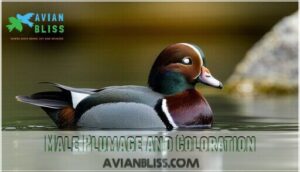
Male Harlequin Ducks don’t do subtle—their alternate plumage features a slate blue body with bold black borders across the head and chest, accented by a striking white crescent in front of each eye and a small white dot behind it.
Reddish flanks add warmth to the slaty blue color variations, creating an intricate pattern that’s unmistakable in the field.
These plumage patterns make male Harlequin Duck identification straightforward even at a distance.
Female Plumage and Coloration
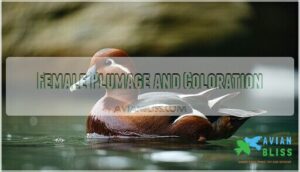
Females trade the male’s flashy palette for practicality—dark brown plumage with a white belly and a triangular white patch that stretches from below and forward of the eye to the bill. You’ll spot two or three white facial patterns on their heads, essential female markings that separate them from scoters.
This brown color scheme with scattered white patches makes female Harlequin Duck identification easier than you’d expect—look for that distinctive facial geometry when glassing rocky coastlines or mountain streams.
Distinctive Physical Features

Beyond plumage patterns, you can nail Harlequin Duck identification by their compact build and proportionally large, rounded head paired with a small bill—features that set them apart from similar diving ducks at any distance. That steep forehead and beak shape create a distinctive profile you’ll recognize instantly.
Their relative size falls between Buffleheads and Mallards, making body size a useful checkpoint. These Harlequin Duck characteristics hold constant across color morphs and sexes, though female Harlequin Duck identification relies more heavily on size shape than feather patterns.
Habitat and Geographic Range

You’ll find Harlequin Ducks in some of the most rugged aquatic habitats on the continent—places where fast water meets jagged rocks. Their range spans from breeding streams in mountain wilderness to winter coastlines pounded by surf.
Let’s break down where these specialized ducks live and how they move between habitats throughout the year.
Preferred Habitats and Ecosystems
You won’t find Harlequin Ducks lounging in calm ponds or sluggish backwaters—these diving specialists thrive where whitewater crashes against jagged rocks and most waterfowl wouldn’t dare to venture.
During summer breeding, they claim mountain streams with fast-flowing freshwater sources in forested riverine ecosystems. Come winter, they shift to turbulent coastal waters where waves pound rocky shorelines.
This Harlequin Duck habitat demands resilience—aquatic landscapes where only the toughest waterfowl characteristics prevail.
North American Distribution
Across North America, Harlequin Duck populations split into two distinct groups separated by geographic isolation—a continental divide that shapes their breeding grounds and coastal habitats.
- Western Migration corridors stretch from Alaska through British Columbia, with isolated river systems in Montana, Idaho, and Wyoming
- Over 100,000 waterfowl winter in the Aleutian Islands annually
- Eastern range centers in Quebec and Labrador, with winter flocks in Atlantic Canada
- Ornithology surveys reveal fewer than 6,000 eastern breeders versus 150,000–250,000 western birds
- Local extinctions occurred in Colorado and California breeding territories
- Understanding the Harlequin Duck habitat requires knowledge of their preferred fast flowing streams and breeding patterns.
Understanding this bird species identification requires recognizing regional scarcity.
Range in Eurasia and Iceland
In eastern Asia, the Harlequin Duck inhabits subarctic streams from Siberia’s Lena River to Kamchatka, with winter populations along rocky coastlines from the Sea of Okhotsk to the Kurile Islands.
Iceland hosts one of Earth’s densest Icelandic breeding concentrations, especially around Lake Mývatn.
This geographic distribution of Harlequin Ducks spans remote arctic habitats, making bird species identification challenging outside the breeding season when Eurasian migration shifts populations coastward.
The conservation of Harlequin Ducks relies on understanding their habitat protection needs to guarantee their survival.
Seasonal Movements and Migration
Harlequin Ducks don’t just wander—they’re born into a rhythm of movement, trading the roar of mountain torrents in summer for the crash of ocean waves come winter. These waterfowl migration patterns reveal precise coastal migration timing, with small flocks following rivers seaward each fall.
Their seasonal habitat shifts demonstrate striking flock dynamics:
- Spring’s upstream pilgrimage—battling currents to reach breeding streams
- Autumn’s coastal gathering—forming winter groups on wave-battered shores
- Winter’s stubborn loyalty—returning to identical rocky coastlines year after year
This harlequin duck migration and distribution reflects evolutionary adaptation to extreme environments.
Feeding Behavior and Diet
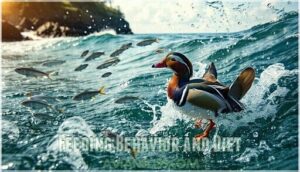
Harlequin Ducks don’t mess around regarding finding food—they’re built for life in the roughest waters you can imagine.
These birds have evolved specialized feeding strategies that let them thrive where most ducks wouldn’t stand a chance.
Here’s how they hunt, what they eat, and how their menu changes with the seasons.
Carnivorous Feeding Habits
If there’s one thing these compact diving ducks can’t resist, it’s a moving buffet of aquatic prey—they’re carnivores through and through, specialized for life in the relentless current. Their Harlequin Duck diet targets aquatic invertebrates with surgical precision. You’ll find them hunting insects like midge larvae and caddisflies in summer streams, while winter brings a shift to coastal crustaceans and mollusks. These feeding adaptations reflect pure aquatic predation—no plant matter clutters their menu.
| Season | Primary Food Sources |
|---|---|
| Summer | Mayflies, midge larvae, caddisflies, fish eggs |
| Winter | Crustaceans, mollusks, marine invertebrates |
| Year-round | Small fish, aquatic beetles |
| Habitat-specific | River insects (streams), sea creatures (coasts) |
Diving and Foraging Techniques
Watch a Harlequin Duck hunt, and you’ll see something most waterfowl can’t pull off—diving headfirst into whitewater rapids that would knock other ducks downstream like leaves. Their foraging strategies exploit turbulent hydraulics that other diving ducks avoid entirely. Here’s how these masters of prey capture operate:
- Water entry against current flow, using momentum to pierce surface tension
- Walking upstream on the bottom, gripping rocks with strong feet
- Prying invertebrates from substrates with specialized bill techniques
- Timing dives between wave surges in coastal feeding zones
- Sustained submersion up to 40 seconds in extreme conditions
These feeding techniques demonstrate waterbird ecology at its most rebellious—thriving where physics says you shouldn’t.
Seasonal Diet Variations
What you’re watching is dietary flexibility in action—those same feeding techniques shift targets as seasons demand. Summer breeding grounds offer abundant aquatic insects, while winter coastal habitats provide different prey entirely. Here’s the nutrient acquisition pattern:
| Season | Primary Food Sources | Foraging Location |
|---|---|---|
| Summer | Midge larvae, mayflies, caddisflies, fish eggs | Fast-flowing mountain streams |
| Winter | Crustaceans, mollusks, marine invertebrates | Rocky coastal zones |
| Spring/Fall | Mixed insects and invertebrates | Rivers and nearshore waters |
| Breeding | High-protein aquatic insects | Shallow rapids and riffles |
| Molting | Energy-rich marine prey | Protected coastal areas |
This seasonal foraging demonstrates food web dynamics at work—Harlequin Duck behavior aligns with ecosystem interactions across landscapes.
Your avian diet and nutrition understanding deepens when you recognize these aren’t just diet changes, but survival strategies tracking resource pulses through different habitats.
Breeding Habits and Life Cycle

Harlequin Ducks don’t follow the typical waterfowl playbook in terms of breeding. These birds pair up early, often by late fall, and their nesting choices reflect their wild streak—building homes near turbulent waters that most ducks wouldn’t dare approach.
Here’s what you need to know about their breeding timeline and the challenges their young face from day one.
Pair Formation and Mating
Unlike most waterfowl that wait for spring courtship, these ducks lock in their partners by late fall—often pairing up before winter even arrives. By December, most have already formed pairs, showing a strong preference for early mate selection and extended pair bonding. This breeding strategy gives them a head start on reproduction once they reach their nesting streams.
Key aspects of Harlequin Duck pair formation:
- Early courtship rituals occur during fall migration, well before breeding seasons begin
- Monogamy is typical, with pairs staying together through the breeding cycle
- Mate selection happens in coastal wintering areas where birds gather in flocks
- Pair bonding strengthens over winter months before spring migration to breeding grounds
- Mating strategies involve males accompanying females to natal streams for nesting
Nesting Sites and Materials
Once pairs reach their breeding streams, females take charge of selecting a well-hidden nesting spot—usually tucked under dense shrubs, fallen logs, or overhanging branches close to the rushing water. They craft a shallow bowl using whatever’s available—conifer needles, moss, leaf litter, or pebbles—then line it with insulating down feathers plucked from their own bodies.
| Nest Site Selection | Nesting Materials | Breeding Habitat |
|---|---|---|
| Ground-level hollows under vegetation | Conifer needles and moss base | Fast-flowing mountain streams |
| Tree cavities or cliff ledges | Down feather insulation | Forested riverbanks |
| Concealed spots near water’s edge | Leaf litter and small pebbles | Rocky, turbulent waterways |
This nesting behavior reflects their adaptation to wild, untamed landscapes where protection matters more than comfort.
Egg Laying and Incubation
After constructing the nest, females lay a clutch of six plain buff or cream-colored eggs—a modest investment that reflects the demanding environment they’ve chosen to raise their young. The incubation period lasts 28 days, during which females remain fiercely protective of their nesting habitat, sometimes showing aggressive behavior toward intruders.
This solitary commitment to egg formation and nesting behavior demonstrates their resilience in harsh breeding habitats where Harlequin Duck breeding habits evolved alongside turbulent waters.
Duckling Development and Survival
Within a day or two of hatching, ducklings abandon the nest and follow their mother to calmer stretches of water where insects are plentiful—a critical shift that tests their survival from the start. Female breeding success in this bird species remains remarkably low, with only 30% of paired females producing broods annually.
Duckling mortality is significant during early growth rates, though surviving young develop diving abilities quickly. Brood size diminishes as fledging period approaches, reflecting the harsh realities of Harlequin Duck habitat where turbulent waters shape avian biology and nest success rates across their breeding range.
Conservation Status and Threats

You might spot Harlequin Ducks riding the rapids, but their survival isn’t as secure as their grip on those slippery rocks.
The species faces different challenges depending on where they live, with eastern populations struggling more than their western cousins.
Let’s break down what’s at stake for these exceptional ducks and what’s being done to keep them around.
Global Population Estimates
Global estimates place the harlequin duck population at roughly 170,000 individuals worldwide—a figure shaped by demographic analysis and estimate methods that track breeding pairs across fragmented habitats. Western populations wintering in the Aleutian Islands number between 147,000 and 1,000,000, while eastern North America hosts fewer than 6,800 birds.
These population trends reveal stark regional differences, reflecting habitat effects and conservation impact on harlequin duck population status. Understanding IUCN status and bird migration patterns helps wildlife conservation efforts target where conservation biology matters most.
Conservation Concerns and Threats
Harlequin ducks face threats that test the limits of survival in fast-moving water and jagged rock habitats. Climate change alters food resources and stream flow patterns critical to breeding success.
Habitat destruction, pollution effects, and oil spills compound the population decline, especially in eastern North America where fewer than 6,800 individuals remain.
Their IUCN Red List status remains Least Concern globally, but conservation strategies must address habitat loss and invest in monitoring to track conservation status and protect existing wildlife refuges.
Human Impacts and Habitat Loss
You can’t protect what you don’t understand—and human activities now threaten harlequin duck populations through multiple pathways. Pollution effects from oil spills devastate coastal wintering flocks, while habitat destruction from dam construction and logging disrupts breeding streams. Climate change alters stream temperatures and insect prey availability. Human disturbance at nesting sites reduces reproductive success, demanding immediate conservation strategies that address habitat loss through wildlife habitat protection and monitoring to improve conservation status across their range.
- Oil contamination persists in feathers, reducing insulation and causing hypothermia
- Streamside development fragments critical breeding habitat in mountain watersheds
- Warming waters shift aquatic insect populations ducks depend on
- Recreation pressure during nesting season forces females to abandon eggs
Conservation Efforts and Protections
Regulatory frameworks now shield breeding populations through targeted Species Management. Canada listed harlequin ducks as "Special Concern" under the Species at Risk Act in 2001, requiring federal Conservation Plans and Habitat Preservation measures. Wyoming protects roughly 70 breeding pairs within Grand Teton and Yellowstone through wildlife habitat protection.
Multi-agency groups coordinate five-year surveys tracking population trends, while Ecological Restoration efforts address oil spill impacts. Recovery modeling shows baseline returns in 24 years under active duck conservation and wildlife conservation efforts.
Frequently Asked Questions (FAQs)
How rare is a harlequin duck?
You won’t spot one easily—with roughly 170,000 individuals globally, Harlequin Ducks aren’t critically threatened but remain uncommon. Their Least Concern conservation status masks regional vulnerability, particularly in eastern North America.
There, habitat loss threatens fewer than 6,800 breeding birds, demanding population monitoring.
Where are harlequin ducks found?
You’ll find these striking ducks across Alaska, western North America’s mountain streams, Eastern Canada, Iceland, and eastern Asia.
Their geographic range spans rocky coastlines and fast-flowing river systems, from tundra regions to boreal habitats, with distinct migration patterns connecting summer breeding grounds to winter coastal habitats.
What are some interesting facts about Harlequin ducks?
These striking waterfowl can live up to 18 years and show extraordinary site fidelity to specific rocky coastlines.
Males form pair bonds by December, months before breeding season.
Their specialized beaks pry prey from submerged rocks in turbulent currents.
What is the difference between a wood duck and a harlequin duck?
You wouldn’t mistake these two if they ghosted you on a dating app—Wood Ducks sport iridescent greens and intricate face patterns in wooded wetlands, while Harlequin Ducks wear slate-blue plumage with bold white crescents, thriving in rocky coastal waters and turbulent mountain streams.
How long do Harlequin Ducks live?
Males can reach at least 18 years based on longevity studies and banded population data.
Annual female survival rates average 78%, reflecting mortality trends shaped by lifespan factors including habitat quality, predation, and environmental conditions affecting avian research populations.
What is the difference between male and female Harlequin Ducks?
You’d think spotting sex differences in ducks would be straightforward—nature doesn’t do subtlety here. Males flaunt slate-blue plumage with bold white crescents and chestnut flanks, impossible to miss during mating rituals.
Females wear cryptic brown with modest white facial patches, prioritizing survival over spectacle in duck identification and breeding habits.
How do Harlequin Ducks adapt to their fast-moving habitat?
You’ll spot these ducks thriving where others can’t—fast rivers and rocky streams demand serious riverine adaptations. Their compact build, powerful legs, and specialized diving technique let them forage in turbulent water, using stream habitat use that balances aquatic predator avoidance with accessing insects and invertebrates clinging to submerged rocks.
Do Harlequin Ducks have any unique behaviors or vocalizations?
Still waters run deep"—but not here. You’ll spot rapid wingbeats and erratic flight patterns as these birds navigate turbulent waters.
Their diving patterns involve frequent submersions in fast currents, while vocalizations remain relatively quiet compared to other waterfowl species.
How do Harlequin Ducks recover from oil spill contamination?
Oil Spill Impact on diving ducks requires wildlife rehabilitation programs that clean contaminated feathers and provide supportive care.
Recovery Strategies depend on toxicity research and immediate response, though survival rates remain low without prompt intervention addressing contamination effects.
How long do harlequin ducks typically live?
Like the old saying goes, "the longer the river flows, the more stories it holds"—and these rugged diving ducks certainly have time to collect tales.
Male Harlequin Ducks can reach at least 18 years of age based on longevity studies and banding records. Annual female survival rates average 78%, though mortality causes include predation, harsh environmental conditions, and oil spills affecting their rocky coastal habitats.
Conclusion
Some claim harlequin ducks possess supernatural navigation—that they "remember" every rock in their home stream. The truth is more impressive: they’ve adapted so perfectly to chaos that what kills other waterfowl becomes their sanctuary.
You’ve now seen how slate-blue plumage, oversized heads, and compact bodies aren’t mere decoration but survival technology. These specialists remind us that mastery doesn’t mean conquering environments—it means becoming so precisely calibrated to violence that you transform death zones into home.