This site is supported by our readers. We may earn a commission, at no cost to you, if you purchase through links.
Most people walk past a flash of yellow in the hedgerow and barely register it. But that’s the American goldfinch — a bird that rewards a second glance more than almost any other backyard species across North America.
The male in breeding season is almost absurdly vivid: jet-black cap, canary-yellow body, white-barred wings. It looks painted. Yet come winter, those same birds molt into something so muted and olive-drab that even experienced birders do a double-take.
What makes Spinus tristis genuinely fascinating isn’t just its appearance — it’s how tightly its entire life cycle, from nesting timing to migration patterns, hinges on a single resource: seeds. Understanding that connection unlocks everything about where these birds live, what draws them to your yard, and how to identify them through every season.
Table Of Contents
- Key Takeaways
- What is an American Goldfinch?
- Identifying American Goldfinches
- American Goldfinch Habitat and Range
- American Goldfinch Diet and Feeders
- Breeding, Behavior, and Conservation
- Frequently Asked Questions (FAQs)
- Is it rare to see an American Goldfinch?
- What does it mean when an American Goldfinch visits you?
- What bird is mistaken for a goldfinch?
- What is a goldfinch’s favorite food?
- What is the difference between goldfinch and American Goldfinch?
- What does it mean when you see an American Goldfinch?
- Are American Goldfinches friendly?
- Where do American Goldfinches nest?
- Is the American goldfinch affected by climate change?
- What are the main threats faced by goldfinches?
- Conclusion
Key Takeaways
- The American goldfinch’s entire life cycle — from its late-summer nesting timing to its seasonal migrations — revolves around seed availability, making native plants like thistle, coneflower, and aster the single most powerful tool for attracting them to your yard.
- Male goldfinches undergo a dramatic seasonal molt, shifting from near-neon yellow with a black cap in summer to muted olive-brown in winter, which means you might be looking right at one in January without recognizing it.
- Nyjer seed in a mesh or tube feeder is the most reliable way to draw goldfinches in close, but keeping that feeder clean every one to two weeks matters just as much as filling it — dirty feeders can quietly sicken the birds you’re trying to attract.
- With a stable population of roughly 43–44 million birds, goldfinches aren’t endangered, but the open, seed-rich meadows they depend on are quietly disappearing to habitat loss and agricultural intensification, making native garden plantings a genuinely meaningful conservation act.
What is an American Goldfinch?
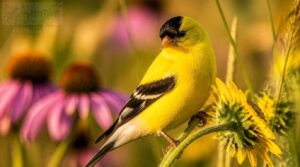
The American Goldfinch is one of North America’s most recognizable songbirds, known for the breeding male’s striking yellow plumage and cheerful, chattering flight call.
Among North America’s most vibrant yellow birds, the Goldfinch stands out for its near-neon breeding plumage and acrobatic, bouncing flight.
Whether you’ve spotted one at your feeder or across a sunny meadow, there’s more to this little bird than its bright colors. Here’s what you should know about what makes it distinctly its own species.
Scientific Classification
The American Goldfinch carries the binomial name Spinus tristis, placing it within the family Fringillidae — the true finches — and the order Passeriformes, which encompasses over half of all known bird species.
Phylogenetically, cladistic analysis groups Spinus tristis among seed-specializing songbirds sharing derived bill morphology. Its full taxonomic hierarchy runs through domain Eukarya, kingdom Animalia, phylum Chordata, class Aves — each rank reflecting deeper evolutionary kinship. This classification is part of the broader zoological and ecological systems used to organize life.
Size and Shape
Taxonomy tells you what a species is; body form reveals how it lives. Spinus tristis is built small, compact, and acrobatic.
Five physical traits define the American Goldfinch’s size and shape:
- Total length: 4.3–5.5 inches, bill tip to tail
- Wingspan: 6.7–7.9 inches, supporting buoyant flight
- Body mass: 0.4–0.7 oz, varying by sex and season
- Conical bill: ~0.3–0.4 inches, precision-engineered for seed-cracking
- Tail length: 1.6–2.4 inches, aiding perch balance
Lifespan Overview
Body size shapes more than flight — it shapes time. Small birds often live shorter lives than larger species, yet Spinus tristis defies simple assumptions.
Wild American Goldfinches usually survive 3–6 years, though banded individuals have reached 10–11 years under favorable conditions. Captivity can extend that maximum lifespan further, where reduced predation pressure and consistent nutrition slow biological aging considerably.
Common Names
Most birders simply call it the wild canary — a nickname rooted in that unmistakable lemon-yellow breeding plumage. Regionally, you’ll hear eastern goldfinch used across Atlantic states, reflecting older taxonomic traditions.
Formally, Spinus tristis carries the standard English name American Goldfinch, though within the broader passerine birds classification, it shares the "finch" and "songbird" labels with hundreds of relatives across North America.
Identifying American Goldfinches
Knowing what to look for makes spotting an American Goldfinch a lot more satisfying than just catching a flash of yellow in the bushes.
These birds actually look quite different depending on the season, the sex, and even the time of year you’re watching. Here’s what you’ll want to pay attention to when you’re trying to make a confident ID.
Breeding Male Colors
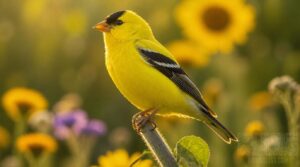
When the breeding season arrives, the male American goldfinch practically glows. Bright yellow plumage peaks in mid-summer after a prebreeding molt, with the most saturated color concentrated on the belly and coverts.
Three things drive that intensity:
- Carotenoid-rich diet from seeds and plant material
- Overall health and parasite resistance
- Age — older males consistently display deeper, more uniform color
UV feather reflectance along wing edges amplifies visibility to potential mates, making feather coloration a reliable signal of male quality during mate selection.
In goldfinches, this UV-enhanced plumage works alongside acrobatic foraging displays — traits explored in depth among yellow birds native to Michigan — to give females a fuller picture of a mate’s fitness.
Female Plumage
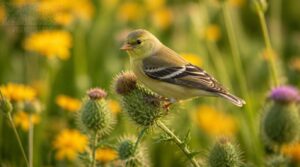
Female goldfinches trade the male’s showmanship for strategic camouflage. Their brown backs, buff underparts, and muted yellow-green tones melt into nesting vegetation — a product of deliberate sexual dimorphism.
| Feature | Female | Breeding Male |
|---|---|---|
| Crown | Slate gray, partial | Deep black |
| Ear coverts | Rufous, subdued | Black |
| Tail color | Pale blue-tinged | Vivid turquoise |
Seasonal molt subtly shifts feather coloration toward grayer tones by late fall.
Winter Appearance
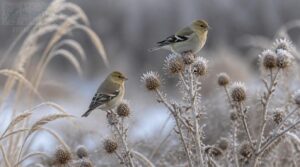
Come winter, the American goldfinch undergoes a dramatic transformation. Vibrant lemon-yellow plumage fades into muted olive-brown and gray-green tones — a seasonal camouflage that helps birds hide in dried grasses and bare hedgerows.
Both sexes adopt similarly drab coloration, with white tail spots remaining the clearest field marker. This shift peaks from late fall through mid-winter, driven by a complete September molt.
Bill and Wing Marks
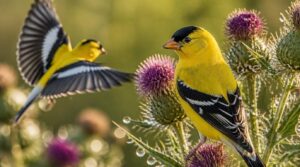
The conical bill — short, stout, averaging 6–7 mm — is your first clue, shaped purely for seed cracking. Even in dull winter plumage, that bill shape stays reliable.
Fold the wings and you’ll spot two pale wing bars across darker feathers — creamy in females, bolder in males. In flight, pale patches flash against dark primaries, making identification quick.
Similar Birds
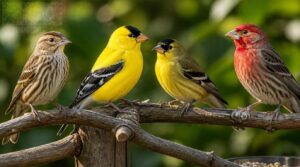
Spotting a goldfinch feels straightforward — until a pine siskin or lesser goldfinch slips into the frame.
Pine siskins share the same feeder habits and flock behavior but wear streaked brown plumage instead of yellow. Lesser goldfinches nearly mirror the American’s size and shape, differing mainly in facial markings. House finches overlap in backyard habitats but carry a heavier, thicker bill.
American Goldfinch Habitat and Range
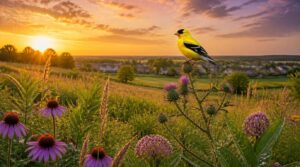
American Goldfinches are remarkably adaptable birds, showing up in places as different as wild meadows and suburban backyards. Their range shifts with the seasons, so where you find them in July won’t necessarily be where they turn up in January. Here’s a closer look at the specific habitats and regions they call home throughout the year.
North American Distribution
The American Goldfinch spreads across an impressive range, from southern Canada through the contiguous United States and into Mexico’s Gulf coast.
Climate-driven movement shapes where birds linger or travel — winter temperatures largely dictate these seasonal migration patterns, with flocks tracking regions where January stays above 0°F. This makes the goldfinch one of North America’s most geographically flexible migratory birds.
Fields and Meadows
Fields and meadows rank among the goldfinch’s most consistent haunts. These semi-open grassland habitats supply an abundance of thistle, sunflower, and composite-family seed heads — precisely the dietary staples this species depends on year-round.
Hedgerows and field margins also support the pollinator networks and plant diversity that sustain these ecosystems, ensuring the structural variety goldfinches need to forage acrobatically and shelter between feeding bouts.
Backyard Habitats
Where fields end, backyards often begin — and goldfinches don’t hesitate to cross that boundary.
Native vegetation like coneflowers, asters, and milkweed mirrors wild foraging conditions, while a layered garden design with ground cover, shrubs, and canopy offers shelter year-round. Place a shallow water feature near perches, and you’ve built exactly the kind of habitat that keeps American Goldfinches coming back.
Seasonal Range Changes
Goldfinches don’t follow a fixed calendar — they follow temperature and food availability. As winter cold retreats, populations shift northward or toward higher elevations, tracking seed production cycles rather than fixed dates.
Climate migration cues like photoperiod and warming temperatures trigger these movements. When phenology mismatch risks emerge — seeds peaking before birds arrive — range use adapts, with birds gravitating toward habitats where resources still align.
Winter Roosting Areas
When temperatures plunge, coniferous tree roosts become critical refuges. Dense evergreen canopies buffer nightly cold swings far better than open branches, reducing heat loss for huddled flocks.
Five roosting priorities goldfinches favor:
- South-facing cavity sites for maximum winter sun
- Mature trees with deep bark crevices
- Dense foliage concealing birds from predators
- Mixed woodland stands offering habitat variety
- Roosts distant from water-edge predator activity
American Goldfinch Diet and Feeders
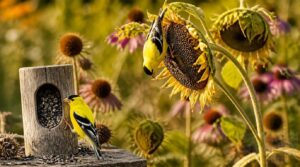
American goldfinches are remarkably particular about what they eat, and understanding that pickiness is the key to attracting them reliably. Whether you’re watching them twist sideways on a feeder or cling upside-down to a seed head, their diet tells you a lot about how they live. Here’s what you need to know about feeding them well.
Favorite Wild Seeds
The American Goldfinch’s wild diet reads like a seed catalog of native plants. Thistle oil and coneflower achenes top the list, while milkweed seeds fuel autumn dispersal journeys.
| Seed Source | Key Benefit |
|---|---|
| Native thistle | Rich oils for energy |
| Wild sunflower | High fat, cold-season fuel |
| Coneflower | Late-summer songbird magnet |
| Aster | Autumn fat replenishment |
Asters and sunflowers keep goldfinches fed long after summer fades.
Nyjer Seed Feeders
A nyjer seed feeder brings American Goldfinches reliably close. Ports measuring 1–2 mm meter tiny seeds precisely, reducing waste and deterring larger birds.
What makes a feeder worth it:
- Mesh or tube design controls seed flow evenly
- Weight-sensitive perches block squirrels naturally
- UV-stabilized materials resist prolonged sun damage
- Removable bases simplify thorough cleaning
Clean your feeder regularly to prevent mold buildup.
Sunflower Seed Options
Black oil sunflower seeds are the smarter pick over confectionery varieties — thinner hulls, higher fat content, and easier cracking for small bills. One ounce delivers roughly 14 grams of fat, which meets the energy demands of active foragers.
Store them in a cool, airtight container to prevent the oils from turning rancid before your feeder visitors arrive.
Acrobatic Foraging
Watch a goldfinch work a thistle stem and you’ll see inverted feeding in action — clinging upside down, beak angled perfectly to pry seeds loose. They hover briefly, glean, then leap sideways to the next seed head.
- Cling upside down on stems
- Hover to probe flower heads
- Leap laterally between seed sources
- Exploit fence and shrub edges
- Switch between stationary and mobile foraging
This granivorous species makes undulating flight look easy.
Feeder Disease Prevention
Dirty feeders are quiet killers. Clean every feeder every 1–2 weeks using a 1:9 bleach-to-water solution, rinse thoroughly, and let it air dry before refilling.
Store nyjer and sunflower seeds in sealed, dry containers — moldy seed causes real harm. Space feeders 10–15 feet apart to cut cross-contamination. If you spot lethargic birds, pause feeding immediately and disinfect everything.
Breeding, Behavior, and Conservation
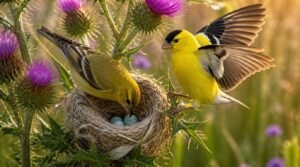
There’s a whole other side to goldfinches that goes beyond what they eat or where they live. From the way they build their nests to how they communicate in flight, their behavior tells a richer story. Here’s a closer look at what makes their breeding season, daily conduct, and conservation standing worth knowing.
Late Summer Nesting
If you track American Goldfinch breeding habits, their nesting period reveals a clever timing strategy: delay until July, when late season seed crops peak.
- Nesting peaks: July–August
- Females incubate a clutch of two to seven bluish-white eggs
- Fledglings emerge 11–17 days post-hatch
- Climate shifts increasingly disrupt late-season food timing
Dense shrubs and understory shield late summer nests from active predators.
Nest Materials
The female constructs a compact cup nest using plant fibers woven together with spider silk — a natural binding agent that holds everything without adding weight.
Moss layers on outer walls manage moisture, while soft hair and feathers line the interior for insulation. Lichen aids camouflage, blending the nest into surrounding bark. Sticks anchor the base, distributing load evenly beneath any clutch of eggs.
Eggs and Fledglings
Once the nest is complete, 4 to 6 pale bluish-white eggs arrive, each lightly speckled and roughly 1 cm long. Incubation lasts 11–13 days.
Three fledgling survival factors:
- Frequent regurgitated feedings by both parents
- Pin feather growth by day 5–7
- Low nest predation near fledging
Hatchlings start blind and wholly featherless, growing rapidly before leaving the nest at 10–14 days.
Calls and Flight
Young fledglings barely clear the nest before undulating flight patterns become instinct — that signature rise-and-dip rhythm, powered by rapid wingbeats and brief glides, is unmistakable. It pairs naturally with the bright "per-chick-o-ree" flight call, a rolling chirp that keeps flocks synchronized mid-air.
| Call Type | Purpose |
|---|---|
| Flight call | Keeps the flock together |
| Alarm call | Signals predator presence |
| Courtship warble | Advertises breeding readiness |
Urban flight risks intensify near lit structures during migration, where disoriented birds face collision threats.
Conservation Status
The American goldfinch least concern classification reflects a population of roughly 43–44 million birds with no sustained decline. That stability depends heavily on open, seed-rich habitats — which habitat degradation and invasive plant species quietly erode.
America’s 44 million goldfinches thrive for now, but their future quietly erodes with every lost meadow
Pesticide exposure risks and agricultural intensification add pressure. Citizen science monitoring through programs like eBird helps track regional shifts before they compound into something harder to reverse.
Frequently Asked Questions (FAQs)
Is it rare to see an American Goldfinch?
Have you ever spotted a flash of yellow at your feeder and thought it must be something special?
Hardly rare — this species of least concern boasts widespread sightings across North America, with local abundance peaking at feeders during fall and winter, making backyard visibility a routine birdwatching delight.
What does it mean when an American Goldfinch visits you?
A visit often signals local seed abundance — your yard offers reliable food, safe perching, and good microhabitat quality. It may also mark a migration rest stop during seasonal movement toward milder wintering grounds.
What bird is mistaken for a goldfinch?
Several similar-looking species spark confusion: the Pine Warbler, Pine Siskin, Evening Grosbeak, Yellow Warbler, and Lesser Goldfinch. Warbler vs Finch bill shape, siskin plumage differences, and wingbars help distinguish each avian species reliably.
What is a goldfinch’s favorite food?
Nyjer seed tops the list — small, oil-rich, and easy to crack. Wild thistles run a close second. When those aren’t available, sunflower seed hearts fill the gap beautifully.
What is the difference between goldfinch and American Goldfinch?
Goldfinch" is an umbrella term — like calling every oak just a tree. The European goldfinch (Carduelis carduelis) sports a red face mask, while the American goldfinch (Spinus tristis) is defined by its bright yellow breeding plumage.
What does it mean when you see an American Goldfinch?
Spotting a flash of lemon-yellow wings is often seen as a sign of joy and renewal. Many cultures associate this bright little bird with optimism and new beginnings.
Are American Goldfinches friendly?
Wildly friendly — these birds practically throw a welcome party at your feeder. They tolerate human presence well, share seeds cooperatively, and arrive in cheerful, chatty flocks that feel less like wildlife and more like backyard regulars.
Where do American Goldfinches nest?
They favor shrub forks and small trees, usually 6–15 feet high, near open areas rich in thistles and composite plants. The female weaves a compact cup nest timed to peak seed production in July and August.
Is the American goldfinch affected by climate change?
Yes, climate change is reshaping range shifts, food timing, and migration phenology for this species. Warming winters push populations northward while food desynchronization during breeding disrupts nesting success and chick survival across North America.
What are the main threats faced by goldfinches?
Predators, habitat loss, window collisions, disease, and climate instability all pressure goldfinch populations. Cats, kestrels, and nest-raiding jays reduce survival, while shrinking meadows and monoculture farming cut off reliable food sources.
Conclusion
Like Thoreau watching seasons reshape Walden’s edge, you now see the American goldfinch differently — not as a flash of yellow, but as a creature precisely engineered by its world. Every molt, every migration, every late-summer nest tells the same story: seeds rule this bird’s life.
Set out nyjer, let your garden go a little wild, and watch what arrives. The goldfinch doesn’t wander randomly. It finds exactly what it needs — and now, so can you.
- https://laplata.wbu.com/content_section/show/284576
- https://blasdell.wbu.com/american-goldfinch
- https://www.allaboutbirds.org/guide/American_Goldfinch/overview
- https://www.audubon.org/field-guide/bird/american-goldfinch
- https://www.sibleyguides.com/2012/05/the-annual-plumage-cycle-of-a-male-american-goldfinch