This site is supported by our readers. We may earn a commission, at no cost to you, if you purchase through links.
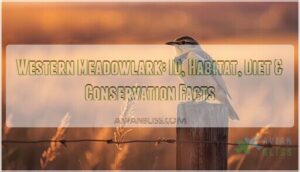
Six states claim the western meadowlark as their official bird. That’s more than any other species holds. But you might walk right past one perched on a fence post without noticing its bright yellow chest and bold black V.
These grassland songbirds blend into prairie landscapes until they open their beaks and deliver one of North America’s most recognizable calls. Western meadowlarks spend their days probing soil for insects with specialized bills and building dome-shaped nests hidden in prairie grass.
Their survival depends on the open grasslands that continue to shrink across the continent.
Table Of Contents
- Key Takeaways
- What is a Western Meadowlark?
- Physical Characteristics of Western Meadowlarks
- Western Meadowlark Habitat and Range
- Diet and Feeding Behavior
- Breeding, Nesting, and Conservation
- Frequently Asked Questions (FAQs)
- What is a western meadowlark?
- Where do western meadowlarks live?
- Why is the western meadowlark a state bird?
- Which states have a meadowlark?
- What does a meadowlark sound like?
- How do you identify a western meadowlark?
- Where do meadowlarks breed?
- Which state bird is a western meadowlark?
- What states have the Western Meadowlark?
- Do female Western Meadowlarks sing?
- Conclusion
Key Takeaways
- Western meadowlarks hold the unique distinction of being the official state bird for six states—more than any other species—reflecting their widespread symbolic importance across the Great Plains and western regions.
- These grassland songbirds have experienced a dramatic 40 percent population decline over the past five decades due to habitat loss, with 79 percent of native prairies destroyed since European settlement.
- The species employs a specialized foraging technique called “gaping” where they insert their bills into soil and pry them open to access hidden insects that other birds cannot reach.
- Western meadowlarks practice a polygynous breeding system where males defend territories for multiple females who build dome-shaped ground nests camouflaged in prairie grass, though up to 22 percent face brood parasitism from cowbirds.
What is a Western Meadowlark?
The Western Meadowlark is a ground-dwelling songbird native to grasslands across North America. You’ll recognize it by its bright yellow chest with a bold black V and its cheerful flute-like song that carries across open fields.
This stocky bird holds special meaning as the state bird for six western states, making it one of the most celebrated grassland species on the continent.
Species Overview and Classification
You’ll find the Western Meadowlark classified scientifically as Sturnella neglecta within the Icteridae family of Passeriformes. Despite its name, it’s not a true lark but belongs to the New World blackbirds. John James Audubon formally described this species in 1844. The Latin name “neglecta” means “overlooked,” reflecting its delayed taxonomic recognition.
Two subspecies exist across its North American range. The female builds a domed nest on the ground.
Key Identification Features
When you spot a Western Meadowlark, look for its bright yellow breast marked with a bold black “V.” This chunky bird measures 6.3 to 10.2 inches long with a wingspan around 16 inches. You’ll notice white outer tail feathers flashing during flight and brown streaking across its back. Its long, slender bill and round-shouldered posture help distinguish it from similar species.
The Western Meadowlark is a North American bird, abundant and widely distributed. Listen for its rich, flute-like song descending in melody—a key difference from the Eastern Meadowlark’s plaintive whistle.
State Bird Significance
Beyond its striking appearance, the Western Meadowlark holds special recognition as the state bird of six states: Kansas, Montana, Nebraska, North Dakota, Oregon, and Wyoming. This widespread state bird selection reflects deep community engagement with the species across the Great Plains. Wyoming led the way in 1927, followed by Oregon that same year.
The bird’s symbolic representation of prairie landscapes and pioneer spirit made it a natural choice, though Western Meadowlark conservation efforts have become increasingly important as populations face decline.
Physical Characteristics of Western Meadowlarks
You can spot a Western Meadowlark by learning what makes it stand out in open country. These birds have a chunky build and specific features that help with identification in the field.
Here’s what to look for when you’re trying to recognize one.
Size, Shape, and Bill Structure
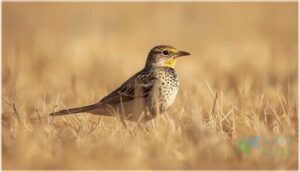
You’ll spot a Western Meadowlark by its compact build and distinctive proportions. Here’s what defines its size, shape, and bill morphology:
- Measurements: These birds stretch 6.3 to 10.2 inches long with a 16.1-inch wingspan, weighing 3.1 to 4.1 ounces.
- Body Proportions: Chunky bodies, flat heads, and round-shouldered postures give them a neckless appearance.
- Long Slender Bill: Sharp-pointed bills probe soil for insects.
- Flight Adaptations: Short, rounded wings and stiff tails suit grassland maneuvers.
Coloration and Distinctive Markings
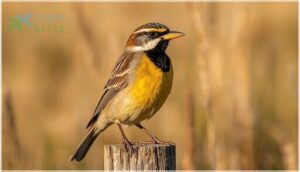
When you look at a Western Meadowlark, its bright yellow underparts and bold black V on the breast catch your eye first. The plumage patterns combine streaked brown upperparts with pale edges and striking facial markings that include dark crown stripes and a yellow moustachial streak.
These markings help you distinguish Western from Eastern Meadowlarks during comparative ID in overlapping ranges.
| Feature | Color Pattern | Key Details |
|---|---|---|
| Breast | Bright yellow with black V | V extends from throat downward |
| Back | Medium to light brown | Streaked with pale feather edges |
| Face | Dark and light stripes | Yellow whisker thickens near bill |
Seasonal Plumage Differences
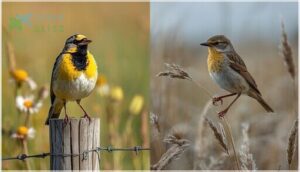
Throughout the year, you’ll notice the Western Meadowlark’s plumage changes dramatically. Breeding plumage features that intense yellow breast and sharp black V, while winter plumage appears duller with a grayish buff veil covering fresh feathers. Juvenile plumage lacks the bold V and shows paler yellow tones.
Molt timing occurs in fall when adults replace all feathers. This winter camouflage helps with survival until feather pigmentation brightens again by spring.
Tail, Wings, and Posture
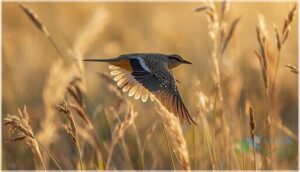
When you observe a Western Meadowlark in the field, you’ll notice its round-shouldered posture creates a compact profile that nearly hides the neck. The spiky tail appears short and stiff, featuring white outer feathers that flash during takeoff.
- Short wings span roughly 16 inches and enable quick, agile movements across grasslands
- The tail’s 12 feathers include six white outer ones used in territorial displays
- Wing structure allows for both sustained migration flights and hovering while foraging
Western Meadowlark Habitat and Range
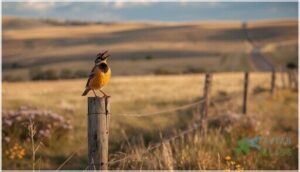
You’ll find Western Meadowlarks across a wide stretch of North America, from the prairies of Canada down to central Mexico. These birds aren’t picky about untouched wilderness—they thrive in working farmland, roadsides, and any open country with short grass.
Let’s look at where they live throughout the year and what draws them to different habitats.
Preferred Grassland and Prairie Habitats
You’ll find Western Meadowlarks thriving in open grasslands and prairies with grass heights between one and three feet. They prefer lightly grazed pastures and dry upland areas with less than 10% woody encroachment. These birds avoid dense forests and favor habitat restoration sites with native plants.
Seasonal shifts drive them toward bare ground in winter for easier seed foraging, making grassland management critical for Western Meadowlark habitat conservation.
Geographic Distribution in North America
You’ll spot Western Meadowlarks across western and central North America, from British Columbia to northern Mexico. Their range stretches east to Lake Ontario, though Eastern Expansion populations have declined since the 1960s.
The Coastal Subspecies inhabits Pacific Northwest regions, while southern populations remain year-round. Winter Range extends into the Gulf Coast, where northern migrants join resident birds despite ongoing Habitat Loss challenges.
Migration Patterns and Seasonal Movements
Western Meadowlarks follow predictable migration rhythms driven by Migration Triggers like temperature and food. Northern populations travel up to 1000 km south, with Diurnal Migration occurring during daylight hours.
You’ll observe Flock Dynamics as small groups of 15-40 birds move together from breeding grounds starting in October.
Connectivity Patterns show migratory birds maintain their latitudinal locations, with spring return to breeding areas beginning in March.
Habitat Selection During Breeding and Winter
As these grassland birds settle after migration, their seasonal habitat shift becomes clear. During breeding season, you’ll find Western Meadowlarks in open habitats with specific needs:
- Grass heights between 1-3 feet with minimal shrub cover
- Territory sizes averaging 14 acres of quality grassland
- Ground nest sites with protective grass domes
- Winter habitat needs focusing on bare ground for seed access
Habitat fragmentation and intensive agriculture threaten these breeding grounds, making habitat restoration critical for survival.
Diet and Feeding Behavior
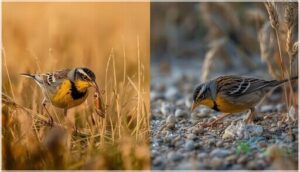
The Western Meadowlark’s diet changes throughout the year based on what food is available. During warmer months, you’ll find these birds hunting insects and other small invertebrates in grasslands.
As seasons shift to fall and winter, they switch their focus to seeds and grains while using specialized foraging techniques to find food on the ground.
Insect and Invertebrate Diet in Summer
During summer months, the Western Meadowlark diet shifts heavily toward insect consumption. You’ll find these birds eating beetles, grasshoppers, crickets, and caterpillars throughout their grassland habitat.
Their foraging techniques include a unique behavior called “gaping,” where they insert their bill into soil and pry it open to access hidden larvae. Spiders, snails, and sowbugs round out their summer insect prey selection.
Seeds and Grains in Fall and Winter
As temperatures drop, you’ll see seasonal diet shifts take over. Western Meadowlark diet now centers on seeds and grains, making up roughly a third of their yearly intake. Agricultural grain dependence becomes clear in winter foraging flocks that sweep across:
- Cornfields and wheat stubble for waste grains
- Roadsides harboring foxtails and pigweeds
- Native grasslands with sedge and grass seeds
This weed seed consumption provides essential calories when insects disappear.
Foraging Techniques and Ground Behavior
You’ll spot these birds walking steadily across open ground, using their sharp bills to probe soil for hidden insects. During breeding season, they rely on a specialized technique called gaping—forcing their bills open underground to access buried beetles and larvae that other birds can’t reach.
Females even build grass runways to their nests, creating safe paths for their frequent foraging trips.
Seasonal Dietary Shifts
As seasons change, you’ll notice these birds switch their menu dramatically based on what’s available. Their dietary flexibility keeps them thriving year-round despite insect scarcity in colder months.
- Spring and summer: Protein-rich insects like beetles, grasshoppers, and crickets fuel breeding and chick-rearing
- Fall shift: Weed seeds become increasingly important as arthropod populations decline
- Winter foraging: Grains and seeds from native grasses dominate their diet
- Nutritional needs: This seasonal shift maintains their energy requirements while supporting habitat health
Breeding, Nesting, and Conservation
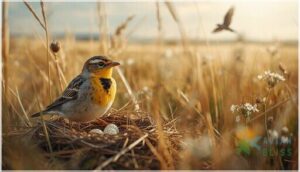
The Western Meadowlark has an interesting approach to breeding that includes multiple mates and hidden nests on the ground. You’ll want to know how these birds raise their young and why their numbers have dropped so dramatically in recent decades.
Here’s what happens from courtship through conservation efforts to protect them.
Mating Systems and Nest Construction
Western Meadowlark nesting habits reflect a polygynous system where one male defends a territory for multiple females. Ground-nesting birds construct dome-shaped nests in prairie depressions using woven grasses.
Nest camouflage and material selection help protect against predators and weather. Brood parasitism by cowbirds affects up to 22% of nests.
Territorial defense through song and displays maintains breeding space.
Egg Laying, Incubation, and Parental Care
Once females complete their nests, clutch size usually ranges from three to seven eggs. Egg appearance features white shells with brown and lavender spotting concentrated at the larger end.
The incubation period lasts thirteen to sixteen days, handled solely by females. Nestling development progresses quickly—young leave nests after ten to twelve days but depend on parental care for food and protection two more weeks before flying independently.
Population Trends and Conservation Status
You might be surprised to learn that Western Meadowlark numbers have dropped over 40 percent in the past five decades. Current estimates place the North American population around 90 million birds, but regional trends reveal troubling patterns:
Western Meadowlark populations have declined over 40 percent in fifty years, dropping from stable numbers to roughly 90 million birds across North America
- Canada has lost roughly 47 percent of its population since 1970
- Minnesota maintains approximately 450,000 to 540,000 breeding adults
- North Dakota shows localized increases since 1984
- Some southern regions display stable or slightly growing numbers
Conservation status updates vary by region, with several states listing the species as threatened due to habitat loss and pesticide use challenges.
Threats and Ongoing Protection Efforts
You face serious challenges protecting Western Meadowlarks. Habitat loss and fragmentation have wiped out 79 percent of native prairies since European settlement. Pesticide use kills essential insects, while climate effects shift ranges northward.
Juvenile mortality factors exceed 70 percent from predation and farming equipment.
Conservation programs like the Meadowlark Initiative now partner with landowners to restore grasslands and implement birdfriendly measures supporting grassland bird conservation.
Frequently Asked Questions (FAQs)
What is a western meadowlark?
You’ll find this bird across prairies and grasslands throughout North America.
The Western Meadowlark (Sturnella neglecta) is a striking songbird known for its bright yellow breast and bold black V-shaped marking.
Where do western meadowlarks live?
You’ll find these birds across western and central North America, from British Columbia to northern Mexico.
They prefer open grasslands and prairies with short vegetation, avoiding dense forests and heavily developed areas.
Why is the western meadowlark a state bird?
Six states chose the western meadowlark as their state bird between 1927 and 1947 because of its melodious song, symbolic representation of prairie landscapes, and strong public support from schoolchildren’s votes.
Which states have a meadowlark?
You’ll encounter meadowlarks across six western and central states: Kansas, Montana, Nebraska, North Dakota, Oregon, and Wyoming.
This geographic distribution reflects the species’ natural range throughout North America’s grasslands and prairies.
What does a meadowlark sound like?
You’ll be whistling a different tune when you hear this bird vocalization. The song characteristics include rich flute-like whistles that speed into musical gurgling.
Mating calls help with bird vocalization identification across grasslands.
How do you identify a western meadowlark?
You’ll spot a meadowlark by its bright yellow breast marked with a black “V,” streaked brown back, and white outer tail feathers visible during flight—key visual identification features.
Where do meadowlarks breed?
You’ll find breeding populations across western and central North America, from British Columbia to northern Mexico. These birds select natural grasslands, prairies, pastures, and agricultural fields. Nest construction occurs on the ground beneath grass cover.
Which state bird is a western meadowlark?
Six U.S. states recognize the Western Meadowlark as their official state bird: Kansas, Montana, Nebraska, North Dakota, Oregon, and Wyoming.
This geographic distribution reflects the species’ widespread range across western and central North America.
What states have the Western Meadowlark?
You’ll find the Western Meadowlark across western and central North America. Their geographic distribution spans from British Columbia to Mexico, with populations in states like Montana, Kansas, and Oregon where they hold state bird status.
Do female Western Meadowlarks sing?
No, female Western Meadowlarks don’t sing the musical gurgling song males do. Song dimorphism is clear in this songbird—males produce complex vocalizations for territory and mates, while female vocalizations remain simple calls for communication.
Conclusion
You won’t find these birds trending on social media, but western meadowlarks have been nature’s original influencers for millennia. Their yellow breasts and clear songs mark them as prairie icons worth protecting.
When you spot one scanning grassland from a fence post, you’re witnessing a species that needs our help. Their future depends on preserving the open spaces they call home.
Listen for their call and you’ll understand why six states chose them.